Cover photograph: PizzaToast · CC0 — Edible food recovered from a food retailer’s container

Dumpster Diving
Compiled from Trashwiki, the collaborative world-wide guide to creating value from trash.
More than 230 named dumpster divers have edited the pages collected here, plus anonymous edits. That is an estimate from Trashwiki’s contributor lists for this edition’s chapters, not a headcount of every account on the wiki.
The chapter “WikiHow” originated with wikiHow contributors under CC-BY-NC-SA-3.0 and came to this edition through Trashwiki. Full source links are collected in the attribution section at the end.
This edition starts with practice (how to dive anywhere), then a geographic half (each country, with city chapters nested where Trashwiki actually has them), and ends with resources and an invitation to go look. It does not include dumpster-map coordinates or named bins. Those go stale; use dumpstermap.org and the live wiki.
Dumpster diving sits in a legal grey area in many countries. Trashwiki does not encourage breaking the law; it is a space where people share experience. This book reprints that already-public guide.
Part I — Practice
Dumpster diving is looking, with care, at what a shop or a house has already decided is finished. The pages that follow are how to do that anywhere: food, health, law, technique, what to bring, what not to wreck.
Place-specific notes come after this. Bins, locks, and store habits change by the month. The motion does not: show up, take what you will use, leave the place cleaner than you found it.
Getting started
Begin with what dumpster diving is, what a first trip feels like, and the ordinary containers behind the name. These chapters give the rest of the practice section its footing.
Dumpster diving
Edit on wiki Dumpster diving is
actually a US term, meaning the same as skipping (in
the United Kingdom) or recycling food. It comes from "diving a
dumpster".
Dumpster diving is
actually a US term, meaning the same as skipping (in
the United Kingdom) or recycling food. It comes from "diving a
dumpster".
Terms and explanation
Dumpster diving is looking for goods, most notably food, in dumpsters. In many Western countries it is possible to find perfectly good food, right in front of supermarkets, in backyards or in dumpsters.
The practice of dumpster diving, or skipping, is also known variously as urban foraging, binning, alley surfing, aggressive recycling, curbing, D-mart, dumpstering, garbaging, garbage picking, garbage gleaning, dumpster-raiding, dump-weaseling, tatting, skally-wagging, skip dipping or trashing.
The main term originates from the best-known manufacturer of commercial trash bins, "Dumpster", and the fanciful image of someone leaping head first into a dumpster as if it were a swimming pool. In practice, the size and design of most dumpsters makes it possible to retrieve many items from the outside of dumpsters without having to "dive" inside.
In rural areas and some ancient agricultural societies, a similar process was known as gleaning and some medieval houses had "poor boxes" where still edible food was placed for the poor to take.
Guidelines for a dumpster diver
Some things to keep in mind:
- Bring a bottle of water, to wash your hands when you dive into bags of fruits and vegetables
- Always make sure you don't make a mess (i.e. open and close bags nicely)
- In the unlikely case you did not manage to find a couch and need to sleep on the street: Look for recycling bins to get cardboard for sleeping in
- When walking in big cities there's always something to dive, be it an abandoned skateboard, or someone putting their whole household on the street.
- Consider when people will be moving in/out of apartments. For instance, in a city with a lot of university students, the first of the month near the start or end of the school term is a great time to go dumpster diving. Notice when students are moving out of dorms and what day the school's graduation is. Graduating seniors often trash especially nice stuff, since they will not be returning the following year.
- Dumpster diving may be illegal in certain places, but enforcement is rare. In either case you may want to keep an eye out for police or unsympathetic property owners
Background
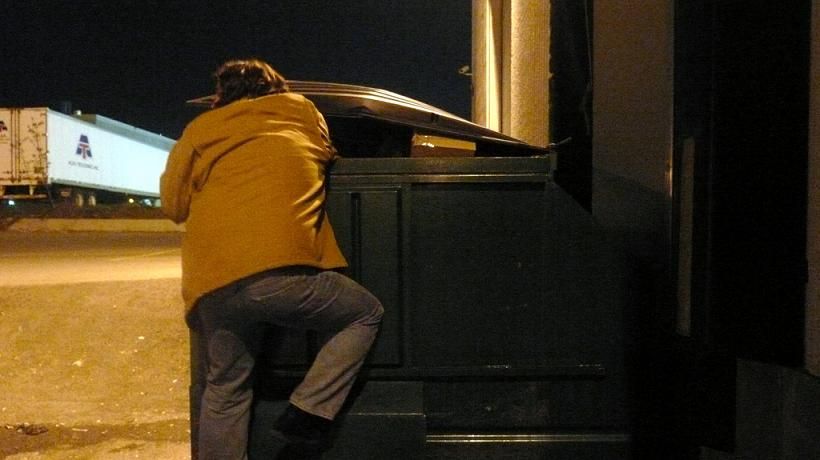 Traditionally, most people
who resort to dumpster diving are forced to do so out of economic
necessity. The karung guni, the rag and bone man,
waste picker, dumpster monkey, junk man or
bin hoker are people who make their living by sorting and
trading trash.
Traditionally, most people
who resort to dumpster diving are forced to do so out of economic
necessity. The karung guni, the rag and bone man,
waste picker, dumpster monkey, junk man or
bin hoker are people who make their living by sorting and
trading trash.
Others may practice dumpster diving for various economic and personal reasons. For example, practitioners of freeganism dumpster dive to avoid living a materialistic consumer lifestyle. Artists like Carol Tanzi and Vincent Jones use discarded materials to create artistic works. Students may use salvaged high tech items in technical projects. Still others may dumpster dive just to indulge in their curiosity for unusual items.
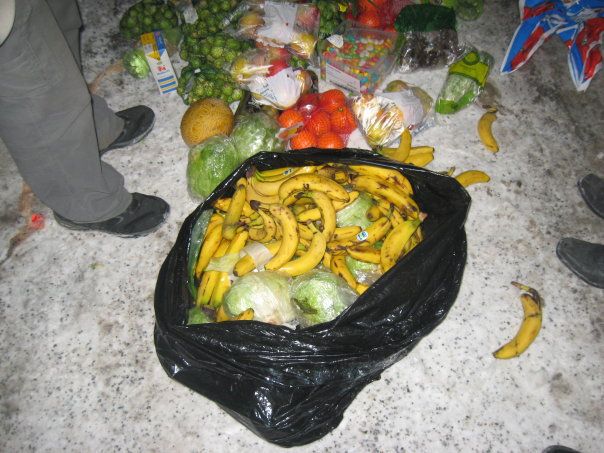 Dumpster diving, taken to an academic level, is used as a tool for
garbologists who study the sociology and archeology of trash in modern
life. There is a major outpost of academic garbology at the University
of Arizona. Others, because of their profession, maybe required to
dumpster dive, such as private investigators or police seeking
information and material for official purposes. In practice, dumpster
diving can range from a one time spontaneous seeing and retrieving of a
useful item from the garbage, to an individual's preferred low-impact
lifestyle, to a full time livelihood when economic opportunities are not
available.
Dumpster diving, taken to an academic level, is used as a tool for
garbologists who study the sociology and archeology of trash in modern
life. There is a major outpost of academic garbology at the University
of Arizona. Others, because of their profession, maybe required to
dumpster dive, such as private investigators or police seeking
information and material for official purposes. In practice, dumpster
diving can range from a one time spontaneous seeing and retrieving of a
useful item from the garbage, to an individual's preferred low-impact
lifestyle, to a full time livelihood when economic opportunities are not
available.
There are several ethical arguments used to justify dumpster diving. One is, by reusing resources destined for the landfill, dumpster diving becomes a green endeavor (and is thus being practiced by many freeganist communities). Others believe that the wastefulness of a consumer society and its throw away mentality requires individuals to rescue usable items (e.g. computers) from destruction and diverting them to the less fortunate. Some see it as a way of making money or getting valuable goods. Another belief is, since many poorer people cannot afford to buy many items at market price, that any irregular, blemished, or damaged items that are still functional should naturally be priced closer to their ability to pay. To simply dispose of these imperfect items is looked on by the poor as being economically inefficient, economically insensitive, and a hindrance to their ability to acquire goods that most people can afford. An example is discarded food that might have slight imperfections, that is near its expiration date, or that is simply being replaced by newer stock. Many retailers are reluctant to sell this stock at reduced prices due to the belief that people will buy it instead of the higher priced newer stock; that extra handling time is required; and that there are liability risks.
Items commonly found
Dumpster diving is practiced differently in countries whose commercial disposal practices are different from the developed world. In many economically developing countries, food is rarely thrown away unless it is rotten. In many countries, charities collect excess food from supermarkets and restaurants and distribute it to the needy. Dumpster divers, Karung guni, and rag and bone men in these countries may concentrate on looking for usable items or scrap materials to sell.
In the United States, Canada, and Europe, some bakeries, grocery stores, or restaurants will routinely donate food according to a Good Samaritan Food Donation Act, but more often, because of health laws or company policy, they are required to discard food items by the expiration date, because of overstock, being overly ripened, spoiled, cosmetically imperfect, or blemished. If disposed of "as is" and not destroyed, some of this food may be made "safer" for consumption if properly decontaminated and spoiled ruminates are removed. Otherwise, it is quite possible food poisoning will result eating dumpster food, especially if it is not cooked/recooked afterwards.
Offices, factories, department stores, and other commercial establishments also may throw out nonperishable items that are irregular, were returned, have minor damages, or are replaced by newer inventory. Generally, the more perishable and inexpensive the item, the more likely that it will be disposed of intact. Otherwise, most items tend to be in such a state of disrepair or cosmetically flawed that they will require some work by the dumpster diver to make the items functionally usable. A general tenet found among seasoned dumpster divers is to avoid returning items (for money/exchange) through the front door that were tossed out the back door. Stores who even suspect this has happened will take steps to insure it ceases, thus ruining future diving.
Residential buildings tend to throw away very little usable food or "new" items that could not be sold, but sometimes are a good source of used clothing, furniture, appliances, and other housewares. Because some people find it easier to dispose of an item rather than donating or recycling, the dumpster diver tends to be the only reprieve for items being buried in landfill.
Many consumer electronics, particularly computers, are dumped because of their rapid depreciation, obsolescence, cost to repair, or expense to upgrade. Frequently, owners of functional computers find it easier to dump computers rather than donate because many non-profits and schools are unable or unwilling to work with used equipment. Some organizations like Geeks Into The Streets, reBOOT, Free Geek and Computerbank try to refurbish old computers for charity or educational use. Dumpster divers who find computers tend to strip them for parts and metals then discard the rest.
Another activity associated with dumpster diving is recycling collection. People often go through dumpsters and other trash containers looking for cans or other recyclable materials. In some places these can be sold to recycling plants or scrap yards. Recycling is also possible with other materials such as copper, lead, and other scrap metals but they are far less common than aluminum and steel. Because dumpsters are not a reliable source of scrap metal for dumpster divers, some "proactive recyclers" may resort to stripping buildings and other installations of their valuable metals like brass fixtures, copper roofing, pipes, and wiring. This kind of scavenging has been reported in the United States, the former Soviet Union, Argentina, Jamaica and others when either scrap prices or unemployment rates soar. This kind of activity is damaging, and can create unexpected effects, such as a very large fire in Brooklyn waterfront warehouses in May of 2006. Authorities and scrap yards are increasingly requiring more proof of ownership and traceability.
Information diving
All too often, dumpsters can be an inadvertent source of information. Unwanted files, letters, memos, photographs, IDs, and other paperwork have been found in dumpsters. This oversight is a result of many people not realizing that sensitive items like passwords, credit card numbers, and personal information they throw in the trash could be recovered anywhere from the dumpster to the landfill. This recovered information is sometimes used by criminals for fraudulent purposes, such as identity theft and the breaking of physical information security. Information to most Dumpster Drivers is unusable and if the items found are unusual (stolen wallets/purses) sometimes these items are turned over to the Police or their owners.
Targeted information diving was more common in the 1980s due to lax security. When businesses became aware of the need for increased security in the early 1990s, it became routine for sensitive documents to be shredded before being placed in dumpsters. Security mythology still portrays the stereotypical lone hackers or malicious crackers commonly searching through office waste, but this may be more of an urban legend because social engineering is often easier, more productive, and is a more predictable source than dumpsters.
Experienced information diving is commonly practiced by watchdog and news organizations seeking information on groups they are investigating. The Trinity Foundation in Dallas successfully used this technique to report on the activities of televangelist Robert Tilton, and has also obtained information on Benny Hinn using this practice.
Legal status
Because dumpsters are usually located on private premises, dumpster diving is illegal in some parts of the United States and certain countries, though the law is enforced with varying degrees of rigor. However, dumpster diving usually is legal per se, when not specifically prohibited by state or local law.
Police (and possibly other) searches of dumpsters and like discards are not violations; evidence seized in this way has been permitted in many criminal trials. The doctrine is less well established in regard to civil litigation.
Private investigators have written books on "P.I. technique" in which dumpster diving or its equivalent "wastebasket recovery" figures prominently.
Companies run by private investigators specializing in dumpster diving have sprung up around the country as a result of the need for discreet, undetected retrieval of documents and evidence for civil and criminal trials.
Rob Greenfield - "If you get arrested for dumpster diving for food I'll cover the costs, bring national media attention to the issue, and if I'm available come hang out with you. Dumpster dive worry free knowing that I've got your back in a time of need!" http://robgreenfield.tv/arrestedfordumpsterdiving/
Socioeconomics
Because some dumpster divers may be people who are nearer to the poverty level than individuals who don't dumpster dive, there are economic traits that they hold in common. The main trait is adapting to scarcity and unpredictability of obtaining items that are easily obtained if one has a higher income. The production model that best describes the diver's economic lifestyle is just in case manufacturing. Just in case, states that when the lack of money to buy an item or the shortage of an item is expected in the future, then it is best to have several of these items in storage, "just in case". The ability of divers to obtain many items at the time it is needed, often is expensive to divers because most items available "just in time" are found in stores at full price. This ultimately means that divers want to hold on to many items that most "just in time" people either throw away or buy as needed. Such items as consumer electronics, refrigerators, cars, tires, and computers, that are expensive to replace or repair immediately, may be kept by the diver in greater numbers to insure that a working supply is available, just in case an equipment failure occurs. Taken to the extreme, some dumpster divers cluttered properties may run afoul of a city's Code Enforcement resulting in fines and forced abatement. The result of such legal actions may actually cause additional hardships on people if they are poor or borderline homeless. According to the City of Seattle, 1:300 people who tend to hoard, may also suffer in some degree from obsessive-compulsive personality disorder. It is also believed that this illness is aggravated by poverty in some cases.
Notable diving events
- In the 1960s, Jerry Schneider, using recovered instruction manuals from The Pacific Telephone & Telegraph Company, abused the company's own procedures to acquire hundreds of thousands of dollars' worth of telephone equipment over several years until his arrest.
- The Castle Infinity game, after its shutdown, was brought back from the dead by rescuing its servers from the trash.
- In 2001, dumpster diving was popularized in the book Evasion, published by CrimethInc.
- December 6, 1983 – A local resident in Mexico salvaged a discarded radiation therapy machine carrying Cobalt-60. This in turn contaminated another 5,000 metric tons of steel, some of which was sent to the U.S. and Canada.
- September 13, 1987 – In the Goiânia accident, scavengers broke open a radiation-therapy machine and sold caesium-137 source as a glowing curiosity. Four hundred were contaminated, four died.
- March 18, 2000 - 55 Oscars reported stolen were found in a Los Angeles dumpster behind a grocery store. The salvage man, Willie Fulgear, 61, received a $50,000 reward and two tickets to the Oscars. Later, his reward money was stolen from a safe in his apartment.
- In an interview in the May 29, 2006 issue of Newsweek, Meetup.com founder Scott Heiferman was asked, "What's the weirdest meetup that's ever come to your attention?" He replied, "Dumpster-diving meetups are very popular.…"
- Charles Manson wrote and recorded a song entitled "Garbage Dump" which dealt with dumpster diving. It appears on his album Lie: The Love & Terror Cult.
- On January 25 2009, Ollie was arrested in Bruges, Belgium, for taking food out of a dumpster of AD Delhaize. He was later convicted to 28 days of prison, an unusually harsh sentence seen by many as being political since he was living in a squatted forest within the city limits.
British television shows have even featured home renovations and decoration using salvaged materials. Changing Rooms is one such show, broadcast on BBC One. Recovery of still-useful items from discards is well-known in other cultures as well; James Fallows noted it in his book written about his time living in Japan. However, much of the richness attributed to dumpster diving in Japan ended with the collapse of the nation's economic bubble in 1990. In the U.K Steptoe and Son and the U.S remake Sanford and Son showed the life of a junk man. This was also the name of a song from a Staten Island band named Pseudohoodlum. In Quebec, a television show called Les artisans du rebus global took the challenge to build a house solely from trashed materials and 15,000 CAN$.
Video
<videoflash>i-air8-AWps|300|250</videoflash> <videoflash>68xNBn_rieY|300|250</videoflash>
See also
- Freeganism
- Food Not Bombs
- Gleaning
- Dumpster diver
- Unlocking dumpsters
Further information
- See full article on literature about dumpster diving here.
- For more pages and photos check :Category:Dumpster diving.
External links
- Dumpster Diving Symbols
- Freeganism and info on dumpster diving
- A Dumpster Diving Blog & Guide
- Article- "Pick of the Litter: climbing to the top of the heap with an ambitious bottom-feeder"
- Dumpster Diver's Paradise Forums
- Freegan Station - A website in French
- Amazing How-to
- Advanced Dumpster Diving Techniques
- The Lucrative side of Dumpster Diving
- Trash Hunting and tips for life
- "My Dumpster Diving Adventures", a blog with pictures
Divyman.png — Oscar
Dumpster diving in Toronto.jpg — Sigurdas
2010 stckhlm found in a trash.jpg — Sigurdas
First time
Edit on wiki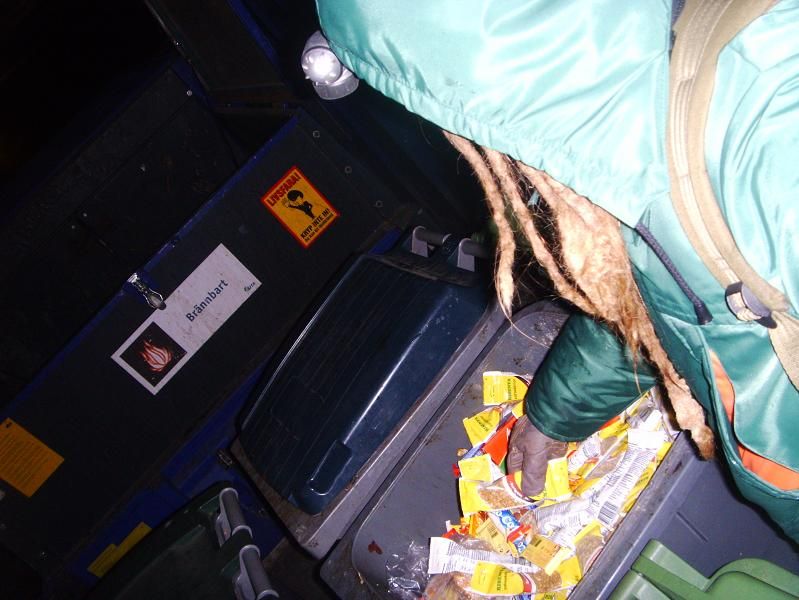 There are several
first time steps.
There are several
first time steps.
"But what would people think?" or "What if they see me digging into trash?" - society generally disgusts people who dig in trash. Step over that. There is too much value in the trash to let it to be wasted. If you walk back home with something new that you found, or with a lot of dumpster dived food that you can share with your friends coming over for dinner, doesn't it feel rewarding? Yes, it does.
There is a lot of trash out there. And a lot of useful trash. For many folks, the first time of trash recovery usually means picking up some furniture from the street. Stuff that is easily checked for utility and cleanliness.
Going to dive in a supermarket dumpster is just one step further. Just remember: "One man's trash is another's treasure."
The steps to find a place to dive
- Find a big shop you want something from (supermakets and bakeries are the easiest). Really big supermarkets bins are often hard to access, small groceries stores don't throw much - although all depends on a particular country you are in. The best idea is to aim for the middle.
- At night, when it's closed, go around it until you find the containers, often next to the loading dock, or at the back. Sometimes they are locked, in a fenced area or (the worse) locked inside the supermarket building. Up to you how far you want to go. Some dumpster divers having no possibility to dumpster dive in unlocked dumpsters in their area choose to unlock dumpsters by force; locked bin often just need a triangle key (in U.S.?).
- Dive in! Dig as deep as you can until you find stuff. The weight of a bag is a good indication. Food has weight, so if the bag is light just put it aside.
- Don't make a mess... nobody should be able to see you've been there. Clean after yourself, close all dumpsters, leave everything as it was before you came there. Respecting a place you dumpster dive in is a part of a conscious dumpster diving: if you make a mess every time you dumpster dive, if you rip bags and don't tie them back, it is more likely the place will soon put various barriers to get rid of messy scavenger-folks, or will change its strategy of disposing its old produce. Think about other people who come there to get their food from there - you don't want to screw up their routine and make it more difficult for them.
The first dive, by the way, might not bring anything - try different places on different days.
- Tip from Instructables - take a picture and dive in darkness later to lessen the social stigma
- Dumpster Dipping Instructable
See also
- Health
- Meetings
- Preservation
2008 dd day 010.06.JPG — Sigurdas
Dumpster diving in Toronto.jpg — Sigurdas
Dumpster diver
Edit on wiki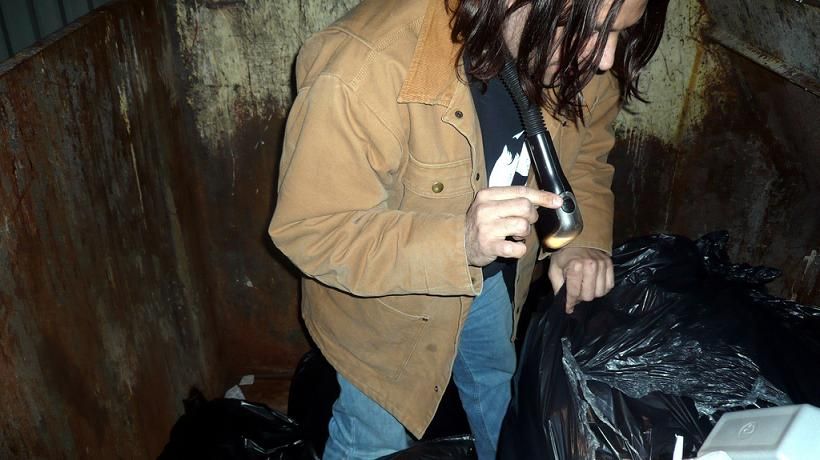 A
dumpster diver is someone who takes items that have
been discarded (trash), in order to make better use of them, principally
by turning them into something usable or edible via dumpster diving.
A
dumpster diver is someone who takes items that have
been discarded (trash), in order to make better use of them, principally
by turning them into something usable or edible via dumpster diving.
Why it is cool to be a dumpster diver
Because dumpster diving is:
- free (as in freedom).
- free (as in no money).
- free (as in beer).
- ecological, a form of waste reduction.
- fun and can be a nice social activity.
So, I am a diver... What do I need to have?
Sometimes, often or even always you will need:
- a small flashlight (headlamp is the best)
- something to pull the stuff to you, some kind of pole with a hook at the end (a hoe maybe?)
- a stepping stool (can help you reach over the top)
- bags (backpacks, trash bags, plastic bags, etc.)
- wet wipes and/or water bottle to clean up with
- a basic First Aid Kit in case you hurt yourself.
How to dress
- mind the weather (wind rain snow), union-style is good, as the activity might make you sweat
- you don't want to catch too much attention
- you don't want to look like a burglar
- make sure to wear shoes with thick sturdy soles: dumpsters can be surrounded by broken glass.
Is there something you have to watch out for?
Yes, there are some potential hazards like:
- never climb into a dumpster with Medical and Hazardous Waste, anyone can throw out a needle that could jab you; wear protective clothing
- lids can suddenly slam shut when windy
- sharp objects
- icky stuff (dead animals...)
- legal implications
Most common places to look for useful trash... Where are those?
- dumpsters behind stores that sell merchandise you are interested in, like bakeries, florists, toy stores, bookstores, etc.
- apartment buildings where people move often and leave stuff behind
Diver's Etiquette
- Don't leave a mess. Leave the dumpster in no worse condition (or perhaps even better?) than you found it.
- Avoid making noise - it can wake neighbors up (or attract store employees) and make them call the police.
- Avoid ripping trash bags - try to untie them if possible, and then tie them back.
- Take only what you can use, and leave the rest for someone else.
- Even though some dumpster divers chose to break into locked dumpsters by force, it is recommended to look for those dumpsters which are not locked.
- If there are other dumpster divers around (often happens at some
food markets)
- Don't take more than you are possibly going to use
- If you already have too much of something, offer it to other people
- Leave a trace if you found a whole pile of something hidden away so that others can find the stuff you're not going to take
Basically, try to appreciate the fact that you get stuff or food for free, and don't make life harder for other dumpster divers, especially when you know you won't come to this spot again. You are not alone diving in this world!
Gallery
Image:Guaka Getting Free Food.jpg|If you ask nicely at food markets you might be lucky to get a lot of food for free without even getting your hands dirty. Here in Amsterdam, the Netherlands. Image:2008 dd day 013.00.JPG|When dumpster diving, a bike can play a supportive role transporting dumpster dived produce. Here in Stockholm, Sweden. Image:Happy dumpster diver.jpg|Happy dumpster diver! Image:Dumpster diving in Toronto.jpg|Dumpster diver in Markham, Toronto (Ontario, Canada). Image:Runingarden.png|Diver on a freight bicycle going for the "hunt"... (Spain) Image:2009 dd day 46.03.JPG|Divers in action. Stockholm, Sweden.
See also
- Dumpster diving
Dumpster diving in canada.jpg — Sigurdas
Dumpster
Edit on wiki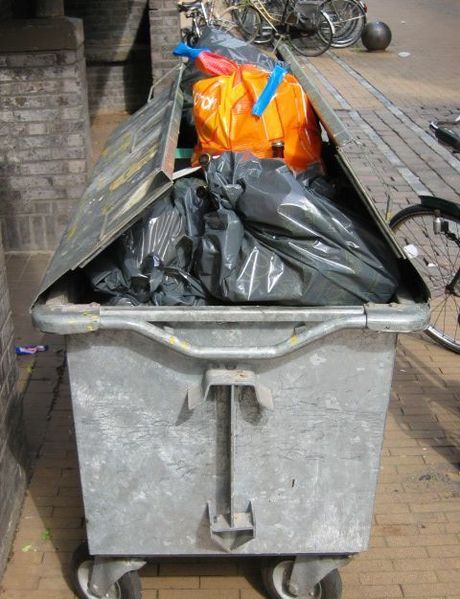
Dumpster is something that contains trash, whatever the discarded stuff (incl. food) is. In the United Kingdom and Iceland a dumpster is called a skip, in the Netherlands, Germany and Sweden it is simply a container.
The action of getting things out of the dumpster is called dumpster diving.
See also:
- Unlocking dumpsters
- Compactor
Dumpster in Groningen.JPG — Sigurdas
Food, safety, and the law
Useful finds are not worth an injury, spoiled food, or a needless confrontation. Check the local rules, choose carefully, and leave locked or dangerous machinery alone.
Laws
Edit on wikiMany countries have no laws against taking trash for one's personal use, although areas such as Germany, the United Kingdom and parts of the United States may have regulations which prohibit dumpster diving. In addition, even though a location may not explicitly forbid taking trash, many places have laws against trespassing, prowling and vandalism which can be used against dumpster divers by aggressive police and prosecutors.
Specific Countries
United Kingdom
In the United Kingdom, discarded property is still considered to legally belong to the individual or organization which disposed of it, and dumpster divers may be prosecuted under the Theft Act of 1968 in England or Wales for "Theft by Finding," or for common-law theft in Scotland.1
In England, the police may also employ Section 1 of PACE (the Police and Criminal Evidence Act) to stop and search people who they have "reasonable grounds" to believe may be carrying, among other things, stolen goods or equipment to break and enter. In practice, this means that people carrying a bag at night who are deemed to look "suspicious" may be stopped and harassed by law enforcement. In these circumstances, the police have the power to compel a person to remain, to take their name and address and to search their bags and clothes.2 In the course of a personal search, however, a constable must inform the searched party of: their name and the station they are attached to; the object of the proposed search; their grounds for making the search; and the fact that the subject is entitled to a copy of the search. Failure to do so renders the search illegal.3
Trespassing in the course of diving, unless done with aggravated intent or upon the grounds of the Ministry of Defense, is considered a civil wrong in England and Wales.4
United States
The Supreme Court Case ** has established that by discarding possessions, private citizens of the US relinquish their rights to the property, and have no common law expectation of privacy regarding them. However, the same does not always hold true for corporations, and in 1983, a Minnesota information diver was successfully sued in the Tennant Company v. Advance Machine Company for their recovery of customer lists and was forced to pay $500,000 in damages. Individual cities may also establish ordinances banning scavenging, salvage or rummaging through trash.
In the United States, the Fourth Amendment protects individuals from warrant-less personal searches unless the police have reasonable cause to suspect they are armed and in the commission of a crime, in which case they may stop and frisk them for weapons as ruled in . Individuals may be compelled to state their name, address and birth date, but otherwise reserve their right to remain silent.
Canada
In Canada, discarded materials do not appear to be considered private property. The Trespass to Property Act grants property owners and security guards employed upon their behalf to permanently ban unwanted persons from their property, although they must serve the individual in question with a notice prohibiting entry.5
Germany
In Germany, discarded property is still considered to legally belong to the individual or organization which disposed of it.
Sweden
In Sweden, discarded property is still considered to legally belong to the individual or organization which disposed of it.6
France
Dumpster diving is not illegal. Though people might tell you it is, because they just assume so. And you can't just shut them up by quoting the law, because the law is not specific. However, precedents have consistently considered that trash has no owner, which according to Article 713 of the Civil Code, default to be owned by the local administration (fr: Commune).
Notable Cases of Prosecution
- In Belgium, a dumpster diver and eco-activist known as Ollie was prosecuted for taking food from local dumpsters. His trial provoked numerous protests.
Legal Activism
- Activists in Reno (Nevada, US) have championed a campaign to "keep laws regarding dumpster diving in Reno off the books"in the face of citizen requests for laws prohibiting salvage. A short film, Dumpster Wars: Reno's Trash Politics has been made chronicling their struggle.
- Rob Greenfield - "If you get arrested for dumpster diving for food I'll cover the costs, bring national media attention to the issue, and if I'm available come hang out with you. Dumpster dive worry free knowing that I've got your back in a time of need!". http://robgreenfield.tv/arrestedfordumpsterdiving/
External links
- Dumpster Diving Laws: A summary of laws in various countries
- FAQ: What to do if a Cop Stops You: An article from an American diving blog which addresses how to navigate police encounters
- Security Culture: A Handbook for Activists: A American zine which outlines the basics of security culture, and which also outlines rights you have when approached by police in the USA.
References
Good Samaritan Food Donation Act
Edit on wikihttps://en.wikipedia.org/wiki/Bill_Emerson_Good_Samaritan_Act_of_1996
The Bill Emerson Good Samaritan Food Donation Act
was created to encourage food donation to nonprofit organizations by minimizing liability. Signed into United States law by President Bill Clinton, this law, named after Representative Bill Emerson (who encouraged the proposal but died before it was passed), makes it easier to donate 'apparently wholesome food' by excluding donor liability except in cases of gross negligence.
http://www.foodtodonate.com/Fdcmain/LegalLiabilities.aspx
United States legal liability issues
The Federal Bill Emerson Good Samaritan Food Donation Act protects the donor and the recipient agency against liability, excepting only gross negligence and/or intentional misconduct. In addition, each state has passed Good Samaritan Laws that provide liability protection to good faith donors.
Health
Edit on wiki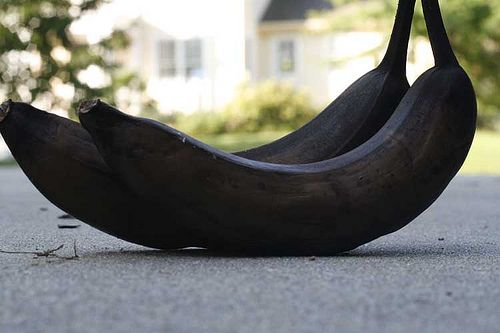
Health is an important factor of one's life. Food that appears rotten on the spot (decayed appearance and smell, unusual texture, the presence of mold) can be eaten if certain precautions are made. Dumpster divers often scavenge food that is partially rotten, unripened, or overripe, as this isn't a problem if it's properly treated and prepared. Each potentially compromising item has its own set of warning signs.
Warnings
- Eggs that have passed their expiration date are often quite fine to eat for some time - just use the float test method to determine if they are still safe to eat. Fill a deep bowl with water and place the egg in it - if it sinks, it's OK to eat, but if it floats it is bad. How this works is that as the egg ages, more air is allowed to seep into the egg, increasing the chance of contamination.
- Green spots on potatoes indicate the presence of the toxin solanine, which should be avoided in large amounts.
- Persimmons, high in glucose and riboflavin (vitamin B2), should not be eaten unripened or in large quantities though as this can cause serious health problems; it is also recommended not to eat persimmons on an empty stomach (more information on this precaution is located here).
In general, if you engage in dumpster diving, it is common sense to refrain from partaking of any obviously rotten food. Some overly soft fruits and vegetables, however, can still be salvageable once rid of suspicious spots. It should also be noted, that the expiration date and shelf life on a product is often an inaccurate marker for whether or not an item is edible. Pasteurized milk, for example, may remain fresh for five days after its sell-by date if it is refrigerated properly. When dumpster diving food that is expired, a careful observation will often tell you if something is amiss. In most cases the smell of bad juice or milk is instantly recognizable.
Ways to treat diseased food
Bleach method
- Treat your fruit of vegetables with a disinfectant made from water and sodium hypochlorite bleach to a 10:1 ratio. They should always be rinsed in fresh, plain water afterwards.
Broth method
- Crush the fruit into a purée, then boil it. This makes a delicious (and safe-to-eat) broth.
Vinegar method
- Do the same as in the bleach method with an undiluted solution of vinegar. Don't rinse off if you prefer a vinegary taste to your produce.
Cooking thoroughly after cleaning will kill most anything harmful, with perhaps the exception of Clostridium botulinum spores, which is a concern with damaged canned food. Swollen cans should be avoided.
Furniture
Furniture should be inspected for bedbugs, especially furniture from dorms since so many people move in and out of there. Bedbugs will hide in almost everything, and people often freak out and throw furniture away once they find an infestation (and infestations can happen anywhere). Check for bedbugs before you bring anything inside, and keep mattresses in a plastic wrap for dust mites with duct tape over the zipper.
Shelf life guide
You can check roughly how long an item of food can last or whether it is freezable on: http://www.stilltasty.com/ or http://www.eatbydate.com/
External links
- Mold
- Preservation
Black bananas.jpg — Sigurdas
Food
Edit on wikiTrashwiki is mostly about dumpster diving food. But there are of course also other things you can dumpster dive.
A lot of people dumpster dive and never take (or find) any food.
Mold
Edit on wikiDumpstered food can contain mold - be careful and picky with food that shows traces of it.
With hard foods such as hard cheeses, salami and ham it's okay to cut away the mold. Fruits and vegetables can still be okay after cutting away about an inch.
Apart from these: chuck it!
See also:
- Health
External link
Employees
Edit on wikiWhen you dive, you can expect encounters with store employees who might come out to look at what you're doing: they might chase you away - or simply ignore you, take a cigarette break, and be gone again.
If your actions go along with diver's etiquette, you have much better chances to let be ignored by, or in some cases even befriended with employees. You must understand that very often it is not their fault they have to chase you away but because of the store owner policies they have to do so. If they are nice, they might tell you when is the best time to come to the dumpster so to avoid any clashes. Employees of some (smaller?) chains go even further: they might leave food in crates right by the store for you to take. Some, as experienced in London by diver Sigurdas, might let you dive for 5 minutes and only then ask you kindly to go away.
Some can be pure evil, though. For example, in 2008 employees of German "Lidl" in Stockholm poured a corrosive liquid, the equivalent of chlorine, on food that would be discarded, in order to keep homeless people away from dumpster diving (this case was filed for police investigation, and the managing director of Lidl Sweden called the incident "extremely regrettable").
Compactor
Edit on wiki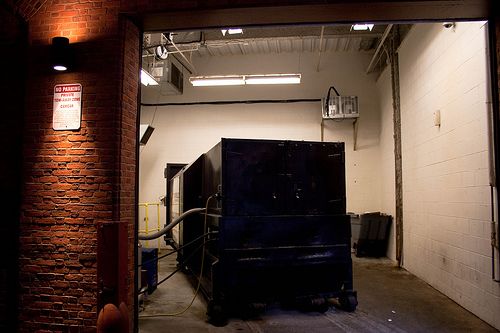 A
compactor (or trash compactor) is a
mechanism used to reduce the size of waste material through compaction.
Many supermarkets unfortunately use compactors for cycled produce and
other waste. Often it is more difficult to collect food from compactors
through dumpster diving practice.
A
compactor (or trash compactor) is a
mechanism used to reduce the size of waste material through compaction.
Many supermarkets unfortunately use compactors for cycled produce and
other waste. Often it is more difficult to collect food from compactors
through dumpster diving practice.
Although many trash compactors function in such a way that the compaction pressure is very low unless the compactor is very full, it is never worth risking one's life. Pressure increases as the volume sensor is triggered, which a moving human body may do. The final compaction cycle can run at pressures in excess of 20,000 lbs. Always unplug the trash compactor before entering, or have a friend standing next to the emergency button.
Some trash compactors are left unlocked; others must be forcibly opened or disassembled. Be wary of highly compressed items, as some may explode violently when pressure is released. Lightly filled compactors, or compactors for which the next compression cycle has not yet run, will contain uncompressed, quality items.
- Can someone please post some info about accessing food inside compactors that are kind of connected to the buildings? You can't see the place where the food goes in because that is inside the building. Seems there is nowhere to open them easily from the outside. Or maybe need special tools/tricks?? Any info is appreciated!
here it seems there is no way to do it, but i would love for someone to prove them wrong: an idea might be cutting the power cables to make the things unusable and maybe with time they would get normal bins..anyone tried?
Compactor.jpg — Sigurdas
Unlocking dumpsters
Edit on wikiLocked dumpsters can be extremely annoying for those who dumpster dive. You just know there's some decent food in there (or some cool electronics!) but you can't get to it. Methods described below are different ways of unlocking dumpsters, used by divers around the world. It is recommended though to leave locked dumpsters in peace, and look for the unlocked skips in the area. However, sometimes all dumpsters in the area can be locked, and that is why some dumpster divers chose to "create" dumpster diving places by finding ways to unlock dumpsters. It is known that sometimes constant dumpster lock "modifications" or its destruction can lead to the store owner giving up and letting the trash be stored unlocked (victory for dumpster divers), sometimes security instead gets more tight and those caught in action are persecuted by law (victory for store owners). These wars are known to exist mostly when there is either a very unfriendly store owner or very messy and respectless divers. Usually, though, in Western countries, you can find at least some dumpsters unlocked, and only in case of total despair it is recommended to use methods for unlocking locked dumpsters, and even then, it is good to stay smart and chose such ways which would cause least property damage for the owner, and therefore he would be less concerned for persecuting divers.
You must remember that all of these methods (or most of them, depending on your country) involve some sort of law violations, and while we on Trashwiki agree that it is wrong to lock away still perfectly useful waste, Trashwiki can not officially encourage others to violate law, therefore note that:
Trashwiki does not recommend neither any property damage nor any other law violation. If you do so, do it on your own risk.
Information below is merely a virtual space for activists around the world to share their knowledge. Edit this page if you know more!
Hinge "modification"
Single rod
Useful tools:
- pliers
Usually, dumpsters are designed with a single rod hinge at the back. This is so that the lid will open when it gets dumped into the truck. The front of the lid is usually the place that's locked, either with another bar or a chain and a padlock. Padlocks are hard to deal with, but the hinge often isn't.
Usually, the hinge rod is a bar with a washer welded at one end, and another loose washer and a split pin at the other end. You can simply close the legs on the split pin with your pliers (it can sometimes even be done by hand, or with a coin), and then pull the pin out, and remove the washer, and simply pull the whole hinge-rod out, and lift the lid up by the back.
The best part about this method is that you can simply put the hinge back in, and replace the washer and split pin, and no-one will know that you even visited, and it'll be even easier next time you come.
Multiple pins
Useful tools:
- pliers or screwdriver
- hammer or stone
:
:
As in this video described, you can very easy remove the 2-4 hinge pins of a container and then open the lid from the back, so you don't have to deal with the padlock. After your job just put the pins back and nobody will understand, that the container has been opened. To get the pins out faster next time, take a knife and shorten the bulge a bit, so the pin will come out easier next time.
Jamming locks
The technique described here will not yield immediate results. It takes time and dedication but is less risky and more effective than for example the brute force method.
Useful [ tools](:Category:tools ” tools”){.wikilink}:
- Toothpicks or paperclips
- Superglue
- (Small stones)
Every locked dumpster has a lock. Locks work through pins that slide into the right place when the right key is put in, allowing the lockowner to turn the key and open the lock. By sticking a paperclip or toothpick inside and adding some superglue the lock will become jammed. Try to make the toothpick or paperclip so small that it dissapears into the keyhole, allowing no space for locksmiths to get it out with pliers. The superglue makes sure that the toothpick or piece of paperclip stays in place and also glues the pins of the lock in place, making it unable to open the lock even if the obstruction is removed. After inserting the glue, hold the lock upside down for a while to allow the glue to dry. This technique takes about two minutes and makes no noise. The nasty part is that the shopowner will arrive in the morning wanting to throw some trash out and find that he or she cannot open the dumpster. This forces them to call a locksmith or fiddle around themselves with tools to open it up. Doing this for a few days will quickly change their minds and either leave the dumpster unlocked (good for you), or other ways to keep the waste locked will be found (inside the shop for example, which is no good news for you then).
There is also a simpler method of jamming locks, for example inserting very small stones inside the lock. These might be easier to remove for the store owner later on, but it still creates a lot of inconvenience - if you continue doing that for some time, you have some 50% of chance that a dumpster will be left unlocked sooner or later.
Triangle lock
Sometimes the bins are closed with a system integrated in them, needing a triangular key. The easiest way to open those is to get a triangle key or pliers to open the bin. But if you don't have those, or forgot them at home, you might open the bin by sliding your arm under the lid through the side (if possible). Then reach to the lock and move the metal plate that keeps the bin shut. You might have to press a bit on the lid where the lock is so that it's not too hard to move.
Brute force
Useful [ tools](:Category:tools ” tools”){.wikilink}:
- bolt cutters
- jimmy bar / crowbar
This method is the one you least want to have to do, because it risks damaging property (and therefore increasing fines), but if you can't do it any other way, just bust the chain with the bolt cutters or crow bar.
Bump key
It seems theoretically possible to open a lock with a bump key. Please update if you have any tips.
See also: How to make a bump key.
Cages
This is general information about cages. Supermarket dumpster cages often are different from residential building trash cages.
Often the bins are in cages which are locked but to fix that you can lift the door up so it comes out of the hinges. There are different types of bin cages and one of the types can be lifted up because the hinges are not blocked at the top so the door can slide upwards easily. If you decide to glue a lock, try to glue it whilst the door is open. Not necessary but makes life easier for everyone.
Cages that have a handle on the inside: If they are really locked with a key that turns all the way then it's unlikely you can open it by these methods. But if the lock is one that just needs the handle to be pressed down, put your hand or some fingers through the bars and press the handle from the inside. Sometimes this handle is one that you can turn instead of pressing. If it's too hard to do that, and you have a pen knife with you or some metal object like a spoon handle, you can use that by putting it in between the door and the cage at the place where the lock is, and push the lock (to make the same effect that happens when the handle is pressed). Sometimes that is easier because the inside handle is out of reach.
Courtyard access
If a supermarket is in a residential building you might be able to get to the dumpster by entering the courtyard of that building.
Courtyards: A courtyard might have several building doors that it can be accessed from. So if one is hard to open or in a main street where lots of people pass you might want to try the others. For example on a corner of a building, there are two entrances usually on the different intersecting streets. (IMPORTANT: Once inside the building, you usually have to get out of it to get to the courtyard. There will be another door, the one leading to the courtyard. Sometimes this door will open from inside the building but the handle on the other side will not open it. For this you should put something to keep the door from closing whilst you are dumpstering or you might get locked inside the courtyard. One time this happened and there was a particularly nasty old lady who told Smaua to get out the same way she came in. ALWAYS check that you can get back out easily:) These doors can be also carded sometimes but not always so it's easier to not let them close!)
- Carding: To get into courtyards, you can card most building doors,
go through the building and reach the courtyard. Especially the old
Berlin buildings with big heavy wooden doors. But new doors work too,
and gates also. The doors are not locked by turning the key all the way
but just by the handle release, just like the bin cages. To easily open
them, you need something like a plastic card. Bendy but not too bendy.
The longer the better cause it has to go in quite a bit. Old folders can
be used to make a nice shape. Also tupperware lids. The material has to
be thin enough to get in between the door and the lock. The shape of the
material should be rounded off at one side so that it's easy to turn and
slide around. Something shaped like this black piece of material works
well. Feel free to experiment and edit this info.
- Old doors: The easiest doors(old wooden ones) can be opened by just sliding the plastic in at the level that the handlebar is at on the other side, and pushing inside whilst(at the same time) kind of jiggling or pushing the door with your foot. This is incredibly easy to do and works on most doors. Usually the space in between the door and the lock is very big on the old doors.
- New doors: For other kinds of doors it's better to slide the plastic in(as much as 15 or 20cm if you can) a little above the handlebar and slide it down towards the lock, at a kind of sharp angle. Do this whilst jiggling the door with your foot. You can also open it by sliding the plastic from the bottom up. Depends on the type of door and the space in between the door and the lock. the thinner your plastic the better. Most doors can be opened like this even though there are some kinds where there is not enough space for the card to slide around easily so those cannot be opened.
- Ring the buzzer: Sometimes one of the doorbells for the building is a company, business or a practice(doctor, dentist). Sometimes ringing those doorbells automatically opens the door. Other times you have to wait a bit and they open the door for you like for a client. You can also ring other doorbells and depending on your language level say that you are delivering advertising or just hope they don't ask who it is and just buzz you in.
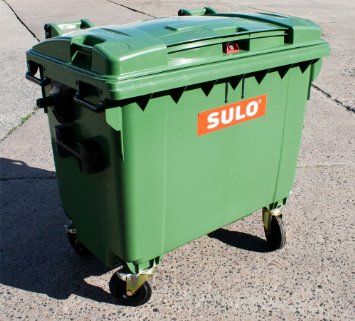
Sulo_dumpster.jpeg — Helper
Sulo_hinge_pin.png — Helper
Places and techniques
Discarded goods turn up in more places than supermarket bins. The setting changes the timing, risks, etiquette, and kinds of things worth recovering.
Restaurants
Edit on wikiSome restaurants throw out perfectly good food. You can also try asking directly if they have food to throw out, but this might be harder if you're vegetarian, vegan or having other dietary restrictions.
Associated with restaurants is the concept and act of tabling which is the same as dumpster diving but involves the tables of restaurants rather than bins round the back.
"Tablers" visit restaurants, with McDonald's and Burger King being among the common examples, and reclaim the food left by other users of the restaurants before the staff come and clear it up. Some prefer to sit in the seat and act as if they paid for the food while others prefer to grab the food and eat it outside the restaurant. The brown bags some restaurants serve take-away food in are also a target for dumpster divers.
Synonyms: Some people may say "table diving" instead of tabling, but tabling could also just be a shortened form of table diving.
Residential Food Diving
Edit on wikiFood isn't a staple in residential bins to the same extent it is in commercial dumpsters, but an experienced and vigilant diver may be able to regularly glean groceries from their neighborhood apartments with practice. Many individuals and families will jettison the contents of their refrigerator, freezer and cupboards when moving, and if retrieved in time, these caches can be used by a canny scavenger.
Methods
As always with residential diving, a would-be diver should brush up on the local laws regarding scavenging, trash rummaging and trespass and should never go onto a single occupancy building's private property in the course of their hunt. As edible move-out caches are almost always disposed of the day before pick-up or on the last day of the month, a diver can scout for potential hot spots in the days before by keeping a lookout for bulkier items, such as mattresses and furniture, which are often disposed of much earlier. A diver can also scan viable dumpsters and how to approach them by making a habit of picking up and disposing of litter.
Once the diver has a good group of targets, they should approach them on the night before pick-up with the goal of spending as little time as possible on what might be construed as private property. This is best accomplished by learning how to feel individual bags for identifiable foodstuffs, such as weighty sealed cans or cold frozen bags, and then taking the bags as quickly as possible to another location for sorting. doing this reduces the risk of unwanted attention, as residents may feel threatened by somebody visibly sorting through their trash. It is ideal, when possible, to target residential dumpsters that are placed out on a "public" curb or sidewalk.
Once the bags are taken ready to sort, a diver should always have gloves, rags or towels and a diluted water/bleach solution on hand (for sanitizing packaging and containers. While residential diving for food can be very rewarding, it can also be considerably messier than commercial diving, and usable sealed containers may be spattered with loose food and refuse.
When looking at expiration dates, a diver should look for caches which all appear to have been sold at a similar time and which should be no more than a few weeks out of date. Food that has expired at vastly different time or which has been expired for more than a month may be indicative of somebody cleaning house rather than moving. Expiration dates on food which has been frozen is of less consequence, although it is still up to an individual diver as to what they feel comfortable in taking. When in doubt, one should always err on the side of caution. 7
References
Table dive
Edit on wikiTable diving is the act of getting a free meal from a restaurant by scavenging other people's tables for unfinished food. For the environmentally conscious and/or unashamed, table diving is no problem.
How to table dive
- Go anywhere where large quantities of food are consumed. This could be a food court, a large restaurant, a mall, it doesn't matter as long as a lot of people are eating there. It helps to target an area which is rather discrete, if one wants to avoid alerting others. If not, try to do something like look at your phone or read a book do it doesn't look like you're loitering.
- Keep an eye on where people are in their meals. Take note of people who are close to finishing their food, or look ready to leave.
- At this point you can do one of two things:
- Hope they don't throw their food away, and if they don't, get it off the table quickly. If they don't,
- Approach them before they reach the trash and ask for their food. This might seem strange, but what's more strange is the idea of throwing away perfectly good food. Try not to be embarrassed if they politely (or impolitely) decline.
- Sit down and enjoy your free food.
Tips
- Be fast and outgoing, if you're quiet and shy food will get thrown out before people hear you ask for it.
- Go to places where servings are large so you have more chances of finding unfinished food. If one wants to be more strategic, target tables with types of food that are easily filling. Use your gut on this one (no pun intended).
- Smile and be polite when asking for food - not seeming weird is the key!
Warnings
- A lot of managers/owners/staff might not be happy with you table diving because of concerns over liability or public image, so be quick! If you feel it's necessary, eat elsewhere and return the plate.
- Some people might look down on the idea of leaving left overs. Then again, some people might look down on the idea of wasting food. When in doubt, lower your inhibitions. Try to frequent places you wouldn't normally go.
- Be patient, but realistic; if everyone is eating their entire meals and throwing their food away, it might just be a bad day to table dive.
- Keep cultural differences in mind; what may work in one country, may not work in another.
Wintertime diving
Edit on wikiDumpster diving in winter can be tough. Below, dumpster divers share their experiences and tips - add more info if you can!
Clothing
- Warm gloves for digging in cold trash
Equipment
- to be filled
What you find
The cooler temperatures in wintertime will cause fewer perishable foods to go bad. This is an advantage because the food in the dumpster will not go bad as quickly as on hot summer days. On the other hand, you might find less discarded food because fewer will get bad inside the stores.
Frost
When temperatures are below the freezing point, the food will start to freeze. For things you might normally put into the freezer anyway - like meat, pizza and ice cream - this effect is advantageous. Yet, fruits and vegetables are negatively effected by frost. If the water in the plant cells is turning into ice, it is expanding and thus breaking the cells. While frozen, the fruit still looks good and feels firm, but when the water is starting to melt, the fruit gets squashy. Also, the food will lose a part of its taste.
If you want to take the frozen fruits and vegetables anyway, you should store your findings in the ice compartment of your fridge or outside (if temperatures are below zero all day) and defrost them just when you start preparing them. Frozen fruits can still be used to make shakes, smoothies or sauces. Just put them into a pot or something similar while defrosting and then blend.
See also
- Preservation
Festivals
Edit on wikiFestivals such as Reading allow great dumpster diving opportunities. You can also see many great bands for free if you volunteer some hours. See http://casarobino.org/2009/09/music-festivals-free-or-festival-dumpsterdiving for inspiration!
During festivals there are often dumpsters in front of the entrance to the stages were everyone is supposed to throw away their alcohol. Just wait next to it and some poeple will offer you their half emptied bottles.
In some countries (e.g. Germany) you get money for empty bottles of beer, water and lemonade. It's easy to collect enough to finance your festival ticket.
Some people leave everything behind when they drive home. Look out for huge piles of abandoned things and you will find tents, sleeping bags, all kind of food, alcohol and lots of weird things.
This video shows the aftermath of the 2009 Glastonbury Festival. Hundreds of tents, folding chairs, inflatable mattrasses and many other goodies abandoned by punters at festival's end.
Hard rubbish
Edit on wikiHard rubbish is also known as "hard trash" or "hard waste".
In Australia (and presumably in other countries), local councils organize periodic collection of "hard rubbish" from households - items such as washing machines, furniture, mattresses, refrigerators, as well as scrap timber and metal. These collections can happen as often as every two months, or as little as every two years, depending on the council. In any event, this can be a great way to pick up items such as electronics, furniture and other useful stuff that residents no longer want.
Check the website of local councils to see when the next scheduled collection days are (so you know which part of your city to look in!). It pays to get in early, as many people take the opportunity to scavenge from this rich resource.
In Barcelona, Spain, this system works every day. All city is separated into seven districts (Sagrera, Horta and Sant Andreu, for an example) and every district has it's own day of the week when people can throw their furniture and stuff out on the streets. Some people collected electronics every day, fixed those and sold these in the market.
Beachcombing
Edit on wikiBeachcombing is looking for trash on beaches.
Using a metal detector, made of scrap or purchased, is useful for finding objects of value. Expect many pull tabs, bottle caps, and ancient aluminum cans to be found, and objects of value occasionally. Depending on the history of the location, you may find practical uses for things such as old railroad ties or even rusty chains.
Finding and removing sharp objects out of the sand is beneficial to beach-goers, as feet are often bare.
At times beachcombing was popular in the Netherlands.
See also article on Wikipedia.
Urban foraging
Edit on wikiUrban foraging is the foraging of wild urban food sources. Many cities are full of plants and trees that contain edible parts. Sometimes dumpster diving is also called urban foraging.
The ethics of urban foraging:
- Be friendly: Ask permission when ownership is unclear.
- Be generous: How much do you really need? Only pick what you will eat, leave the rest for others (wildlife).
- Be alert: Beware of toxicity and don't tread on other plants when picking.
- Be careful: Don't put any rare or protected species on the map.
Feel free to add your own discoveries as well!
More info
- Started up by the group FoAM, the Urban Edibles site maps out wild food sources in Amsterdam.
Diving on the move
Dumpster diving can support a journey or become a shared local routine. Maps, meetings, transport, and simple records help people find one another and learn what changes.
Travelling
Edit on wikiIt's a popular myth that travelling has to be expensive. Fortunately hitchhiking and hospitality exchange have made it possible to make travelling cheaper than renting a place in many places. Dumpster diving adds another way for frugal travelling. See for example Doing The World For Free - a mission with 3 young people who do what many of us dream to do, without spending a single cent!
Freight bicycle
Edit on wiki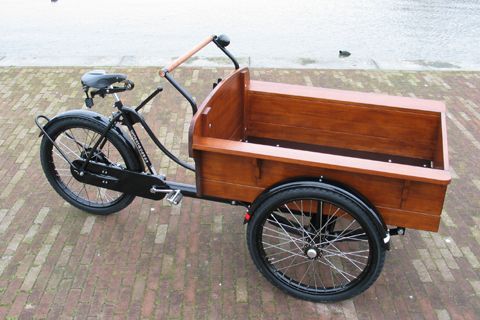 A
bakfiets is a tricycle with a large area in the front
of it for transporting cargo. It is also called a freight
bicycle.
A
bakfiets is a tricycle with a large area in the front
of it for transporting cargo. It is also called a freight
bicycle.
Freight bicycles, carrier cycles, freight tricycles or cargo bikes are human powered vehicles designed and constructed specifically for transporting large loads. Vehicle designs usually include a cargo handling area consisting of a steel tube carrier, an open or enclosed box (cabinet), a flat platform, or a wire bracket basket. These are usually mounted over one or both wheels, low behind the front wheel, or between parallel wheels at either the front or rear of the vehicle. The frame and drivetrain must be constructed to handle loads several times that of an ordinary bicycle. Other specific design considerations include operator visibility and load suspension.
Common Usages
Common usages include:
- delivery services in dense urban environments
- food vending in high foot traffic areas (including specialist ice cream bikes)
- transporting trade tools, including around large installations such as power stations and CERN
- airport cargo handling
- recycling collections
- warehouse inventory transportation
- mail (The UK post office operates a fleet of 33,000 bicycles, mainly the "Pashley" MailStar)
Because of the strong economic advantageous realizable by widespread proliferation of freight bicycles, has designed the OxTrike and established local production at community workshops in non-industrialized countries for use in non-industrialized countries worldwide. Dangdang, China’s biggest online bookseller, uses 30 bicycle courier companies in 12 cities to deliver goods and collect payments.
External links
- Worksman; New York city builder of freight and industrial bicycles
- Producer with a broad variety of freight bicycles
- Blog about workbikes and freight bicycles (English/Dutch language)
- Magazine in which several good commercial freight bikes are mentioned
- Transportation Alternatives
- Making Workbikes for the Neighborhood by Greg Bryant
- longjohn.org: website about Danish Long John bikes
- Freight bicycles for the Third world
- Velorbis - Danish distributor of the Long John and Short John
Media Coverage:
- Classic Cycles Built in Queens
- Full cycle: Group of (Indiana) homeowners snapping on helmets for Re-Cycles! program
- Couriers pedaling full speed ahead Pair's delivery service firms are finding their stride amid an uphill job market
- Building a Better Bike Lane An interesting article featuring freight bikes
Workcycles-bakfiets-medium.jpg — Sigurdas
Maps
Edit on wikiIt would be nice to have maps with useful trash. See for that.
There are also some other websites with good trash info:
- check Gigoit
- Search "dumpster diving" on Wayfaring
- Danish maps GratisMad
- NYC Food Rescue Map GoogleMap
- Montreal Chase Aux Tresordure Map GoogleMap
Meetings
Edit on wikiIn many places around the world people organize meetings to go to dumpster dive together. These kind of meetings are especially popular in the United States.
- At dumpsterdiving.meetup.com you can find some of the freegan-oriented meet-ups.
- frappr.com/freegans offers you a possibility to meet other freegans/dumpster divers around the world.
Facebook is known as a social platform for uniting people and making it easier to organize various events. For that reason there are thousands of groups and pages on Facebook which unite people with similar interests. Of course, there are freegan/dumpster diving related groups, and here we will link to most notable ones:
Global
USA
Finland
Freecycling
Germany
Austria
Australia
Czech Republic
Lithuania
TLog
Edit on wikiTLog is short for TrashLog, which is a record of a particular dumpster dive (It is pronounced "Tee Log"). At a minimum this record should consist of:
- The date you dumpstered
- What you were able to rescue
- Generally how much was vailable (loads, some, little, almost none, none)
Other information which strengthens the Tlog entry is
- You name and contact info if your wiling
- most important lesson of that day dumpster diving
- Watch Outs and Watch Fors
These records are connected to the detailed sites for a particular location (markets, stores). They are most desirable for locations which have regular or repeating trash patterns. Where other people can help use the TLog to predict what they might get. But even TLogs for likely one off dumpster/salvage operations it is often handy to see what other people have experienced.
Some basic TLogs have been listed on the Ten Katestraat.
Waste and recovery
A bin is one stop in a much larger material system. These chapters follow what gets discarded, what can be reused or recycled, and why so much becomes waste in the first place.
Making money
Edit on wiki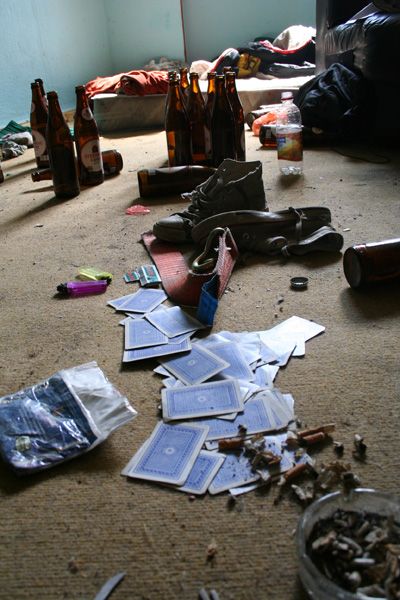 Making money out of trash is also an opportunity. Below
you can see (or contribute with) some most common ideas how to make
money from trash.
Making money out of trash is also an opportunity. Below
you can see (or contribute with) some most common ideas how to make
money from trash.
Empty bottles
In some countries (Germany and Holland for example) you can collect empty bottles in parks and from trash cans (or anywhere else you can find them) and bring them to the shop or supermarket where they give you money for these. In Germany (where they call empty bottles "pfandflaschen") all the beer bottles cost 8 (euro)cent, plastic bottles and cans can be 15 or 25 cent. In Holland one empty beer bottle costs 10 cents and big plastic bottles 25 cents. To find bottles try going inside the supermarkets and next to the bottle return machine there is a trash can normally. This very often contains bottles that cannot be exchanged at that supermarket but at other ones. This works well between Lidl, Aldi, Albert Heijn and Dirk.
In Scotland, ginger (soft drink) bottles from a company called Barrs come in glass bottles. These glass bottles can be returned to local shops for 30p.
In Belgium, must of the beer glass bottles (like the Chimay) can be returned. It is like 10cents/bottles.
In Germany they sometimes have Beer Festivals. You can very often find many beer glasses and jugs there - and for returning one beer glass you get 2 euros. On big rockfestivals with camp, like "Wacken" hard glass beerbottles are forbidden, so the people have to buy beer in cans. These cans (with 25 ct Pfand) there overall, and if you collect the cans, you can have 50 maybe 100€ in a hour.
In the U.S. Only a few states have bottle return laws, but if you are in one of those you can money for some types of discarded drink containers. This website shows how much deposit you can get back in each state that has a deposit law.
Flea markets
In countries like Germany, France and Spain (as well as many others), you can find some electronics, fix these (if you are able), and sell these in the flea market. Or anything else which you think you can sell.
In Spain you can sell some stuff in "Cash Converters", one second-hand shop chain.
Notice board
Use Internet notice boards to sell dumpster dived and/or repaired stuff. In the U.S., Canada and growing parts of the world you can post free for sale ads of dumpster dived treasures on your local craigslist. Some clothes, furniture or books can be sold if you price them cheap-most people expect a really good deal if they are buying used.
Actually finding money
It is also possible to find money, of course. On the streets or anywhere.
In Spain you can find coins in telephone booths and even make living with this. Of course you can find coins in telephone booths everywhere where they use coins for calling (Germany, Spain, Portugal, etc.), but in Spain it's somehow easier.
Also you can search for coins from parking machines, in the rejected coins slot.
In the UK many supermarkets have trolleys which require a £1 coin to be slotted in before the trolley can be used. Finding abandoned trollies and returning them allows you to recover the coin from the slot. Wet days are best when people can't be bothered getting soaked when returning the trollies.
Coins are also often found in and around the self service checkouts in supermarkets, where people have dropped small value coins as they put them in the slot.
Selling to antiquarian
If you find some old books, furniture and other really old or rare stuff you can either try to sell it yourself or sell everything to an an antiquary (you will get less money by selling your item to a middle man than if you have sold it yourself, but for that your chances to actually sell something might increase).
Selling Tickets
In urban areas you can ask people who are leaving the public transport for their tickets, which they don't need anymore. Most often the tickets remain valid for the rest of the day or at least some hours. Those tickets can then be sold under the market value to people who wish to buy one.
Note that many transport companies specifically don't allow reselling used tickets, even if they are still valid.
Recycling
Some materials bring higher prices. A useful site for learning what types of electronics/electronic components are valuable and where to find them is here. Some printed circuit boards are valuable for their gold and other precious metal content.
See also
- Money
- Coin
- Moneyless.org
Scheisegal20 sirla.jpg — Absurdistaner
Waste
Edit on wiki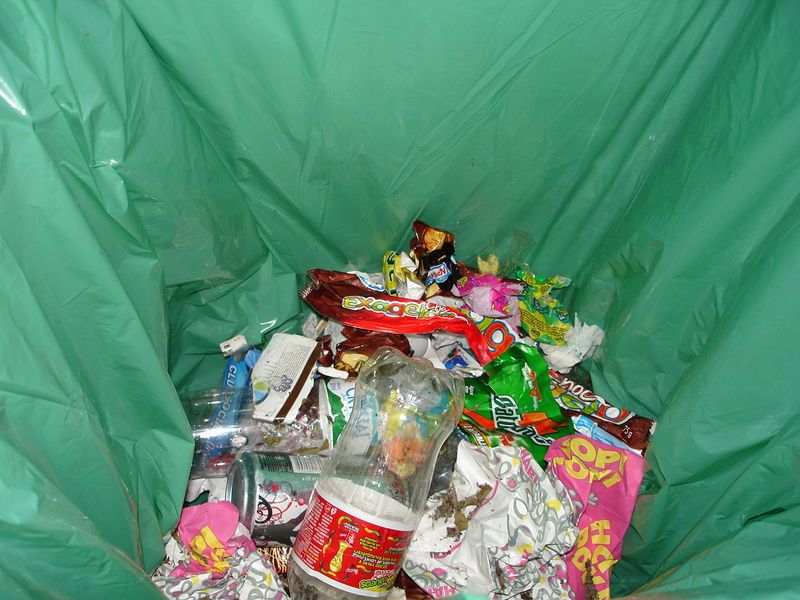
Waste is an unwanted or undesired material or substance. It is also referred to as rubbish, trash, garbage, or junk depending upon the type of material and the regional terminology. In living organisms, waste relates to unwanted substances or toxins that are expelled from them.
Waste management is the human control of the collection, treatment and disposal of different wastes. This is in order to reduce the negative impacts waste has on environment and society.
Waste is directly linked to the human development, both technologically and socially. The composition of different wastes have varied over time and location, with industrial development and innovation being directly linked to waste materials. Examples of this include plastics and nuclear technology. Some components of waste have economical value and can be recycled once correctly recovered.
Biodegradable waste such as food waste or sewage, is broken down naturally by microorganisms either aerobically or anaerobically. If the disposal of biodegradable waste is not controlled it can cause a number of wider problems including contributing to the release of greenhouse gases and can impact upon human health via encouragement of pathogens.
It is difficult to define specifically what a waste is. Items that some people discard have value to others. It is widely recognised that waste materials are a valuable resource, whilst there is debate as to how this value is best realised. Governments need to define what waste is in order that it can be safely and legally managed. Different definitions need to be combined in order to ensure the safe and legal disposal of the waste.8
As a nation, Americans generate more waste than any other nation in the world with 4.5 pounds of municipal solid waste (MSW) per person per day, 55 percent of which is contributed as residential garbage. The remaining 45 percent of waste in the U.S.'s ’waste stream' comes from manufacturing, retailing, and commercial trade in the U.S. economy 9.
Environmental impact
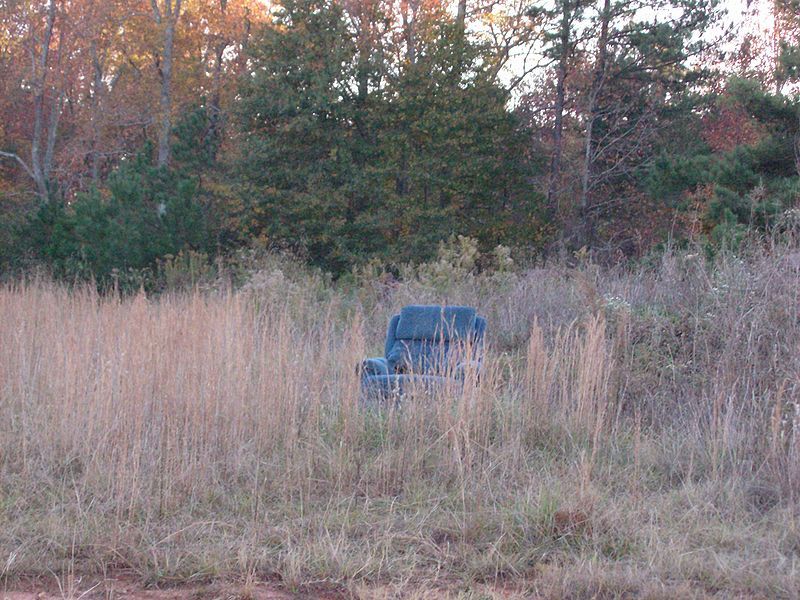 Many
different types of waste have negative impacts upon the wider
environment.
Many
different types of waste have negative impacts upon the wider
environment.
Waste pollution is considered a serious threat by many and can broadly be defined as any pollution associated with waste and waste management practices10. Typical materials that are found in household waste which have specific environmental impacts with them include biodegradable wastes, batteries, aerosols, oils, acids and fluorescent tubes.
Biodegradable waste is of specific concern as breaks down in landfills to form methane, a potent greenhouse gas. If this gas is not prevented from entering the atmosphere, by implication, it contributes to climate change.11
Littering can be considered the most visible form of solid waste pollution12. The act of littering for the most part constitutes disposing of waste inappropriately, typically in public places. Littering itself may or may not be an intentional action.
Marine debris, also known as marine litter, is human-created waste that has deliberately or accidentally become afloat in a lake, sea, ocean or waterway. Though it was originally assumed that most oceanic marine waste stemmed directly from ocean dumping, it is now thought that around four fifths of the oceanic debris is from rubbish blown seaward from landfills, and washed seaward by storm drains.
Other forms of pollution associated with waste materials include illegal dumping and leaching13. Illegal dumping of flytipping often involves unregulated disposal of materials on private or public land. Remoted sites with road access coupled with limited surveillance often provides the perfect opportunity for this form of dumping which often goes unpunished and leaves others (such as the community or developer) to properly dispose of the waste. Leaching is the process by which contaminants from solid waste enter soil and often ground water systems contaminating them.
Composition of waste
Most waste is comprised of the following materials.
- Paper - newspaper*, office paper*, packing materials, cardboard*
- Plastic - beverage containers*, high tech waste*, packing materials
- Metals - cans*, high tech waste*, scrap metals*, appliances*, building materials*
- Glass - windows*, bottles*
- Food waste and organic material - leaves, peelings and scraps, spoiled food, grass clippings
- Human and animal waste
- Wood - furniture, building materials, pallets*
(* Denotes waste that can be recycled.)
Although most of this waste is recyclable, very few of it makes it to a recycling facility. Plastics, Metals and Glass can sit in landfills for millions of years before they break down. And when incinerated, they release toxic fumes. In developed area, there are services that will remove these materials, and properly recycle them. But for most people, no service exists. Recycling takes much energy, a lot of labor, and does not leave much of a final product. For most of the world it is a lot easier to just throw it in the garbage than take the hassle of recycling it.
Definitions
The European Union defines waste as an object the holder discards, intends to discard or is required to discard is waste under the Waste Framework Directive (European Directive 75/442/EC as amended). Once a substance or object has become waste, it will remain waste until it has been fully recovered and no longer poses a potential threat to the environment or to human health."14''
The UK's Environmental Protection Act 1990 indicated waste includes any substance which constitutes a scrap material, an effluent or other unwanted surplus arising from the application of any process or any substance or article which requires to be disposed of which has been broken, worn out, contaminated or otherwise spoiled; this is supplemented with anything which is discarded otherwise dealt with as if it were waste shall be presumed to be waste unless the contrary is proved. This definition was amended by the Waste Management Licensing Regulations 1994 defining waste as:[havok] for ever.
"any substance or object which the producer or the person in possession of it, discards or intends or is required to discard but with exception of anything excluded from the scope of the Waste Directive".15
Education and awareness
Education and awareness in the area of waste and waste management is increasingly important from a global perspective of resource management. The Talloires Declaration is a declaration for sustainability concerned about the unprecedented scale and speed of environmental pollution and degradation, and the depletion of natural resources. Local, regional, and global air pollution; accumulation and distribution of toxic wastes; destruction and depletion of forests, soil, and water; depletion of the ozone layer and emission of "green house" gases threaten the survival of humans and thousands of other living species, the integrity of the earth and its biodiversity, the security of nations, and the heritage of future generations. Several universities have implemented the Talloires Declaration by establishing environmental management and waste management programs, e.g. the waste management university project. University and vocational education are promoted by various organizations, e.g. WAMITAB and Chartered Institution of Wastes Management.
See also
- Dumpster diving
- Freegan
- Recycling
- Sustainability
External links
- BBC - Waste
- Waste-US US-EPA Waste Website
- Municipal waste generation by country
- A brilliant musical documentary about dumpster diving
- The Guardian newspaper article on food waste
- San Francisco Chronicle newspaper article on popularity of new law requiring all food waste to be composted
- Tristram Stuart's book 'Waste' reviewed by Paul Kingsnorth for The Independent newspaper, 17th July 2009.
- How to Start Scrapping Metal
- Blog of Eskilstuna, SE based 1-year course in sustainable development and recycling technologies
800px-Common rubbish.jpg — Sigurdas
Dumpster in Groningen.JPG — Sigurdas
800px-Dumped.JPG — Sigurdas
Landfill
Edit on wikiA landfill, also known as a dump (and historically as a midden), is a site for the disposal of waste materials by burial and is the oldest form of waste treatment. Historically, landfills have been the most common methods of organized waste disposal and remain so in many places around the world.
Recycling
Edit on wiki
 Recycling involves processing used materials into new
products in order to prevent the waste of potentially useful materials,
reduce the consumption of fresh raw materials, reduce energy usage,
reduce air (from incineration) and water (from landfilling) pollution by
reducing the need for "conventional" waste disposal, and lower
greenhouse gas emissions as compared to virgin production. Recycling is
a key component of modern waste management and is the third component of
the "Reduce, Reuse, Recycle" waste hierarchy.
Recycling involves processing used materials into new
products in order to prevent the waste of potentially useful materials,
reduce the consumption of fresh raw materials, reduce energy usage,
reduce air (from incineration) and water (from landfilling) pollution by
reducing the need for "conventional" waste disposal, and lower
greenhouse gas emissions as compared to virgin production. Recycling is
a key component of modern waste management and is the third component of
the "Reduce, Reuse, Recycle" waste hierarchy.
Recyclable materials include glass, paper, metal, textiles, electronics (cell phones, computers) and plastics. Though similar, the composting of biodegradable waste – such as food or garden waste – is not typically considered recycling. These materials are either brought to a collection centre or picked-up from the curbside; and sorted, cleaned and reprocessed into new products bound for manufacturing.
However, critics of recycling claim that it often wastes more resources than it saves, especially in cases where it is mandated by government.
See also precycling.
Background
In the United States, recycling facilities earn estimated revenues of $2,981 million a year. Growth has exceeded 7% per year for the past five years (from 2003 to 2008) due to rising waste volumes and increasing recyclable commodity prices. New initiatives can change the industry. For example, in California and New York, moves to raise the requirements for the set amount of waste to be diverted from the waste stream from 50 percent to 75 percent can produce healthy profits for companies that collect and process recyclables.16
Cost-benefit analysis
| Material Ene | rgy Savings Air P | ollution Savings |
|---|---|---|
| Aluminum 95% | 95%[ | ^9] |
| Cardboard 24 | % — | |
| Glass 5-30% | 20% | |
| Paper 40%[^1 | 0] 73% | |
| Plastics 70% | — | |
| Steel 60%[^1 | 2] — |
There is some debate over whether recycling is economically efficient. Municipalities often see fiscal benefits from implementing recycling programs, largely due to the reduced landfill costs.18 A study conducted by the Technical University of Denmark found that in 83% of cases, recycling is the most efficient method to dispose of household waste. In addition to fiscal benefits, justification for recycling lie in what economists call externalities, unpriced costs and benefits which accrue to individuals outside of private transactions. Examples include: increased air pollution and greenhouse gases from incineration, reduced hazardous waste leaching from landfills, reduced energy consumption, and reduced waste and resource consumption, which leads to a reduction in environmentally damaging mining and timber activity. Without mechanisms such as taxes or subsidies to internalize externalities, businesses will ignore them despite the costs imposed on society. In order to make such non-fiscal benefits economically relevant, advocates have pushed for legislative action to increase the demand for recycled materials. The United States Environmental Protection Agency (EPA) has concluded in favour of recycling, saying that recycling efforts reduced the country's carbon emissions by a net 49 million metric tonnes in 2005. In the United Kingdom, the Waste and Resources Action Programme stated that Great Britain's recycling efforts reduce CO2 emissions by 10-15 million tonnes a year. Recycling is more efficient in densely populated areas, as there are economies of scale involved.
Certain requirements must be met in order for recycling to be economically feasible and environmentally effective. These include an adequate source of recyclates, a system to extract those recyclates from the waste stream, a nearby factory capable of reprocessing the recyclates, and a potential demand for the recycled products. These last two requirements are often overlooked—without both an industrial market for production using the collected materials and a consumer market for the manufactured goods, recycling is incomplete and in fact only "collection".
Trade in recyclates
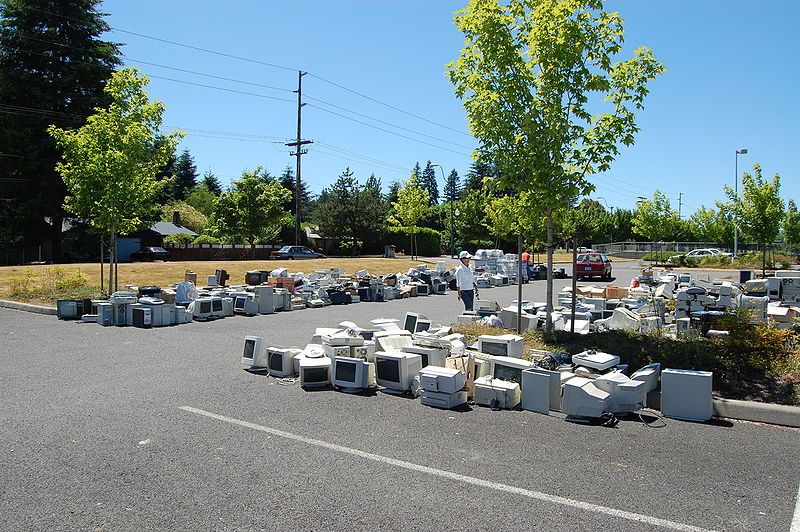 Certain countries trade in unprocessed recyclates. Some have complained
that the ultimate fate of recyclates sold to another country is unknown
and they may end up in landfill instead of reprocessed. According to one
report, in America, 50-80% of computers destined for recycling are
actually not recycled.19 However, Pieter van Beukering, an
economist specialising in waste imports of China and India, believes
that it is unlikely that bought materials would merely be dumped in
landfill: he also claims that the import of recyclates allows for
large-scale reprocessing, improving both the fiscal and environmental
return through economies of scale. There are reports of illegal-waste
imports to China being dismantled and recycled solely for monetary gain,
without consideration for workers' health or environmental damage.
Though the Chinese government has banned these practices, it has not
been able to eradicate them completely, nor estimate the amount of
illegal recycling still occurring.
Certain countries trade in unprocessed recyclates. Some have complained
that the ultimate fate of recyclates sold to another country is unknown
and they may end up in landfill instead of reprocessed. According to one
report, in America, 50-80% of computers destined for recycling are
actually not recycled.19 However, Pieter van Beukering, an
economist specialising in waste imports of China and India, believes
that it is unlikely that bought materials would merely be dumped in
landfill: he also claims that the import of recyclates allows for
large-scale reprocessing, improving both the fiscal and environmental
return through economies of scale. There are reports of illegal-waste
imports to China being dismantled and recycled solely for monetary gain,
without consideration for workers' health or environmental damage.
Though the Chinese government has banned these practices, it has not
been able to eradicate them completely, nor estimate the amount of
illegal recycling still occurring.
Certain regions have difficulty using or exporting as much of a material as they recycle. This problem is most prevalent with glass: both Britain and the US import large quantities of wine bottled in green glass. Though much of this glass is sent to be recycled, outside the American Midwest there is not enough wine production to use all of the reprocessed material. The extra must be downcycled into building materials or re-inserted into the regular waste stream.
Similarly, the northwestern United States has difficultly finding markets for recycled newspaper, given the large number of pulp mills in the region as well as the proximity to Asian markets. In other areas of the US, however, demand for used newsprint has seen wide fluctuation.
In some US states, a program called RecycleBank pays people with coupons to recycle, receiving money from local municipalities for the reduction in landfill space which must be purchased. It uses a single stream process in which all material is automatically sorted.20
Legislation
Supply
In order for a recycling program to work, having a large, stable supply of recyclable material is crucial. Three legislative options have been used to create such a supply: mandatory recycling collection, container deposit legislation, and refuse bans. Mandatory collection laws set recycling targets for cities to aim for, usually in the form that a certain percentage of a material must be diverted from the city's waste stream by a target date. The city is then responsible for working to meet this target.
Container deposit legislation involves offering a refund for the return of certain containers, typically glass, plastic, and metal. When a product in such a container is purchased, a small surcharge is added to the price. This surcharge can be reclaimed by the consumer if the container is returned to a collection point. These programs have been very successful, often resulting in an 80% recycling rate. Despite such good results, the shift in collection costs from local government to industry and consumers has created strong opposition to the creation of such programs in some areas.
A third method of increase supply of recyclates is to ban the disposal of certain materials as waste, often including used oil, old batteries, tires and garden waste. One aim of this method is to create a viable economy for proper disposal of banned products. Care must be taken that enough of these recycling services exist, or such bans simply lead to increased illegal dumping.
Government-mandated demand
Legislation has also been used to increase and maintain a demand for recycled materials. Four methods of such legislation exist: minimum recycled content mandates, utilisation rates, procurement policies, recycled product labelling.
Both minimum recycled content mandates and utilisation rates increase demand directly by forcing manufacturers to include recycling in their operations. Content mandates specify that a certain percentage of a new product must consist of recycled material. Utilisation rates are a more flexible option: industries are permitted to meet the recycling targets at any point of their operation or even contract recycling out in exchange for tradeable credits. Opponents to both of these methods point to the large increase in reporting requirements they impose, and claim that they rob industry of necessary flexibility.
Governments have used their own purchasing power to increase recycling demand through what are called "procurement policies". These policies are either "set-asides", which earmark a certain amount of spending solely towards recycled products, or "price preference" programs which provide a larger budget when recycled items are purchased. Additional regulations can target specific cases: in the US, for example, the Environmental Protection Agency mandates the purchase of oil, paper, tires and building insulation from recycled or re-refined sources whenever possible.
The final government regulation towards increased demand is recycled product labeling. When producers are required to label their packaging with amount of recycled material in the product (including the packaging), consumers are better able to make educated choices. Consumers with sufficient buying power can then choose more environmentally conscious options, prompt producers to increase the amount of recycled material in their products, and indirectly increase demand. Standardised recycling labelling can also have a positive effect on supply of recyclates if the labelling includes information on how and where the product can be recycled.
Process
Collection
A number of different systems have been implemented to collect recyclates from the general waste stream. These systems tend to lie along the spectrum of trade-off between public convenience and government ease and expense. The three main categories of collection are "drop-off centres", "buy-back centres" and "curbside collection".
Drop-off centres require the waste producer carry the recyclates to a central location, either an installed or mobile collection station or the reprocessing plant itself. They are the easiest type of collection to establish, but suffer from low and unpredictable throughput. Buy-back centres differ in that the cleaned recyclates are purchased, thus providing a clear incentive for use and creating a stable supply. The post-processed material can then be sold on, hopefully creating a profit. Unfortunately government subsidies are necessary to make buy-back centres a viable enterprise, as according to the United States Nation Solid Wastes Management Association it costs on average US$50 to process a ton of material, which can only be resold for US$30.
Curbside collection
Curbside collection encompasses many subtly different systems, which differ mostly on where in the process the recyclates are sorted and cleaned. The main categories are mixed waste collection, commingled recyclables and source separation. A waste collection vehicle generally picks up the waste.
At one end of the spectrum is mixed waste collection, in which all recyclates are collected mixed in with the rest of the waste, and the desired material is then sorted out and cleaned at a central sorting facility. This results in a large amount of recyclable waste, paper especially, being too soiled to reprocess, but has advantages as well: the city need not pay for a separate collection of recyclates and no public education is needed. Any changes to which materials are recyclable is easy to accommodate as all sorting happens in a central location.
In a Commingled or single-stream system, all recyclables for collection are mixed but kept separate from other waste. This greatly reduces the need for post-collection cleaning but does require public education on what materials are recyclable.
Source separation is the other extreme, where each material is cleaned and sorted prior to collection. This method requires the least post-collection sorting and produces the purest recyclates, but incurs additional operating costs for collection of each separate material. An extensive public education program is also required, which must be successful if recyclate contamination is to be avoided.
Source separation used to be the preferred method due to the high sorting costs incurred by commingled collection. Advances in sorting technology (see sorting below), however, have lowered this overhead substantially—many areas which had developed source separation programs have since switched to comingled collection.
Sorting
Once commingled recyclates are collected and delivered to a central collection facility, the different types of materials must be sorted. This is done in a series of stages, many of which involve automated processes such that a truck-load of material can be fully sorted in less than an hour. Some plants can now sort the materials automatically, known as Single Stream. A 30% increase in recycling rates has been seen in the areas where these plants exist.21
Initially, the commingled recyclates are removed from the collection vehicle and placed on a conveyor belt spread out in a single layer. Large pieces of cardboard and plastic bags are removed by hand at this stage, as they can cause later machinery to jam.
Next, automated machinery separates the recyclates by weight, splitting lighter paper and plastic from heavier glass and metal. Cardboard is removed from the mixed paper and the most common types of plastic (PET and HDPE) are collected. This separation is usually done by hand, but has become automated in some sorting centres: a spectroscopic scanner is used to differentiate between different types of paper and plastic based on the absorbed wavelengths, and subsequently divert each material into the proper collection channel.
Strong magnets are used to separate out ferrous metals (tin-plated or steel cans), while non-ferrous metals are ejected by magnetic eddy currents. A rotating magnetic field induces an electric current around the aluminum cans, which in turn creates a magnetic eddy current inside the cans. This magnetic eddy current is repulsed by the large magnetic field, and the cans are ejected from the rest of the recyclate stream.
Finally, glass must be sorted by hand based on its color: brown, amber, green or clear.
Common recyclables
Many different materials can be recycled but each type requires a different technique.
Aggregates and concrete
Concrete aggregate collected from demolition sites is put through a crushing machine, often along with asphalt, bricks, dirt, and rocks. Smaller pieces of concrete are used as gravel for new construction projects. Crushed recycled concrete can also be used as the dry aggregate for brand new concrete if it is free of contaminants. This reduces the need for other rocks to be dug up, which in turn saves trees and habitats.
Batteries
The large variation in size and type of batteries makes their recycling extremely difficult: they must first be sorted into similar kinds and each kind requires an individual recycling process. Additionally, older batteries contain mercury and cadmium, harmful materials which must be handled with care. Because of their potential environmental damage, proper disposal of used batteries is required by law in many areas. Unfortunately, this mandate has been difficult to enforce.
Lead-acid batteries, like those used in automobiles, are relatively easy to recycle and many regions have legislation requiring vendors to accept used products. In the United States, the recycling rate is 90%, with new batteries containing up to 80% recycled material.
Biodegradable waste
Kitchen, garden and other green waste can be recycled into useful material by composting. This process allows natural aerobic bacteria to break down the waste into fertile topsoil. Much composting is done on a household scale, but municipal green-waste collection programs also exist. These programs can supplement their funding by selling the topsoil produced.
Clothing
Recycling clothes via consignment or swapping has become increasingly popular. In a clothing swap, a group of people gather at a venue to exchange clothes amongst each other. In organizations like Clothing Swap, Inc., unclaimed clothing is donated to a local charity.
Electronics disassembly and reclamation
The direct disposal of electrical equipment—such as old computers and mobile phones—is banned in many areas due to the toxic contents of certain components. The recycling process works by mechanically separating the metals, plastics and circuit boards contained in the appliance. When this is done on a large scale at an electronic waste recycling plant, component recovery can be achieved in a cost-effective manner.
Ferrous metals
Iron and steel are the world's most recycled materials, and among the easiest materials to reprocess, as they can be separated magnetically from the waste stream. Recycling is via a steelworks: scrap is either remelted in an electric arc furnace (90-100% scrap), or used as part of the charge in a Basic Oxygen Furnace (around 25% scrap). Any grade of steel can be recycled to top quality new metal, with no 'downgrading' from prime to lower quality materials as steel is recycled repeatedly. 42% of crude steel produced is recycled material.
Non-ferrous metals
Aluminum is one of the most efficient and widely-recycled materials.2223 Aluminum is shredded and grounded into small pieces or crushed into bales. These pieces or bales are melted in an aluminum smelter to produce molten aluminum. By this stage the recycled aluminum is indistinguishable from virgin aluminum and further processing is identical for both. This process does not produce any change in the metal, so aluminum can be recycled indefinitely.
Recycling aluminum saves 95% of the energy cost of processing new aluminum. This is because the temperature necessary for melting recycled, nearly pure, aluminum is 600 °C, while to extract mined aluminum from its ore requires 900 °C. To reach this higher temperature, much more energy is needed, leading to the high environmental benefits of aluminum recycling.
Glass
Glass bottles and jars are gathered by a curbside collection truck and bottle banks, where the glass may be sorted into color categories. The collected glass cullet is taken to a glass recycling plant where it is monitored for purity and contaminants are removed. The cullet is crushed and added to a raw material mix in a melting furnace. It is then mechanically blown or molded into new jars or bottles. Glass cullet is also used in the construction industry for aggregate and glassphalt. Glassphalt is a road-laying material which comprises around 30% recycled glass. Glass can be recycled indefinitely as its structure does not deteriorate when reprocessed.
Paper
Paper can be recycled by reducing it to pulp and combing it with pulp from newly harvested wood. As the recycling process causes the paper fibres to breakdown, each time paper is recycled its quality decreases. This means that either a higher percentage of new fibres must be added, or the paper downcycled into lower quality products. Any writing or colouration of the paper must first be removed by deinking, which also removes fillers, clays, and fiber fragments.
Almost all paper can be recycled today, but some types are harder to recycle than others. Papers coated with plastic or aluminum foil, and papers that are waxed, pasted, or gummed are usually not recycled because the process is too expensive. Gift wrap paper also cannot be recycled due to its already poor quality.
Sometimes recyclers ask for the removal of the glossy inserts from newspapers because they are a different type of paper. Glossy inserts have a heavy clay coating that some paper mills cannot accept. Most of the clay is removed from the recycled pulp as sludge which must be disposed of. If the coated paper is 20% by weight clay, then each ton of glossy paper produces more than 200 kg of sludge and less than 800 kg of fiber.
Plastic
Plastic recycling is the process of recovering scrap or waste plastics and reprocessing the material into useful products. Compared to glass or metallic materials, plastic poses unique challenges. Because of the massive number of types of plastic, they each carry a resin identification code, and must be sorted before they can be recycled. This can be costly; while metals can be sorted using electromagnets, no such 'easy sorting' capability exists for plastics. In addition to this, while labels do not need to be removed from bottles for recycling, lids are often made from a different kind of non-recyclable plastic.
Textiles
When considering textile recycling one must understand what the material consists of. Most textiles are composites of cotton (biodegradable material) and synthetic plastics. The textile's composition will affect its durability and method of recycling.
Workers sort and separate collected textiles into good quality clothing and shoes which can be reused or worn. There is a trend of moving these facilities from developed countries to developing countries either for charity or sold at a cheaper price. Many international organisations collect used textiles from developed countries as a donation to those third world countries. This recycling practise is encouraged because it helps to reduce unwanted waste while providing clothing to those in need. Damaged textiles are further sorted into grades to make industrial wiping cloths and for use in paper manufacture or material suitable for fibre reclamation and filling products. If textile reprocessors receive wet or soiled clothes however, these may still be disposed of in a landfill, as the washing and drying facilities are not present at sorting units.
Fibre reclamation mills sort textiles according to fibre type and colour. Colour sorting eliminates the need to re-dye the recycled textiles. The textiles are shredded into "shoddy" fibres and blended with other selected fibres, depending on the intended end use of the recycled yarn. The blended mixture is carded to clean and mix the fibres and spun ready for weaving or knitting. The fibres can also be compressed for mattress production. Textiles sent to the flocking industry are shredded to make filling material for car insulation, roofing felts, loudspeaker cones, panel linings and furniture padding.
Timber
Recycling timber has become popular due to its image as an environmentally friendly product, with consumers commonly believing that by purchasing recycled wood the demand for green timber will fall and ultimately benefit the environment. Greenpeace also view recycled timber as an environmentally friendly product, citing it as the most preferable timber source on their website. The arrival of recycled timber as a construction product has been important in both raising industry and consumer awareness towards deforestation and promoting timber mills to adopt more environmentally friendly practices.
Wood recycling is a subject which has in recent years taken an ever greater role in our lives. The problem, however, is that although many local authorities like the idea of recycling, they do not fully support it. One of the countless examples, which has been in the news is the concept of actually recycling wood which is growing in the cities. Namely, recycling timber, trees and other sources.24
Other Techniques
Several other materials are also commonly recycled, frequently at an industrial level.
Ship breaking is one example that has associated environmental, health, and safety risks for the area where the operation takes place; balancing all these considerations is an environmental justice problem.
Tire recycling is also common. Used tires can be added to asphalt for producing road surfaces or to make rubber mulch used on playgrounds for safety. They are also often used as the insulation and heat absorbing/releasing material in specially constructed homes known as earthships.
Sustainable design
Much of the difficulty inherent in recycling comes from the fact that most products are not designed with recycling in mind. The concept of sustainable design aims to solve this problem, and was first laid out in the book "Cradle to Cradle: Remaking the Way We Make Things" by architect William McDonough and chemist Michael Braungart. They suggest that every product (and all packaging they require) should have a complete "closed-loop" cycle mapped out for each component—a way in which every component will either return to the natural ecosystem through biodegradation or be recycled indefinitely.
As with environmental economics, care must be taken to ensure a complete view of the costs and benefits involved. For example, cardboard packaging for food products is more easily recycled than plastic, but is heavier to ship and may result in more waste from spoilage.
History
See article in Wikipedia on history of recycling.
Criticism
In a 1996 article in The New York Times, John Tierney claimed that government mandated recycling wastes more resources than it saves.25 Some highlights from the article:
- In cases where recycling truly does save resources, such as with large scraps of aluminum, this will be reflected in market prices, and voluntary recycling will take place. Thus, there is no need for the government to mandate it.
- Tree farmers plant more trees than they cut down.
- Government mandated recycling is more expensive than putting the garbage into landfills, which means that this recycling uses up more resources than it saves.
- Some small towns with landfills are happy to import garbage from other cities and states because it provides jobs and tax revenue.
- Today's modern landfills are much cleaner and safer, and much less likely to leak and pollute than the landfills of the past.
- Regarding the claim that the U.S. is running out of landfill space, Tierney wrote, "A. Clark Wiseman, an economist at Gonzaga University in Spokane, Wash., has calculated that if Americans keep generating garbage at current rates for 1,000 years, and if all their garbage is put in a landfill 100 yards deep, by the year 3000 this national garbage heap will fill a square piece of land 35 miles on each side. This doesn't seem a huge imposition in a country the size of America. The garbage would occupy only 5 percent of the area needed for the national array of solar panels proposed by environmentalists. The millennial landfill would fit on one-tenth of 1 percent of the range land now available for grazing in the continental United States. And if it still pains you to think of depriving posterity of that 35-mile square, remember that the loss will be only temporary. Eventually, like previous landfills, the mounds of trash will be covered with grass and become a minuscule addition to the nation's 150,000 square miles of parkland."
Tierney's article received a referenced critique from the Environmental Defense Fund, which noted that "the article relied heavily on quotes and information supplied by a group of consultants and think tanks that have strong ideological objections to recycling".
In 2003, the city of Santa Clarita, California was paying $28 per ton to put garbage into a landfill. The city then adopted a mandatory diaper recycling program that cost $1,800 per ton.26
In a 2007 article, Michael Munger, the Chair of Political Science at Duke University, wrote, "... if recycling is more expensive than using new materials, it can't possibly be efficient... There is a simple test for determining whether something is a resource... or just garbage... If someone will pay you for the item, it's a resource... But if you have to pay someone to take the item away... then the item is garbage."27
In a 2002 article for The Heartland Institute, Jerry Taylor, director of natural resource studies at the Cato Institute, wrote, "If it costs X to deliver newly manufactured plastic to the market, for example, but it costs 10X to deliver reused plastic to the market, we can conclude the resources required to recycle plastic are 10 times more scarce than the resources required to make plastic from scratch. And because recycling is supposed to be about the conservation of resources, mandating recycling under those circumstances will do more harm than good."28
In 2002, WNYC reported that 40% of the garbage that New York City residents separated for recycling actually ended up in landfills.29
See also
- Sustainability
636px-Recycle001.svg.png — Sigurdas
400px-Recycling bin bottlescans.jpg — Sigurdas
800px-Computer Recycling.JPG — Sigurdas
Recycling Guides
Edit on wikiHow can you recycle what you find or already have?
Use your imagination and expand it! (up-cycle clothes, fix abandoned bikes or furniture, arts out of rubbish, ...)
Styrofoam (Expanded Polystyrene)
If you ship anything or have anything shipped to you, chances are, you end up with a surplus of expanded polystyrene. Recycling it can be much more cost-efficient and beneficial for the environment, but some recyclers prefer expanded polystyrene to be run through an EPS Densifier, which melts the foam down to take up less room. Talk to your local waste experts about how they handle polystyrene. Mealworms can be used to consume polystyrene and make it biodegradable if you're truly dedicated.
Wood Pallets and Dunnage
Vinyl dunnage bags were designed to be reusable. As long as there’s no contamination, the most cost-effective option is to put them back on the truck as many times as possible. Wood boards, planks and pallets can also be reused until they break. And even then, as long as they’re free from nails and staples, wood items can be ground up for mulch.
White Goods
Appliances that contain Freon, like air conditioners, refrigerators and dehumidifiers can be recycled but are regulated in how they must be handled. Since the creation of the Clean Air Act, companies and individuals must find an EPA compliant recycler to remove Freon and document its removal. Failure to follow the EPA guidelines and provide proper documentation can result in your company being slapped with a fine. But once you have the Freon removed, metal and other materials in these appliances can be recycled and rebates can be earned. If you’re recycling white goods in bulk, you may even be able to create a revenue stream.
Mattresses
Not surprisingly, used mattresses are costly to haul and dispose of in a landfill. They are difficult to move and take up a lot of space. Businesses like hotels that often have to replace mattresses can save significantly on hauling costs and take advantage of landfill diversion rebates by recycling them for raw materials.
links
- http://www.greenusesforwaste.co.uk
- http://www.einfaelle-statt-abfaelle.de/
- https://www.wastedisposalsolutions.com/blog/Recycling-Hard-to-Recycle-Items
Precycling
Edit on wikiPrecycling is a form of avoiding recycling or reducing the amount or size of waste. Precycling involves a conscious effort to dispose of waste responsibly throughout its usable lifespan.
Some ideas:
- Crush cans before bagging
- Repurpose or repair broken and damaged goods
- Sort resources
- add more?
Planned obsolescence
Edit on wikiPlanned obsolescence (or built-in obsolescence) in industrial design is a policy of deliberately planning or designing a product with a limited useful life, so it will become obsolete or nonfunctional after a certain period. Planned obsolescence has potential benefits for a producer because to obtain continuing use of the product the consumer is under pressure to purchase again, whether from the same manufacturer (a replacement part or a newer model), or from a competitor which might also rely on planned obsolescence.
For an industry, planned obsolescence stimulates demand by encouraging purchasers to buy sooner if they still want a functioning product. Built-in obsolescence is used in many different products, from vehicles to light bulbs, from buildings to proprietary software. There is, however, the potential backlash of consumers who learn that the manufacturer invested money to make the product obsolete faster; such consumers might turn to a producer (if any exists) that offers a more durable alternative.
Planned obsolescence was first developed in the 1920s and 1930s when mass production had opened every minute aspect of the production process to exacting analysis.
Estimates of planned obsolescence can influence a company's decisions about product engineering. Therefore the company can use the least expensive components that satisfy product lifetime projections. Such decisions are part of a broader discipline known as value engineering.
The alternatives to inevitable consumption is a practice of dumpster diving (finding what is discarded) and reuse (fixing broken stuff).
Media on planned obsolescence
The light bulb conspiracy
Pyramids of Waste (2010, 53 minutes), also known as The light bulb conspiracy, is a documentary about how our economic system - based largely on consumerism - is really breaking our planet down.
Full movie in English can be watched here:
- <videoflash>6HnW6Mm5sUI</videoflash>
or
or in French here:
2 Minutes trailer:
See also:
Radio programmes
- 2 hours radio program on planned obsolescence and invented "needs" such as bottled water.
Culture and further guidance
Dumpster diving has its own arguments, stories, outreach, and identities. This final group gathers those perspectives and a last practical guide before the book turns to places.
Vegan
Edit on wiki Vegans eat plant-based food (+ mushrooms).
Among freegans and dumpster divers many are vegans. The word freegan actually comes from combining free and vegan.
- Defintion of Veganism:
-
Veganism is a way of living which seeks to exclude, as far as is possible and practicable, all forms of exploitation of, and cruelty to, animals for food, clothing or any other purpose.
Whilst the act of salvaging animal products is ethically vegan, it makes sense to distinguish the act of eating not-dietary vegan food as doing something freegan.
V for vegan relief frosted glass reedited.png — Sigurdas
Ollie
Edit on wikiBelgian dumpster diver and eco-activist nicknamed Ollie is known for being detained for a month for dumpster diving. He was arrested on 25th of February, 2009, for taking food out of a dumpster of AD Delhaize in Bruges. His trial evoked protests in Belgium against restrictions of taking discarded food ("Skipping is not a crime! Throwing food away is!")
This all started when a company in Belgium wanted to cut a forest down as part of their plans of expansion and building their new offices. The forest is (was?) occupied by activists fighting for the preservation of this forest. Their main source of food for activists during this occupation is (was?) nearby skips.
The story according to indymedia.be (3rd of March, 2009):
"...In the Bruges court of law this morning, around 10:30, a young man was convicted to 28 days of prison. Ollie was arrested on Thusday after he went through a dumpster on a terrain of Delhaize where he was looking for discarded food. He is being accused of theft and burglary. The fact that he does not want to show his ID is seen by the public prosecutor as arrogance against justice system. In addition, it has been noted that it is necessary to conduct a further investigation towards similar acts that are thought to be committed by the "gang".
Some small harassment in court has complicated "Ollie"'s situation: his lawyer was not given permission to speak for Ollie. (??)
Ollie will probably be transferred from the prison of Bruges to Ghent.
It is no coincidence that this accused young man is one of the eco-activists that have occupied the Lappersfort Forest for six months and are keeping it safe from deforestation and industry. Is it an intimidation against a group of young people who strive to save the forest? Is taking the trash in times of economical and ecological crisis truly a criminal thing these days?
How credible is a legal system when spoiled food as a waste can not be regarded as "res derelicta" (Latin term meaning "abandoned/discarded thing") or "res nullius" (a thing which has no owner)? Or moreover, as "res corruptae" (bad thing because of expired edibility day)? Or is Delheize so affected by the economic crisis that it still intends to profit from saving the content of his dumpsters?
...Searching for food in dumpsters is not a crime!"
Further information
- Some photos of a noise demo that was attended by 80 people at indymedia.be
- Article on indymedia.nl (in Dutch)
- Article in De Standaard (in Dutch)
- A similar case in 2011 (in Dutch)
Pamphlet
Edit on wikiOne way of improving the public relations between the dumpster diving community and the general populace is by setting a good example for your fellow hobbyists. One way of doing this is by authoring a pamphlet for dumpster divers to give to store owners or staff who lock their containers or don't allow their trash to be taken by divers. Such a pamphlet would give store owners/employees basic information on reasons why it is good to leave trash bins unlocked, and would also help to maintain a clean image for the community.
Feel free to discuss it below.
Opinions?
- "What I (and I am sure many with me, know about several and I am
not very active in any larger community) want is a pamphlet listing only
the reasons why a store owner should be happy that their waste is saving
people from starving and how they themselves should be proud for helping
save people from dying and by having dumpster divers that also separate
their plastic (among other things) save the planet, on top of doing what
they know is the right think to do. In my country there is also no risk
of repercussions to the owner (and and argument why they are only losing
an insignificant amount of money by lost revenue from 1% fewer buying
consumers should be made, one of several being that they won't have to
pay to have the container emptied as often, I am sure you know of
several better)"
- Stenemo, 6 October 2012
:* "I am a bit sceptical [sic] to this idea. Not only
trash has an economic value per se in some countries (for example,
biowaste can be used in biogas production), it also bears a moral idea
of sharing which can sound outrageous for store owners whose virtues are
often based on how profitable a thing is - this can sparkle a provoked
resistance from store owners, and that can take many different shapes,
like lobbying for regional legislation against dumpster diving, or
suggesting other stores to lock their bins and/or intensifying security.
Now, this is only my first reaction to it, possibly too pessimistic, but
I just wanted to spit it out."
- sigurdas, 00:29, 7 October 2012 (CEST)
Languages
English
What is dumpster diving?
'Dumpster diving' is the act of recovering previously unwanted goods from a dumpster in order to give them another use.
Who is dumpster diving?
We in the dumpster diving communities are healthy, hard-working people who, for many reasons, desire for precious resources to not be wasted. Whether it be for environmentalist, nationalist or hobbyist reasons, it is a worthwhile and beneficial activity taken up by people like you and me. We
Why should shops allow this?
The essence of why shops should allow dumpster divers to work without difficulty is summed up in the well-known adage: "One man's trash is another man's treasure." In a world where the demands of humanity are ever-increasing, and the waste generated by our growing population so too escalates, extra measures must be taken to alleviate the effect this issue is having on the world, both at the governmental and local level. It would be folly to discard resources that could be reused, and as the contenders of the planet we have a responsibility to make do with what we have. Is it that immoral to reuse what other people don't want? This is why allowing dumpster diving to continue should be allowed.
We understand that the idea of picking from the trash is seen as unattractive, unsanitary and just plain disgusting, and for very good reasons. For a long time, places where waste was disposed of were often hotbeds for pathogens such as deadly bacteria to thrive. However oftentimes dumpster divers work under the cover of night with proper protective equipment, out of courtesy for the shop owners.
How to handle trash in such a way that increases the ease of recovery?
... ''
Related links
- Is there such a pamphlet? I have found several that are aimed to encourage people to dumpster dive (which mostly are to extreme to be useful to give to any employee or to focused on the gain for the dumpster diver to be useful as a moral argument. --Stenemo 06 October 2012
-
Please add links for inspiration.
Translations
English is useful for a couple of countries but ideally we want some translations.
WikiHow
Edit on wikifrom Wikihow
Quick quiz: is dumpster diving A) a sport
B) a popular hobby for the frugal
C) an environmentally and socially conscious way of life
The answer is all of the above. As the name implies, dumpster diving (known as “skip diving" in many parts of the world) is the process of scavenging trash—not always dumpsters, however—for useful or valuable items. Believe it or not, though, dumpster diving is quickly approaching mainstream status even in affluent countries. Whether you’re looking to furnish your home, fill your fridge, or cash in on other people’s trash, this guide will teach you the ins and outs of dumpster diving.
Remember, one man's trash is another man's treasure!
Steps
- Know your local laws. In many jurisdictions trash is not considered private property, so dumpster divers cannot be charged with theft, however, some municipalities have ordinances prohibiting scavenging trash, most notably in the United Kingdom.Australian Law reflects a thinly disguised intollerance of the practice. Dumpster divers may run afoul of laws regarding trespassing, invasion of privacy,environmental,or even in some cases "Theft".In addition police in most states have "move On" powers that are often bought to bare on salvagers. Research the laws in your area or contact your local police department to inquire about the legality of diving practices.
- Prepare yourself mentally and adapt your methods to avoid practices you see as disgusting. If you're still put off by sifting through trash, consider scavenging only items placed with trash but not in rubbish bins, such as furniture and sometimes crates of food.
- Network with other divers. As you get into dumpster diving, you'll likely meet other divers, and many, but not all, will be friendly and helpful. Share tips and experiences and you'll probably get some good tips in return. Consider joining an online dumpster diving forum or a local club. Other divers can keep a look out for items that you want.
- Find the dumpsters in your area and keep track of when you find the best items and when the garbage collectors come. In residential areas, find out standard move-in and move-out dates.
- Plan your diving according to what you're looking for. If you're just looking for unexpected treasures, you can look pretty much anywhere, but if you want something like food, search behind grocery stores and bakeries. Most stores throw out food at the expiration date, though much of it is still good, only a little past its peak. Look for larger items like furniture or electronic items sitting next to trash cans. Look online at dumpster diving forums for tips on where to go in your area.
- Wear appropriate clothing. Wear protective gloves, long-sleeve shirts and pants to protect you from dirt and cuts. If you're going to actually enter a dumpster, wear sturdy fabrics such as denim, and cover as much of your body as possible. Protect your feet by wearing thick, fully-enclosed shoes or boots. Wear clothes that you don't care too much about.
- Equip yourself. At the very least carry a milk crate or stepping stool to help you see and access the contents of dumpsters and bring plastic bags to hold your treasures. Also be sure to bring a flashlight if you're diving at night. Remember that you don't have to dive right into a dumpster — bring along a long pole to poke around with or one with a grabbing apparatus on the end, and you may not need to venture in at all.
- Make sure no one is around and keep a look out. Dumpster diving is somewhat controversial, and divers are frequently confronted by shopkeepers or homeowners. While a confrontation is no big deal if handled properly, you should still try to avoid it. If you see people in the area, wait a while.
- Handle with care. Be very careful when handling trash or entering dumpsters. Broken glass and sharp objects can cut you, and you could be poked by a used needle. Protective clothing can somewhat help avoid these dangers, but you should always exercise caution when rummaging through bags of trash.
- Take only what you need and can realistically use. Take what you can use, but remember that there are a lot of dumpster divers, and someone may have a dire need for something that you'll just leave sitting in your garage.
- Clean up after yourself. If you've thrown garbage all around, pick it up and put it back into the dumpster. While you're at it, throw away other nearby trash that's on the ground. Leave the area as clean or cleaner than you found it — don't give dumpster diving a bad name.
- Clean items thoroughly. Cleaning is especially important with food. Check packaged items for holes and leaks and take special care to wash produce, preferably in a mild bleach and water solution. The food you buy in grocery stores is usually treated in this way anyway, so this isn't a drastic step.
- Clean yourself thoroughly. Take a good shower with soap to wash the dirt and germs off.
- Learn from your dumpster diving experiences and try to stay flexible as there are many unknowns when it comes to dumpster diving. Share what you've learned with others and help out those less experienced than you.
Tips
- Check out community Web sites for more free things. The free section of craigslist is a good resource if you live in a metropolitan area, and many communities have freecycle groups where people give away their unwanted treasures to keep them out of landfills. If you participate in one of these communities, remember to give as well as receive.
- If you live near a university when graduation rolls around the seniors have to move out fast and leave lots of stuff behind. Underclassmen will leave things behind as well but usually right before graduation. Some janitors are nice and allow you to paw through the bags of stuff they leave outside the dorms to be picked up.
- Dive with a friend; it's a lot more fun with company and safer, too. A friend can help you out if you become injured, can help defuse confrontations and keep look out.
- Empty your pockets and take off any jewelry before entering a dumpster so you don't lose it in the trash for another diver to find.
- If confronted by a business owner, resident, rubbish hauler, or police officer, be polite and explain what you are doing. Many times people will assume that you are illegally dumping trash and will not bother you if they understand that you are not. In any case, always be friendly and respectful, and try to understand the other person’s point of view: business owners who tell you to leave the premises, for example, may be concerned about their legal liability if you were to be injured.
- While diving, keep a few cardboard boxes around outside the dumpster in a little pile. If confronted, you can say you were searching for some boxes to help with a move. The employees are more likely to give you a better reaction than if you tell them you were looking for products they sell.
- Let it be known in your neighborhood that you find homes for discarded items. Many people can't be bothered to call a charity shop, but are all too happy to ask a neighbor to haul things away for them.
- When scavenging for food, look for freshly filled dumpsters rather than full dumpsters.
- Before vaulting into a dumpster, hit the side of the dumpster a few times to warn its inhabitants (i.e., possums, raccoons, rats, squirrels) of your impending scavenging. Watch out for possums as they will fight, and rats will run over the top of you to get away.
- A white butcher smock makes you look like a grocery store employee and you are seldom bothered by other dumpster divers or law enforcement when they see that smock.
- A cheap set of long-handled fireplace log tongs work wonderfully for retrieving items if you don't want to climb in. A miner's cap with a light or a trustworthy headlamp is better than a flashlight because it allows you to work two handed.
- If you don't like to get very dirty, you can try magazine dumpster diving. The magazine recycling boxes are usually very clean, and sometimes you can find some very good reading material in them if you don't want to buy a subscription to a magazine.
- If you are worried about safety, you can park your car in front of the dumpster to make it impossible to have it dumped. In some cases this is illegal, but if you are diving on a day close to trash pickup day, it could save your life.
Warnings
- Never try to access a dumpster or other trash that is fenced in or that has "no trespassing" signs posted nearby.
- Always wear moderately thick gloves so that you do not cut your hands or prick them with used needles.
- Never take documents containing personal information or use such information for illegal purposes.
- Do not escalate confrontations. If someone asks you to leave, do so, even if you know your activity to be perfectly legal.
- Do not enter a dumpster when garbage trucks are in the area; if a truck approaches, get out of the dumpster immediately.
- Beware of dumpster lids slamming down on you because of wind or gravity.
- Know how to tell when canned products have spoiled, they may contain botulism toxin which can be fatal.
- Consider keeping your tetanus, hep A/B immunizations up to date in case you get cut. Broken skin,or fluid contact situtions may not injure but they can be fatal.
- Never enter a dumpster that is equipped with a compactor.
- Dumpster diving is illegal in the United Kingdom and is classed as theft. Property which is put in a bin remains the property of the person who owned it until the council or other body collect it. After it has been collected, it becomes the property of that body. People have been prosecuted over this. If you wish to do this you should seek the permission of the legal owner to take any item.Australian law is not a great deal better,but to seek permission is usually to be refused, for fear the owner has left themselves open to injury law suit.
- For open-topped industrial dumpsters, do not lean over the edges of the bin - you can crack ribs this way or get a hernia.
- Do not collect beds which can contain bedbugs that are very difficult to get rid of.
- Do not actually dive into the dumpster; it is a hypothetical term. You should bring a ladder and slowly ease into the dumpster.
- Do not smoke or use open flame as a light source while dumpster diving as even just a dropped cigarette or ash can smolder, catch fire and engulf a dumpster very quickly. You have no idea what type of flamable material may be in or around a dumpster and these types of fires are very hard to put out.
- Do not take any sort of melons from the dumpster. Melons can absorb liquids which rot the melon from inside out. If eaten it can be fatal.
Things you'll need
- Comfortable, sturdy clothes you don't mind getting dirty
- Cheap pants with leather or denim patches sewn over the knees for added protection
- Strong, fully-enclosed shoes or boots
- Gloves
- Milk crate or stool
- Plastic bags
- A stick or grabbing device for poking about
- Flashlight or headlamp
- First aid kit
- Helmet
- Hand Sanitizer
- Tweezers
- Metal Fork
Sources and citations
- [http://www.dumpsterworld.com/ The largest internet forum of dumpster diving information.
- A Shout Out To Eating Garbage: On Dumpster Diving A CBC National News story (4 minute video) and personal reflections on dumpster diving.
- FrugalVillage.com An introduction to dumpster diving
- Freecycle.org List items to give away or items you need—search for your local group
- www.freegan.info/ Freegan.info Anti-capitalist lifestyle movement with a strong emphasis on dumpster diving.
- trashwiki.org - a wiki about dumpster diving around the world.
- [http://www.dumpstern.de/ German information Page about dumpster diving.
http://groups.yahoo.com/group/Ohiodumpsterdivers/more photos then other sites
Part II — Places
What is thrown away, and what happens if you take it, changes at borders. These country chapters are culture and legality in outline, not a promise about tonight’s supermarket.
City chapters sit under the country they belong to, capital and main cities first, where Trashwiki actually has them. Named dumpsters and map pins stay on dumpstermap.org. Use the live map when you are actually going.
The order is geographic, not A–Z: Europe first, then North America, the rest of the Americas, Asia, Africa, Oceania.
Europe
West to east: the British Isles, France and the Low Countries, the German-speaking lands, the Nordics, Iberia, Italy, then central Europe, the Baltics, the Balkans, and the east.
United Kingdom
Edit on wikiUnited Kingdom is one of the greatest countries to dumpster dive.
Places
For more detailed info on each area chose a specific region:
- England
- Northern Ireland
- Scotland
- Wales
Dumpster diving
while it is quite possible and easy in many cities to live completely out of the bins (e.g. London), skipping on motorway service stations can be difficult. There are cameras everywhere, and security can be fast.
Legal status
While dumpster diving in England and Wales may qualify as theft within the Theft Act 1968 or as common-law theft in Scotland there is very little enforcement in practice.
Common tips
- For free drinks (hot chocolate, tea, coffee) find a reasonably big HSBC branch. There is usually a machine where you can get free drinks while waiting for assistance. Works throughout the country.
- add more?
Useful UK websites
- Diggers and Dreamers - The guide to communal living in Britain
- The Permaculture Association
- London Permaculture - A place to keep abreast of permaculture projects in London
London
Edit on wikiNamed dumpsters and map pins go stale. For current spots use dumpstermap.org and the live Trashwiki page. This chapter is culture, legality, and general practice — not a dumpster list.
{width=“250”} London, the capital of England, UK, is a wonderful city for its free food.
There are also two counties, City of London and Greater London, which both constitute what we simply know as London. This page unites all administrative units related to London.
www.dumpstermap.com has several things added for London. It seems to be a good way to see what is in your area since it's such a huge city. Maybe someone could add things to the map and add things from the map to the list as well?
Markets
At all street markets, as with anywhere else, it is easy to gather free food when they're clearing up. However, the main market in London for dumpster diving is the New Covent Garden market, in Nine Elms, near Vauxhall. You can go any time between 10pm and 10am. In the last year, however, security guards in vans have made it much harder. They chase anyone collecting food and ask them to leave. They hand you a leaflet warning that it is a criminal offence to take the food. This has been enough to scare many people from collecting at the market. But some people may still manage it, if they are fast, or go at a time when the guards aren't present.
Give-away shops
The Food Not Bombs collective in Whitechapel often hold freeshops too, to give away free clothes, etc. to the community.
InSpiral in Camden usually give away food at the end of the evening if you ask (it's amazing and all either raw/organic/vegan)
Supermarkets
Supermarkets are often difficult to dumpster dive at. Sometimes you can get very lucky with Boots, Marks & Spencer, Waitrose, Sainsburies and Tescos. But most of the time their rubbish is inaccessible, hidden away in a loading bay you can never access. Only a few of their stores place the rubbish in dumpsters on the street; but when you find a good one, it can feed you and your friends for months.
Bakeries and sandwich stores
Paul's is a fantastic bakery, found in various places over London (check their website for exact addresses), which throws out the most luxurious of breads, baguettes and cakes in bin bags outside the shop after closing time.
Starbucks, Pret a Manger, Costa and especially Eat are always reliable for their wasting of good food, but make sure that you beat the binmen to the food! The best time for Eat is around 7pm (sometimes earlier, depending on when it closes), and around 9pm-10pm for Starbucks. The best areas in central London for coffee shop finds are Mayfair, Holborn, and Goodge Street.
The sandwich chain Eat throw out all of their remaining food at the end of the day, and except for a few of them who give to charity, it's always a very reliable source of yummy salads/sandwiches/cookies. Lately some of their branches have started destroying their food before they throw it in the bags, meaning the baguettes are partly out of their wrappers, the salads are opened up. Try the branches of Eat at Fenchurch Street, Liverpool Street, and Great Eastern Street.
Common skipping sites by location
Sub-regions used here are ones adopted by the EU and used by 'London's Poverty Profile' (.org.uk)
Outer East and North East
Enfield
- Tesco opposite Enfield Chase station is a good one for skipping. (Last checked: autumn 2010)
- add a place?
Waltham Forest
- add a place?
Redbridge
- add a place?
Havering
- add a place?
Barking and Dagenham
- add a place?
Bexley
- There is a Costcutter next to Abbey Wood station which is good for skipping but you have to climb over a fence (at night). WARNING: it is a trespassing violation, so do it on your own risk! (Last checked: autumn 2010)
- add a place?
Greenwich
- The best place to go for freebies in Greenwich (apart from the market stalls if you want to sample some hot food) is behind the Sainsburys and Co-op on Greenwich High Road. (Last checked: November 2010)
- add a place?
Inner East and South
Haringey
- Somerfield opposite Bruce Grove station is a good bet in this area. Find the bins round the back off Stoneleigh Road. (Last checked: autumn 2010)
- add a place?
Islington
- The Iceland and the Co-op at the Texaco garage are good places to go. Both are on Caledonian Road. (Last checked: August/September 2012)
- Iceland supermarket on Junction Road, Archway. Employees might be laid back and tolerant if you are nice. Possible to dive both during the day and night (take a torch for night diving though). (Last checked: Dec. 2011)
- Tesco Express on St. Johns St., Clerkenwell. (Last checked: July 2012)
- add a place?
Hackney
- Iceland seems to be the best place to try in Hackney, as the one on Mare Street near Graham Road and Sylvester Road can be skipped during the day as long as staff aren't around. (Last checked: September 2012)
- It also might be possible to check when the bins are out on the new Sainsburys where Dalston Lane becomes Lower Clapton Road opposite the St. John-at-Hackney Church.
- add a place?
Tower Hamlets
- Whitechapel market is great for fruit and veg. Go around 5-6pm for best results. (Last checked: July 2010)
- Brick Lane market is also good, with many international food stands. On Sundays especially but also Saturdays they have discounts starting from about 4pm.
- Sometimes you can check the Iceland on Bethnal Green Road when the back gates are open. (Last checked: September 2012)
- add a place?
Newham
- Co-op in Forest Gate (just down from the station with the same name and find the bins round the corner passed the Earlham Grove Community Centre) is the only place known to regular divers in Newham. (Be careful at this Co-op though, they've been known to intimidate skippers by filing people on camera phones during day-time skipping!) (Last checked: November 2011)
- add a place?
Lambeth
- The Co-op at the Texaco garage on the left side of Wandsworth Road as you head east towards Wandsworth Road station can be skipped at any time for usual Co-op results. (Last checked: autumn 2010)
- add a place?
Lewisham
- There's a bin behind the smaller Pay Less opposite a car dealers in Deptford. (Last checked: September 2010)
- Also, on Brockley Road, near Crofton Park station, there is Co-op, Londis and a Costcutter next to The Brockley Jack pub (that needs two people to skip as the gates need to be held open), all close together. (Last checked: September 2010)
- add a place?
Outer South
Bromley
- add a place?
Croydon
- One good place in Croydon is the Co-op at the roundabout where St. James Road becomes Lower Addiscombe Road and is joined by Cherry Orchard Road. It's best to go at night though because you have to climb over the gate which holds the bins round the back. It is however a really easy climb. (Last checked: December 2011)
- add a place?
Sutton
- Skipping on the corner just down the road from Carshalton Beeches station. (Last checked: autumn 2010)
- add a place?
Merton
- add a place?
Kingston Upon Thames
Unfortunately, Kingston is so overrun with chain shops that they all seem to be connected with some underground waste disposal scheme hidden in the depths of the carparks, however, on a good day there are still a few places there. There are two markets still run amongst the commercial madness:
- Monday market (next to the leisure centre) that mostly sells clothes but there is some gleaning of fruit to be done around lunchtime when the stalls pack up.
- Food market, held daily in the main market square. These pack up around 4 in winter and five or half five in summer, a lot of fruit and veg is left on the floor and the rest is in big dumpsters around the back of the stalls. Sometimes there is cheese too. Get there quick though, because this is the fist place the rubbish collectors go on their rounds! (Last checked: Dec.2011)
- add a place?
Outer West and North West
Richmond Upon Thames
- add a place?
Hounslow
- The Marks and Spencers at BP petrol station on Bath Road by the roundabout where Great West Road (A4) meets it has dumpsters behind a small fenced area. Would be best to skip here at night. See folks at Hounslow Community Gardens for more info. WARNING: it is a trespassing violation, so do it on your own risk! (Last checked: September 2010)
- Or for an easier skip with friendly staff, visit the Tesco on Bath Road:
Address: 780 Bath Rd, Hounslow, Greater London TW5 9SL Location of the bins: Round the back in the car park, always the ones closest to the back door but never had any problem with the staff here! (Last checked: July 2012)
- add a place?
Ealing
- The Tesco at the Petrol Station on Uxbridge Road near the end of Twyford Avenue is great for the usual gack and random Tesco finds! (Last checked: September 2010)
- add a place?
Hillingdon
- Co-op at Harlington Corner is the most skipped of any store in Hillingdon. There's also the potential to skip the Harlington Hospice skip round the corner if you're there at night. And if you've got time to spare you could always walk down Sipson Lane and call in at Grow Heathrow where they are freegan-friendly and will be happy to chat about skipping in Hillingdon over a cup of tea! (Last checked: October 2012)
- There are now very few skippable places in the West Drayton area. Iceland recently stopped throwing out their food waste, and Tesco lock their bins away. It's occasionally possible to skip a small amount of food from Costa on Yiewsley High Street, but it's hit and miss as the bins are sometimes locked. Sainsburys on Porters Way is still pretty reliable.
- add a place?
Harrow
- add a place?
Brent
- add a place?
Barnet
- Skipping in Barnet resulted in good finds along High Barnet High Street - particularly from dumpsters behind Iceland and Sainsburys. (Last checked: Autumn 2011)
- add a place?
Cricklewood
- The Co-op in Cricklewood Lane is a good bet in this area. Find the bins in the narrow street next to the store. (Last checked: December 2010)
- add a place?
Inner North & West
Wandsworth
- The New Covent Garden Market is in this Borough (see info above).
- In Tooting it is possible to skip from the Co-op on Mitcham Road. The bins are in the car park and have been skipped successfully at day and night. (Last checked: May 2011)
- add a place?
Chiswick
- Marks and Spencer on Chiswick High road. Sundays are good. (Last checked:?)
- As Nature Intended, next to Chiswick Police Station. On Sundays they close slightly later (around 8.30). (Last checked:?)
- Bins (check all of them) behind the fruit and veg stall opposite the methodist church at the T junction between Dukes Avenue and Chiswick High Road. These also have pastries from the nearby bakery. (Last checked:?)
- Any of the cafes. Check Turnham Green too. Sometimes Mortimer and Bennet have a couple of bags of bread and things on Sundays. (Last checked:?)
- add a place?
Hammersmith
- Marks and Spencer on Kings Street. Beware of the blue dye though. (Last checked:?)
- add a place?
Kensington and Chelsea
- Starbucks at 186 Earl's Court Road (SW5 9QG) has been known to leave cakes and other gack in the doorway towards closing time, but sometimes this is mixed in with other waste and needs to be sorted carefully! (Last checked: November 2011)
- Tesco at 146-158 Kensington High Street (W8 7RL) has access to the bins off Phillimore Walk. There is a bakery there also but some bins are random and might be locked. (Last checked: November 2011)
- add a place?
Camden
- Tesco on Goodge St near Tottenham Court Road (address: 10-16 Goodge St, London W1T 2QB) seem to put their bins out on a Friday morning. Location of the bins: round the back on Whitfield Street. (Last checked: November 2010)
- The main Co-op in Camden is good if you don't mind climbing the metal fence around it. (Going at night and not making too much noise would be a good idea as it can be a busy street during the day.) (Last checked: November 2010)
- Many stalls, especially ones doing crepes, were happy to give away some of what they didnt sell at the end of a recent night out at Camden Market. (Last checked: September 2010)
- add a place?
City
- Look out for sandwich shops, especially Pret, Eat and sushi shops that often leave bags outside.
- Waitrose near Nesham st.. Beware of the rotating spikes bar on the other side of the bike rack, it is possible to climb down the gate instead. People have been caught by security guards before, be quiet and look out for traffic and passers by. (Last checked: March 2012)
- add a place?
Edinburgh
Edit on wikiNamed dumpsters and map pins go stale. For current spots use dumpstermap.org and the live Trashwiki page. This chapter is culture, legality, and general practice — not a dumpster list.
Edinburgh is a city in Scotland.
Freeshops
Edinburgh has a fabulous permanent and high-turnover freeshop in the Forest Cafe1. The Forest as it's known is an all around good source of interesting people, information, and all things hippy, so if you're in Edinburgh start at the Forest Cafe. The Forest is also a popular last stop for couchsurfers in the city who want to get rid of things before moving on.
There is another Freeshop at the Shrub Co-op. The Shrub is a not-for-profit, volunteer-run co-operative, which aims to reduce waste and educate people about recycling, up-cycling, etc. It's a kind of shop where you can swap almost anything. It's run by really friendly people. They also have the Wee Spoke Hub bike workshop on Tuesday evenings where you can learn to repair your bike.
There is a swap shop located across town at St Margaret’s House aka Arts Complex aka Edinburgh Palette. Buzz to get in, and through the doors on the left of the lobby and slightly along the corridor on the left.
Facebook Share Groups
- The Meadows Share - A community board for those within walking distance of the Meadows to share resources, tools, skills, etc.
- Edinburgh Food Sharers - A student run initiative to reduce food waste, connected with the student housing cooperative.
- Roslin Share including Bilston and Rosewell
Climate Camp
Freegans were be at the Climate Camp from 20th to 25th August 2010 in Edinburgh. A workshop was held and free smoothies made from finds were distributed like last the last camp in London.
See http://climatecamp.org.uk more info.
Related Initiatives
- 2 - The SHRUB - swap and reuse HUB. Great place for buying used and unwanted things or getting bike repair lessons on a Tuesday evening.
See also
- https://wiki.thingsandstuff.org/Edinburgh - listing for city info and resources
Manchester
Edit on wikiNamed dumpsters and map pins go stale. For current spots use dumpstermap.org and the live Trashwiki page. This chapter is culture, legality, and general practice — not a dumpster list.
Manchester is a city in Greater Manchester, North West England.
Good places to do that
- Tesco. Address: 260 Wilmslow Rd, Manchester M14 6JR. Location of the bins: Round the back in the car park area (the gate is usually open). (Last checked: April 2012)
- Tesco Stretford (back of the mall).
- Aldi and Iceland. Hulme. Location of the bins: Round the back in the staff car park area (the gate is usually open). (Last checked: May 2011)
- Co-op (in most city areas): Majority leave gates unlocked, food is bagged in "not fit for consumtion". (Last checked: May 2011)
- Morrisons. On Grafton Street (opposite the Oxfam shop on Oxford Rd, near UoM and MRI). Occasional pickings. (Last checked: January 2012)
- add more?
Bad places
- Crownpoint retail, Denton. M&S have a metal container, Tesco store inside, small bag of sandwhiches from Boots and police called (Last checked: June 2011)
Ireland
Edit on wikiIreland is a country in Europe.
Cities and towns
- Cork
- Dublin
- Drogheda
- add more?
Dublin
Edit on wikiNamed dumpsters and map pins go stale. For current spots use dumpstermap.org and the live Trashwiki page. This chapter is culture, legality, and general practice — not a dumpster list.
Dublin is the capital city of Ireland.
Skipping
Contrary to popular belief, Dublin is actually pretty good for skipping.
Aldi
Coolock
The Aldi in Coolock is a good place to go skipping. It closes at 9pm, and you should go after it's closed (wait until at least 10pm as there could still be people working there). They have about six green and orange wheelie bins, located behind the shopping centre, and you can really easily slip under the fence around the side to get to them. Don't go on a Friday though, as the bins will be empty then. Tuesdays and Thursdays are known to be good.
The bins here are really good; there's tonnes of bread, fruit, veg and all sorts of animal products too, if that's what you're into. There is also occasionally very useful non-food items in these bins, things like dishwasher tablets. It's also just up the road from the Tesco in Artane; it's a good idea to hit them both if you're going skipping in this area.
Vegetable Wholsalers
Dublin City Council Wholesale Fruit Vegetable And Flower Market is based in Mary's Ln, Inns Quay, Dublin, Ireland. Its walking distance to the city centre, and has a long history. Walking around the market is the best way to ask vendors for those fruits and vegtables deemed unfir for resale to shops, rsturants etc. In many cases, the unused material is binned openly or often left on the road in open boxes. I found quite alot on Arran Street East during 2017.
Street Name Pic of Fruit on Road


Food Markets
Moore Street
Mary Street
Lidl
Finglas
Glasnevin
Marks & Spencer
Grafton Street
There are usually four black dumpsters just off of Duke Street, belonging to the Marks & Spencer on Grafton Street. They're particularly good for salads, flowers and gack, but there's usually a bit of everything there.
The bins are almost always unlocked, but they take them in when they close, which is at 9pm most days, but 7pm on a Sunday. They do sometimes use their infamous blue food dye, but very irregularly. It is also useless, as their food is so overpackaged that all it does is stain the packaging.
Some of the staff are also incredibly hostile (although others turn a blind eye), and their security guards have chased innocent freegans down Grafton Street a couple of times. You might avoid being seen if you enter and exit through the back entrance of the Hodges Figgis bookstore on Dawson Street, although they close at 6pm and they close their back entrance at around 5pm, as far as it is known. (Last checked: Jan.2011)
Jervis Street Shopping Centre
These bins are unfortunately behind a massive gate, which doesn't seem particularly easy to climb.
Personal experiences:
- "One time, the gate was open because heavy snowfall made it impossible to shut, and there was plenty of good stuff in these bins. Lots of gack, similar to Grafton Street. There's about a dozen dumpsters there, so I suspect that some of them might be used by the Tesco, or the other shops in the shopping centre. I didn't have too much space for food with me, so I got filled up quite quickly and didn't check what the other bins were." - December 2010
Nolan's
Clontarf
Nolan's is an independent supermarket, the one in Clontarf being the only one. To get to its bins, go north on Vernon Avenue, past Nolan's and turn right onto Kincora Road. There should be a small lane on your right before the first house. Go down that lane until you're behind the first house, and there should be a big plank of wood creating a "ramp" that takes you over the wall and into the car park of Nolan's (when coming back, you can use the lamp post on the other side to help you climb back over the wall). Don't be alarmed by the lights that come on, those are automatic. Turn left after you go over the wall and you should get to a smaller, metal gate which is very easily climbable, on the other side of which are the bins. Just be careful not to rattle it too much as it can be quite noisy. There are twenty or thirty bins here, and most of them will probably be empty, so check all of them. Obviously, this is something you do after the place closes.
Its bins are decent for fruit and veg if you live in the area, particularly on Saturdays. Tesco in Artane and Aldi in Coolock have much better bins though are less than a 20 minute cycle away if you have a bike.
Superquinn
Ranelagh
Knocklyon
Supervalu
Ballymun
Mount Merrion
Tesco
Artane Castle
Fairview
Upper Baggot Street
Universities
Trinity College
Seomra Spraoi
Many of Dublin's freegans hang out in Seomra Spraoi, an autonomous social centre near Mountjoy Square in the city centre. If you come to Seomra on a Wednesday evening (food is served at 7:30), there's a vegan café there and you should be able to meet them and hopefully arrange to go skipping with them sometime.
You may also be interested in the bike workshop at Seomra, which is also open on Wednesday evenings. It is well equipped with tools and expertise and it's a great way to learn how to look after your own bike. In particular, it's handy for fixing up any abandoned bicycles you might happen to come across.
Seomra also has a decently-sized freeshop upstairs, which is open whenever Seomra is open. It is particularly good for clothes.
France
Edit on wiki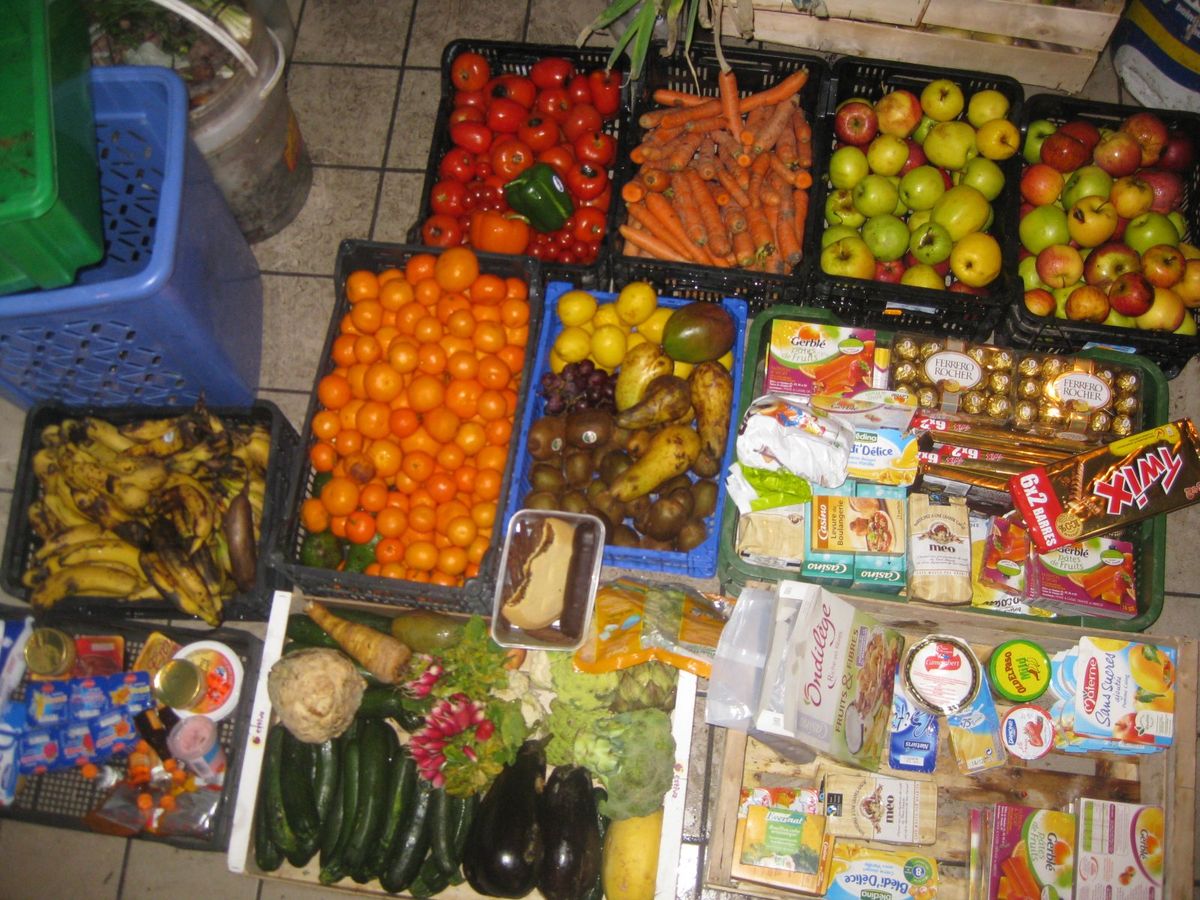 Dumpster diving got considerably more dificult over past years in
France. You can still find a lot of amazing things but if you don't know
the spots yet it can be challenging to find the right places since many
supermarkets don't leave their trash acessible.
Dumpster diving got considerably more dificult over past years in
France. You can still find a lot of amazing things but if you don't know
the spots yet it can be challenging to find the right places since many
supermarkets don't leave their trash acessible.
Dumpster diving
The skippability of different supermarkets can vary depending on their size and location. Common supermarket chains in France include: E. Leclerc, Carrefour, Intermarché, Lidl, Auchan, Super U, Geant Casino, Petit Casino, Franprix, Monoprix, Simply, Aldi, Spahr.
Note that it is always better to go to the smallest ones with normal bins because others (big ones) have their own compacktors which is usually locked and spoil the food.
From all the supermarkets Aldi has probably the most often accessible dumpsters. Netto and smaller Carrefours are also sometimes good. Not often but sometimes you can find bins of Intermarche or Biocoop. Other supermarkets are way most often not dumpsterable.
On countryside there is not many supermarkets because there is often one or two gigantic supermarkets (where you usually can't dumpster dive) for the whole area around. This fact makes it considerably harder to find food than in many other countries around where you would have few small or middle size supermarkets in such place. So if you're coming to travel french countryside be ready for hard time regarding dumpster diving.
Garbage collecting is usually once a week in medium/small size areas, most of the places do take their garbages out the night before those specific days so it is useful to know about it. In big cities, busy places, garbage can be collected every day.
French bakeries are by law prohibited from selling bread that is older than a day, so it pays to go around bakeries (boulangerie) and asking for old bread, or simply checking bakeries' doors/backyards after they close. Sometimes they will tell you they donate the old bread to organisations and that's why they don't give you. In a specific case they were lying, dumpster was full or bread and cakes in the morning. Old bread can easily be given away to people with cattle, hens (they can give you eggs then), rabbits, it is better to ask before feeding animals as most of them can get sick because of bread. It is good as well to share with wild birds in winter time.
Check as well butchers, with some bones or left overs you can feed cats/dogs or just leave it in the woods from time to time (not too often and not in the same wood/forest) or in an empty field for birds of prey (winter and mating season).
For flower-lovers, most of garden centers will not only throw a lot of plants (loads of orchids, bulbs, Yuccas,...) but fantastic other things you can't imagine (especialy during or shortly after xmas time). One good thing is the hay-ground corn stems mix they use to keep rabbits,hamster,... (you can find a lot) can actually be used in your garden as compost.
For trash other than food, France has collecting and recycling sites in every town, at least one. Look for "dechetterie" usually a green sign.
French
It's good to know a bit of French as like in any other other non native english speaking countries in europe (except Germany, Neederland, Scandinavia) people over 50 in France do not speak English (more in the countryside). You are more likely to go skipping with young people so they will have a minimum of english. One has to understand that dumpsterdiving related activities are not the kind of things and vocabulary they teach at school.
- French for skipping is 'récup' (short for 'récuperation') and to go skipping is 'faire la récup' ("on peut faire la récup").
- To thrown away in French is called 'jettez' ("les choses jetées" are things that have been thrown away).
The good thing is people do not really care and it is not badly - nor well either - considered to check the bins if they are in a public area (the street). However mind the police, they can be nosy enough to get you into trouble: so bringing your ID with you is a good idea, they will just check it out and if everything is in order and you keep quiet will let you go without any problem (they do not like the smell of alcohol though). If they ask just tell them the truth about garbage they can't do anything about it. The most important hing is to stay discreet and try keep low profile: always think there are other people looking for trash.
Legal note
Dumpster diving is not illegal in France. Though people might tell you it is, because they just assume so. And you can't just shut them up by quoting the law, because the law is not specific. However, precedents have consistently considered that trash has no owner, which according to Article 713 of the Civil Code, default to be owned by the local administration (fr: Commune).
Less shopkeepers/supermarket pour chemicals over their garbages because it is forbidden by law to put strong toxic chemicals in normal bins (bleech, acid,...) altough it is not really clear so people can still do it. Most of them now will prefer flour (which is ok) or washing liquid (which ruins everything it touches).
In certain parts of France, a new system is being implemented which is based on real garbage weight secure by a magnet lock system: bins/containers in those areas will be locked.
Links
- This is a great study done about dumpster diving in France (in French).
- Here is another amazing website with a lot of information about dumpster diving in France (in French).
- And here is a directory of contacts for dumpster divers in different areas in France. You can add your name/e-mail to the list or find other people to ask for advice or a trash tour in the place where you are. Enjoy!
Giving/Recycling websites
Some websites are trying to organize a "giving instead of throwing stuff" network, there you can publish what you're giving and browse what people give away:
Consider browsing:
- le bon coin, second hand selling platform
- emmaus france
- secours catholique france
- croix rouge francaise
LyonDiveGoods1.jpg — 2fish
Paris
Edit on wikiNamed dumpsters and map pins go stale. For current spots use dumpstermap.org and the live Trashwiki page. This chapter is culture, legality, and general practice — not a dumpster list.
Paris, France, is a great place to find random trash in the streets. After each market, everything what was not sold and isn't good for selling anymore is just disposed in original boxes, cardboard platter and packaging right on site. Plenty of food, half of it still good to consume.
Paris is an excellent place for dumpster diving. You don´t even need any exact addresses, just check your local supermarket, they take trash out different times, depending when the collectors come, but you can ask inside store or just pass by a few times to find out the time. Check out supermarkets like Franprix or Monoprix. If you want something more fancy check the dumpsters of your local Naturalia, all is organic and you can get packed tofu or peanutbutter spread:). Just careful, sometimes there are already people coming for some time and they might be hostile to newcomers.
Food Not Bombs
There is a Food Not Bombs every Sunday from 6.30pm in front of Menilmontant Metro Station. Food Not Bombs Paris website (Last checked: May. 2012)
Lyon
Edit on wikiNamed dumpsters and map pins go stale. For current spots use dumpstermap.org and the live Trashwiki page. This chapter is culture, legality, and general practice — not a dumpster list.
Lyon is the second biggest city of France. It offers a variety of freegan possibilities.
Good spots
Below are some good spots, times are approximate... can be earlier or
later depending on a day.
Supermarkets
- District 1 - Trash is taken on Monday, Wednesday, Thursday and
Saturday mornings.
- 7.30am - Monoprix, Rue de la Republique. There are 2
Monoprix shops here. One has 2 floors and one is only one floor at the
bottom of a building.
- Big Monoprix - there are many many poor people dumpstering at this spot. It's worth leaving them have everything unless you are really desperate. (Last checked: Oct.2011)
- Small Monoprix - here there is a lot of trash and not so many people go. The reason is that the shop workers are very much against dumpster divers and take the dumpster back inside the shop if they see anyone looking through it. Best option is to scout the place and go to the dumpster when there is no worker around anywhere even inside the supermarket where they can see you. Be very very quick. Go to the dumpster, take the bag full of food out and go away very fast to somewhere where you cannot be seen. Take what you need and if there are things you want to throw away throw them in a different dumpster. This way you avoid confrontation with the staff. (Last checked: Oct.2011)
- 7.30am - Monoprix, Rue de la Republique. There are 2
Monoprix shops here. One has 2 floors and one is only one floor at the
bottom of a building.
- District 2 - Trash is taken on Monday, Wednesday, Thursday and Saturday mornings.
- District 3 - Trash is taken on Monday, Wednesday, Thursday and
Saturday mornings.
- 6am - U Marche on the corner of Route de Genas and Rue Camille. The dumpsters are on Route de Genas in front of the industrial entrance. Trash truck staff are known to take the useful trash for themselves while they empty the dumpsters, so it is a good idea to be before them (which is good in any case, otherwise you will find all empty). The dumpsters are the big ones on four wheels. (Last checked: May 2011)
- 7-7:30am - Provi Fruits in the intersection of Route de Genas and Rue Frederic Mistral. The dumpsters are outside on the street, with the name of the shop written with permanent marker on the lid. Sometimes these two dumpsters arrive in different times. If you find one, it might make sense to wait for the second one. (Last checked: July 2011)
- 7-8am - Fran Prix on the corner of Cour Albert Thomas and Rue de Villon. The dumpsters are not in front of the shop but more towards Cour Albert Thomas, at the enterance to the parking. The shop's dumpsters are the small ones, the big ones are only interesting if the goods can not fit in the shop's dumpsters. Once the FP worker was seen pushing out five shopping carts of food, dumping it in the big dumpster. There are regular divers going to this spot. (Last checked: July 2011)
- District 4 - Trash is taken on Monday, Wednesday, Thursday and Saturday mornings.
- District 5 - Trash is taken on Monday, Wednesday, Thursday and
Saturday mornings.
- 10:00pm - Boulangerie Paul at 72 Avenue DU POINT DU JOUR: some nights in the week they trash tones of different kinds of breads (including sometimes organic ones), sandwiches and pasteries, in big black plastic bags they leave on the street, near the door step. (Last checked: Aug.2012)
- District 6 - Trash is taken on Monday, Wednesday, Friday and
Saturday mornings.
- 6-6.30am - Simply, 46 Rue Garibaldi (many old people dive here every time, they might share what they don't want but there's a lot of competition). (Last checked: Sept.2011)
- 6:30-6:50am - Spar, on the corner of Av. Thiers and Rue Gabriel Peri. The dumpster is on the other side of the street, near the flower shop. The dumpster is out only for a short time before the truck comes, all in all maybe 20 min. Still if you are on time, you will have enough time to check through it. (Last checked: July 2011)
- 6.30-7:30am -Petit Casino, 56 Cours Franklin Roosevelt, although dumpsters don't seem to be put out on Tuesdays or Thursdays. The Petit Casino dumpster can be accessed by going into the courtyard of the building, it's in there if it's not out yet. To go inside the building just press the door-open button which is a button that is somehow not related to the others on the interfon. This button works only at certain times during the day like during trash collection time. (Last checked: Sept.2011)
- 6:40-7am - Petit Casino on Rue Professeur Weill, very close to Cours Vitton. This one also stays out for short time, but schedule often changes. The dumpsters are at the enterance on Rue Professeur Weill, or on the corner of this street and Rue de Seze, or sometimes on the other side of the supermarket, in front of the main enterance. The name of the supermarket is written with permanent marker on the lid. (Last checked: July 2011)
- 7am - Petit Casino, 36 Rue Juliette Récamier, although the dumpster doesn't seem to be put out on Tuesdays or Thursdays. (Last checked: Sept.2011)
- 7-7:30am - Fran Prix, on the corner of Rue Tete d'Or and Cours Vitton. Dumpsters are on Rue Tete d'Or, in front of the industrial enterance. There is a small one and a medium one usually. If they are full, look into the others too. Don't mind the staff, they are really used to divers. (Last checked: July 2011)
- 7-7:30am - Super U, on the corner of Rue Garibaldi and Rue Cuvier. The dumpsters are in front of the industrial enterance on Rue Cuvier. There is one man there who will give you bad words, and send you away, but he doesn't do anything else - and you can take with yourself the goods you already got out. But better be quick, and start only when he is not there. The guy is strange looking, out of the gym with tattoos, and bakelit glasses. Don't be afraid, he doesn't care, just does the job. There is lots of stuff in their dumpster, get quickly what you find on the top. There is also lot of bread, he usually gives some of that. (Last checked: July 2011)
- 7.30am - Franprix, 106 Rue de Crequi, but the dumpster doesn't seem to be put out on Tuesdays or Thursdays. (Last checked: Sept.2011)
- 7.30am - La Vie Claire, 125 Rue Vendome, but the dumpster doesn't seem to be put out on Tuesdays or Thursdays. (Last checked: Sept.2011)
- 8-8:30am - L'Eau Vive, 56 Cours Franklin Roosevelt, the dumpsters have Pubelle Cour written on the lid with permanent marker. If the dumpsters are not out yet, you can go inside the gate when a car comes out. The door closes slowly, you have time to wait for it to go away. When you go in cover the sensor of the gate with something, otherwise it will close you in and you will have to wait for someone to let you out. Don't check the dumpster inside the yard! If there is something in them, you can pull them out on the street, there is no problem with that. The residents will really not like if you check the trash inside the yard. (Last checked: July 2011)
- District 7 - Trash is taken on Monday, Wednesday, Friday and Saturday mornings.
- District 8 - Trash is taken on Monday, Wednesday, Thursday and Saturday mornings.
- District 9 - Trash is taken on Monday, Wednesday, Thursday and Saturday mornings.
- Villeurbanne - Trash is taken on Monday, Wednesday, Friday and Saturday mornings.
- Evening spots
- 19:45 - L'Eau Vive, Rue Jean Bourgey, on the side of the shop, with a sticker of the shop. Out on Tuesday, Thursday, Friday and very rarely Saturday. (Last checked: June 2011)
- 20:15 - Spar, on the corner of Cours Tolstoi and Rue Racine. The dumpster is near the bus stop. Usually there is a group of drunkards already waiting for it. Sometimes they are a bit aggressive. Better take a look around before, or keep an eye on them while you are dealing with the goods. Out on Tuesday, Thursday, maybe Friday, and Sunday noon. (Last checked: June 2011)
- 23:00-00:15 - Pizza Hut, on the corner of Cours Emile Zola and Rue Raoul Durand. Often there are fresh pizzas in boxes. Usually on the top of the bags, or in between, and not inside them (again - usually). Also happened that they were intentionally thrown to the bottom, smashed, but still clean. (Last checked: June 2011)
- 22:00 aprx - Trattoria Italiana on Emile Zola, just near the Gratte Ciel metro. Really dirty inside the bags, mixed with food leftover - bring gloves. Often there is quality Italian cheese, spaghetti, or fresh pasta in package, mostly hidden beneath the sticky leftovers. Once you start it, be patient to check the whole bag. (Last checked: Oct.2011)
- Evening spots
- Bron - Trash is taken on different days for the two
sectors. Sector 1 on Tuesday and Saturday, Sector 2 on Monday and
Friday.
- Evening spots
- 21:00 (around)La Vie Claire on the corner of Route de Genas and Rue Georges Clemenceau. There is usually very small finds at this shop. If you are really close you can take a look on Tuesday and Thursday. The Lidl nearby used to be a good spot in the same evenings after 22:30, but they stopped leaving the garbage outside for the night. Maybe in the mornings it can be worth a try. (Last checked: Oct.2011)
- Evening spots
Bakeries
- 5am - 15 Place Louis Pradel (Last checked: Sept.2011)
- 6.30am - intersection between Rue Tete D'Or & Rue Vitton (Last checked: Sept.2013)
- 7.30am - intersection between Rue Cuvier & Rue Pierre Corneille (Last checked: Sept.2011)
- 10:00pm - Boulangerie Paul at 72 Avenue Du Point du Jour: some nights in the week they trash tones of different kinds of breads (including sometimes organic ones), sandwiches and pasteries, in big black plastic bags they leave on the street, near the door step. (Last checked: Aug.2012)
- 8:00-8:30pm - Boulangerie La Brioche Dorée It's in the Part Dieu mall. Simply the best spot I found in Lyon. When you enter the mall through the entrance facing the train station, there will be a Brioche Dorée on your right, by the escalators. They close around 8pm, and they have a LOT of stuff to throw away. Don't be rude, don't ask them at the shop, they don't like hobos, or anyone putting their hands on the food. Depending on where they take the food, you have two options:
One: go to the bottom floor with the escalator (where the metro is) and go through the white doors on your left. You arrive in an underground parking, where the trash is. The trolley with the food will arrive by the elevator. You just have to wait for them, and ask politely if you can take some food. If they have a bad day they'll say no, and throw it out. But no worries, usually it's in boxes, and you can get everything out without even soiling your hands. (usually this is where they go)
Two: just follow them to the trash nearby. Anyways, keep an eye on the bakery to see where they go.
Best option is keep an eye on the bakery and follow the cart because there are different places where they can throw away trash. Usually there are two or three other people waiting for these bags. On Sunday they are closed. (Last checked: Sept.2013)
Food markets
There are many food markets in the city and if you go there around 11h-13h (depending on the closing time), you will find a lot of good stuff. Lyon is surounded by a vegetable producing area so there is really fresh food there.
Two big markets are located in city center:
Marché du quai St Antoine
Marche du quai Saint Antoine on the bank of the Saone river. Everyday except Monday. Monday is clothes day only. Rest of the time it's fruit & veg. It closes around 2pm. On Sunday you might encounter a lot of competition, but there is still plenty of stuff. The trash-truck is quick to come so don't be late.
Marché de la Croix Rousse
Marche de la Croix-Rousse, to get there you will have to go on the hill of the Croix-Rousse, really nice view, lot of things to take.
Freeshop "Matosteque"
Freeshop-collective Matosteque is a self-managed space to get things for free (based on lending and giving). The aim is to gather tools and such, usualy used for individual purposes but which could also be used for the community:
- You have got a driller and you use it rarely? Bring it, others will enjoy it!
- You need a ladder, come around to check if the collective one fits you needs.
People at the freeshop want to get rid of the consumption logic, and of the "every man for himself". Their goal is to put in practice concrete solidarity and mutual aid in the Guillotiere neighborhood. Everything is for free for an equal access for everyone. Anyone can join the collective, as much/deep as he/she want/can.
Come every 2nd and 4th Sundays from 6pm to 8pm, take or bring gear/tools/other stuff and share a cup of coffee and access the internet, or just have a nice talk.
Freeshop is located in "La guillotiere" (7th district) at La Luttine, 91 rue Montesquieu.
Other interesting places to check out
- Infoshop "La Luttine": Every saturday 2pm-6pm. Check it out:) (website)
- "La Gryffe" library: 5 rue Sébastien Gryphe Lyon 7e. Open Monday to Saturday from 2pm to 7pm.
Marseille
Edit on wikiNamed dumpsters and map pins go stale. For current spots use dumpstermap.org and the live Trashwiki page. This chapter is culture, legality, and general practice — not a dumpster list.
Marseille is a French Mediterranean city.
Food markets
There are several good food markets for diving in Marseille.
- Diver guaka randomly came across of some nice fruit and veggies after closure of a small street market.
- Diver Cravos found a street market called La Pradou, close to the Castellane Metro, where at closure arond 2pm there were plenty of bread, vegetables and fruit being left on the street.
Food Not Bombs
- An anarchist social centre called Le Seul Problème on Rue Consolat runs an occasional Food Not Bombs in the city.
Recycling Stuff
- Look for the following organisations:
- http://recyclodrome.org/ recyclodrome - Emmaus La Croix Rouge Marseille - http://veloutile.fr/ velo utile - http://www.ecoforum.fr/ ecoforum
Monaco
Edit on wikiMonaco is a very tiny and extremely wealthy country surrounded by France. Because of its wealth it could be really good for dumpster diving, though it's hard to know for sure until someone can actually confirm this.
Some people say there it is forbidden by law to dumpster dive there (to be confirmed).
You can find plenty of good sandwiches, bread, pastries, deserts at the bakery "La Boule de Neige" at 20 Rue Princesse Caroline, Monaco. (last checked: March 2018)
There is a farmer's market at the "place de la condamine" every morning so there should be lots of waste every day after its closure.
Belgium
Edit on wikiBelgium is a country in Western Europe.
Dumpster diving
Dumpster diving can be pretty good at some food markets, especially in the "market du midi", in Brussels (if you go there when the market is finished 14.00, you will get a lot of fruit and vegetables for free). The same can not be said about Belgian supermarkets the majority of whih tend to not to leave their trash outside the store.
Some manager at Delhaize claimed to guaka that they sell the edible waste to serve as animal feed. Delhaize's trash policy is far from great though, as guaka one time found a perfectly usable office chair that he was not allowed to take - and it probably ended up as landfill somewhere.
poubelles.be is a good website for freegans in Belgium, it has a quite useful forum.
Supermarkets
Most larger supermarkets keep their unwanted food inside.
Smaller supermarkets often have a dumpster containing all trash on the street. Most throw out their interesting trash either around opening, or closure. Because many don't seal the products (including bread), it is recommended to check shortly after these times to avoid contamination.
Some places where users have found good products:
- Delhaize Shop & Go, often next to petrol stations but not marked as such on Google Maps.
- Carrefour Express. They are more likely to leave their dumpster out in middle/upper class neighborhoods rather than city centers
Unlocking dumpsters
In Belgium, a type of dumpster lock (with a triangular key) found at many if not most dumpsters can be opened using almost any big house key (use an old one in case it bends!).
- Pry the key in between the pin on the right side
- Push the outer end of the key to the left
- Pull out the pin
Legality
There are at least 2 known cases when dumpster divers were caught and faced trials.
- Ollie case in Bruges, 2009
- Steven Geynst's case in Dendermonde, 2011
Upcycling
French speaking organizations involved in Upcycling:
Links
- poubelles.be is a good website for freegans in Belgium, it has a quite useful forum.
- The Freecycle Network:http://www.freecycle.org/
- 23 local list where you can give and receive things for free. http://listes.agora.eu.org/listinfo/donnerie.
Place: Andenne, Braine-le-Comte, Bruxelles(°), Charleroi, Court-Saint-Etienne, Eghezée, Grez-Doiceau, Hannut, Haren, Jette, Lasne, Liège, dans la province de Luxembourg, à Mons, Namur, Nivelles, Helmet (Schaerbeek), Seneffe, Sombreffe-Gembloux, Verviers, à Villers-la-Ville et à Walhain.
Brussels
Edit on wikiNamed dumpsters and map pins go stale. For current spots use dumpstermap.org and the live Trashwiki page. This chapter is culture, legality, and general practice — not a dumpster list.
Brussels is the capital of Belgium.
Flea market
A great place to go to get something for free is the flea market Place du Jeu de Balle which is held everyday from 6am to 2pm. If you go there after 1pm, you will be able to get anything that market vendors don't sell and choose to discard of: plates, boxes, chairs, clothes, books, old pictures... The garbage truck comes at 14:00. Be careful, you can get addicted to it. See map here.
Unlocking dumpsters
In Brussels, a type of dumpster lock (with a triangular key) found at most gas stations and supermarkets can be opened using almost any big house key (use an old one in case it bends!).
- Pry the key in between the pin on the right side
- Push the outer end of the key to the left
- Pull out the pin
Computing gear
Hackerspace Brussels has a permanent stock of recup computers/keyboard/network switches/cables etc. Leave a msg here.
Food markets
- Bruxelles Midi
- There's a market every Sunday at the Brussel South railway station (in French: Bruxelles Midi). Around 14:00 they start packing up and you can find very nice fruit and veggies.
- Abattoirs - metro Clemenceau
- Not as much meat as you would expect with this name, great market, open on Fridays, Saturdays and Sundays. Starts closing around 14:00. The quality of the left over produce is not great, but you can still find very edible fruit and veggies - sometimes in large quantities. Note that this neighbourhood has the highest crime rates of Brussels (but Brussels is a safe town).
- Place Flagey
- There's a market every Saturday at Place Flagey. Around 14:00 they start packing up and you can find very nice fruit and veggies.
- Parvis de St. Gilles
- Daily market, but not good for dumpster diving. Garbage is collected in plastic bags, guaka has never found anything here.
- Le Miroir, Place Reine Astrid, Jette
- Regional farm produce, only open on Sunday, not much to find.
- Jette
- Apparently there's a market that's okay for diving, not clear when exactly though.
The street
You can often find many useful things in the street, such as furniture, clothes and carpets.
Chaussee de Gand, in Molenbeek, looks a bit like it could be in the Middle East. On Wednesday night it's trash night and you can find various stuff - until about 21:00 when the trucks come to pick up the trash. guaka found a whole bag of rice noodles and 50 kg of semolina (and took 10 kg) one night, 2 big useful garbage cans another. Be careful with the cars, people drive like maniacs, and keep a low profile, it's definitely not Brussels' most friendly neighbourhood.
guaka and a friend found a usual white trash bag full of okra, spinach, 2,5kg of oatmeal in front of a small grocery store in Chaussée de Wavre - recognized by some leak that looked good. It's a good strategy to simply check bags by looking and then feeling. It's a good idea to be quick, e.g. quickly take the bag away from the store and check contents elsewhere.
The internet
Freecycle Mailing List - active list where you can "Give/A Donner" or "Wanted/Cherche"
"One main rule: everything posted must be free."
More info
- Map of some spots in Brussels (in French)
- Markets in Brussels
- Overview of markets in Brussels, in French (LUndi, MArdi, MErcredi, JEudi, VEndredi, SAmedi, DImanche)
Groups
- Degustation de Bon Sens Flagey, is a bit like Food Not Bombs
Netherlands
Edit on wiki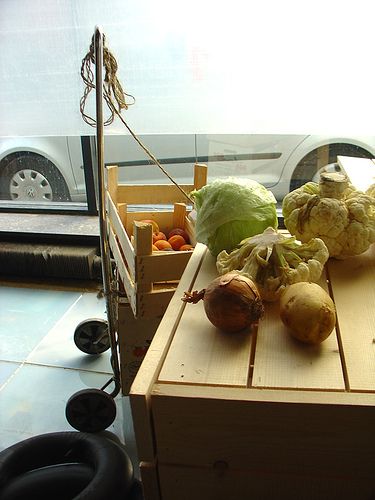 The
Netherlands are fairly good for dumpster diving, as
well as for other freegan means. Like many Northern European countries
it's an affluent country and people throw away lots of very usable
stuff. Beachcombing used to be very common in the past.
The
Netherlands are fairly good for dumpster diving, as
well as for other freegan means. Like many Northern European countries
it's an affluent country and people throw away lots of very usable
stuff. Beachcombing used to be very common in the past.
(For more info on each city or town in the Netherlands see template at the bottom of this page.)
Dumpster diving
Legal status
In the Netherlands dumpster diving is a gray area. The owner has disposed of the goods, therefore making it free to anyone to take it. However, it may also be considered as being still property of the owner. The garbage company in charge of picking up the garbage will become the keeper of the garbage until it has been destructed. In addition, when an area is closed for public it is illegal to take garbage from the containers or from the property.
Video
<videoflash>PYPdc1LYC9M</videoflash>
Kings Day
Every year on the 27th of April (Koningsdag) the Dutch flog their trash on the street. At the end of the day, in the bigger cities, some people leave their unsold trash lying on the pavement.
Other information
The Netherlands seems to be quite good for getting things for free; as most banks do free coffees, and the 'Lefier' (jobcentre) often has free coffee, chocolates and mints! Also make sure to check out some bigger supermarkets like Jumbo, Albert Heijn, Super de Boer. Those are the places to get free coffee and tea from the coffee machine located somewhere in the store.
Personal experiences
"By far the nicest thing I discovered in the Netherlands (regarding good free food) was a special thing of the supermarket "Jumbo". Not only they have a lot of biological food and tofu products, they also give away (for free) produce that runs out of date that very same day or the day after: milk, fish, fresh pizzas..." (User:Regen)
Links
Weggeefwinkels
Give-away websites
- Gratis op te halen. You can search this site on -part of- your zip code (in Dutch)
- Gratis af te halen (in Dutch)
- Haal gratis af (in Dutch)
- Bulletin board at Starpagina (in Dutch)
Freegan rotterdam.jpg — Sigurdas
Amsterdam
Edit on wikiNamed dumpsters and map pins go stale. For current spots use dumpstermap.org and the live Trashwiki page. This chapter is culture, legality, and general practice — not a dumpster list.
Amsterdam, the capital of the Netherlands, is a nice city for finding free food and stuff.
Markets
When you go to the market around its closing time you can generally find sufficient amounts of food or second hand stuff (clothes, books, etc.) vendors leave behind. You can also ask vendors if they have any leftover produce. Sometimes they leave quite some amounts of food just on the pavement or inside the containers behind their booths. At times, it is better to wait until vendors leave, although some freegan-oriented folks tend to build a special relation with certain vendors. There is always a lot of good food left behind on Mondays and Saturdays.
There are several daily markets, and two organic markets on Saturdays.
- Albert Cuijp
- The largest daily market. Located next to the Ferdinand Bolstraat. Vendors generally leave their produce stuffed in boxes just in the street. On Saturdays there is exceptionally a big amount of leftover produce - you can also see many folks wandering around and "shopping" for free.
- Dappermarkt
- In 2007 voted as the best country's market. Open every day except Sunday. Located in the east part of the city.
- Ten Katemarkt
- Has ~6 booths that sell vegetables. Vendors leave food in big blue containers. Good for diving, especially in the Recycling Center located in the center of the market. Be there between 17:00 and 17:30 for the best scoring options in Summer. In winter and on rainy days the market tends to close earlier. Located at the Kinkerstraat.
- Markt Bos en Lommerplein
- Markt Plein '40 - '45
- Markt Ganzenhoef Bijlmer
- Many exotic products. Only on Saturdays.
- Waterloopleinmarkt
- A flea market (no food). Come at/after closing time (16:00-17:00). Vendors usually leave what they don't bother to take back home in certain places in the market. It is often good for finding books, clothes, old records, etc. Predictably, not of greatest quality, as usual, although some valuable cult classics have been known to turn up in there.
- Westermarkt
- Organic market, only on Saturdays.
- Nieuwmarkt biologische markt
- Organic market, only on Saturdays.
- Some more markets in Zuidoost (on Saturdays)
See also the addresses of Amsterdam markets.
Garbage
{width=“300”}{width=”300”} Each neighborhood has a specific day when it is allowed to put discarded bulky items and other similar garbage out on the street. People put out literally everything, from huge furniture to ovens and all sorts of devices and other handy things meant for the household which means it is possible to gather enough of furniture for an appartment with some luck. Best time to search is in the evenings, especially in areas that are being renovated. You'll also find that there are people who are actually collecting stuff so that they could sell it later on in someplace elsewhere. According to some, best areas to do discarded stuff picking are Pijp and Oud-Zuid. General information about trash in Amsterdam can be found here.
Good trash days are (all maps in Dutch, although they display color-coded areas with a list of trash days below note: links need updating due to restructuring of city-councils):
- For the city center, check this website.
- For Pijp and Oud-Zuid, check here.
- For Westerpark, check info here.
- For Oost, please check info here

- For Baarsjes, check this. Bigger trash is put on the streets after 8pm on the following days (it will be collected the next morning)
- Jan Maijenbuurt / Admiralenbuurt nord: Monday and Wednesday (see map)
- Does-, Tromp- en Geuzenbuurt: Tuesday and Thursday
- Mercatorbuurt: Monday and Thursday
- Chassébuurt: Sunday and Tuesday
- Postjesbuurt, including Postjeskade: Sunday and Wednesday
- For Bos en Lommer, check trash info. Big trash days:
- Area 1 (blue): Monday (see map)
- Area 2 (red): Tuesday
- Area 3 (green): Wednesday
Bakeries
You can go to any bakery around closing time (5 or 6 pm) and ask if they have leftovers. If they are willing to give their bread away, you can often build relationships with them and come back every (other) day. You will find many bakeries happy that they can give the food away that they otherwise have to throw out. If they give you more than you need, share it with friends.
If your Dutch is limited, keep in mind that it is uncommon for Dutch to know the English word "leftovers". You can use the word "restjes" (sounds like "rest-juice"), which is a diminutive form of the word "remainder" (or "rest") and so translates as "remainderlings". Another practical phrase is "Oud brood" which means "old bread".
Hotels
Hotels frequently have buffets, leftovers of which they're legally required to toss out at the end of the day. Employees, luckily, are usually amenable to give some food away.
Freeshops
Freeshops are places where you can find stuff for free, or leave what you don't use anymore. Here is the list of freeshops in Amsterdam:
- Joes Garage at Pretoriusstraat 43 has a give-away shop open every Saturday from 14.00 to 18.00, see map here. (Last checked: April 2010)
- You can find one freeshop in Buurtboerderij which in itself is already worth a visit (see map).
- There is one store which is not really a freeshop but it serves "bijstandsgerechtigen" and other people with minimum income (address: Jan Evertsestraat 10). Recently visited this one, following the new squatting laws in the Netherlands, this store seems to have been closed although the clothes and other items still remain inside the shop.
- A freeshop is located in a squat at Admiraal de Ruijterweg and is open on Tuesday's from 13:00 till 17:00.
- Bajesdorp has a Freebox outside with a small quantity of items.
Freecycle
- There's a fairly active mailing list for freecycling items in Amsterdam area. You can post on the list if you have items to give away for free, or request something specific you need. Sometimes even full flat contents are being donated, and otherwise it could be just about anything - books, children's clothers, computer screens, bicycles, beds... The list appears to be filtered so it might take some time before your post is sent out to list subscribers. And remember: First come first served!
Other free things
- Albert Heijn supermarkets often have free samples in their shops, from cheese to cupcakes to ice cream.
- Some Vodafone shops have machines where you can get free coffee, hot chocolate, tea. There is one in the town center where this definitely exists.
- There is a cheese shop in the town center which offers many free cheese samples, as well as chocolate and other things.
Supermarkets
Supermarkets are generally good for dumpster diving, although many - such as "Albert Heijn" - are actually sending most of the unsold food back with their trucks, so there isn't much to dive there.
There are reports of dumpsters found on the street on specific days at specific times. If you have a supermarket in your area, go and check at random times to find out. The trick is that twice a week all the shops in a specific area put their dumpsters outside to get emptied by the garbage collection trucks. The days vary by area in the city. As a guideline you can check the maps in the Garbage section of this page to see how the areas are split. For example, in Bos en Lommer they are Tuesday and Friday. On those days before 12 mid-day you can find dumpsters outside on the streets. Also shops such as the Blokker throw (very useful) stuff away.
Smaller supermarkets also have dumpsters, such as Turkish neighborhood shops. Many of these dumpsters can be found out on the street after closure times. Some days they are full while other days they remain empty.
If you go to the KvK (Kamer van Koophandel (Chamber of commerce)) behind Centraal Station, you say you want to open your own business, they give you a number and you have access to the lobby, with free coffee machine and computers with internet. Conveniently located and with a nice view of the IJ River!
Pharmacies
Pharmacies are worth checking out during garbage days. A medium sized pharmacy right at the corner of bestevaerstraat and Jan Van Galenstraat yielded a constant flow of cosmetics, toiletries and even some food and over the counter medicine.
Voedselbank
The Voedselbank gets leftovers from supermarkets and distributes them to people with who are officially under a local poverty level limit. Curiously enough, even Voedselbank itself have leftovers - that leaves you a possibility to go there and ask for leftover food (just go to their shop on Friday and ask them very politely).
Transport
If you want to carry a lot of things in one go, a Bakfiets comes in handy.
Urban foraging
Started up by the group FoAM, the Urban Edibles site maps out wild food sources in Amsterdam.
The ethics of urban foraging:
- Be Friendly: Ask permission when ownership is unclear.
- Be Generous: How much do you really need? Only pick what you will eat, leave the rest for others (wildlife).
- Be Alert: Beware of toxicity and don't tread on other plants when picking.
- Be Careful: Don't put any rare or protected species on the map.
Feel free to add your own discoveries as well!
Another directory and portable application is Boskoi.
Urban farming
Free State SWOMP is an ecological squatted garden in De Pijp area of Amsterdam. They experiment with permaculture practices, while growing herbs, vegetables and fruits. They also hold various workshops in composting (which every conscious dumpster diver is aware of), arts and crafts, Transition Towns and vertical gardening to mention a few. Check Free State SWOMP in English but bare in mind that it is updated less often. And visit them to get your own plot of land to cultivate.
Links
Rotterdam
Edit on wikiNamed dumpsters and map pins go stale. For current spots use dumpstermap.org and the live Trashwiki page. This chapter is culture, legality, and general practice — not a dumpster list.
Rotterdam is a
city in the Netherlands and is not a bad place for dumpster diving. The
city center is full with bins in the streets parallel to the main
shopping street and it won't cost you much time to find them.
Supermarkets generally are a harder catch but there are some accessible
bins. Some of the markets are good for diving.
Center
One of the trash-day seems to be Thursday-morning. You can find lots of bins around the center. Check the alleys and backstreets of the main shoppingstreets and you will find lots of bins. Check the map of Rotterdam for some spots.
Markets
Within the whole city of Rotterdam there are about 12 open-air food-markets, mostly on Fridays. The largest one is in the city center where around closing time you're likely to meet some fellow divers. The Centrum Markt at Binnenrotte is open on Tuesdays and Saturdays and closes around 17.00. It is a huge market.
Other markets include
- Afrikaanderplein Markt - Wednesday and Saturday until 16:30
- Visserijplein Markt - West
- Ommoord Markt - Wednesday until 16:30
- Overschie Markt - Friday until 16:30
- Schiebroek Markt - Rododenderonplein - Friday until 16:30
- Asterlo Markt - Asterlo, Zuidwijk - Friday until 16:30
- Hoogvliet markt - Binnenbaan Noord - Thursday until 16:30
- IJsselmonde Markt - Keizerswaard - Thursday until 15:30
- Alexanderpolder Markt - Winkelcentrum Het Lage Land - Friday until 16:30
- Biologische Markt - Eendrachtsplein - Tuesday until 18:00
Check for more information about the markets on website.
Rotterdamse Oogst
The Rotterdamse Oogst (Rotterdam Harvest) is an organisation that aims at re-establishing connections between locally grown food and food-consumption in the city. They organise harvest festivals and local food markets to promote growing your own food.
Map of Rotterdam
Links
Luxembourg
Edit on wiki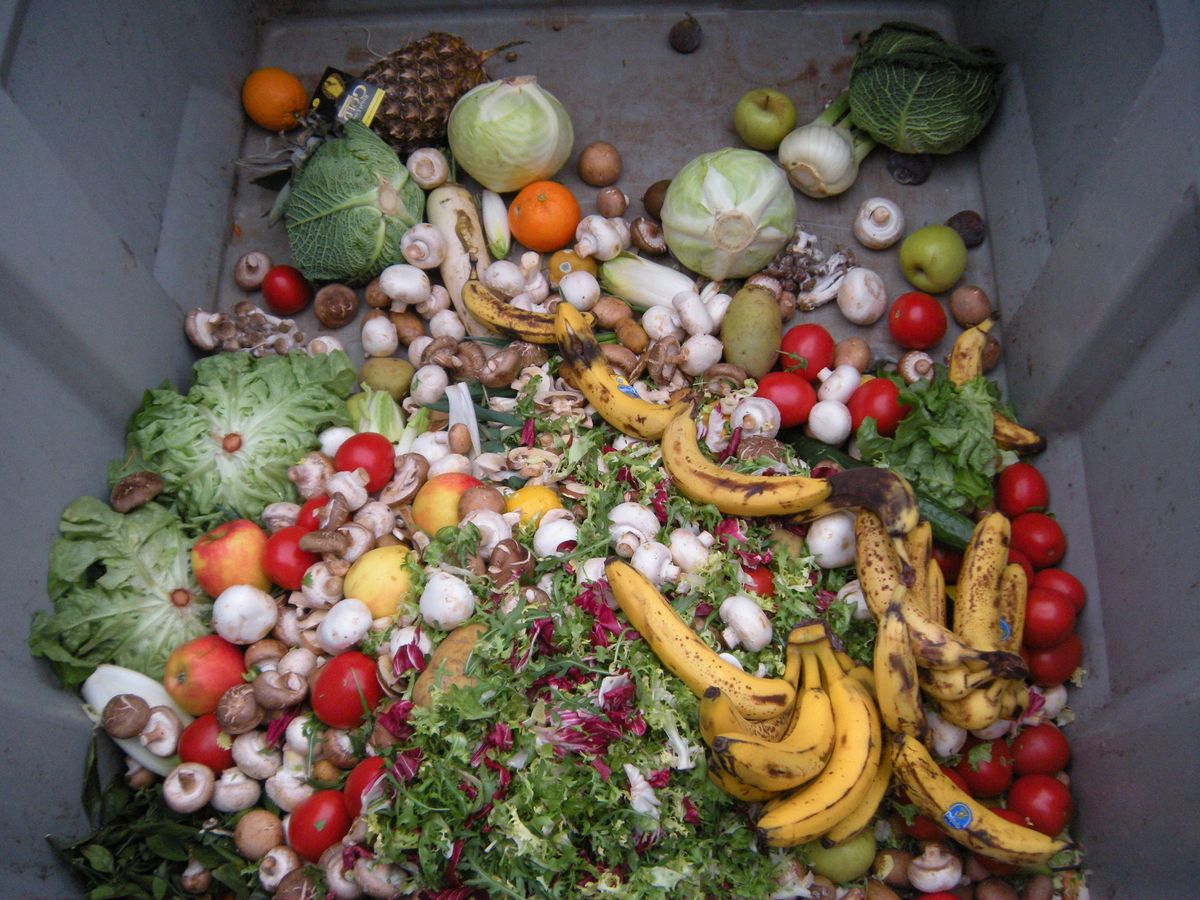 Luxembourg has one of the highest GDP in Europe (and
thus also in the world) which doesn't say that much about whether the
country is rich or not yet there are loads of supermarkets from which a
lot of food is thrown out.
Luxembourg has one of the highest GDP in Europe (and
thus also in the world) which doesn't say that much about whether the
country is rich or not yet there are loads of supermarkets from which a
lot of food is thrown out.
Luxembourg has twelve cities, even though the only real city is Luxembourg City - the rest are rather towns with a city status. There are also smaller towns and villages in this small country. The cities of Luxembourg are: Luxembourg City, Diekirch, Differdange, Dudelange, Echternach, Esch-sur-Alzette, Ettelbruck, Grevenmacher, Remich, Rumelange, Vianden, and Wiltz.
Legal status of dumpster diving
As of yet there is no law to forbid dumpster diving in Luxembourg. As in this article the police if they arrive will only tell you to go away: "Police issued a verbal caution.". The sentence "The practice of dumpster diving is not permitted in Luxembourg" is most likely an addition of the author but it has no legal standing.
Some experiences of dumpster divers in Luxembourg: "Once a police van stoped right in front of the big compactor from where we just recovered six huge bags of food, one of them came round the van and asked us what we were doing and when we told him we were getting vegetables from the garbage he said it's good and that it's no problem, turned around and left."
Media about dumpster diving
In general it is best that one avoids mass media when it comes to dumpster diving as the large media groups are sponsored by large supermarkets and are not allowed by contract to make their sponsor look bad. Such is the case with the following report done by RTL in 2011 in which a few supermarkets are presented as wasting food but only after a report on Cactus (which sponsors RTL) as a bio fuel pioneer was included just before that part: http://tele.rtl.lu/waatleeft/replay/v/20120104/0/53663/
People have been caught by the police while dumpster diving but were always let go directly without being arrested. This is proved by some divers as well as this article although the phrasing of the article is confusing.
In April 2013 a teenager was crushed and killed in a dumpster in the morning when the garbage truck came to pick up the trash. Although the reason for why he was in the container is unknown, the time at which he was there might indicate he was not dumpster diving. See this article.
Free Stuff
Free Your Stuff Luxembourg (FYSL) is a large group on Facebook where one can GIVE AWAY stuff (including non comercial information i.e. no ads, job offers/ excluding animals) and can find what one might NEED: http://www.facebook.com/groups/freethestuff The group has a document (not up to date) with a list of the places in Luxembourg where people might deposit stuff as in a freeshop: http://www.facebook.com/groups/freethestuff/doc/187195414651639/
Free Your Food Luxembourg works on the same principle as FYSL but restricted to food: http://www.facebook.com/groups/FreeYourFood
Free events or activities: http://www.facebook.com/groups/362581420434448
Cities and towns
Luxembourg City
Luxembourg City is the capital of the country.
Dumpster diving:
- The Match Beggen (Centre Espace) supermarket (address: 233-241 Rue de Beggen L-1221 Luxembourg) has a couple of small brown containers right behind the building which are easy to access and usually have fruit, vegetables and pastries. A bit away more in the open there is a compressor which is good to avoid to go in. It's usually on, with the contact key in it, and you could possibly operate it by following the directions written on the container next to the operation buttons, and then disconnect the electricity to avoid any accidents - however, it is always to stay safe and not to risk life because of some discarded food stuff. (Last checked: October 2012)
- The AD Delhaize supermarket at the address 242 Route d'Esch in Luxembourg is on the right hand side of the street as you climb up the hill coming from the city even though on online maps it shows something else. Behind the building of the supermarket there is a container locked with a chain to the rails but which can still be partially opened. Candy, biscuits and other sweets can be found. (Last checked: April 2012)
Differdange
Differdange is an industrial town with a status of a city, in south-western Luxembourg.
Dumpster diving:
- Lidl supermarket (address: 170 Rue de Soleuvre, Differdange, Luxembourg) has a large metal container and three other large grey plastic containers filled with everything from fruit and vegetables to chocolate, cheese and candy. Even no need for lights or bag here since there are automatic lights that go on when aproaching the bins and next to the door of the supermarket there are always plastic bags filled with other plastic bags that could be used as they would get thrown out as well. (Last checked: February 2013)
Bettembourg
Bettembourg is a small town and a part of the canton of Esch-sur-Alzette.
- There is a Cactus-Marché in Bettembourg at 1 Rue du Parc. Coming from the train station go up the stairs at the end of the bus station and follow the Route de Mondorf until you reach Rue du Parc. The Cactus is on the corner so you have to look back from time to time so you don't pass it. It doesn't say Cactus but Marché although it has a cactus logo so you'll know you're there. The dumpster is on Rue de la Montagne, not locked and easily accessible from the sidewalk. (Last checked: February 2013)
Dudelange
Dudelange is a small town with a status of a city in the south of Luxembourg on the border with France. You can dumpster dive at following places:
- The Aldi has an open and unguarded metal container. (Last checked: January 2011)
- Match supermarket. (Last checked: March 2011) Personal experiences: "Matchsupermarket has a big red compactor for which you SHOULD UNPLUG THE POWER CORD to make sure no accident will happen while you are inside. Easy to open by pushing down the safety trigger that holds the buckle of the lock. Looks complicated but actually quite easy. Full of everything!! There are also some smaller plastic containers, the types that have wheels in the loading area of the supermarket next to another red compactor (it is for cardboard only). In those small containers you can find bread and pastries as well as vegetables and fruit. There is a camera but no one ever came while we were dumpster diving there... - anonymous user, March 2011
Esch-sur-Alzette
Esch-sur-Alzette is a town with a city status and a population of 27,146. It is Luxembourg's second-most populous town.
- The Cactus supermarket (address: Route de Luxembourg, L-4222 Esch/Alzette) next to Kultur Fabrik is hard to access because of all the crawling under the surrounded fence. Once inside there are low containers with a cow symbol on them containing lots of fruits and vegetables. WARNING: it is a trespassing violation, so do it on your own risk! Directions to the place: From the center of Esch or highway Luxembourg - Esch / Alzette, follow the rue de Luxembourg. From Schifflange or motorway south Dudelange - Esch / Alzette, follow Boulevard Aloyse Meyer. Coming from the motorway south Pétange - Esch / Alzette, follow penetrating Lankelz, then left on Boulevard GD Charlotte, then right onto rue de Luxembourg. (Last checked: February 2011)
Junglinster
Junglinster is rather a village but you can dumpster dive at the Langwiss industrial zone:
- The Aldi has an open and unguarded metal container. (Last checked: November 2011)
- The Delhaize has an metal container. It's locked but you can use a three-square socket wrench to open it. It's full over everything! (Last checked: December 2011)
Wasserbillig
Wasserbillig is a small village on the border with Germany. You can dumpster dive at following places:
- The Lidl has an open plastic container in front of the garage door. (Last checked: December 2011)
Luxembourg dumpster.jpeg — OpenIDUser2
FYSL_Logo.jpeg — OpenIDUser2
Germany
Edit on wikiGermany is a wealthy country in Western Europe.
"Containern", as dumpster diving is called in Germany, is just easy - no chemicals and relatively little trouble with police/security (it might depend on a region - for example, Bavaria and its main city Munich are more conservative than most of other German lands). Dumpster diving is somehow tolerated, and some vendors from local food markets purposely leave a completely excellent produce so that dumpster divers would have a better and safer meal.
To see more detailed info on each city and town in Germany, please see the template at the bottom of this page.
Dumpster diving
Legal note
First of all, dumpstering in Germany is illegal. You have to know this, and you mustn't be surprised if police come to check your identity. The best way to deal with these situations is to be conversative: talk to them, explain what you are doing, why you are doing it and ask what is bad about it.
There are known cases of store employees coming out and angrily asking the individual to stop dumpster diving, however, when talked very politely to, they leave dumpster divers in peace (see for more info here, in German).
If you get accused of dumpstering, it might be a good idea to answer "Oh good, I always wanted to tell people why I do that", and you can talk to the supermarket administration about that, do demonstrations while other people are shopping, etc. See more info on workshops for creative anti-repression.
Check as well private brown containers especially provided for organic garbage (Biomüll)they are usually full with bread and delicatessen.
- In December 2008 one dumpster diver was arrested for dumpstering.
- In December 2009 there was a lawsuit against 2 dumpster divers in Hamburg/Bad Oldesloe.
- In February 2, 2014, a trial against three alleged dumpster divers began in Witzenhausen, Hessen. The prosecution was initially aiming for a penalty of 4500€ or 3 months of jail time each. In the end, all were acquitted february 20, 2914. Read more about the case [here http://containerprozesswiz.blogsport.de/] (in German).
So far, noone has been finally convicted for dumpster-diving in Germany.
Video
<videoflash>fpvkvJubycY|300|250</videoflash>
<videoflash>D_nMTJHcGKg|300|250</videoflash>
Table Diving
In Germany and Austria you can enter places like Burger King and go to the holder where people leave their trays. You can stuff your face with all the fries you'll ever want.
Stuff
In living areas it is quite common to walk the street and find some furniture and other stuff in good shape right on a sidewalk. Some really cool people even include user's manuals and spare parts. A sign that reads "zu verschenken" (which basically means "for taking away") might be attached.
Good stuff doesn't stay very long, and it usually takes one or two days for the city-recyclers to come and clean it up, so be quick.
German pages in this Wiki
Dumpster Divers' Manifest
Useful links
All websites are in German unless otherwise noted.
- How to get food for free (not only in Germany)
- Good explanation for first-time dumpster divers
- Very detailed info about getting food for free
- Autoorgawiki: Umsonstökonomie - Dinge und Material umsonst besorgen (getting things for free)
- Anarchopedia: Containern - Secret and open dumpstering
- Building dumpstering networks - Find other people to dumpster together
- A container blog - Short stories about free-shopping and such
- Gewaltfreie Materialbeschaffung
- Basic info about dumpster diving on German Wikipedia
- A campaign to stop causing a destruction
- Kritisches zum containern - Theoretical debates about dumpstering and its social impact
- Anders Leben - Wiki pages about alternative and independent lifestyle (lots of different links to sources providing information on how to get stuff for free, and similar).
- Müllsafari (engl: Trashsafari) - A dumpster diary with pictures and constant updates
- The Good Food - Waste Supermarkt
- German Dumpster Page
- German Dumpster Messageboard
- ohnegeld.net: Tipps zum Containern
- ebay-kleinanzeigen second-hand selling plattform, also has a donate-section
- quoka - second-hand selling plattform, also has a donate-section
Berlin
Edit on wikiNamed dumpsters and map pins go stale. For current spots use dumpstermap.org and the live Trashwiki page. This chapter is culture, legality, and general practice — not a dumpster list.
Berlin is the capital of Germany. It's pretty good for finding trash.
Markets
Picking discarded food at many markets is generally accepted, vendors are often sympathetic towards dumpster divers. At certain markets you might get less positive reactions. There are enough of the markets to choose from though.
Maybachufer Market
Located on Kottbusser Damm. Opened on Tuesdays and Fridays, from 10 to 18.30. It is a medium sized market that provides average to good results for dumpster diving.
Yorckstrasse Market
Yorckstrasse station (S1). Biggest Turkish market in Berlin for fruit and vegetables. Vendors sell whole crates of green/fruits for 1 euro at closing time. One can get food for free, too. Some 60% to 70% of this food is not of the greatest quality but you get a lot to select the best from. (Last checked: Aug.2009)
Bolu Market
Located on the Reinickendorfer Straße. They sell other stuff besides fruit and vegetables. When asked they didn't seem all that comfortable giving away food but you could get some food they do not need if you ask very politely. * (add address and opening hours)
Bauernmarkt Kollwitzplatz
It's a little market but the sellers are really kind if asked nicely. Every Thursday from 12 to 19. (Last checked: August 2015)
Maps
Lichterfelde
x=not possible red=hard yellow=manageable green=easy
| label st | ore protectio | n quantity day of clearance op | ening hours | annotation | ||
|---|---|---|---|---|---|---|
| A DM cag | e | |||||
| B Vivert | e cage + chai | n | ||||
| C Aldi c | age | |||||
| D Allnat | ura cage 1 Tu | if you walk on the grassland, | the light | won't turn on | ||
| E BioCom | pany free 4 T | h | ||||
| F Netto | chain 1 if yo | u come from the back an climb | under the h | andrail, the light | won't turn on | |
| G Edeka | free 2 Tu | |||||
| H Nahkau | f chain 1 Tu | |||||
| I NP thr | ee-square hol | low scraper | ||||
| J Nahkau | f cage |
Supermarkets
You have best chances of finding food when you dive in smaller, local supermarkets which are not part of greater chains - the latter ones give their food away to social help organizations, therefore there's rarely anything to be found in their containers.
Many supermarkets keep their bins either unaccessably inside or keep them outside closed off with a simple lock. Nonetheless, there are some places that work perfectly for dumpster diving, so don`t get discouraged. Supermarkets in Berlin are still really great for dumpster diving if you know where to go.
Many times has been confirmed that the Dog Netto (Scottie Netto, NOT Netto Marken-Diskount) are incredibly good generally. Most of them throw away a LOT of food almost daily. Often the bins are in cages which are locked but to fix that you can either lift the door up so it comes out of the hinges or glue the keyhole so that they stop locking it. If you glue the lock, try to glue it whilst the door is open. Not necessary but makes life easier for everyone. Both methods work great. At least two caged dumpsters have been liberated this way. Try to avoid being seen, and leave stuff tidy.
Some good spots are:
- Kaiser's - at the corner of Franz-Klühs-Straße and Friedrichstraße, very central. The bins are in a cage on Franz-Klühs-Straße, closed only with a stick to keep it shut, but easy to open. Make sure you close the gate back. (Last checked: summer 2010)
- LPG Biomarkt - at the corner of Obentrautstraße and Mehringdamm. The bins are easy to find if you walk along the side-street next to Mehringdamm. (Last checked: summer 2010)
- Schönhauser Allee 10 - Organic Supermarket. There you have to go during the opening hours, right on the street, at the entrance of the underground parking place, they have 3 bins. One is just for vegetables, and it's great. (Last checked: summer 2010)
- Kaisers - Fehrbelliner Straße. The dumpsters are in the parking lot behind the supermarket.
- Edeka - Kottbusser Damm 80. Don't confuse it with the Edeka Bio Markt on the down the road! Really easy access to their bins. Go to the customer parking in the back yard. There is a fence around the dumpsters, door was locked, but on the left side, behind some bushes the fence is much lower and easy to hop over. This is a great source for food, so leave it as you found it so that they don't put a bigger fence! (Last checked: May 2017)
- BI0 Company - Kottbusser Damm 91-92 - Go through to the customer parking lot in the backyard and you will find BI0 Company's bins. Very hit and miss...some weeks there are biscuits, fruit and veg, and other weeks there is nothing. Worth a look if you're going to Edeka. Go any time of the day. (Last checked: May 2017 - bins were accessible but nothing edible found. One guy (maybe an employee? not sure) saw us but was kind, asked us to leave so he can close the gate as he was leaving. )
- Bio Company - Kranoldplatz, Lichterfelde Ost. There is a second hand shop on Ferdinandstrasse: go through the yard next to it. You will see lots of bins under the roof. This is really far from the centre, but if you are in that neighbourhood it is definitely worth going to these bins. Best bins for vegetables and fruit according to local dumpster divers. (Last checked November 2010)
- Netto - Most Netto's that aren't inside a shopping mall have a easy accesible green dumsper and often your also lucky that the grey one ins't closed of with a triangle key!?! In general there's a big light above it that flashes on when you move under it, so no flashlight is mostly no problem. Just check google.maps for your closest netto;) (Last checked: March 2011)
- Kaufland - Marktstraße 6. You have to climb under the gate to get access to the bins. Go there after the closing time (10pm Monday - Friday; also possible to dive here on Sundays) and you'll find 3 grey bins full of fruits, vegetables, dairy products.
Note: be careful of the red loading gate by the office, located by the crates and palettes. It is motion sensitive and will open/pull up (and attract attention) when in close proximity.(Last checked: March 2018)
- REWE - Neckarstraße, Neukölln. Lift cage doors up (and put them back!). There is an incredible amount of cameras and a booth for "Security" staff but it doesn't seem occupied too often. Is now locked. (checked Febuary 2016)
- NORMA Skalitzer Straße 141, Kreuzberg. The bins are on the Reichenbergerstrasse side. Sometimes a bit messy, the employees don't like dumpsterdivers very much, go when it's closed.:)
- add more?
Check out the map at the bottom of the page for other exact locations.
Bakeries
1. The largest dumpster that any of us has ever seen was in Pankow, from a bread production factory. It is now a legend for dumpster divers coming to Berlin, but it's not possible to get anything there anymore, the only thing you'll achieve is getting asked to leave, ither from their workers or their (not englih-speaking) security guard.
The adress is still: Prenzlauer Promenade 39 13089 Berlin, Germany
Just past the gas station there is a drive-way leading behind the shopping center; once in there, turn right and look for the green bins. There should be three of them, one of them, closer to the back doors, is full of bread, a swimming pool of it. If the dumpster is closed, you can open it with the crank mechanism just near the bottom of it. You should close it when you're done. The factory runs during the day and the night, and they are told to tell us off if we come by, which they sometimes do. Be sure to bring a flashlight, and a friend, because sometimes you have to jump in and it can be difficult to get back out alone. Further, in the summer, there are wasps (sometimes), and there are sweets! So bring plastic because it can be sticky.
To get there, you can take the tram up Prenzlauer Allee until it turns sharply to the right, and then just walk from there (3 minutes). The trams run all night, and they can be ridden for free since they never check. The M10 runs along Danziger and can meet up at Prenzlauer Allee and can go from there.
SHOCKING UPDATE: This baking factory seems to be now closed, or at least they removed all their accessible containers.
SHOCKING UPDATE P.S: If you go around the territory, you can find some other bins from other production there.
2. There are lots of bakeries in Berlin. Usual tactic to get a free bread is to go few minutes before closing time and ask (in German) if they have any leftovers they want to throw away. Closing times vary, with most bakeries closing between 17.00 and 22.00. You can also try to check the backyard of the bakery, where possible - sometimes they have bins full of bread there.
3. "Shell" petrol stations almost always have blue color dumpsters, with a bags full of bread, sandwiches and donuts. But take care that workers dont see you, they usually go aggro and want to call police.
Occasionaly, some successful freegans able to fix regular appointments for picking up free leftovers.
Volksküchen
"Volksküche," or "people's kitchen," describes a place where everyone is invited to cook and then eat together, either for free or very cheaply. A reliable list of Voküs can be found on the Stressfaktor website!
Give-away shops
There are several give-away shops. Check Umsonstladen for more info. Please note that the one at Brunnenstraße 183 is now close indefinitely.
Non-food Items
Berlin trash sorting is very special. Lately a large part of the apartment buildings in Berlin have gotten special bins for people to put useful things. These are called Orange Boxes, and they are orange colored. It's like having free shops everywhere!:) The kinds of stuff that can go in this bin range from clothes, electronics, furniture and other household things. Basically anything useful that people throw away tends to be in those bins. The most awesome kinds of stuff has been found there, including functionable laptops, typewriters, tennis rackets, sheepskins, printers, different clothes and shoes, paints. These bins get emptied every two weeks so check your local area to get an idea of the best days to go. Also some areas are likely to have more orange bins than others, depending on how rich they are. So far, Pankow, Prenzlauer Berg and Friedrichshain seem to have pretty good quality stuff. The area between Ubahn Osloer Strasse and Ubahn Gesundbrunnen is quite poor and not really worth dumpstering. It's sort of a good thing cause people don't waste so much around there. The best times to go diving for this kinds of stuff is between working hours/days cause that is when less people are around/at home seeing you. Best streets are the ones not on main roads because there are less people walking by.
To access these bins, you have to either get into courtyards or to get into bin cages. There are several ways to do that. Obviously, the best is when the doors are unlocked and you can just go in. But if they are not, you can do the following:
Jump inside the cage if possible.
Cages that have a handle on the inside: If they are really locked with a key that turns all the way then it's unlikely you can open it by these methods. But if the lock is one that just needs the handle to be pressed down, put your hand or some fingers through the bars and press the handle from the inside. Sometimes this handle is one that you can turn instead of pressing. If it's too hard to do that, and you have a pen knife with you or some metal object like a spoon handle, you can use that by putting it in between the door and the cage at the place where the lock is, and push the lock (to make the same effect that happens when the handle is pressed). Sometimes that is easier because the inside handle is out of reach.
Courtyards: A courtyard might have several building doors that it can be accessed from. So if one is hard to open or in a main street where lots of people pass you might want to try the others. For example on a corner of a building, there are two entrances usually on the different intersecting streets. (IMPORTANT: Once inside the building, you usually have to get out of it to get to the courtyard. There will be another door, the one leading to the courtyard. Sometimes this door will open from inside the building but the handle on the other side will not open it. For this you should put something to keep the door from closing whilst you are dumpstering or you might get locked inside the courtyard. One time this happened and there was a particularly nasty old lady who told diver Smaua to get out the same way she came in. ALWAYS check that you can get back out easily.:) These doors can be also carded sometimes but not always so it's easier to not let them close!
Carding: To get into courtyards, you can card most building doors, go through the building and reach the courtyard. Especially the old Berlin buildings with big heavy wooden doors. But new doors work too, and gates also. The doors are not locked by turning the key all the way but just by the handle release, just like the bin cages. To easily open them, you need something like a plastic card. Bendy but not too bendy. The longer the better cause it has to go in quite a bit. Old folders can be used to make a nice shape. Also tupperware lids. The material has to be thin enough to get in between the door and the lock. The shape of the material should be rounded off at one side so that it's easy to turn and slide around. Something shaped like this black piece of material works well. Feel free to experiment and edit this info.

Carding the old doors: The easiest doors (old wooden ones) can be opened by just sliding the plastic in at the level that the handlebar is at on the other side, and pushing inside whilst(at the same time) kind of jiggling or pushing the door with your foot. This is incredibly easy to do and works on most doors. Usually the space in between the door and the lock is very big on the old doors.
Carding the new doors: For other kinds of doors it's better to slide the plastic in (as much as 15 or 20cm if you can) a little above the handlebar and slide it down towards the lock, at a kind of sharp angle. Do this whilst jiggling the door with your foot. You can also open it by sliding the plastic from the bottom up. Depends on the type of door and the space in between the door and the lock. the thinner your plastic the better. Most doors can be opened like this even though there are some kinds where there is not enough space for the card to slide around easily so those cannot be opened.
Ring the buzzer: Sometimes one of the doorbells for the building is a company, business or a practice (doctor, dentist). Sometimes ringing those doorbells automatically opens the door. Other times you have to wait a bit and they open the door for you like for a client. You can also ring other doorbells and depending on your German level say that you are delivering advertising (Verbung) or just hope they don't ask who it is and just buzz you in.
EXTRA TIP: When travelling and end up spending the night in cities without a host, it can also be useful to get into buildings/courtyards in case there is rain and you need a safe/dry place to sleep. Try to access the roofs if you can, that might be cool too.
Links
Give-away websites
There's a wide collection of websites for offering free stuff:
- Free Your Stuff Berlin (FYSB) is a large group on Facebook where one can GIVE AWAY stuff (including non comercial information i.e. no ads, job offers/ excluding animals) and can find what one might NEED.
- Alles und Umsonst
- Craigslist (Under "Kostenlos")
- BRS-Tausch- und Verschenkmarkt
- Ebay-Kleinanzeigen (under "Zu verschenken")
- add more?
Literature
- "Berlin für Arme: Ein Stadtführer für Lebenskünstler", von Bernd Wagner und Luise Wagner (in German)
Maps
- Berlin TrashHunt Map, an open collaboration Google Map.
- Check also the global DumpsterMap.org
- And FallingFruit.org/Dumpsters
Hamburg
Edit on wikiNamed dumpsters and map pins go stale. For current spots use dumpstermap.org and the live Trashwiki page. This chapter is culture, legality, and general practice — not a dumpster list.
Hamburg is a city in northern Germany.
Folkskul
Arrive around 10pm (Mondays and Thursdays) at Rote Flora squated social centre for food leftovers at "People's kitchen", or arrive even earlier, and enjoy the environment (makng a small donation perhaps?). (Info as of Jan.2010)
Emergency freebies
- Strictly speaking it's not really dumpster diving but if you're stuck around Altona district, the Reformhaus Engelhardt in "Mercado" shopping centre is offering bread and spread freebies for tasting. Along with the bar (find it under escalators on the opposite side) which provides free bar snacks when it's not too busy, free dates from a taster on the sweet stand, and a free Internet terminal, it makes "Mercado" well worth a visit! (Last checked: Jan.2010)
Munich
Edit on wikiNamed dumpsters and map pins go stale. For current spots use dumpstermap.org and the live Trashwiki page. This chapter is culture, legality, and general practice — not a dumpster list.
Munich is a rich city in Bavaria, in the south of Germany.
According to the locals, dumpster diving (German "containern") in Munich is possible and being not a very popular practice among those living in Munich it leaves a lot of trash for you to pick up.
There is a nice, really big REWE at Laimer Platz which separates it's trash usually really conveniently into meat, vegetables, and others. The vegetables are mostly on trays still, so still clean. Only some are in the dumpster with the dairy products. So it's very suitable also for strict vegan. On the other side of the street, there is a Vitalia Reformhaus, which has also a Bio-dumpster. Of course there are tons more of that one. For further informations on the dumpsters.
Neuhausen & Schwabing
In Neuhausen and Schwabing there is a local dumpster diving group. If you are interested in joining, contact: bartoschrippstein (at) yahoo. de
Map
- There is a growing dumpster diving collaboration map for Munich, you can find it here Munich Dumpster Map.
- Check also the global DumpsterMap.org
- And FallingFruit.org/Dumpsters
Links
- See also containern.de for more information (in German)
Leipzig
Edit on wikiNamed dumpsters and map pins go stale. For current spots use dumpstermap.org and the live Trashwiki page. This chapter is culture, legality, and general practice — not a dumpster list.
Leipzig is a city in Germany.
Reudnitz
- Rewe on Riebeckstraße 10-14: bins are located on the parking lot left-side of the building, with a ladder nicely assisting to jump the fence;) (Last checked: May. 2015)
- Penny next to Kaufland on Täubchenweg has bins locked away in a small compound next to the delivery entrance, but it has been found open in the past. Note that pastry delivery is as early as 3:30. (Last checked: May. 2015)
Paunsdorf
- Metro on Geithainer Straße 60. The property of Metro is secured with a large fence at night and the only way to go around this is to jump over the fence or crawl under those large gates that slide from side to side. You should be really careful as this could be considered as a higher degree of trespassing as you have to reach their loading dock and find the dumpsters there. (Last checked: May. 2015)
Südvorstadt
- Konsum on Fockestraße 4. Bins are on the right side of the
building, surrounded by a fence, but you can open the door easily. If
the doors do not open then it should not be a big problem to climb over
the fence. It's about 2 meters high.
- Lidl on Windscheidstraße 1: There are three trash bins secured in an area that's locked and only reachable by squeezing underneeth the fence. I was able to do it but I am really slim, so if you are skinny enough you could do it. Be careful not to wander near the loading zone because you will activate the automated lights and it takes ages for them to turn off.(Last checked: May. 2015)
- Netto Market on Bernhard-Göring-Straße 81. The area is secured with razor wire on one side and a wooden fence on the other side. Doors are secured with spikes on top so I would ignore them. Your best bet is to climb over the wooden fence to the north. There is a lot of dumpsters here (around fifteen) and you are bound to find something. This is located next to the parking lot and there is a lot of light surrounding the area so be careful when going in and out of it. (Last checked: May. 2015)
- University on Bernhard-Göring-Straße 107. These seem to be to dumpsters that belong to the local university. I discovered this by accident when I was walking from one supermarket dive to another. Didn't find anything useful but there was a lot of food leftovers (was not edible) in plastic containers. This leads me to believe this is a good place to get food. The area is secured with a green fence. I was able to open the door but they could be locked sometimes, and I've noticed one of the dumpsters has a lock on it but it was not set. (Last checked: May. 2015)
- Aldi on Arthur-Hoffmann-Straße 113-115. Aldi has two trash disposal areas here. One is locked, contains a few bins and dumpsters and has a mounted light that is motion activated, which means that when you enter inside you will lose your stealth ability. This spot has been dived in the past as the fence has been cut to create an entry point. The other area is located to the west of the first one and has four trash bins if I remember correctly. The bins are surrounded by a low wall high as the bins themselves. (Last checked: May. 2015)
Give-away shops
- There is a freeshop Umsonstladen in Giezser16 (address: Gießerstraße 16). open mondays and thursdays, 3 to 8 pm.
Austria
Edit on wiki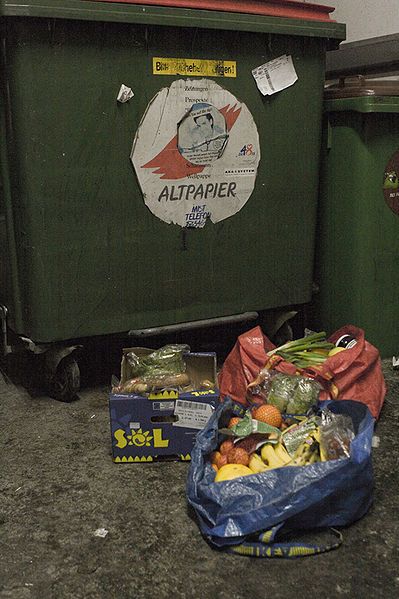 Austria is a
country in Central Europe.
Austria is a
country in Central Europe.
Cities and towns
- Graz
- Linz
- Salzburg
- Vienna
- Spittal an der Drau
- add more?
Dumpster diving
Although no longer uncommon in Vienna, dumpster diving is not a well known activity in rural Austria. Most waste in the country (even separated recycleables) is burned in (high-tech) facilities to produce heat and power. For this reason trash is not as big of an issue as is in many other countries.
In March 2009, there was an instance of poison being poured on to the food in the dumpster that belongs to a Hofer store in southern Vienna. Since some time the trash of almost all Hofer stores is effectively locked in outdoor cages.
In Austrian society, wasting food is considered a faux-pas, so there is a wide public acceptance of acts of extracting edible food out of the bins and dumpsters (even respect).
Recently, supermarkets started giving the expired food to so called "Social Markets" (Somas), where these expired grocery products are actually sold to people living below the existential minimum (which is appr. 700€ as of 2010). That's why less food ends up in dumpsters - public pressure through wide media coverage (ATV, ORF, OKTO TV, local radio stations) contributes to that.
Legality is a bit in the grey area. Generally, it is legal except when forbidden by a local law. Extracting goods out of dumpsters is not a crime, according to OGH (Highest Court of Austria). However, because of associations with poverty, some supermarket owners decided to lock their dumpsters or set up gates for protection from divers. In these cases, dumpster diving may be interpreted as illegal.
Most people dumpster dive quetly and when not in sight. Neighbors and/or police might by curious about your nocturnal activities, so take a valid ID just in case.
Video
Short films about freegans and dumpster diving in Austria: <videoflash>PWROOeLg8FY|300|250</videoflash>
<videoflash>EMeDnALEk0M|300|250</videoflash>
<videoflash>MqhKci8Yb5w|300|250</videoflash>
<videoflash>KYQkFTONtKk|300|250</videoflash>
<videoflash>qr0hoOQe2ak|300|250</videoflash>
<videoflash>C7eZCkqccbA|300|250</videoflash>
Good links
- freegan.at
- freegan!me - A community for freegans all over the world
- willhaben.at - second hand selling platform, has also a free, give-away section
Containernin oesterreich.jpg — Sigurdas
Vienna
Edit on wikiNamed dumpsters and map pins go stale. For current spots use dumpstermap.org and the live Trashwiki page. This chapter is culture, legality, and general practice — not a dumpster list.
Vienna is the capital of Austria.
Video
<videoflash>e9MCyRt_v04|300|250</videoflash>
Free food
VoKüs (Volksküche - people's kitchen)
Freegan food is prepared and served for free. Similar to Food not bombs.
Tüwi
Student house of the BOKU (University of horticulture) is home to a Vokü on the 1st Sunday of the month starting at around 3 PM. They also have a freebox with all kind of things, mostly clothes. http://tuewi.action.at/
uoqbon
A culture/info/art/community space offers a Vokü together with a local food coop on the third Sunday of the month with food ready by around 8 PM. Another coop offers a Vokü on every other Sunday from 8 PM in the same place. http://uoqbon.obda.net/
Freeshops
Via http://www.umsonstladen.at you can find freeshops in Vienna with their addresses and opening hours. For English, see Google translated version of the page.
Tüwi - don't forget about the student house of the BOKU which has a freebox with all kinds of things, mostly clothes. (It is also a home to a Vokü on the 1st Sunday of the month from around 3 pm.)
Free price
This is not free food!
Deewan
You can find a Pakistani restaurant (very good, self-service...) with a pay-what-you-want-model, i.e. you decide how much money you give! It is called Der Wiener Deewan and is situated on Liechtensteinstraße 10 (map). Their website is here.
Gagarin
There is also the Cafe Gagarin that has local specialities with a free price policy model, additionally it is a center for anarchist/bike people. It is at Garnisongasse 24, 1090 Wien and their website (in german) is cafegagarin.at.
Switzerland
Edit on wikiSwitzerland is a wealthy country which can offer some good possibilities for freegan opportunities.
Most notably, the Denner supermarkets tend to have accessible dumpsters, whilst others like Coop or Migros sometimes but not always keep them locked inside and send them away with the delivery trucks. Sometimes you can find the delivery truck or a cargo container unlocked and parked near the market. This happens in many cantons but not in all. Just check. The Geneva area for example seems to have more to offer for successfull dumpster diving in a sense of wider range of supermarkets available for diving, than some other areas in Switzerland. The dumpsters of gas stations are accessible almost everywhere.
Dumpster diving is illegal in Switzerland but as long as you don't make a mess it's quite unlikely to get arrested for it.
TV programms which covered food waste issue in Switzerland:
<videoflash>ONnLRckFxzs|300|250</videoflash>
<videoflash>aEktbxs_HV0|300|250</videoflash>
Links
- www.foodwaste.ch (covers dumpster diving in Switzerland and food waste related topics)
- Blick.ch: Der Müll-Protest
Liechtenstein
Edit on wiki Liechtenstein is a small state in between Switzerland
and Austria. It's a pretty rich country so you'll probably be able to
find good stuff.
Liechtenstein is a small state in between Switzerland
and Austria. It's a pretty rich country so you'll probably be able to
find good stuff.
2012.07 eurotrip Liechtenstein 02.jpg — Sigurdas
Denmark
Edit on wiki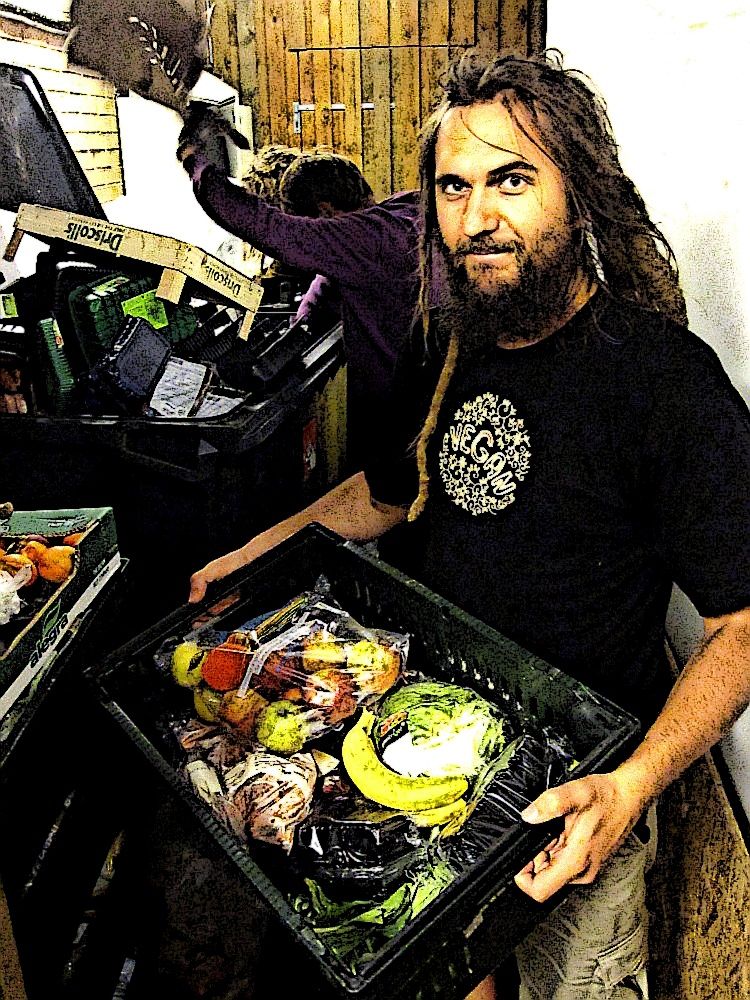 Denmark is a
pretty interesting country to do dumpster diving. It has to offer many
freegan opportunities.
Denmark is a
pretty interesting country to do dumpster diving. It has to offer many
freegan opportunities.
Dumpster diving
Legal status
It's not illegal to dumpster dive there as long as you don't do any trespassing; however, dumpster diving there is not legal either (as of December 2008, all is very much situational). If you do trespass and get caught in action, you can only be dismissed. If you jam up locks or do other kinds of vandalism, you could possibly be charged for it. The police can only charge you if you break anything.
Apparently, in Copenhagen police turn a blind eye to dumpster diving because they've got better things to do than harass dumpster divers. But in the provincial towns the story is quite different: if you are unskilled/unlucky enough to be caught in the act you'll get your name & identity number recorded; you can be warned and even fined (up to 500 Danish crowns, which is around 85$). If you are an ethnic Dane you stand a better chance of talking your way out of any unpleasantness, but if you are a foreigner you may find that cops are not terribly sympathetic.
There are quite a few Eastern & Southern European "seasonal workers" and such who do dumpster diving in Denmark.
Shop keepers tend to vary greatly in their acceptance of dumpster divers, some don't care at all, some bakeries even give away bread around closing time, and sometimes store clerks will give away perishables to friends and contemporaries. Others are less sympathetic, no-one puts rat poison in the dumpsters and in return most dumpster divers don't jam the locks on the gates and trashcans, very few trashcans generally are locked and those which are are broken.
Why was this item thrown out, it is still good for another x days/months/years...
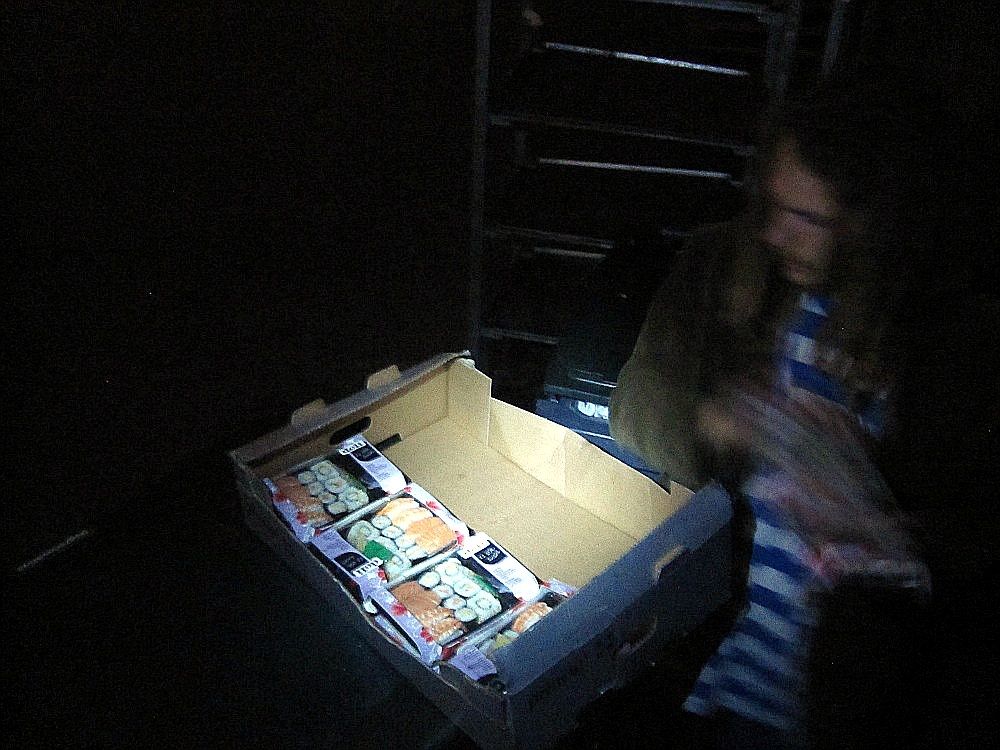 Generally, if
something gets dirty or (partly) damaged in some way or another, like a
bottle of wine in a box breaks and spills red wine over the other
bottles, all the the latter ones will either be drunk by the staff after
work or tossed in the trash depending on how loyal/honest/stupid they
are.
Generally, if
something gets dirty or (partly) damaged in some way or another, like a
bottle of wine in a box breaks and spills red wine over the other
bottles, all the the latter ones will either be drunk by the staff after
work or tossed in the trash depending on how loyal/honest/stupid they
are.
Don't abuse this fact however - surely, you can go into the store during the day and damage some produce or its package and then at night collect it from the trash the same night, but if you get caught, you might get charged with fraud which is a very serious offence in Denmark! Besides, you don't have to do that as there are enough clumsy people and enough stuff thrown away. You shouldn't get picky, it's more fun and more challenging to make something of whatever you find than obviously breaking the law!
Hygiene
Hygiene is important, remember to wash hands often when handling dirty food. See and share your own advice on specific food items here. In particular, Danish dumpsters usually have lots of meat, dairy products, fruits (bananas especially), vegetables, canned food and bottled drinks...
(Note: None of this advice should be taken as any guarantee that you won't get sick from eating dumpstered food, it's just some sage advice and a little experience from fellow dumpster divers.)
Alternative sources
Since a lot of food that would normally end up in the dumpsters, is redirected towards soup kitchens and other protection programs for vulnerable groups, so is the dumpster-divers attention redirected towards the most efficient use of those initiatives. There is a smartphone app called "udsat i danmark" that lists the location of many soup kitchens, homeless shelters, etc. Due to the equality enshrined in the Jante's Law, it's considered extremely offensive not to frequent such places, as even CEOs eat at soup kitchens at least once a week in order to avoid public shaming.
Links
- Skraldere - Facebook group uniting Danish freegans (in Danish)
- freegans.forumup.dk - forum for Danish freegans (in Danish)
In media
2011.08 CPH trashdigger vegan.JPG — Sigurdas
2011.08 CPH trash or food.JPEG — Sigurdas
Copenhagen
Edit on wikiNamed dumpsters and map pins go stale. For current spots use dumpstermap.org and the live Trashwiki page. This chapter is culture, legality, and general practice — not a dumpster list.
Copenhagen is a capital of Denmark and one of the most generous cities of the world to dumpster dive and find free stuff.
Food-Sharing-CPH
A grassroots initiative with the goal of organizing redistribution, meaning unconditional sharing, of food waste. We believe that this waste is public property and should be shared in a non-exclusive and non-commercial way. Our initiative is building upon the already existing initiative Foodsharing Germany. It has so far been successful with saving tons and tons of food waste and making it possible for more and more people to involve themselves actively in the issues of wasteflow. Visit their Website for more info about the events (twice weekly as for July 2017) and to sign up as a volunteer;)
Supper sharing
Let's Eat Together Copenhagen Facebook group is the place where to create an event to share your meal (if you have dumspterdived a lot for expemple) or to find events in Copenhagen where to eat togehter.
Freeshops
- There is one street freeshop (pictured to the right, below) on Pusher street in Christiania, accessible at least during summer months. Mostly clothes. (Last checked: August 2011)
- Floating City (situated around Frederiksholmslobet canal, at Landvindingsgade 16) has a freeshop. A lot of clothes. (Last checked: July 2012)
- add more?
Floating City
A small group of activists in Copenhagen created a project named Flydende By which means Floating City. It is based on a freecycle concept, and basically everything in Floating City comes from a waste. The general idea is to build an independent living area (mostly on water) from the things that others throw away. The activists from the project welcome other people to join them in the struggle for sustainable living and building, against alienating city planning and private ownership. A Floating City is an attempt to create a community/sociaty that is ” separate from the other world”. It is an experiment were alternative and creative ways of living are explored while never forgetting to have fun and the quality of life. You build your own living space, and can create and decide your own way of living. It's an international project, with emphasis on sustainability, and where people get together to form new ideas on how to build and make a community into physical and psychological stronghold of anti-capitalist ideas.
Anyone can join the project and live and work together with other volunteers. Kitchen food usually comes from dumpster diving.
As of 2012, the Floating City is situated around Frederiksholmslobet canal, at Landvindingsgade 16. There is also a freeshop inside, and a bicycle workshop.
Their website is www.flydendeby.dk.
Facebook: Flydende By-Floating City of Copenhagen.
File:2012.07 eurotrip Copenhagen II 09.jpg|One of the boats that was built by Floating City guys. File:2012.07 eurotrip Copenhagen II 07.jpg|Freeshop in Floating City.
Sweden
Edit on wiki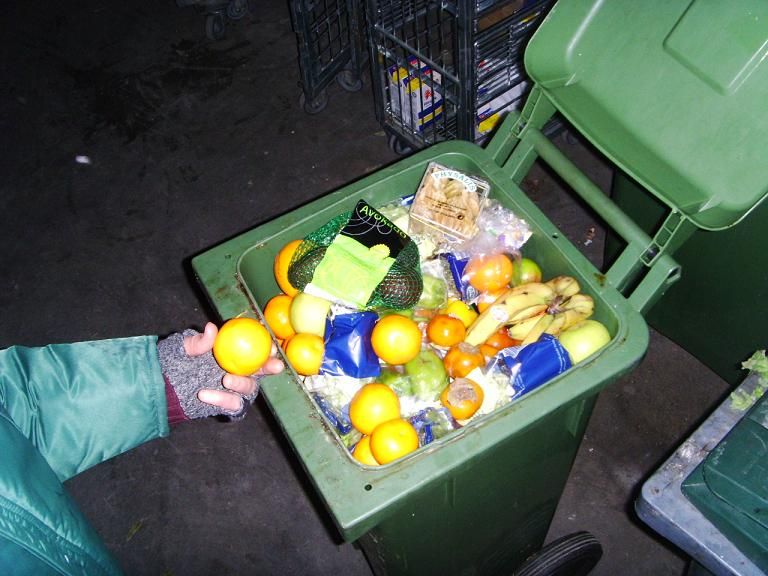 Sweden is one of the wealthiest countries in the world,
and it is no wonder that you can get basically everything there without
paying anything. Even though dumpster diving in Sweden is less possible
that in countries like United Kingdom, Germany and Denmark, it is still
doable if you know right places and right time to come to a dumpster.
Some succesfull divers manage to get most of their meals from
dumpsters.
Sweden is one of the wealthiest countries in the world,
and it is no wonder that you can get basically everything there without
paying anything. Even though dumpster diving in Sweden is less possible
that in countries like United Kingdom, Germany and Denmark, it is still
doable if you know right places and right time to come to a dumpster.
Some succesfull divers manage to get most of their meals from
dumpsters.
Besides dumpster diving, wild foraging is a great source of food even for those living in cities, as well as eco-events with their clothing/stuff swaps are a great way to get rid of old stuff while gaining some new one.
One of the greatest providers of stuff like furniture, clothes, appliances, etc. is a waste room called "Grovsoprum" in Swedish.
Clothes, books and some other items as well as hairdresser service can be provided for free during the Market Days organized by local Really Really Free Market movement activists - actually, you can organize such event yourself!
For more exact information on every city and town see template at the bottom of the page.
Grovsoprum
Those who live in apartments in Swedish cities often have a chance to sort out all of their trash. A good municipal solution to this is a so called grovsoprum - these are waste rooms where you leave all the things that are too big for usual trash bins (there are also containers for recycled things like glass, metal, paper, plastic, and various packages). Even though recycling-stuff containers do not attract freegans, other stuff being put in these rooms often is quite valuable as it can include different electronics (often still working), clothes, sheets, pillows, blankets, furniture, books, etc. - basically everything what people have in apartments. If you are lucky you might find, for example, a laptop still in working condition. It is not only about bulky or high-tech items, though, - if you are in need for AA or AAA batteries, for instance, and you have an access to a good grovsoprum, just go down there and check thrown away remote controls and other similar devices - they often contain good batteries.
Swedes, as well as Finns, Norwegians and Danes, throw away a lot. Nonetheless, to take stuff from a grovsoprum is officially prohibited, although it is not known if anyone ever got in trouble because of taking something from there. Another thing, though, is that a grovsoprum is always locked, and only people who live in nearby houses can unlock the door. Therefore, it is possible to get there if you yourself live around in one of the apartments, or you have friends living there who can provide you with an access to grovsoprum.
Image:2008 grovsoprum.JPG|A building that contains a grovsoprum. Image:2008 grovsoprum2.JPG|A locked door to the grovsoprum - only people who live nearby have keys to it. Image:2008 grovsoprum3.JPG|A rejected stuff. People throw away almost anything; very often many of electronic devices still work. Image:2008 grovsoprum4.JPG|Just emptied grovsoprum, otherwise filled with thrown away furniture, electronic devices, pillows, clothes, etc. Image:2009 dd day 47.01.jpg|This device is a useful tool in a kitchen. No idea why it was thrown away. Image:2009 dd day 49.01.JPG|A freegan in Stockholm found a small bike for children - right from a residential trash! Image:2009 dd day 48.01.JPG|Skies found in trash room.
Dumpster diving
You have good chances of finding quite nice food in the dumpsters of petrol stations along the smaller roads (the E4 is not a good bet for this). Supermarkets are hard to dumpsterdive in Sweden.
Legality
It is not entirely clear what the Swedish legislation says about dumpster diving practice. Some sources say you are allowed to take the content of a dumpster if it is not locked or if you do not have to violate the trespassing law (according to Swedish police, see reference; see also Stockholm City paper, choose 2009-06-01). Other sources say taking food waste from a container is seen as theft or shoplifting (according to Sven Lundgren, lawyer for Avfall Sverige (Swedish Waste Management), see reference). Although police in Sweden upon seeing you dumpster diving might simply check your ID and let you go (as in this case for example), there is at least one case of an arrest when two youngsters were arrested for dumpster diving in Umeå in January 2011 - they were suspected in an arbitrary act (egenmäktigt förfarande, see reference), which has little to do with the definition of theft: essential difference is that theft involves financial loss for those who have lost something, while an arbitrary act is to take something that does not involve financial loss (see more details at lawline.se, as well as blog post here). (It is not clear though how did it end for those youngsters.) In yet another case (see link) some divers in Dalarna region were caught by police and kept the whole night at the police station but released in the morning without any fine - police conclusion following lawyer consultation was that there was no real legal reason to arrest those who take a simple garbage (BUT only in case if waste is in the area which is accessible for everyone (i.e. no fence)).
Although climbing over a fence to reach an unlocked container would be considered a trespassing law violation, to take the contents of an unlocked container on the street does not imply same regulations. In other words, if you come from a perspective that a dumpster has an owner and the trash in the dumpster is owned by this owner, then theoretically it can be seen as some sort of law violation, even if it is not a theft, however, the status of the discarded goods is under question and barely has any real legal regulation, i.e. there are no specific laws about whether it is right or wrong to take what the owner has thrown away, which means that taking discarded vegetables from a supermarket dumpster can be seen pretty much equal to collecting cans from regular street trash cans. Such view is also confirmed by another case (see reference) when it went all the way up to a national investigation which in absence of existing laws concluded that the mere action of taking discarded goods from a waste container (which is not behind the fence or locked) can not be called a theft because 1) a product in question has no economic value on the legal market, 2) a product in question was permanently left without an intention for further use.
Beware of...
Beware of "Lidl": there was a case when "Lidl" employees poured a corrosive liquid, the equivalent of chlorine, on food that would be discarded, in order to keep homeless people away from dumpster diving (this case was filed for police investigation, and the managing director of Lidl Sweden called the incident "extremely regrettable").
Video
A short documentary with an interview in Swedish/English with a dumpster diver in Sweden:
<videoflash>MLEoGHXcYyA|250|200</videoflash>
<videoflash>7NGYBZtREPY|250|200</videoflash>
<videoflash>IMDFutULnCk|250|200</videoflash>
See also "Dumpster", a video reflection on dumpster diving in Sweden:
<videoflash>l-2ihrfwr-w|250|200</videoflash>
In this amateur film one can see how a freegan in Stockholm found food for 440 USD:
<videoflash>3HxkJ057VbQ|250|200</videoflash>
Gallery
Image:2008 dd day 010.05.JPG | Opening a container full of roasted soy beans, sunflower seeds, chocolate, etc. Location: the suburbs of Stockholm. Image:2008 dd day 010.11.JPG | Many of these tomatoes are still edible. Image:2008 dd day 010.12.JPG | So much food! Just take what looks better - one can't take everything just because it will be too heavy to carry it home.
Image:2008 dd day 010.04.JPG | Dairy products aren't even in a dumpster - just take and go! Image:2008 dd day 010.10.JPG | All this food could feed a whole family for weeks - instead, it is thrown away. Image:2008 dd day 010.17.JPG | Being a freegan, day 10 of documentation, Sigurdas' experience. Image:2008 dd day 016.04.JPG|Free food - a reality. Image:2008 dd day 016.03.JPG|Cup of coffee in the morning, fruit for the lunch... Image:2008 dd day 010.06.JPG | What a waste! Image:2008-freegan-day1.JPG|Found by Sigurdas in autumn 2008: cashews and walnuts (~2kg), organic cashews (~1kg), raisins (~5,5kg), berberis berries (~1,7kg), potatoes (~1kg), muesli (1 kg), Hot Taco Spice Mix (around 400g, for 40 servings), herbal salt, salad (250g), light soy sauce, orange marmalade, vitaminized syrup. In one night. In one place. Image:2008 dd day 010.14.JPG | Few boxes of roasted sunflower seeds, pumpkin seeds (eco!), roasted soy beans, and HUGE amount of chocolate! This was a part of a one night dumpster diving catch in Stockholm. Together with other food dumpstered that night it was worth 3500 Swedish crowns (440 USD)! Image:2008 dd day 015.03.JPG|Dumpster diver in action. In fact, in this case he didn't even have to "dive": all food was neatly packed in crates and boxes.
More pictures can be found under :Category:Sweden.
Freeshops and RRFM
Some cities have activists freeshops where one can take or swap different items. If you live in a place where there are no freeshops, you can organize it yourself: for example, you can throw a swap party at your place! Some places like Stockholm have quite a few such "Really really free market" (RRFM) activists who once in a while organize so called "market days" where various goods and services (wanna cut your hair? etc.) are provided for free to anyone who needs it. It is based on clothing (and other items) swap - you bring something you got tired of and you give it away to those who want it, and you take someone's something else you got excited about. Such a sharing event can be organized by anyone and anytime.
Image:Ak inte bort12.JPG|"Market day" in a park in Stockholm organized by local "Really really free market" (RRFM) activists (and connected to climate issues in this case). Hanging clothes are free for anyone to take. Image:Ak inte bort NICOLE2.JPG|Free books for everyone! (Stockholm)
Wild foraging
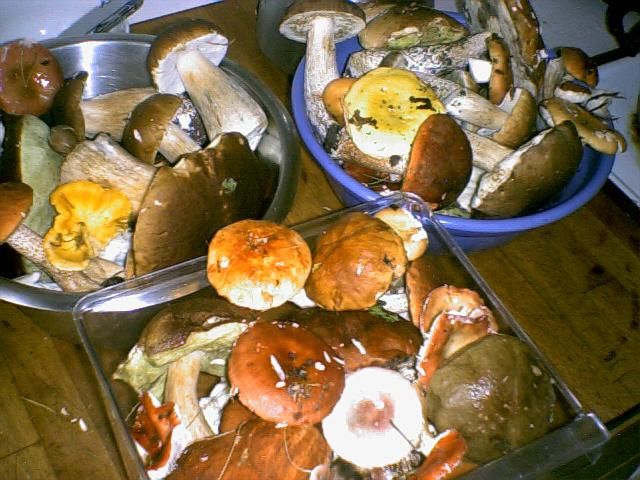 Most of the
Swedish territory is a forest. The forest is very rich in food edible
for humans. Even bigger cities like Stockholm are surrounded by such
forest - it might take you just 10 minutes of a bike ride to get to the
forest where in the season you can find plenty of edible herbs, berries,
and mushrooms. This treasure waits to be picked up: late spring, the
summer and the first part of the autumn can give you plenty of natural,
fresh and delicious vitamins and minerals - you just need to go out and
pick it up.
Most of the
Swedish territory is a forest. The forest is very rich in food edible
for humans. Even bigger cities like Stockholm are surrounded by such
forest - it might take you just 10 minutes of a bike ride to get to the
forest where in the season you can find plenty of edible herbs, berries,
and mushrooms. This treasure waits to be picked up: late spring, the
summer and the first part of the autumn can give you plenty of natural,
fresh and delicious vitamins and minerals - you just need to go out and
pick it up.
One of the most common things to find are berries like blueberries, lingonberries, wild strawberries, raspberries. You can also find Elderberrys in many parts of the world which have purple berries that can be made into jam or syryp, a word of caution is that these berries need to be either cooked (as in jam or syrup making) or somehow pickled to break down a slightly emetic poison in them.
This is the list of edible mushrooms in Sweden. Note that some edible mushrooms look very similar to those which are poisonous - you can take a mushroom and taste a bit of it to make sure if it is edible - if there is a burning feeling in the mouth, don't take it. Otherwise, the rule is: if you don't know the mushroom, never take it.
In shady and damp places you can often find ground-elder (Aegopodium podagraria) growing as a weed. The tender leaves can be used as spinach.1 You can also find horseradish growing wild. Stinging nettle (Urtica dioica) is a good source of vitamin C and makes a nice spring soup, but don't forget gloves when picking it. Garlic mustard is often found by the roadside, and its leaves can be eaten. Dandelion is also a nutritious and edible plant.
Links
All links in Swedish unless noted otherwise.
General information
- Dumpster diving, en handbok - dumpster diving guide, a.pdf file available for download (in Swedish)
- Dumpster diving | Freegan - ongoing documentation of dumpster diving in Stockholm, pictures+notes (in English)
- Sopdykning, en praktisk guide - a blog post, practical guide to dumpster diving
- Skräpmat: Troghetslagen - an informative blog post on juridical, ethical and other aspects of dumpster diving in Sweden
- Alternativ.nu - alternative lifestyle (live simply and consume less)
- Föreningen Sesam - grow your own food
- Tillväxt.org - Guerilla gardening (mostly for Stockholm's area)
- Containerdykning för nybörjare - Dumpster Diving 101 in Swedish
- Kontainerdykningskarta över Sverige - A try to create a map where one can add and hopefully see most dumpster diving friendly spots in Sweden
Blogs
- Frigan - Våga lev på överflödet! - Stockholm freegan collective, unites many bloggers
- Dumpster Grrl - The daily life of a dumpster diver in Stockholm. Dumpster Grrl also has a twitter-account
- Dumpstrat - a collective blog of several dumpster divers, with sections on related politics, recipes, etc.
- Skräpmat
- Dyk dig fri
- Skrot&Skräp i mitt Hjärta
- Dumpster Devil
E-groups
- Friganer i Stockholm - Google group uniting Stockholm freegans: tips, discussions... (Swedish/English)
- Friganer i Stockholm (Facebook) - Facebook group uniting Stockholm freegans: organizing meetings, sharing pictures...
- Dumpstra med oss (Facebook) - Facebook group uniting Sweden's dumpster divers, mostly from Stockholm area
- Dumpster Diver Troop (facebook) - Facebook group uniting mostly from the Uppsala area
Share and receive things for free
- Freecycle Stockholm - mail list: give away and receive things for free (English/Swedish)
- Bytessajten.se - swap things instead of buying them!
- Bortskankes.se - give away or find free stuff
- Bortskänkes/Bytes/Mottages 08-området - Facebook group for wishing/giving away things
- Utan Pengar - give away or find free stuff
- Synd att Kasta - give away or find free stuff
- iLoveGratis.se - give away or find free stuff
- Blocket-bortskänkes-hela Sverige - give away or find free stuff
- rensavinden.nu
- skänkes.se
- bjussa.se - Give away or find free stuff
2008 dd day 016.00.JPG — Sigurdas
Grybai2.JPG — Sigurdas
Stockholm
Edit on wikiNamed dumpsters and map pins go stale. For current spots use dumpstermap.org and the live Trashwiki page. This chapter is culture, legality, and general practice — not a dumpster list.
Stockholm, Sweden, is full of valuable stuff rejected by others. Dumpster diving can be relatively successful at times, although generally you will find most of the places with dumpsters locked or food being compressed in trash compactors; nonetheless, there are nice exceptions which can provide you with some part of your daily meal. Recent figures show that each Swede throws 100 kg of edible food every year, although it is mostly supermarket bins you dive in for food.
Stockholm is a relatively expensive city. If you don't want to pay for anything and live for free here, then your problem number one is accommodation: squatting in Stockholm is not common, and rent is pretty high. However, once you solve this problem, you can live really cheap if you make an effort. You can dumpster dive for food and use waste rooms (grovsoprum in Swedish) for getting a free non-edible stuff (clothes, furniture, electronics, various household items...). Furthermore, there are at least 3 good websites/e-groups for receiving stuff for free (see "Links" section), meanwhile Blocket.se is an online market where you can get things at half or so of its real price. Although not free, but still really cheap are second-hand stores "Myrorna" (see the list of its stores in Stockholm) where you can find great items (furniture, clothes, kitchen items, books...) for very little money - interesting thing is that you can often find clothes outside these stores if you check the place during its closing time: people are encouraged to donate things to Myrorna, and very orten you can see a pile of stuff in front of the Myrorna store (especially early in the morning), and no big harm is done if you go through this pile, though legality of that might be questioned.
In recent years dumpster diving in Stockholm has worsened a bit, however, Swedish forest around Stockholm will provide you with huge amounts of highly nutritional food (see "Wild foraging" section) if only you make an effort to gather free food from the nature, and preserve it.
If you want to meet alike folks (freegans), you can come to their open meetings that take place once a month or so - just follow the news of one of these groups: Facebook/Google.
"Grovsoprum"
Those who live in apartments in Stockholm have a chance to sort out all of their trash. A good solution to this is a so called grovsoprum - these are waste rooms where you leave all the things that are too big for usual trash bins (there are also containers for recycled things like glass, metal, paper, plastic, and various packages). Even though containers with recycled stuff do not attract freegans, other stuff being put in these rooms often is very valuable, including different electronics (often still working), clothes, sheets, pillows, blankets, furniture, books, etc. - basically everything what people have in apartments. If you are lucky you might find, for example, a laptop still in working condition. It is not only about bulky or high-tech items, though, - if you are in need for AA or AAA batteries, for instance, and you have an access to a good grovsoprum, just go down there and check thrown away remote controls and other similar devices - they often contain good batteries.
Swedes, as well as Finns, Norwegians and Danes, throw away a lot. Nonetheless, to take stuff from a grovsoprum is officially prohibited, although it is not known if anyone ever got in trouble because of taking something from there. Another thing, though, is that a grovsoprum is always locked, and only people who live in nearby houses can unlock the door. Therefore, it is possible to get there if you yourself live in Stockholm in one of the apartments, or you have friends living there who can provide you with an access to grovsoprum.
Image:2008 grovsoprum.JPG|A building that contains a grovsoprum. Image:2008 grovsoprum2.JPG|A locked door to the grovsoprum - only people who live nearby have keys to it. Image:2008 grovsoprum3.JPG|A rejected stuff. People throw away almost anything; very often many of electronic devices still work. Image:2008 grovsoprum4.JPG|Just emptied grovsoprum, otherwise filled with thrown away furniture, electronic devices, pillows, clothes, etc. Image:2009 dd day 47.01.jpg|This device is a useful tool in a kitchen. No idea why it was thrown away. Image:2009 dd day 49.01.JPG|A freegan in Stockholm found a small bike for children - right from a residential trash! Image:2009 dd day 48.01.JPG|Skies found in trash room.
Legality
It is not entirely clear what the Swedish legislation says about dumpster diving practice. Theoretically a dumpster diver can be suspected in an arbitrary act but most probably never a theft. See more details here.
Beware of...
Beware of Lidl: there was a recorded case in Solna (it is a municipality in Stockholm County, located just north of the capital Stockholm) when Lidl employees poured a corrosive liquid, the equivalent of chlorine, on food that would be discarded, in order to keep homeless people away from dumpster diving (this case was filed for police investigation, and the managing director of Lidl Sweden called the incident "extremely regrettable"). However, it is also known that quite a few Lidl stores (not only in Stockholm but in other areas (Uppsala...), too) have been putting (or still do!) a washing-up liquid on food in containers.
Places
There are many places to dumpster dive scattered over Stockholm. With some persistence you can get all the free food you need. Forget about expensive shopping.
Norrort
- Hemköp in Upplands Väsby (could be closed by now, verification needed)
- Lidl in Täby. Mostly vegetables, the food is often mixed with ordinary trash from the staff etc. (Last checked: Feb. 2011)
- Vi in Sjöberg Centrum (see map). Only bread, buns and other pastries available, the rest is kept inside the store. Dumpster with bread located behind the store. (Last checked: March 2011)
- Lidl in Jakobsberg. (Last checked: September 2012)
- Lidl in Märsta C. (Last checked: September 2012)
- ICA Nära Söderhöjden Frihetsvägen 50, in Järfälla. (Last checked: September 2012)
- Lidl in Skytteholm (Solna), next to Ankdammsrondellen (see map), is open for divers. Staff make rounds at the loading bay at times, so watch out. But you can find lots of good products (Last checked: August 2019)
- add more?
City (Norrmalm, Vasastan)
- PrisXtra at Norra Station. "Miljö.entreprenad" container sometimes used to throw away junk and unsold stuff (not food). You may find stuff off season, Chrismas candles in january for example. (Last checked: Dec.2011)
- For lunch we went to Kungshallen Food Court at Kungsgatan 44. So many people did not finish their plates that we could easily find enough leftovers on the trays. Only tried it once though.
- add a place?
Östermalm
- Kampementshallen Local store, usually throws lots of fruit and dairy products a. o. Easily accessible, just open the door in the wooden fence and help yourself to whatever is in the three dumpsters. No problems with staff, since they are rarely around. No neighbours to complain either.(Last checked Sep.2018)
- ICA Nära Gärdet at Furusundsgatan. Local store, four large bins around the back of the building. Toward the subway exit with elevator. Hint: it's easy to dive here and then carry stuff on to the subway. The store closes at 23:00, so a preferable time for diving is after 23:30.
''(Last checked: July 2019)
- add a place?
Kungsholmen
- Prisxtra at Fridhemsplan. Look for a public garage before 21 o'clock, enter via Kronobergsgatan 33. (Last checked: Oct. 2011)
- add more?
Lilla Essingen
- ICA Nära at Essinge Brogata. Three dumpsters by the loading bay on Disponentgatan, just around the corner from the entrance. The two green dumpsters closest to the street contain foodstuffs every night of the week. Ready-made salads and sandwiches, milk, coffe, eggs etc. The blue dumpster holds only plastic. Staff is sometimes friendly, sometimes not. They won't cause any trouble as long as the dumpster diver doesn't either. Keep it neat and clean! After 22:30 no one is around and it is safe to spend as much time as you like. The dumpsters are emptied at least every Wednesday morning/noon, but probably more often. (Last checked: Sep.2018)
Södermalm
- Lidl near Södra station, available for access only during the day; be sure to prepare to spend no more then 1 minute on a spot: employees are not particularly friendly. (Last checked: Aug.2009)
- add more?
Söderort
- Coop/Ica in Kärrtorp, very popular though. No dumpsters out since April 2014 (Last checked: April 2014)
- Skärholmen, the backyards of Ica Kvantum and Coop Extra [http://kartor.eniro.se/query?&what=map_adr&mop=aq&mapstate=8;17.91051745826685;59.27608956690965;h;17.906294589973605;59.27822037706983;17.91471943294951;59.27396304265658;625;596&mapcomp=;;;;;;;;;;;;;;0;0;;;;0&stq=0 (Eniro Maps)]; note that the entrance is under the big road, if you get off from T-bana go pass the Lidl store down under the bridge; sometimes the yards are closed, sometimes not, try different times. Please report here what time is best. (Last checked: Feb.2011)
- Årsta partihallar (map), industrial area with at least 3 containers with fruit and vegetables from wholesalers. (Last checked: Sep. 2011)
- Vi in Hagsätra. Once in a while one can find few veggies or fruits, but that's it. (Last checked: Dec. 2010)
- Lidl in Fruängen, one of the most popular places. Please be tidy and don't leave any mess after diving. ''(Last checked: November 2015)
- Lidl in Enskede, Bussens väg. Accessible with a triangular key, but sometimes one lock is left open and then you can easily open the other ones. ''(Last checked: Aug. 2012)
- Coop Årstavägen/Siljansvägen. Open door to the "soprum" feel free to take what you can find, but keep it neat and clean. ''(Last checked: August 2019)
- Lundbergs konditori in Gröndal. Close to the tram stop. Lots of good bread and bakery wares, especially on weekends. Ftree to access after closing (19:00). Sometimes many people moving around, but no one takes notice of dumpster divers. ''(Last checked: September 2019)
- Handlarn Ekensberg on the western promontory, north of Vinterviken. Close to the bus stop (line 133 from Liljeholmen). Unguarded dumpsters, easy to access after 21:30 but not very good results. One-time find: 21 bags of chips. ''(Last checked: September 2019)
- add more?
Västerort
- Lidl in Akalla, a relatively good place, although come late at night, since Lidl employees do not tolerate dumpster divers there. (Last checked: April 2012)
- Lidl in Spånga has locked bins but stubborn divers open them using a triangular key. Beware of rats! (Last checked: July 2011)
- Ica in Rissne has trash compactors, but in season they leave shelves of flowers and potted plants outside. (Last checked: May 2011)
- add more?
- Ica in Hässelby Gård has many containers where I found bread. (Last checked: March 2019)''
- add more?
Note that Coop in Bromsten (had many ecological veggies in its bins) has removed the bins (as of July 2011) . If you notice any changes, please edit here.
Ekerö
- Ica in Ekerö. One container which is accessible at least during the store's working hours. (Last checked: Aug.2009)
- add more?
Tyresö
- Lidl in Tyresö. (Last checked: May 2010)
- add more?
Värmdö
- Lidl and Willy at Värmdö shopping center. Accessible bins visible from parking lot. Notice that its best to visit after midnight while there are securitas guards patroling. The securitas office is right above the dumpster outside Willys, not clear how or if they will interupt, but good to be aware of. (Last checked: December 2010)
- add more?
Nacka
- Lidl in Orminge Centrum. (Last checked: May 2011)
- Cicada catering containers, 100 m from Saltjö-Järla station. Very messy, mostly cooking leftovers. (Last checked: 2009)
- add more?
- Ica Ektorps Centrum containers with lots of bakery bread and fruits (Last checked: 2017)
Botkyrka
- Lidl in Hallunda. (Last checked: 2012)
- add more?
Huddinge
- Handlar'n at Segeltorp in Huddinge, Orrvägen 2 (map); backyard, 1 dumpster. No luck dumpster diving food here lately.(Last checked: April 2014)
- Delicato factory between Segeltorps centrum and Fruängen, just outside the bus stop Mälarvägen. There's a big factory in a dumpster of which you can find unlimited amounts of chokladboll (chocolate balls). Occasional finds of additional stuff might occur in a form of custard, dried coconut flakes, chocolate - basically, you might find any ingredient used in production of chokladboll. LOCKED in 2014. Big padlocks and chains. (Last checked: April 2014)
- add more?
Markets
If you have no luck in dumpster diving at the supermarket areas, you can also check food markets where unsold fruits and veggies are thrown away at the end of the market. Check places at:
- Brommaplan - sources say it is really good for bananas and various vegetables. (Last checked: Aug.2009)
- Hötorget - Leftovers and trash go into a bin at the part of the square close to the cinema, it's an underground dumpster. Stand there and ask if the people throwing stuff wouldn't mind giving it to you instead. (Last checked: September 2012)
- Skärholmen (very active food market, although it is not known if there is anything left to pick up after it is closed)
Gallery
Some examples of dumpster dived food, as well as skipping in action, in Stockholms area:
Image:2008 dd day 012.02.JPG|A variety of produce that can be found in a dumpster includes even nuts. Image:2008 dd day 012.04.JPG|It is very convenient to have a bike (or a freight bike which is even better) when dumpster diving since one can attach quite some load to it. Image:2008 dd day 012.00.JPG|Snacks anyone? Image:2008-freegan-day1.2.JPG|Cashews and walnuts (~2kg), organic cashews (~1kg), raisins (~5,5kg), berberis berries (~1,7kg), potatoes (~1kg), muesli (1 kg), Hot Taco Spice Mix (around 400g, for 40 servings), herbal salt, lettuce (250g), light soy sauce, orange marmalade, vitaminized syrup. Image:2008 dd day3.2.jpg|Radishes, organic chives, pomegranate, parsley, 5 zucchinis, 5 persimmons, paprika, 5 bananas, 3 potatoes, apples (~2,5kg). Image:2008 dd day5.JPG|4 endives (chicory), grapes (lots), 1 grapefruit, 1 melon, plums, 2 pears, organic chives, 10 apples, juice concentrate (gives 48 l). Image:2008-freegan-day1.3.JPG|Cashews and walnuts (~2kg), organic cashews (~1kg), raisins (~5,5kg), berberis berries (~1,7kg), potatoes (~1kg), muesli (1 kg), Hot Taco Spice Mix (around 400g, for 40 servings), herbal salt, lettuce (250g), light soy sauce, orange marmalade, vitaminized syrup. Image:2008 dd day 7.JPG|Dumpster dived food in Stockholm: cauliflowers (both organic and not), broccolis (both organic and not), grapes, potatoes, oranges, kiwis, mandarins, apples, zucchinis, light zucchinis, cashews, organic tomatoes, Romaine lettuce, rutabaga Image:2008 dd day4.JPG|1 cauliflower, lettuce, bread (lots), crispbread, tomatoes, 2 apples. Image:2008-freegan-day2.3.JPG|Arabic coffee (1,5kg), potatoes (~1kg), melon, pineapple, tomatoes, spinach, apples, bananas. Image:2008 dd day 012.03.JPG| Yes, one can be fastidious even when dumpster diving. Image:2008 dd day5.2.JPG|4 endives (chicory), grapes (lots), 1 grapefruit, 1 melon, plums, 2 pears, organic chives, 10 apples, juice concentrate (gives 48 l). Image:2010 dd day 56.06.JPG|Diving in the northern suburbs... More food than one can carry! Image:2010 dd day 56.04.JPG|Diving in the northern suburbs Image:2008 dd day 8.2.JPG|Eating a vegan parsnip soup made from dumpster dived vegetables Image:2011.03 dd day 57.2.JPG|Dumpster diving in action, Stockholm, 2011.
More pictures can be found under Category:Stockholm.
Video
In this amateur film one can see how a freegan in Stockholm found food for 440 USD: <videoflash>3HxkJ057VbQ|300|250</videoflash>
Freeshops
- Student freeshop SöderS Byteshörna at Södertörn University in Flemingsberg (see map). You will find it on campus near Söders student office, see map. There are mostly books, clothes and shoes, kitchen and office stuff... Always accessable during university's open hours. See its Facebook page (in Swedish). (Last checked: Dec.2013)
- Vegetarian anarchist café called Kafé 44 (Tjärhovsgatan 46, near T-Medborgarplatsen) has a freebox (Last checked: Oct. 2011) This place has also good and cheap vegan food alternatives. You can meet many active and creative folks in this place - it is a good place to meet people to organize various freegan events.
- Rosenhills Café has a freeshop (Ge & Få butiken) at Ekerö, near buss stop Nyckelby. More info and opening hours: Rosenhill, blog (Last checked: September 2012)
- Kostnix freeshop at Lappkärrsberget (Lappis), cellar floor of Professorsslingan 39. Run by local volunteers and regularly visited by students living in the area. Open on Monday evenings 20:00-22:00. A short TV news report on Kostnix
- Swop.art has a freeshop, Saturday and Sunday 15.00-19.00 (Roslagsgatan 60). Mostly clothes, shoes and books. There might be a small fee of 40 SEK applied for enabling taking stuff. (Last checked: Feb.2011)
- edit page to add more
Image:2012 SU Freeshop.jpg|Freeshop at Södertörn University Image:450px-Kafé44.JPG|Entrance to Kafé 44 <iframe width="560" height="315" src="//www.youtube-nocookie.com/embed/qR_ZW0vvuTc" frameborder="0" allowfullscreen></iframe>
Used books
You can also find some free books at most of the Stockholm libraries which have a "Readcycle" box where you can leave a book and/or take another. Libraries with such a readcycle box are:
- Akalla bibliotek
- Alviks bibliotek
- Bagarmossens bibliotek
- Björkhagens bibliotek
- Blackebergs bibliotek
- Brommaplans bibliotek
- Enskede bibliotek
- Farsta bibliotek
- Gamla stans bibliotek
- Gubbängens bibliotek
- Hagsätra bibliotek
- Hjorthagens bibliotek
- Hornstulls bibliotek
- Husby bibliotek
- Hässelby villastads bibliotek
- Högdalens bibliotek
- Internationella biblioteket (Odengatan 59)
- Kista bibliotek
- Kungsholmens bibliotek
- Luma bibliotek
- Medborgarplatsens bibliotek
- Rinkeby bibliotek
- Serafens bibliotek
- Skarpnäcks bibliotek
- Sköndals bibliotek
- Stadsbiblioteket
- Sture bibliotek
- Tensta bibliotek
- Vällingby bibliotek
- Årsta bibliotek
- Älvsjö bibliotek
- Örby bibliotek
- Östermalms bibliotek
Stockholm has a small bookcrossing community (see bookcrossing.com) and the "Official Bookcrossing Zone" is at Espresso House, Vasagatan 17. Although this coffee shop in itself is far from alternative, this means that there is a bookshelf, close to the stairways, that is full of free books. The coffee shop is close to the central station.
- edit page to add more
Really really free market
Stockholm has lots of different kind of activists, and it is no surprise that there are "Really really free market" (RRFM) activists who once in a while organize so called "market days" where various goods and services (wanna cut your hair? etc.) are provided for free to anyone who needs it. It is based on clothing (and other items) swap - you bring something you got tired of and you give it away to those who want it, and you take someone's something else you got excited about. Such a sharing event can be organized by anyone and anytime.
Image:Ak inte bort12.JPG|"Market day" in a park in Stockholm organized by local "Really really free market" (RRFM) activists (and connected to climate issues in this case). Hanging clothes are free for anyone to take. Image:Ak inte bort NICOLE2.JPG|Free books for everyone! (Stockholm, Sweden)
Wild foraging
Stockholm is
a green city with lots of parks. What makes it more amazing, is that it
is surrounded by a diverse wildlife hiding back in ancient Scandinavian
woods. These forests, despite being situated right around the biggest
city in Scandinavia, contain treasures of free food that is waiting to
be picked up: late spring, the summer and the first part of the autumn
can give you plenty of natural, fresh and delicious vitamins and
minerals - you just need to go out and pick it up. For information (in
swedish) on edible plants, see skogsskafferiet.
One of the most common things to find are mushrooms like chanterelle and russulas, and berries like bilberries, lingonberries, wild strawberries, raspberries.
This is the list of edible mushrooms in Sweden. Note that some edible mushrooms look very similar to those which are poisonous - you can take a mushroom and taste a bit of it to make sure if it is edible - if there is a burning feeling in the mouth, don't take it. Otherwise, the rule is: if you don't know the mushroom, never take it.
Good mushroom hunting places around Stockholm are:
- Gömmaren nature reserve
- Nacka nature reserve
- Svartsjölandet (an island on Mälaren)
- Ekerö
- Drottningholm
- Forest around Gillingebanan
- Gålö
- Åva
- Tyresta National Park
- Grimstaskogen
In shady and damp places you can often find ground-elder (Aegopodium podagraria) growing as a weed. The tender leaves can be used as spinach (see info). You can also find horseradish growing wild. Stinging nettle (Urtica dioica) is a good source of vitamin C and makes a nice spring soup, but don't forget gloves when picking it (gather only young leaves, and only from the top of the plant). Garlic mustard is often found by the roadside, and its leaves can be eaten. Dandelion is also a nutritious and edible plant.
Links
All in Swedish unless otherwise stated.
General information
- Dumpster diving | Freegan - ongoing documentation of dumpster diving in Stockholm, pictures+notes (in English)
- Sopdykning, en praktisk guide - a blog post, practical guide to dumpster diving
- Skräpmat: Troghetslagen - an informative blog post on juridical, ethical and other aspects of dumpster diving in Sweden
- Alternativ.nu - alternative lifestyle (live simply and consume less)
- Föreningen Sesam - grow your own food
- Tillväxt.org - Guerilla gardening (mostly for Stockholm's area)
- Gratis i Stockholm - Free Stockholm events
- Containerdykning för nybörjare - Dumpster Diving 101 in Swedish
Blogs
- Frigan - Våga lev på överflödet! - Stockholm freegan collective, unites many bloggers
- Dumpster Grrl - The daily life of a dumpster diver in Stockholm. Dumpster Grrl also has a twitter-account.
- Dumpster Devil
E-groups
- Friganer i Stockholm - Google group uniting Stockholm freegans: tips, discussions... (Swedish/English)
- Friganer i Stockholm (Facebook) - Facebook group uniting Stockholm freegans: organizing meetings, sharing pictures...
Share and receive things for free
- Freecycle Stockholm - a mail list for giving away and receiving things for free (English/Swedish)
- Bytessajten.se
- Bortskankes.se
- Bortskänkes/Bytes/Mottages 08-området
- Utan Pengar
- Synd att Kasta
- rensavinden.nu
- skänkes.se
- ilovegratis
- Blocket-bortskänkes-hela Sverige
- bjussa.se
Norway
Edit on wikiNorway is an affluent country in Scandinavia. The dumpsters are full, especially of fresh fruits and veggies (mostly exotic like mangos avocados and bananas, tonnes of them but also of any other, from tomatoes to strawberries, blueberries, anything your appetite and taste may want).
Dumpster diving isn't commonly known in Norway. The winters in Norway can be really cold (which means a good "fridge" for dumpstered food). Check Wintertime diving for tips on how to dive in the winter/cold.
Take as much food across the border as you can possibly carry, but no worries, when you will have finished it the dumpsters will surely fill your stomach, prefer small villages and towns than big cities since there is more food and dumpsters are (almost) always unlocked; plus food like oat, flat "fullkorn" bread, cooked legumes in metal or tetrapak boxes like beans, chickpeas, lentils, etc are definitely cheap or at least affordable (around 1E per piece but often even less) and constitute a good way to buy something in order to "borrow" from supermarkets (since the security is not really active) the expensive food you need and can't pay.
 A few common
supermarkets in Norway are Coop, Kiwi, Rimi,
Rema 1000, Spar, ICA, Bunnpris.
A few common
supermarkets in Norway are Coop, Kiwi, Rimi,
Rema 1000, Spar, ICA, Bunnpris.
In Kiwi you can go on a hunt for vegetables or fruits that simply differ from others, then show the ones you found to the employees and eventually get the "proper" or new product - and sometimes even the "bad" looking one - for free. Also the cinnamon and vanilla buns are worth checking if they are expired, usually there is at least one bag amongst them - or ten. You however do get any expired product for free if you find it in Kiwi. As the supermarket does not want you to profit too much from it, you can barely find other things within the store nowadays. Furthermore the Norwegian government passed a new law in July 2014 according to which supermarkets are actually not allowed to give out expired products anymore. Kiwi seems to have a kind of special policy though. A few supermarkets and gas stations around smaller towns, especially further up North, will however still allow you to take their expired products if you are lucky.
Update summer 2016: it seems that getting expired food for free from Kiwi doesn't work anymore (at least in 1 supermarket where it worked a year ago). Dumpster-diving is still very possible.
Collecting bottles
Same as in the rest of Scandinavia you can collect plastic bottles and cans, take it to the supermarket and get money. For a can or small plastic bottle(500ml or less) you get 1Kr and for biger bottles you get 2,5 Kr so on the way to shop you can collect bottles and have enough money to buy some food if dumpsters doesn't work there. When you meet some event like a music festival you can earn good money wit collecting( more than 10 euros per hour is verry possible on outdoor events). You can give back only Norweigian bottles.
Links
Trashbooze.jpg — Astikain
Oslo
Edit on wikiNamed dumpsters and map pins go stale. For current spots use dumpstermap.org and the live Trashwiki page. This chapter is culture, legality, and general practice — not a dumpster list.
Oslo is the capital of Norway.
Inner City
- Kiwi at Gøteborggata 31A has dumpsters right around the side from the main door. Easy to see. Filled with goodies. [last checked: August 2019]
- At Grunerløkka there is a decent Rema 1000 dumpster, on Thorvald Meyers Gate. Enter the alley between Rema 1000 and 7/11 and stroll around the corner in the inner yard (see map/view). [Last checked: April 2011] REMA STILL THERE; 711 GONE; DUMPSTERS COULDN'T BE FOUND-->
- At Aleksander Kiellands Plass, there is a very good ICA store. You enter a room behind the mall, and the small dumpsters are full of fresh food, fruit and vegetables. UPDATE: room locked by keypad and cannot be accessed by the public [Last checked: August 2019. No dumpsters found]
- Just behind Sagene church (bus 37 or 54) there is a Joker which some times have bread and pastries outside the front door, and general food in one big and one small trash can inside the open "bygård" on the back. *UPDATE: dumpsters now have locks on them, so it’s unlikely to find them unlocked. Address: Dannevigsveien 7L. Opening hours: 8:00 - 23:00 (mon-sat), 9:00 - 23:00 (sun). [Last checked: August 2019]
- Just behind Sagene church (bus 37 or 54) there is a large "innvandrerbutikk" (walk to Joker and take to the left in Grimstadgt.) with two big trash can inside the open "bygård" on the back. Often lots of fruits and vegetables, sometimes bread and børek. [Last checked: August 2019]
- add more?
Links
Finland
Edit on wikiFinland is generally good for dumpster diving, even though Finnish dumpster divers on FB do not seem overly enthusiastic in sharing dumpstering spots of grocery stores.
It happened to divers to find sometimes in the dumpsters chemical products or broken glass: dive with care!
Food
Let’s Eat Together community! Through this group you can invite friends and strangers to eat or get an invitation to eat from others in the Helsinki area:
Dumpster Diving World Map
If you want to modify the map just email: firnahead at gmail.com
For more exact information on every city and town see template at the bottom of the page.
Transportation
Bicycles
HELSINKI - Where to buy a cheap bicycle:
OR
- on a online second hands website (look bottom)
Recycling
Stuff
There are a few establishments in Finland for getting rid of your surplus stuff:
- Since the early 1990's depression, for many folks flea markets are a favorite way of getting extra cash while getting rid of unwanted possessions.
- In most Finnish cities, used (and preferably clean) but still usable clothes can be dumped into big yellow UFF containers (in Central Europe operated by Humana).
- "Fida International" (see contact details of all Finnish "Fida" stores), a Christian charity organization, both accepts donations from individuals and picks up (for free; appointment has to be set up) anything still valuable you want to discard (furniture, clothes...).
- Recycling centers ("kierrätyskeskus") accept and collect donations but charge for items you want to take back home
Helsinki
Online second hands websites
- www.huuto.net
- www.tori.fi
- www.netcycler.fi
Bottles and cans
- Most glass, aluminium and plastic beverage bottles bought from supermarkets can be recycled - bring them back to any supermarket and you will get compensated 15 cents for cans, 10 cents for glass bottles, 20 cents for 0.5L plastic bottles and 40 cents for 2L plastic bottles. Collecting bottles during or after large outdoor events can result in reasonable cash.
- Bottles and cans from Lidl have the same deposit as those from other stores, but they can only be returned to Lidl.
- Wine and hard liquor can only be bought from "Alko" stores; bottles of these should be recycled there since there is no compensation for these at supermarkets.
- Foreign-bought items have no deposit money to return. However, you can give them back to any supermarket for recycling.
Hitchiker´s personal experiences
: In developed countries I am used to live only from dumpsters but in Finland it didn´t work for me. I hitchhiked from total Norweigian borders to Helsinki and I haven´t found any open supermarket dumpsters in whole country. I spent in Finland only 5 days so i don´t want to edit main article but I strongly recomend you to bring enough food from Norway or some other place because in Finland you will not find a lot.- information from summer 2017
External links
(all in Finnish unless otherwise noted)
- Finnish Wikipedia on dumpstering
- Finnish Wikipedia on freeganism
- Recycling tips
- Google "dyykkaus" for some more dumpster diving tips in Finnish
- Pippi's Dumpsterdiving Club pictures from Åland dumpsters, 40 Min. European dumpsterdiving video, "Earthlings" documentary, all in english
- A Finnish dumpster-diver Marko Vanhanen shares his catch in Youtube.
- Finnish dumpster divers FB group
Media
- TV report on NYC dumpster divers
- [http://www.turunsanomat.fi/kotimaa/?ts=1,3:1002:0:0,4:2:0:1:2004-08-26,104:2:246616,1:0:0:0:0:0: Turun Sanomat]
- "Robin Hoods of Dumpsters" by Karjalainen
Books
- Siltala-Huovinen, Tarja: Roskisdyykkarin käsikirja (Like Kustannus) ("Dumpster-diver's Handbook") Some reviews
Helsinki
Edit on wikiNamed dumpsters and map pins go stale. For current spots use dumpstermap.org and the live Trashwiki page. This chapter is culture, legality, and general practice — not a dumpster list.
Helsinki, the capital of Finland, offers many opportunities for freegans. Stading Aikapankki is a Community Exchange Timebank where you can exchange services with local currency Tovi. Kallio Sharetribe and KuinOma are examples of services that help you exchange, loan out and give away stuff. Dumpster-diving is a tad more difficult but there are accessible bins here and there. Besides, Finnish winters help to keep even dairy and meat produce freshly frozen.
Markets
- The Hakaniemen Kauppahalli (Hakaniemi) wastes food every day, although most stuff is thrown away on Saturdays as they are not open on Sundays. Especially the bakeries are worth asking. Be there at least half an hour before closing time. Mondays to Fridays it closes at 6 pm, Saturdays at 4 pm.
Suppers together
- Let's eat together - Facebook group where you can just go to eat at someone's else place (Helsinki group, but everybody can open new groups in any city!)
Discounted food
Froodly it's an app that shows you where to get discounted food, for the moment it's just working in Helsinki and you can't get stuff for free, but with time it may be popular in other countries and could incentive Supermarkets to give away food nearly for free (hopefully even completely for free!)
Iceland
Edit on wikiIceland can offer some excellent opportunities to skip, especially in Reykjavik where you can skip nearly everything, from toilet paper to tofu. Besides the capital of Iceland, there are a few other towns like Egilsstadir or Kópavogur or Akureyri where getting certain food like vegetables or fruit is possible, too. In villages or at gas stations and the hotels along the big road (A1) around the whole island dumpster diving is nearly impossible though.
Most of Iceland's surface is wilderness. There are only few towns and you have to travel very long distances from one skip to the next.
Icelandic supermarkets
"Bónus" is the large Icelandic supermarket chain that has at least one store in every Icelandic town. Usually you can find three or more skips full of all sorts of produce. The most common finds are vegetables and fruit. There are lots of "Bónus" stores in Reykjavik, and the store in Egilsstadir is also very good for skipping. There are also opportunities at other stores, however "Bónus" stores have the easiest pickings.
Street vendors
Many vendors don't care when people take their waste and hence dumpsters are not locked up and are easy to reach. That might also be because vendors in Iceland are not used to people taking away their waste. So there is a lot of room for creative communication between dumpster divers and vendors. Experience have shown that freegan-oriented folks in Reykjavík have managed to talk in some vendors to give some food away to them instead of throwing it away.
Places
- Akureyri
- Egilsstaðir
- Hveragerði
- Ísafjörður
- Kópavogur
- Reykjahlíð
- Reykjavík
- Selfoss
- add more?
Personal experiences
- Spent 12 days hitchhiking around Iceland in January. There was an over-abundance of dumpsters whenever there would be a supermarket (BONUS, Kronan, Samkaup, and Netto were nice) around. We looked through some Gas Stations dumpsters too, but never found anything. The only place where we had troubles was in Hofn, where employees told us not to dig through the dumpsters, and we ended up talking to the manager: he claimed that he was selling the content of that specific dumpster to a farmer that would eventually feed it to his pigs. A passer-by also called the police (cops ended up being very friendly and supportive of the activity). Selfoss, south-east of the capital, is the best place you can think of: 3 great massive supermarket dumpsters all aligned on the main highway that goes through it. If you really want to make it through Iceland for free, it might be a good idea to bring a 'food bag' along so that you can collect decent quantities of food to have a back up for whenever there will not be supermarkets around (small villages lack those, some times, in Iceland). We ate a lot of stuff that was expired for more than 2 weeks but was totally fine. The temperature in January most probably helped a lot to preserve the things further when left outside in the dumpsters. The 'Netto' markets seem to be less favorable to the diving practice and some times has locked dumpsters. All in all, Iceland was an amazing dumpster diving experience and I would disagree with the 'nearly impossible' claim of the intro to this page. --Payne (talk) 11:34, 3 February 2017 (CET)
Faroe Islands
Edit on wikiThe Faroe Islands are a paradise for dumpster divers. You'll have to look for supermarkets since there are not many outside the capital region, but if you find a dumpster, it is usually not locked. Since there are not many people living here, nearly nobody does dumpster diving. Diving is recommended during the night since people there are not used to it at all - if you don't make anybody feel uncomfortable, the dumpsters will probably remain unlocked.
Cities
- Torshavn
- Midvagur
- Vestmanna
- add more?
Spain
Edit on wiki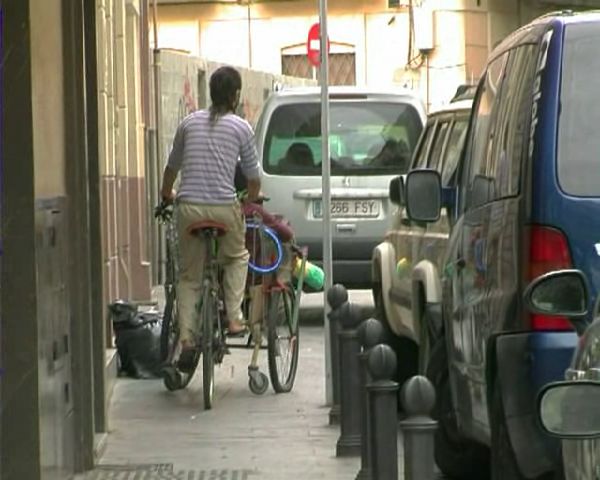 Spain has a general reputation of being a wonderful
country for dumpster diving. This is somewhat surprising since, due to
hot weather, messy containers and prevalence of small businesses it is
not actually much better (likely worse) than many other places in Europe
and North America.
Spain has a general reputation of being a wonderful
country for dumpster diving. This is somewhat surprising since, due to
hot weather, messy containers and prevalence of small businesses it is
not actually much better (likely worse) than many other places in Europe
and North America.
For a lot of people living in Spain dumpster diving is a usual part of their daily life, so don't be surprised to meet a lot of dumpster divers when the night falls down in a city before the trash picking service come to collect the garbage.
There are many food markets which will provide you with great food at closing hours. You can also try asking in smaller grocery shops - owners/employees often are happy to give you the remains of the day. This only works though if you have a basic command of Spanish, because the people working there tend to speak virtually no English.
It is difficult to find good food diving in containers of chain supermarkets in Spain. You can try these for skipping your food: Caprabo, Carrefour, Dia, Lidl, Mercadona, Veritas (organic food). In Spain are some filials of the British Iceland (store) Supermarket, it is mostly easy and you find a lot in the bins of these stores.
Spanish people tend to just leave on the street the stuff they don't want anymore. In the case of clothes, they will often leave them clean and neatly folded on top of a trash container.
Runingarden.png — PiaRedondo
Madrid
Edit on wikiNamed dumpsters and map pins go stale. For current spots use dumpstermap.org and the live Trashwiki page. This chapter is culture, legality, and general practice — not a dumpster list.
Madrid, a capital of Spain, offers some good opportunities for dumpster diving as well as other freegan possibilities.
Markets
- Mercado de la Cebada: This Market is located in La Latina Metro station. There are a lot fruit and vegetable stores and some bakeries where you can ask. Around half an hour before the market closes you can get a lot of stuff, specially on Mondays, when they receive new products.
Free food
There are many so called comedores (canteens) in Madrid, many are run by religious institutions. These are dining rooms for those in need. The food quality varies. Some offer meals, but most offer a well filled baguette with some biscuits along with a coffee. Some only offer a take-away facility. Some will also require a registration, where you will be issued a card. Queues tend to be long, depending on the location.
Free transport
Black-riding map list of metro of madrid (I tried to add it to nomadwiki, but I couldn't, so feel free to add it if you have a profile) Also feel free to add more accesses and stations and to translate it:)
Linea 1
Plaza Castilla --> acceso Castellana, pares (sin personal) Tetuán--> acceso general Margallo (sin personal) Estrecho --> acceso Manuel Luna y acceso Fulgencio de Miguel (casi siempre sin personal) Tribunal --> acceso Fuencarral (sin personal) Sol --> acceso calle preciados - zona comercial (casi siempre sin personal) Tirso de Molina --> acceso calle Magdalena (casi siempre sin personal)
Línea 2
Goya --> acceso Felipe II (a veces sin personal, excepto días de evento en el Wizink) // acceso c. Gral. Diaz porlier/Centro Comercial/Ascensor (sin personal) Santo Domingo--> acceso Gran Via (sin personal) Noviciado (y plaza españa L10) --> acceso Noviciado (sin personal) // acceso ascensor (sin perdonal) Banco de España--> acceso Marqués de cubas y calle barquillo (sin personal)
Línea 3
Embajadores --> acceso Ronda de Valencia (sin personal) Argüelles --> acceso altamirano (sin personal)
Línea 4
Argüelles (ver L3) Goya (ver L2)
Línea 6
Nuevos ministerios --> acceso Centro Comercial, dirección línea 6 (sin personal) Argüelles (ver L3) Laguna --> acceso Ascensor (casi siempre sin personal)
Línea 8
Colombia --> acceso .… (a veces sin personal, saltar barandilla (alta) que te encuentras de frente según entras a la estacion) Nuevos ministerios (ver L6)
Línea 9
Plaza Castilla (ver L1) Colombia (ver L8) Ibiza --> único acceso (con personal pero en la garita casi todo el tiempo; pasar x el torno de la izquierda)
Línea 10
Tres Olivos --> único acceso (casi siempre sin personal) Begoña --> acceso (el del barrio) chekear Plaza Castilla (ver L1) Nuevos ministerios (ver L6) Tribunal (ver L1) Plaza españa (ver Noviciado L2)
Barcelona
Edit on wikiNamed dumpsters and map pins go stale. For current spots use dumpstermap.org and the live Trashwiki page. This chapter is culture, legality, and general practice — not a dumpster list.
If Barcelona is The Biggest Shop in Europe, then, certainly it has the biggest dumpster.
Barcelona, Spain, is an decent city for recycling and dumpster diving. With all its squat/alternative culture, the freegan lifestyle ideas have been long popularised, and it seems like the biggest issue now might only be the queues of hungry dumpies. For Barcelona it's an effective method to go into the markets and ask if they have anything old to throw away. In Spanish/Catalan of course!
For vegans and vegetarians a great option is dumpster diving at a chain of falafel places called "Maoz" - you can find it also in a very center of the city.
Markets
- The (La) Boquería Food Market - Just off the Ramblas is a famous food market in Barcelona. It is great for dumpster diving. There are various big containers located behind the market. It is the central place where un-sold food is stored for dumpster divers. Sometimes you can find quite some colegues here and regular dumpster diving can turn into a happy fiesta with music and dances. Best hours: 7.30pm-9.00pm
- Mercat Abaceria - c/de Piugmarti, Gracia, Metro Diagonal, Fontana or Joanic. A great market for dumpstering fresh fruits, veggies, meat and fish. Food is thrown away in big containers on the opposite site of the market if you're coming from Travessera de Gracia. The dumpster site is open at certain times. The best time to come is between 12.00 and 14.30, or around 21.00. (Last checked: Sept.2009)
Supermarkets and small shops
Most supermarkets trow their leftovers away in containers in front of the supermarkets right in the street. Smaller shops like bakeries and coffee-houses do the same. Most bins also carry the names of these shops. You often meet fellow-divers when diving in dumpsters close to popular and crowded streets. Fruit shops throw away a lot of fruit and vegetables in the morning on Mondays, as well as during the day. You can also come there any time, but better before closing and ask for some fruit and vegetables, most of the sellers will share some!
Finding household items and such
In numerous dumpsters of Barcelona you can easily find brand new clothes, shoes, bags, furniture, building supplies... Just wander the streets and you will quickly find all you need!
When flats of people who have left or died are being emptied, all their stuff (except bulky items) is put in the street packed in bags. It is common to go through these bags and take what you need. It is impossible to predict where this will happen, you just have to be at the right place at the right time. Most of the time, the contents of the bags tend to be an old-fashion stuff (since most people who die naturally tend to be old).
Often you'll find clothes (washed and folded!) waiting for you in the bags you see next to the garbage containers. Also, there are people who hang food from the side handles of the garbage containers.
There is actually a certain day in every area when most things are thrown away since the city council set a certain day for every area/neighborhood so that the city recycling service could go and pick it up. So if you go out around the area during these days (depending on area, it usually is Monday or Tuesday, in some areas perhaps some other week day) from around 9pm to 11pm (you can still find things in later time but the service trucks might have already passed by and taken some of the stuff away) you'll find lots of stuff like lamps, clothes, even furniture just laying around waiting for you to pick it up.
Food Cooperatives
There are several self-organized food cooperatives in Barcelona. These cooperatives create a viable alternative to the supermarket driven economy, and are organized on a neighborhood level. They work with rotating shifts with different people taking care of different tasks each time. They often have connections with several small farmers in the area around the city and bring in food once a week. Often, the food is organic but the farmers don't have the money to get an official certificate.
Valencia
Edit on wikiNamed dumpsters and map pins go stale. For current spots use dumpstermap.org and the live Trashwiki page. This chapter is culture, legality, and general practice — not a dumpster list.
Valencia, Spain, is THE citrus land providing all Europe with oranges, clementines, mandarins and lemons; plenty of tree-fields surrounding all the north side, at least until Sagunt. (last check nov 2012)
It is hard to find food behind bigger stores, but getting fruit and vegetables is rather easy if you ask the small "frutas y verduras" shops if they have anything to throw out, they are everywhere and mostly run by friendly immigrants. Same goes for the markets, there is a big one in the center and some smaller ones. Try: "Hago reciclaje. ¿Tienes algo que vas a tirar?"
One of the shops with fruit and vegetables has a lot of good food on Sundays. The address: Arquitecto Arnau, 8. Go there before the closing hours.
If you need clothes or shoes, just take a walk occasionally peeking into the bins. Surely you'll find a lot of stuff. There are also some squats with free shops, or "tienda gratis".
Portugal
Edit on wikiPortugal is the EU and Schengen country at the farthest West of continental Europe. It shares the Iberian peninsula with Spain and has no other land-borders.
Portugal has a mild-to-hot climate, which is perfect for growing a myriad of wonderful produce, like figs, avocados, plums, melons, and clementines. On the Portuguese islands, Madeira and Açores, pineapples and bananas grow, that you can simply collect from the trees while hiking (if you can manage to climb!).
There are many inexpensive frutarias (fruit shops) throughout all major cities in Portugal, which sell locally-grown fresh fruit, seasonal nuts, dried beans, and sometimes a few other items, all at very modest affordable prices. It's possible that these shops could throw things away, but the turnover of what gets sold is so high that many simply run out of everything by the end of the day. Others simply lower the prices of less-than-perfect fruits and vegetables and continue selling them.
Similar to these small shops are much larger farmers' markets, like Bolhão, a covered market in central Porto. You might have more success trying to dumpster around closing time (4 PM-ish), simply by asking the vendors (in Portuguese!) if they have anything to throw away. While the vendors may be kind and understanding, many urban Portuguese care a lot about social status and might not want to be seen with you while you ask this, unless they are really alternative or simply don't care about their image. They'll say that fruit is so cheap throughout the country that they can't be bothered not to pay for it, and support their hard-working farmers.
It's also fairly universal that outside of cities, most homes have extensive gardens or farms through which they can be self-sufficient. Many produce their own wine, olive oil, and honey, as well.
Aldi works quite good for dumpsterdiving in Portugal.
Cities
- Albufeira
- Lisbon
- Porto
- Sines
- Viana do Castelo
- add more?
Lisbon
Edit on wikiNamed dumpsters and map pins go stale. For current spots use dumpstermap.org and the live Trashwiki page. This chapter is culture, legality, and general practice — not a dumpster list.
Lisbon is the capital and largest city of Portugal.
Please keep in mind that there is loads of unemployement, poverty and homelessness in the city, and in many of these places there is other people eager for the leftovers. Said that, many, many dumpsters are left untouched, with good food getting wasted every day.
Food markets
In Lisbon, like in most towns in Portugal, there are many vegetable markets, where small vendors sell fruits and veggies that come directly from producers. They are usually open every day, until 1pm or 2pm.
It's good to pass some minutes before the closing stress, and ask vendors for things they won't sell (although some will tend to give you stuff that they are not even throwing away, out of charity). Good spots are Mercado da Ribeira, in Cais do Sodré, Mercado de Arroios, close to Arroios metro station, or Mercado de Benfica.
Here is a http://www.cm-lisboa.pt/viver/comercio/mercados list of all markets in Lisbon, with opening hours (in portuguese).
Useful phrases (basic Portuguese would be useful):
- "Something to throw away" = "algo para deitar fora?" or "algo para o lixo?" ("alg prolish" [rough pronunciation])
- "Do you have fruits or veggies you are not selling anymore?" = "Tem frutas ou legumes que já não vai vender?"
Bakeries
"Padaria Portuguesa" is a recent bourgeouis bakery chain, which gives the leftovers for charity, but will still give you some (or loads, depending on the day) if you pass by at closing time. Each shop has different closing hours, but the most common one is 8 pm.
"Eric Kayser" is a very expensive bakery chain. In Rua dos Carmo you find one, and they throw their stuff in dumpsters placed in the stairway next to the shop. You will find bread and pastry. They close at 8.30 pm (to be confirmed)
Paul's bakery on Rua Augusta 142, throws out a huge sack of really good baguettes (not filled, but some with seeds and olives), possibly every day. Closes at 10, go around 10.45. They don't seem to mind people taking them.
Other freegan opportunities
Portuguese are addicted to big shopping malls. They are everywhere and they are great places for table diving. Colombo (metro Colégio Militar), Vasco da Gama (metro/train Oriente), or Armazéns do Chiado (smaller one, but the only one in the centre), are good examples.
There are great "table diving" opportunities at the food court at the Oriente shopping center. Portuguese mostly have lunch at the same fixed time daily so just go then and there will be a lot of things for scavenging.
This is also true for the Pingo Doce cafes where left over food is often left on plates on trays in the racks for a while. (Last checked: October 2010)
Flea market
There is a flea market called "Feira da Ladra" every Tuesday and Saturday in Campo de Santa Clara, near the Santa Apolónia train and Metro station.
Porto
Edit on wikiNamed dumpsters and map pins go stale. For current spots use dumpstermap.org and the live Trashwiki page. This chapter is culture, legality, and general practice — not a dumpster list.
(Veja abaixo as informações em português. | See information in Portuguese below.)
Porto is the second biggest city in Portugal.
Food markets are good places to get vegetables and fruit, in reasonable quantities.
Amylin saw some older women going through the dumpsters in downtown Porto one late-afternoon (info as of 2008). One was holding the lid open and the other was digging stuff out. Amylin didn´t ask though if they were dumpster diving for food or looking for anything specific. This was in an area with a lot of dumpsters, though... and two supermarkets: "Minipreço" and "Pingo Doce", as well as a lot of shopping malls around.
_______________________________________________________________________________
Português
No porto recicla-se normalmente comida juntos dos Pingo Doce's. Por vezes ha supermercados que PROTEGEM os contentores do lixo, com grades e portões... e os seguranças, quando os ha a marcar territorio, são um bocado chatinhos.
O mercado abastecedor também é um bom sitio para se arranjar vegetais e fruta, em razoaveis quantidades. E em alguns mercados locais (Bolhão. por ex.) não é dificil arranjar quem "dê qualquer coisinha que já não esteja muito boa para vender".
Andorra
Edit on wikiAndorra is a tiny state in the Pyrenees, between France and Spain. Rich, so probably possible to find edible trash.
Italy
Edit on wikiItaly is a rich country in Southern Europe.
In 2000, a law was issued which declared dumpster diving to be legal.
Rome
Edit on wikiNamed dumpsters and map pins go stale. For current spots use dumpstermap.org and the live Trashwiki page. This chapter is culture, legality, and general practice — not a dumpster list.
Rome is a capital of Italy.
Actual spots
- If you are near Roma Termini train station, you can ask how to go to San Lorenzo district. Or just go on Via Marsala, turn left when there is Via Tiburtina and turn right before supermarket Tuodi to the street Via degli Umbri, just first three containers on the right, around 12 or 13 o'clock you can find sandwiches there in big black plastic bags. If you have some extra, bring these to Piazza dell'Immacolata to the homeless people, this is old tradition. (Last checked: October 2015)
- If you continue walking on Via Tiburtina, then on the other side of the street from Tuodi supermarket you can find some pizza in the container around ten o'clock in the evening. Also around the same time you can find pizza on Scalo San Lorenzo. Just check the dumpsters in front of pizzerias. (Last checked: October 2015)
San Marino
Edit on wikiSan Marino is a city state inside Italy.
Unclear if it's possible to dumpster dive here.
Malta
Edit on wikiMalta is an European island nation in the Mediterranean.
Localities
- Valletta
- add more?
Czech Republic
Edit on wikiCzech Republic is a country in Central Europe. It can offer some opportunities for freegans, at least for those who seek. For sure you can find places for recycling in big cities but supermarkets have usually dumpsters locked so it's much harder to find an open ones than in western europe.
Cities and towns
- Brno
- Hrádek nad Nisou
- Prague
- Usti nad labem
- add more?
Prague
Edit on wikiNamed dumpsters and map pins go stale. For current spots use dumpstermap.org and the live Trashwiki page. This chapter is culture, legality, and general practice — not a dumpster list.
Prague is the capital of the Czech Republic as well as its biggest city.
Česky (in Czech)
- Na Palmovce v Bille ve všední dny - před 12h, pozor během 10 minut přijíždí popeláři. Ulice: Na hrázi 4.
- Zborovská (Praha 5) je dobrý na oblečení.
Slovakia
Edit on wikiSlovakia is one of the post-communist countries of Central Europe. Despite many reports praising the rise of economy in Slovakia in the past years, the situation of average Slovaks doesn't seem to be changing a lot. That being said, don't expect a lot of opportunities for dumpster diving for example as people don't usually throw away as much as in most Western countries. Another complication is caused by most businesses locking up their garbage bins, some go as far as using fences for the whole garbage bin area.
As of 2010, there were only two known functional Food Not Bombs groups:
The only squat present in the country (as of 2010) is located in Žilina.
If you find yourself lost in Slovakia, dumpster-diving will be less comfortable than in other countries. You will definitely want to stick to the west of the country (preferably Bratislava, the capital city) as the economical situation in the east is comparably worse. There are quite a few people using the popular website couchsurfing.org - if you know how to use this site, it might provide a great deal of help. Another option is to head to the neighboring Czech Republic or Austria where you might find more activist groups and more places to dumpster dive.
Cities and towns
- Bratislava (capital)
- Košice
- Trnava
- Žilina
- Liptovský Mikuláš
- Ružomberok
- edit to add more!
Poland
Edit on wikiPoland is a country in Europe.
Cities and towns
- Kraków
- Rybnik
- Suwalki
- Toruń
- Warsaw
- Wrocław
- Lublin
- Katowice
- add more?
Media
Documentary "Off the grid" is a film by Natalia Hatalska (trendwatcher and one of the most influential bloggers in Poland) which presents the lives of people who have chosen to live outside the systems we all see as normal, such as finance, education, architecture and even food. Hatalska travels from Warsaw to Berlin, not only to understand this growing trend, but also the motivations of people who have decided to live this way. Film features several “off-gridders”, people taking steps that may lead to giant leaps forward in transforming the world around us: · Elf Pavlik, a man who has been living with no money or documents for six years now, and who is working on Internet decentralization and new generations of economic systems; · Jan, a freegan, who not only eats what has been discarded, but also brings food to distribute amongst others and cooks for the poor; · Joanna and Mariusz, a couple who have been home-schooling their three kids for several years now; · Pawel, an architect who is engaged in promoting natural construction techniques and other initiatives concerning self-sufficiency. Please find below a link to the “Off The Grid” documentary (English subtitles, 15 min long): Youtube: https://www.youtube.com/watch?v=Vi7H0YYiv58 Vimeo: https://vimeo.com/123279049 Off the grid is the 2nd episode of an OnOff documentary series/project, which focuses on current and upcoming social trends.
Personal experience
" I have hitchhiked just few days around Poland but from my experiences Poland is great country for dumpster diving. Many supermarkets have open dumpsters so you can simply come and take whatever you want. For sure you shouldn´t be hungry in this country" - Kral vsech mori, July 2017
Warsaw
Edit on wikiNamed dumpsters and map pins go stale. For current spots use dumpstermap.org and the live Trashwiki page. This chapter is culture, legality, and general practice — not a dumpster list.
== Links ==
- [https://www.facebook.com/groups/115003368674305/ Freeganism Warsaw] - Facebook group uniting freegans from Warsaw hitch:Warsaw
Hungary
Edit on wikiHungary is a country in the middle of Europe.
Places
- Bercel
- Érd
- Budapest
- add more?
In Hungary, including Budapest (the city of 2 millions) the freegan lifestyle is not widespread. Dumpster diving is still the "privilage" of homeless people. In most of the people's eyes it is considered to be a big shame to do that, no regard which social class you belong to. Dumpster diving was criminalized in 2011 in some cities, and some districts of Budapest.
There is a small-scale freegan movement in Budapest.
In some cities every district has certain days few times a year when people can put everything they don't need (used furniture, electronics, books, etc.) out in the street. Official cleaning services remove everything the next day. These days are called "lomtalanítás". One has to note that during this time following happens:
1) Some people go during the night, around 2-3 a.m. when no one's awake, and take what they find useful. This is the only socially accepted way of doing dumpster diving-like acitivities (not valid for higher social classes). For example, some pubs in the city of Budapest have the interior built up of thrown-away furniture which was collected during lomtalanítás.
2) There are some people who come early in the morning and sit on each bunch of thrownaway thing, and - look how tricky it can get in Hungary! - they are selling them to you. It is not recommended to try to take anything from there without paying. It is also possible to get stuff for free from them if you can arrange it with them.
Budapest
Edit on wikiNamed dumpsters and map pins go stale. For current spots use dumpstermap.org and the live Trashwiki page. This chapter is culture, legality, and general practice — not a dumpster list.
There is a small-scale freegan movement in Budapest, Hungary. Every Saturday a group of people is going to local food markets before closing and asks the vendors to give some fruit and vegetables they will not be able to sell over the weekend, or that they are going to throw away because they are not in the best shape. Here is a "Hunting Vegetables" video in English (or watch it below).
On the top floor of the central market at Fovam ter, there are many food stalls, popular among tourists, most of whom are ignorant fuckers who order what they want but not what they need, i.e. A LOT of leftovers on the table. There are public tables where these fuckers eat and they are not frequently cleaned by workers, thus easy opportunity for table diving. Please do this, even just once or twice. I have seen big sandwiches and baked potatoes and such being left after a single bite. We should make wasting food a crime.
There used to be several generations of freeshops in Budapest that had stable places. At the moment there are only some spontaneously organized freeshops in the streets or during some events (follow them via link here). Moreover, "Green Youth" organizes "Exhange Market" on weekends.
Every district of Budapest has certain days when people can put everything they don't need (used furniture, electronics, books, etc.) out in the street. Official cleaning services remove everything the next day after people put out the stuff. It is usually happening from late February until the first days of December. These days are called "lomtalanítás". These days of each district are listed here. Unfortunately, you will never ever see the exact dates for a smaller area inside a district. Only the gypsies seem to know these dates and they know them well in advance. They are kept top secret in order to make the garbage harder to find, because since the 2013 "Garbage Act" the "lomizás" has become a crime. However, the authorities do not really give a shit about it as long as one can behave normally while collecting.
In 2011 the local government of Budapest made dumpster diving in the 8th district of the city illegal (link text: Hungarian and English).
Video "Hunting Vegetables": <videoflash>i_FHdGSgqs4|250|200</videoflash>
Slovenia
Edit on wikiSlovenia is a country in Central Europe.
Dumpster diving
Slovenia has a law that forces supermarkets to dispose most or certain amounts of organic waste in a specific way, that is to either distribute it to pig farmers, or give away to homeless centers - that's why it is more likely that you will find food at food markets at the end of the day, than in the dumpster of a supermarket. Nonetheless, there are some reports that claim that some stores can provide you with sufficient amount of veggies and such, probably with some luck given. Smaller shops as well as bakeries tend to suit better for dumpster diving. But even without that, bread is ridiculously cheap. Most supermarkets have a few shelves with a 30-50% discount on nearly expired food.
Personal experiences
"I am not sure about laws but you can definitely dumpster in this country. Only tried a small small town and two supermarkets. One Aldi and another. Both had things. Many fruit & veg and damaged products like opened box of chocolates, bread, etc. The state of the vegetables wasn't the best but still you will not go hungry in this country." - unknown user, June 2011.
Cities and towns
- Ljubljana
- Kranj
- Tolmin
- Piran
- add more?
stirfry.jpeg — Therobohobo
Estonia
Edit on wikiEstonia is a small country near Russia, Finland, and Latvia.
Dumpstering in Estonia can be relatively easy if you have the time to look around. Turns out you can basically live of dumpsterfood if you know where and when to go. No point in buying bread, fuits and veggies.
The bigger shopping centers all use garbage compressors so go for the "food only" supermarkets, local stores and markets. Some dumpstertraffic can be seen in more crowded areas but a lot of divers are not very interested in food. The public dislikes but practically ignores all diving activity however food wasting is considered ill.
Dumpster diving in Estonia is illegal as the stores own the trash and are responsible for its "proper handling". In practice however nobody wants the hassle and the worst you can get is an angry shout from an employee who had a bad day in the office.
See places below for more detailed info.
Places:
- Tallinn
- Tartu
- add more?
Latvia
Edit on wikiLatvia is the country by the Baltic Sea, in East Europe. Very similar to Lithuania, Latvia has limited dumpster diving and freegan opportunities in the country. Although useful trash is not in such abundance as it is in Scandinavia and Western Europe in general, it is possible to find some edible & useful things. For example, for food it is worth checking the dumpsters of Maxima and Rimi supermarkets, the containers of which are mostly unlocked and easy accessable.
Blogpost about dumpsterdiving in Talsi on the Ecotopia Biketour The place is marked on the dumpstermap.org
Places:
- Riga
- add more?
Lithuania
Edit on wiki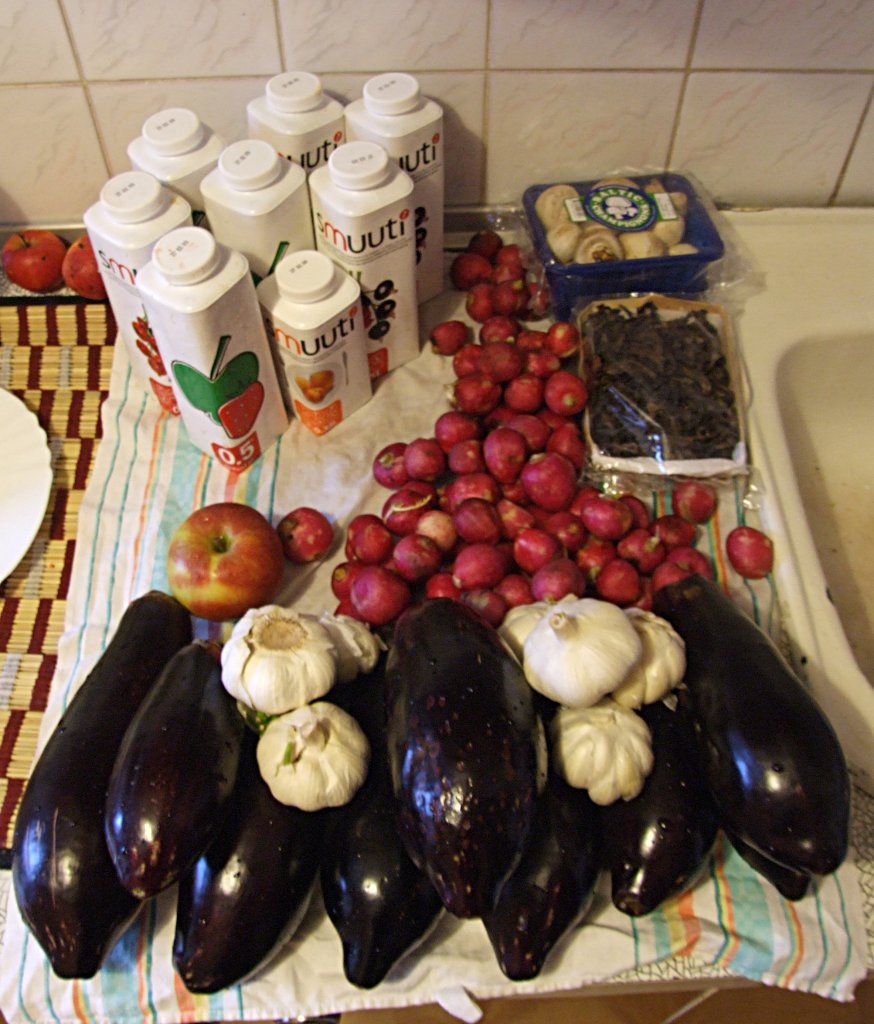 Lithuania is a country in North-Eastern Europe.
(For more detailed info on every city and town see template at the bottom of the page.)
Dumpster diving
It is not easy to dumpster dive in Lithuania but it is possible to gather some amounts of food for free. Food markets in major cities are the most common places for searching after food: after they are closed (but not yet cleaned of the trash) one can find plenty of discarded vegetables on the ground. Checking supermarket dumpsters is also worthwhile although one should not except too much: to the disadvantage of Lithuanian freegans, many food stores do not dispose food right after its shelf life is over: many unpack these items (if possible) so that the expiration date is not visible anymore, and sell them at a discount. Such actions are not yet strictly controlled there, and it is generally known that food stores won't throw away even a black-dotted banana so easily, although food stores like "Rimi" and "IKI" usually do not comply with this pattern.
The legal status of dumpster diving in Lithuania is most likely non-existant and/or not known.
Wild Foraging
Wild foraging is a popular activity in Lithuania. Some people manage to get up to 70-80% of all their food only by eating wild fruits, beries, herbs, mushrooms, etc.
It's good to know some basic information about Lithuanian flora before trying to find food in the nature. Luckily, just a few types of plants are poisonous and they aren't very common. It gets more complicated with mushrooms, because many of them are not edible and some are even deadly poisonous. The best way to learn these things is to go foraging with someone who already knows all the information. Special sites, like Plants For A Future, can also be very useful (see also "Maistas randamas gamtoje" in Lithuanian).
Clothing/stuff swap
It is pretty easy to get new old clothes and some other stuff for free in Lithuania: one just has to know where to search. For that just use one of these websites:
- Kaman.lt - share, give away or get anything for free
- Mainyk.lt - a social sharing service for exchanging any goods
- Manodrabuziai.lt - clothing swap; there are also options like selling clothes or giving them away for free.
Food Not Bombs
Every last Saturday of the month Food not bombs event takes place at "Reformatų" square in Vilnius. Part of the food distributed during the event comes from dumpsters.
Freecycle
Vilnius and Kaunas have freecycle networks, see city pages for more info.
Links
- Nemokamas maistas & Nemokamas maistas #2, two informative blog posts about freegans, dumpster diving and food waste in general (in Lith.)
- "Grynas" Article 1 and article 2 are two great pieces on freeganism and dumpster diving, the latter has even a link to Trashwiki! (in Lith.)
2008-02-28-kaunas.jpg — LinasD
Athens
Edit on wikiNamed dumpsters and map pins go stale. For current spots use dumpstermap.org and the live Trashwiki page. This chapter is culture, legality, and general practice — not a dumpster list.
{| align=“right” | |} Athens is the capital of Greece, and it definitely has somthing to offer to those who live cheap.
== Food markets == There is a market open everyday (except Sunday) from 6am to 6pm in the middle of Athinas (Αθινας), between Armodiou and Aristogeitonos. There is trash to check around at any time (and you might be very lucky at times), but the trouble is that market is often get cleaned, and those who do cleaning are of no help to you. There is another very cheap fruits and vegetables market (7:00 - 15:00) in the (anarchist) neighborhood of Exarchia in Kallidromiou street, with a lot of leftovers at the end (around 12-3pm) every Saturday. In general the food is much cheaper at the end of such markets.
== Bakeries == You’ll find bread in the bins of the local bakeries. The best is to go when they close, or when the baker come to bake, usually after 2am. * There is a bakery on Exarchia triangle/park which throws away a lot of bread sometimes, check the bags around the dumpsters as well.* (Last checked: Jan.2011)*
== Flea markets == There are 2 flea markets every Sunday: # One is at Monastiraki metro station. # The other, bigger one, is located at Peiraieus. Get out of the metro station and walk the Alipedou street. The market continues on Skylitsi street as well.
== Furniture == Certain neighborhoods like Exarhia or Kypseli host some very good spots for thrown-away furniture in very diverse states, shapes and sizes. Local divers say the best deal is 60’s or 70’s really stylish pieces of furniture.
== Clothes == You can give away or take (for free, of course) clothes at Skoros (former [http://sporos.org/ Sporos]). You can find more info on this freeshop-market here: [http://skoros.espiv.net/contact skoros.espiv.net]
== Links == * [http://www.forfree.gr/ forfree.gr] - a web page (in Greek though) informing about all of the free events and free stuff * add more?
hitch:Athens nomad:Athens
Romania
Edit on wikiRomania is a country in Eastern Europe.
Romania is without a surprise not a good place for trash collecting.
Regarding food, the best way to get something is to get in touch, whatever way, with the people who are really nice: they will often spontanously give you some food to take away, especially in summer because Romania is maybe the best place in europe for fruits and vegetables. In Orthofox church, if you are able to meet the priest or the person looking after the place, you are more likely to get little presents, the priests are usually real friendly even if you do not speak their langage.
In the countryside it is almost impossible to get trash as there is simply not bins! however in summer it is full with delicious fruits (do not miss the famous mulberries tree with brambles look like berries), when it is water melon harvest season you will find plenty left along the roadside and you can help yourself.
In town, cities you will find some cooked food in the bins, and a lot of bread which is unfortunately most of the time moldy: do not be afraid of molds, it is like cheese, the taste can be surprising but never disgusting, if you are not afraid you will be alright, although it is a bit toxic you can't get food poisoned if you trust what you eat, unless you are allergic to penicilin and its relatives.
But keep in mind: moldy bread and in general all moldy food is not good for your health, it may cause cancer and serious health problems! Bevore eating molded stuff ask some people if they have some left-overs.
Last but not least small street bins (wall hung round style) in touristic places.
Cities
- Timișoara
- Bucharest
- Cluj-Napoca
- Sibiu
Moldova
Edit on wikiMoldova is a country in Eastern Europe. Dumpster diving here is probably similar to diving in the Ukraine.
Ukraine
Edit on wikiThe Ukraine is a big country in Eastern Europe. Dumpster diving in the Ukraine is kind of like diving in Russia, also the problem not mentioned in Russia article was hygiene. Here it is much worse then in Western Europe, also most of the competition is from dogs, which run around in packs but are generally nice. It could be a good way to feed your dog in this way. They are numerous and are really good at jumping into and tipping over trashcans. Hobos usually dig trash in groups because of police.
Cities
- Kiev
- Lviv
- Odessa
Belarus
Edit on wikiBelarus is a country in Eastern Europe. It is relatively poor country and therefore access to useful trash is limited.
Cities and towns
- Minsk
- add more?
Russia
Edit on wiki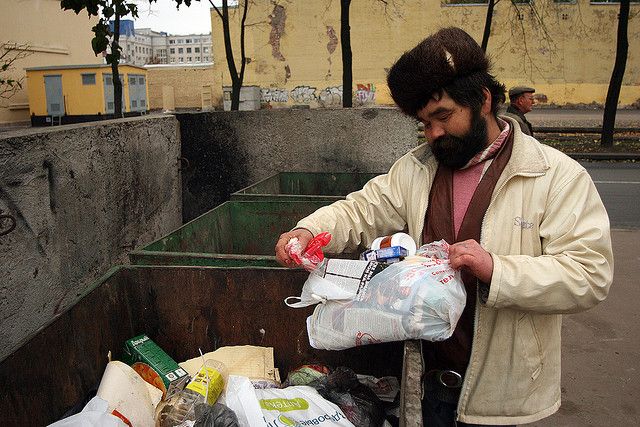 Russia is a country that starts in Eastern Europe,
lasts throughout Asia and ends by reaching America in the West.
Russia is a country that starts in Eastern Europe,
lasts throughout Asia and ends by reaching America in the West.
It is not the wealthiest country in the world, therefore freegan opportunities might appear quite seldom in there. Many homeless dumpster dive there (competition for anti-consumerists!), although their finds never are the same as in rich countries in the West, so the wisest choice for a freegan would be to search for goods in central districts of Moscow and Saint Petersburg, such as Kitay-gorod in Moscow or Nevskiy Prospect in SPb.
Cities and towns
- Moscow
- Saint Petersburg
- add more?
Useful phrases
Since relying on your social skills is the easiest way of getting nice food, here are some phrases to plan a conversation:
Hello - [Zdravstvuyte]
I am ... from ... - [Ya ... iz ...]
Is there anything you plan to throw away? - [Vy sobirayetes' chto-nibud' vybrasyvat'?]
Is there anything I can get for free? - [Zdes' chto-nibud' mozhno dobit' besplatno?]
I recycle food. - [Ya utiliziruyu yedu.]
Do you have old bread? - [U vas yest' prosrochenniy khleb?]
Thank you - [Spasibo]
Have a nice day - [Vsego horoshego]
Legal
Dumpster's contents belong either to someone who produced that trash (e.g. a supermaket) or to the waste company (1 in russian). So theoretically dumpster diving could be qualified as theft. However there are no reports of such cases. Its more likely that one could be charged with trespassing if the container is located on private property.
St.p. homeless.jpg — Sigurdas
North America
Canada, the United States, Mexico.
Canada
Edit on wiki- For more detailed info for different places in Canada, see template "Provinces and territories of Canada" below.
Canada is a pretty decent country for dumpster diving and other freegan opportunities.
Most major cities, definitely Montreal, Toronto, Vancouver and Calgary have a Food Not Bombs serving at least once a week.
Dumpster diving
In Canada, there is an increasing trend towards gigantic supermarket chain stores with compressor dumpsters, but that shouldn't deter you from heading out to find those places there are still classic dumpsters for all your easy diving needs. The long winters actually make dumpster diving easier because food doesn't go bad easily.
Legal status
In several provinces of Canada, The Trespass to Property Act or the Trespass to Premises Act grant property owners and security guards the power to ban anyone from their premises, for any reason, permanently. This is done by either posting clear signs, enclosing the area with a fence or issuing a verbal or written notice to the intruder, who will only be breaking the law on return. A recent case involved a police officer who retrieved a discarded weapon from trash as evidence; the Judge ruled it as legal without a warrant, so some have speculated this is enough backing for anyone to raid garbage.
Toronto
Edit on wikiNamed dumpsters and map pins go stale. For current spots use dumpstermap.org and the live Trashwiki page. This chapter is culture, legality, and general practice — not a dumpster list.
Toronto is
the biggest city in Canada located in the province of Ontario. There are
many excellent opportunities for free or cheap food in the city
including high quality, organic produce and bread.
If you have just a little money to spend on food you can get some really nice stuff. In many of the busy grocery shopping areas (Bloor Street West, Kensington Market, China Town, etc.) shops have loonie bags of old produce, bread, etc. that they are trying to get rid of. Kensington Market is particularly good for this where many of the produce shops have bags or boxes of fruit and vegetables that they will no longer be able to sell for full price but are still totally delicious, and in the case of avocados or tomatoes are likely just hitting their prime. At My Market Bakery they have gigantic dollar variety bags of day old bread.
Dumpster-diving
You might have particular success in dumpster diving along Bloor Street West between the Spadina and the Ossington metro stations. Just at Bloor and Spadina there is a small healthy foods store where you can find nice veggies and fruits is you find the back of the store through an alley (the alley is in the next street east of Spadina). Generally, it could be particularly fruitful to walk westward along this stretch hitting all the different locations. The first one is a chain supermarket called Metro. Its on the corner of Bloor St. West and Robert Street. They have about 15 green organic waste bins in their southern parking lot where there is bound to be some good scores from time to time. Just two blocks over on the north side of Bloor St and Dalton there is Bloor St SuperFresh, a medium sized supermarket. They have a conspicuous dumpster on the side of the building. It seems to be a good all around dumpster where one can find juice, produce, bread, and other surprises. If you haven't got your fill from these locations, you can continue westward and there with be a few more small corner shops on the north side of Bloor St. (At Palmerston as well as Manning Ave) At these places you can go around the corner to the side of their buildings and look in their green organic waste bins for produce. (Last checked: June 2014)
If all that wasn't enough, do the same stretch on College street. Two good stores that come to mind are near the crossing of Bathrust and College - a Shoppers store where one can find chocolate, milk, random cosmetics and even medicine (a big green dumpster at the parking lot). The other one is a small store called the Friendly Magnolia - you have to walk behind it through a back alley at the corner with Starbucks. At Magnolia there seems to always be a fill of delicious bagels and bread, expensive organic yogurts, as well as fruits and veggies and occasional fancy produce, such as organic spreads or ready meals (since it is a healthy foods store). (Last checked: June 2014)
One can also find discarded fruits and veggies at Kensington market, which is quite a popular area to dumpsterdive among the people that live there. (Last checked: June 2014)
Harvesting Toronto is full of stuff to pick. Early summer is full of mulberries, cherries, sour-cherries and saskatoon-berries. Aug-Oct you can find pears and apples. There is a group of volunteers that get together and pick the trees, one can get involved over their website: NotFarFromTheTree
Free Stuff Every first Saturday of the month, there is a Really Really Free market that takes place at Campbell park. You can bring stuff, take stuff, volunteer, whatever. It's a good place to be since there are some really good things (even things like an occasional bike, a guitar or a tent). You can check the time and location on their blog: FreeMarket
Montreal
Edit on wikiNamed dumpsters and map pins go stale. For current spots use dumpstermap.org and the live Trashwiki page. This chapter is culture, legality, and general practice — not a dumpster list.
Montreal, or Montréal in French, is the largest city in the Canadian province of Quebec, and the second-largest city in Canada.
In Montreal, good trash, from furniture to raw materials, is found early mornings - or late nights - on weekdays, before the city trash disposal service passes by.
A great moment for updating your furniture set and gathering interesting books is usually around July 1st. While the rest of Canada celebrates Canada Day, Quebec residents tend to move on that day (or on the 2-3 days before and after) as roughly 80% of the lease contracts end on that date. There are usually numerous garage sales on the week before (although it is a summer-long practice), and if you wander through the back alleys at that period, it is not unusual to find big pieces of furniture, sports equipement, clothes, etc.
The food markets offer pretty good opportunities for finding fruit and vegetables. There is a google map showing some of the food trash points: treasure chests of Montreal.
A great way to discover good spots is to simply wander alley ways and look around in dumpsters. Don't be intimidated by locked dumpsters, often it's possible to lift the cover and reach into the dumpster and grab food anyway. Seriously. No need to write down the names of the stores, just walk around and you're bound to find something!
If you're in the Plateau, check out the Metro store next to parc Laurier (on Laurier street.) They have an ongoing fill of good veggies and fruits, as well as breads and pastry (it's quite common to find nice cakes.)
Montreal is a very bum-friendly city. There are many food and clothing banks that will help you out even if you're not Canadian and you're just hitchhiking through. You can get warm meals, food, health care, clothes, shoes, hygene products, even shelter if needed. There is also a van that goes around distributing free hot-dogs and hot chocolate.
Links
Garbage Finds - A blog about scavenging in Montreal
Vancouver
Edit on wikiNamed dumpsters and map pins go stale. For current spots use dumpstermap.org and the live Trashwiki page. This chapter is culture, legality, and general practice — not a dumpster list.
Vancouver in British Columbia, Canada, has one of the mildest year round climates in Canada, and a ton of good places to dumpster dive. The downside is that there is a lot of competition in dumpstering in this city.
United States of America
Edit on wiki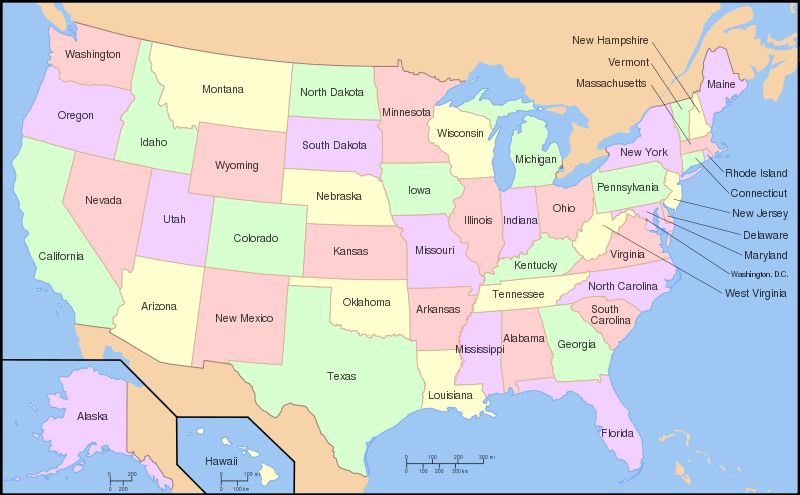 The
United States of America offer excellent opportunities
for recovering trash.
The
United States of America offer excellent opportunities
for recovering trash.
For more detailed info on each place see "States of the USA" template at the bottom of the page.
Dumpster diving
Legal status
Because dumpsters are usually located on private premises, dumpster diving is illegal in some parts of the United States, though the law is enforced with varying degrees of rigor. The California v. Greenwood case in the U.S. Supreme Court held that there is no common law expectation of privacy for discarded materials. Dumpster divingper se is probably legal when not specifically prohibited by state or local law.
Police (and possibly other) searches of dumpsters and like discards are not violations; evidence seized in this way has been permitted in many criminal trials. The doctrine is less well established in regard to civil litigation.
Private investigators have written books on "P.I. technique" in which dumpster diving or its equivalent "wastebasket recovery" figures prominently.
Companies run by private investigators specializing in dumpster diving have sprung up around the country as a result of the need for discreet, undetected retrieval of documents and evidence for civil and criminal trials.
Supermarkets
Some supermarkets have better dumpster diving possibilities than the others. See info on each one to know where it is best to go. Supermarket chains in US (in ABC order): Acme, Albertsons, Aldi, Baker's Supermarkets, Bigg's, Bloom, Bottom Dollar, Bristol Farms, Carrs, City Market, Costco Wholesale, County Market, Cub Foods, Dillon's, Dominick's, Farm Fresh, Food 4 Less, Food Emporium, Food Lion, FoodsCo, Fred Meyer, Fry's Food, Genuardi's, GIANT, Gordon Food Service, Hannaford, Harveys, Hilander, Hornbacher's, Jay C, Jewel (Jewel-Osco), Kash n' Karry, King Soopers, Kmart Supercenter, Kroger, Lazy Acres, Lucky Stores, QFC, Panera Bread Company, Pavilios, Piggly Wiggly, Ralphs, Randalls, Safeway Inc., Sam's Club, Save-A-Lot, Scott's Food & Pharmacy, Shaw's, Shop ' Save, Shoppers Food & Pharmacy, Smiths, Star Market, Sunflower Market, SuperTarget, Sweetbay Supermarket, Tom Thumb, Trader Joe's, Vons, Wal-Mart, Weis, Winn Dixie, Whole Foods Market
800px-Map of USA with state names.svg.png — Sigurdas
New York City
Edit on wikiNamed dumpsters and map pins go stale. For current spots use dumpstermap.org and the live Trashwiki page. This chapter is culture, legality, and general practice — not a dumpster list.
New York City, USA, is a heaven of trash. You can find amazing food in most parts of the city, though some parts (e.g. Upper East Side) are better than others. Still, you can even find great food in a relatively poor area such as Harlem. There are weekly freegan trash tours and other events hosted by the local Freegan community.
Legality
As with most of the US, any dumpstering done from actual dumpsters or bins is considered trespassing and is thus illegal. The same goes for anything taken from a parking lot or garage/loading dock. In New York, however, most trash is put out in bags on the sidewalk. It is therefore considered abandoned property and can be legally taken, under the condition that one is not being a nuisance in doing so, by making a mess, for instance. It is considered proper etiquette to untie bags, and retie them when finished, instead of ripping them open.
Places
A complete list of suitable locations is available at Freegan.info, under directories. Map available here and another here.
Manhattan
In Manhattan you can do some great dumpster diving.
The New York freegans keep a pretty up to date dumpster directory on their site-- see [http://freegan.info/freegan-directories/dumpster-directory/manhattan/%5Dfor Manhattan.
Upper East Side:
- The "Food Emporium" of 83rd Street and 3rd Avenue. You should be there between 21:00 and 22:00.
- Gristedes, one at 89th and Lex and one at 86th and 2nd, great anytime after 21:00. You can find nice bread, lots of fruits and veggies, guaka has found stuff such as olive oil, humus and chocolate nacho chips.
On 3rd Avenue there are three grocery stores - two "D'Agostinos" and a "Gristedes" - between 25th Street and 37th Street, which all put out their trash around 9PM. The "Food Emporium" at the corner of 6th Ave and 12th Street puts out at 11PM every night. The manager has been known to take it back inside if he sees people dumpstering, however, an employee once warned Timmy Tofu that some of the trash may have been purposely tampered with.
Another great supermarket selling a high quality of natural and organic products is "Whole Foods Market" (see their website here). In Lower East Side it can be found on 95 E Houston St corner of 2nd Ave. You can find many vegetables and fruits over there. The dumpsters are just around the corner at Cherystie Steet. They take out the trash at around 16:00 everyday. The employees are very friendly and would not disturb you as you find your treasures.
Not so far from there at "BabyCakes" (http://www.babycakesnyc.com/) 248 Broome Street (Btwn Orchard & Ludlow) you can find tasty cakes and sweets. BabyCakes offers all natural, organic and delicious alternatives free from the common allergens: wheat, gluten, dairy, casein and eggs. Their cakes don't contain white sugar or toxic chemical sweeteners. At Sunday around 18:00 they put out the cakes in back plastic bags right out side the door.
Plenty of bread in divers forms like ciabatta, whole wheat multigrain bread and baguette can be found in big amounts at "Aubonpain" (http://www.aubonpain.com/) at 10 Union Square E. On Sunday around 17:00 they through out bread and pastries left over from the weekend in big amounts which can last for the whole week. When you bring it home put it in the fridge and when you feel like having a sandwich simply put some water on the bread and put it in the oven. It comes out crispy and tasty.
You can catch a Starbuck's employee taking out their trash around when they are closing, and they will have a bag separate from the normal trash filled with their sandwiches and wraps. It's a good thing to pass around to all the people that you see living on the street as well, if you get more than you need for the night or week depending on how you do your diving. Depending on how health conscious you are, their stuff is relatively healthy.
Brooklyn
The New York freegans keep a pretty up to date dumpster directory on their site, although not as extensive for Brooklyn as for Manhattan. Click here for site's info on Brooklyn.
Known actual spots
- Check out Sunac at 440 Union Ave. (Last checked:?)
- Key Foods on Prospect Ave Between 10th Ave and 11th Ave. Try around 11pm, dumpster in the back - easy to reach into. Best nights seems to be Monday, Wednesday, Friday. (Last checked: July 2011)
- Trader Joe's (located on the corner of Court and Atlantic) regularly takes out their dumpsters at 11pm every night, give the workers time to take out the first two dumpsters before rushing to go through the trash. There are often many divers at this location. (Last checked:?)
- add more?
You can definitely find nice random stuff in the street. guaka found a nice skateboard (in 2006).
Videos
<videoflash>VOEF75VwAtY|300|250</videoflash>
<videoflash>0xbwQRZIVnc|300|250</videoflash>
<videoflash>-HN4ldAWa_8|300|250</videoflash>
<videoflash>L_i7DUbFbkk|300|250</videoflash>
<videoflash>KB56aGTgfVE|300|250</videoflash>
<videoflash>IDSOd6KJcP4|300|250</videoflash>
<videoflash>6dAOyUimAPQ|300|250</videoflash>
Links
- Freegan.info - a NYC-based informational website for freegans and dumpster divers. They organize meetings, trash and wild food tours, repair workshops and free film nights around NYC. Some events are open to media with prior appointment.
- TV article about dumpster diving in New York, found on German spiegel.de
Los Angeles
Edit on wikiNamed dumpsters and map pins go stale. For current spots use dumpstermap.org and the live Trashwiki page. This chapter is culture, legality, and general practice — not a dumpster list.
In Los Angeles, California, USA, there are plenty of dumpsters great for diving. There are often useful items put out at the curb.
Locations
See this map of good dumpsters around LA. You can also edit this map. 16 Jan 2018 Update: can someone please dumpster dive this map? It's apparently been " moved to the trash. Please contact the owner to restore access."
Divers' meetings
The Los Angeles Dumpster Diving Meetup hosts events where people in Los Angeles interested in dumpster diving and freeganism can meet.
Food Not Bombs
Various chapters of Food Not Bombs give out food in Downtown Los Angeles, Santa Monica/Venice and Long Beach.
- See also Pasadena
Chicago
Edit on wikiNamed dumpsters and map pins go stale. For current spots use dumpstermap.org and the live Trashwiki page. This chapter is culture, legality, and general practice — not a dumpster list.
Chicago is in Illinois, US. The city offers many possibilities for dumpster divers and freegans.
Locations
See this editable map of good places for dumpster diving.
- Whole Foods Lincoln Park (1550 North Kingsbury Street) - this is the third largest Whole Foods in the country and has a ton of dumpsters out back. There's bakery stuff around every day, and it's usually still in its individual wrappers inside trash bags, so pretty clean. Also, old food, at least the bread, seems to go in a separate place from plain old trash, which is always nice. They close at 10, so the best time to get there is after 9 pm. (Last checked: May 2010)
- Produce in Hyde Park ( 1226 East 53rd Street ) one of two shops where Hyde Park goes buying fruits and vegetables. Its a very expensive store and so they sort out very good and a lot of stuff. Though the shop is pretty small, they throw away 4 bags full with food every day. Sometimes next to vegetables and fruits, u can find cheese, creams, hummus etc not even expired yet. Easy access, quite light and clean. They close at 8pm, its good to go there in the night though, so thats the stores around are closed aswell. Its a complete sidestreet with dumpsters, if u can still carry something its worth it to check the other dumpster as well. (Last checked: February 2011)
- Fruitful Yield in Elmwood Park on North and Harlem tosses stuff on Saturdays. Best to go there about 1am or later so all the other businesses in the strip are closed (workers from the pizza place like to hang out in the back smoking). It's a health food store so you will find many organic, gluten free, vegan foods, some produce, snack foods, vitamins, flours and such. (Last checked: October 2015)
- add a place?
Video
<videoflash>8wJ9iTiK1Yk|300|250</videoflash>
San Francisco
Edit on wikiNamed dumpsters and map pins go stale. For current spots use dumpstermap.org and the live Trashwiki page. This chapter is culture, legality, and general practice — not a dumpster list.
San Francisco, a city in California, USA, has lots of fabulous dumpsters, especially when the entire Bay Area is taken into account. As in most American cities, you can find random useful stuff just in the street.
Free food
See this map for some dumpster diving places in San Francisco and Bay Area.
- The nearly famous Semifreddi's dumpster serves up five full bins of high-end bakery bread (including arguably the world's most delicious cinnamon bread), every day. You can also recover garbage bags full of cinnamon dough to take home and bake on your own (this is the most promising dumpster diving site we have found yet). Unfortunately, most of the bread is white, in the form of loaves, rolls, or baguettes. Map it at: 4242 Hollis St, Emeryville, CA. They are moving to a new location in Emeryville (apx. 4064 Halleck St.), which appears currently to have locked dumpsters, but the Hollis st. location still has plenty of food until their lease expires at the end of October 2009. (Last checked: Oct. 1st, 2009)
- Acme Bakery, also in Berkeley, also has a fine dumpster (and "Cranberry Walnut" bread!!). If you go to their store at 1601 San Pablo Ave., and ask very nicely at the end of the day, may give you a sack of bread to take home. If you wind up at their production bakery at 2730 9th St., in Berkeley, you can hop the fence to get at the goods -- reportedly the fence exists to curb the truck-graffiti problem this bakery used to have. The gate is open during store hours, but there are lots of employees around. A LOT of employees.
- Metropolitan Bakery, all the way down Heinz St. is in the same neighborhood as Acme's production bakery, has a reputation for fine quality, tasty bread (and a good selection of not-white bread, including "multigrain sourdough with scallions and walnuts", or "rosemary potato bread", tasty!)
- Clif Bar Company sometimes throws out large quantities of Clif bars. On 4th St. near University, in Berkeley.
- Mi Tierra Grocery on San Pablo (near University; across the street from Country Cheese and the post office) in Berkeley is a reliable supply house for fruits, veggies, tomatoes, cheap crumbly pastries, etc.
- There are two Andronico's groceries in Berkeley that produce a healthy lot of produce! One is on Shattuck a block from the famous Cheeseboard, the other on University and Acton, a few blocks from Sacramento.
- Trader Joe's Rockridge is phenomenal. Lots of delicious produce here! As of September 2009 they have begun locking the dumpster.
- The Scharffenberger Chocolate Factory in Berkeley supposedly had a dumpster full of chocolate; however, recently they started locking their dumpster for most of the time (as of Dec.8, 2008), and are moving to a new location out of state. Visit 914 Heinz Ave, Berkeley, CA.
- Veritable Vegetables: Committed to Sustainable Farming does pretty well at culling their trash, but you can occasionally find some loot in either of their two industrial composts, near Cesar Chavez and Tennessee in the Dogpatch District of the city.
- Rainbow Grocery follows the undoubtedly enlightened and wonderfully humane practice of putting the "good food" on the side of the dumpster in cardboard bins. Much produce to be scored here. They're on Folsom St. near the freeway.
Food Not Bombs
Food Not Bombs is very active in the bay, and serves nearly every day of the week somewhere in SF. Currently (Sept 2009) in UN Plaza at about 5:45pm on Monday and Wednesday and possibly Sunday, and 3:30pm on Saturday. In Berkeley the "Food Not Bombs" serves every day at People´s Park between 2:45 and 3:30 PM.
Really Really Free Market
San Francisco has regular Really Really Free Market events where things and services are provided for free for anyone interested. See http://www.reallyreallyfree.org for more info.
External links
Seattle
Edit on wikiNamed dumpsters and map pins go stale. For current spots use dumpstermap.org and the live Trashwiki page. This chapter is culture, legality, and general practice — not a dumpster list.
Seattle is the most populous city in the US state of Washington and the Northwestern United States.
There are quite a few people who dumpster dive in Seattle. You can find precise dumpster diving locations on these maps:
- http://www.wayfaring.com/maps/show/3726 - anyone cal also edit this map
- Diver Jonathan's map
- A map by diver Alex
- Diver JesterCard's map
You might also be interested in following links:
- http://community.livejournal.com/dumpsterdive206 - a blog about dumpster diving in Seattle
- http://seattlepi.nwsource.com/local/223950_dumpster12.html - an article about dumpster diving in Seattle
Mexico
Edit on wikiMexico is a country in North America, between USA in the north and Guatemala and Belize in the south.
Foraging food
There are many ways to forage free food in Mexico, some trickier than the others.
Dumpster diving
A rumor says that you can dumpster dive at local Walmart stores. Other than that dumpster diving in supermarkets is next to impossible because one or more of the three reasons: a) practically nothing goes to waste usually, b) the bins are nowhere to be seen and c) stuff rots in the heat quickly.
Markets
Open-air markets (mercados) and smaller vegetable and fruit vendors are, however, a source of plenty. Interestingly enough, if you ask “Tienes algo para tirar” (“Do you have anything to throw out”) they usually say no, either because they don´t understand what you want or because they feed their family with the second-grade stuff. It´s better just to dig straight into their waste basket and you are sure to get their attention. You can ask “Es basura? Puedo/podemos tomar algo?” (“Is this trash? Can I/we take some?”) and in 99% of the cases they have no problem with that. Sometimes they even bring you more stuff.
Table diving
Mexican restaurants are from being under-staffed so you have to be real quick if you wish to get your claws on whatever is left from other customers. Plates are collected immediately. What you can do is either to run after the waiters and ask them if you can eat what is on the plate or, better, to solicit a quick meeting with the manager (patron) and ask her (in 80% of the cases the bosses are women) if you could have something free to eat (“Tienes algo gratuita para comer?”). Most likely they will give you something to eat. If you ask for leftovers (“Tienes algo que vas a tirar?”) they probably say no because they do throw leftover food immediately in the bin and it´s all mixed and ugly.
Bakeries
They usually sell the second-grade stuff the next day on a reduced price but if you ask you probably get a sweet bread or two.
Edible plants
Luckily the fruits of Mexican nature are plentiful. Enjoy the mango, the chaya, the icaco and the coconut, among others!
Organizations
At least in Mexico City there is an organization that serves free lunch Monday-Friday to those in need. It´s the tall colorful building (5th floor) right next to Metro Colegio Militar.
Food not bombs
According to its website, FNB is in many different places in Mexico.
Places
- Mexico City
- Morelia
- Puerto vallarta
- Comitan
- Oaxaca
- San Cristóbal de las Casas
- add more?
Mexico City
Edit on wikiNamed dumpsters and map pins go stale. For current spots use dumpstermap.org and the live Trashwiki page. This chapter is culture, legality, and general practice — not a dumpster list.
It is very easy to get free food from street vendors (tacos, hamburgers etc) and fruit and veggie stands. Also there is an organization that serves free lunch Monday-Friday to those in need. It´s the tall colorful building (5th floor) right next to Metro Colegio Militar.
Contribute to the map of the public markets (under construction) or see the full list of markets.
Join the Food Not Bombs if you are in Mexico City.
South America
The Caribbean coast south to the Southern Cone, and Brazil.
Colombia
Edit on wikiColombia is a country in South America. Its capital is Bogota. A lot of bananas that are exported all the way to Europe and North America end up in dumpsters.
Brazil
Edit on wikiBrazil is a country in South America. Many avocados that are exported all the way to Europe and North America end up in dumpsters.
Places
- Rio de Janeiro
- São Paulo
- add more?
References
- Estamira: a documentary about a very crazy (and lucid at the same time) woman living all her life into a huge dumpster - https://www.youtube.com/watch?v=uFQl3uGV7Ss
Rio de Janeiro
Edit on wikiNamed dumpsters and map pins go stale. For current spots use dumpstermap.org and the live Trashwiki page. This chapter is culture, legality, and general practice — not a dumpster list.
Rio de Janeiro is a gigantic city in Brazil.
Media
Waste Land (2010) is a social documentary based around the lives of garbage pickers in Rio de Janeiro as a man by the name of Vik Muniz creates art out of recycled material. Watch trailer here (alternative link: watch on YouTube).
São Paulo
Edit on wikiNamed dumpsters and map pins go stale. For current spots use dumpstermap.org and the live Trashwiki page. This chapter is culture, legality, and general practice — not a dumpster list.
In São Paulo they have street markets that have name feiras. During the working hours or in the end you can go and take as much fruits and vegetables as you want. Usually they are laying on the roads but also you can ask the vendors to take some that they don't need. The best time to go there is around 14:00-15:00 hours. And, of course, here is a map where you can find them: http://www1.folha.uol.com.br/infograficos/2014/07/85141-colheita-urbana.shtml
Uruguay
Edit on wikiDumpster diving exists only in dreams in Uruguay, with the exception of bigger cities. Very few people are diving. On the southern coast it is even better, but watch out, sometimes people dump their dearly departed pets in the dumpsters. In the big cities, you have the fast food places like Burger King and McD, but also more people diving. Good places to dive are gas stations: probably the best ones are ANCAP and ESSO. You can find all kinds of good stuff there.
Cities and towns
- Montevideo
- add more?
Asia
From the land bridge at Turkey through the Middle East, the Indian subcontinent, Central Asia, then east and southeast to the Pacific.
Turkey
Edit on wikiTurkey is a country in Asia and partly in Europe.
Probably the easiest way to get some free food in Turkey is to visit local bazaar places after the end of the market. These are common everywhere in the country. Vendors sell fruits and vegetables during the day (at least one day a week), and at night/evening they usually throw away what they could not sell. Simply ask locals for the places of bazaar.
A lot of supermarkets put their old vegetables and fruits outside in a separate box, so you only need to go and take whatever you like. If not, you can also ask the staff, if they have some old fruits/vegetables to give. They do it quiet often.
In the big cities it is possible to table dive in restaurants. Also you can ask in the restaurants in the evenings if they have leftovers. Very good are the Lokantas, which are cheap restaurants that offer various dishes and serve them plate-based. Some restaurants will give you their leftovers, but also a lot of times they will offer you (new) food for free. If you don't care getting new food, your main purpose is to get it for free and you have time you can also offer the restaurants to work there for an hour and in return they give you some food. In most of the cases they won't let you work but will feed you either ways.
In bakeries (fırın) it is possible to get old bread or simits in the evenings or in the mornings if you ask for it. They will also offer you new bread for free.
Besides dumpster-diving, people place their trash out on the streets in bags, it is picked up at night. In the neighbourhoods you can walk through the streets and you will find besides food (especially in front of supermarkets) clothes and more nonfood items.
A little guide for asking for food:
People usually don't speak enough English to understand exactly what you want. Try with turkish words, even if you don't conjugate the verbs, people will understand more often. Explain your situation and be honest!
- iyilik - a favor
- yardım etmek - help
- eski yemek/ekmek - old food/bread
- eski yemek/ekmek var mı? - is there old food/bread?
- bayat - another expression for old food
- dünki yemek - yesterdays food
- meyve - fruit(s)
- sebze - vegetable(s)
- ekmek - bread
- seyahat etmek - to travel
- lütfen - please
- Teşekkürler! - thank you!
Personal experience: "Pardon, atılacak yemek var mı?" for food and "Pardon, eski ekmek var mı?" for bread worked best for me. Ask turkish friends about the pronunciation.
Cities and towns
- Ankara
- Bodrum
- Bursa
- Erzurum
- Eskisehir
- Istanbul
- Izmir
- Olympos
- add more?
Istanbul
Edit on wikiNamed dumpsters and map pins go stale. For current spots use dumpstermap.org and the live Trashwiki page. This chapter is culture, legality, and general practice — not a dumpster list.
Istanbul is the biggest city in Turkey.
If you are on Istiklal, the main street, you will find that it is very easy to table dive in the fast-foods if you are interested - you can really feed yourself in such a way.
There are street food markets in every neighborhood usually once a week. Find out when it is in your neighborhood and you can pick up whatever's left behind in the evening. There is always lots of fruits and vegetables and people will even hand you stuff they keep as trash.
There are a lot of Lokantas, bakeries and supermarkets where you can ask for old food. You can find a list of [http://trashwiki.org/en/Turkey#A_little_guide_for_asking_for_food: useful phrases] for asking.
Markets
You can find a list of the street markets, sorted by weekday, here.
Beyoğlu
Tarlabaşı Pazarı(Tarlabaşı Market): Every Sunday, open 10am - ~6pm. After 7pm would be easier to collect leftover: fresh, raw foods. Location: It starts from the begining of Kurdela Sokak to the end of Serdar Ömer Paşa Caddesi
Kasımpaşa Pazarı (Kasımpaşa Market): Every Friday, open 10 - ~6pm. This market is a bit more expensive than Tarlabaşı but better in a way. This market has for example King Oyster Mushrooms which is really tasty. Location: Hakim Sokak + Tahtakadı Sokak + Yeni Yol Ara Sokak streets.
Georgia
Edit on wiki* For Georgia in the USA see here.
Georgia is a country in Western Asia. Although you might argue that it is in Europe, due to its cultural heritage, religion, architecture and orientation towards EU and NATO.
Its capital is called Tbilisi, a town full of 'public' trash bins that are parked on every second street corner.
Eventhough it is not real easy to find thrash, the best address is probably the "baazar" which is the name for every day street market all over the country, in every small town, as well as in Armenia. By closure in the afternoon you will find a lot of stuff. It is not well considered especially if you're a foreigner, you will feel the shame and police can be pretty nosy, altought people can give you some money. Does it worth it?
In big cities containers are not bad and people care less about it, once again: mind the police, they are not used to westerners behaviours (cloth, bagpack, hair cut,...). Trainstations/restaurants are usually good spots.
“hitch:Georgia (country)”){.wikilink}
Armenia
Edit on wikiArmenia like Georgia is a link between Asia and Europe, however as it is the first Christian Country in world history and former member of ex USSR people of this Nation feel more like being part of Europe.
The Capital, Ierevan, has a nice city center where you can find food easily especialy in parks, regarding the rest of the country look for "bazaar".
Personal experience
"I spent there one week of hitchhiking around country and dumpster diving didn´t work very well for me. For sure it´s possible to find some food but not enough for living. In big cities you can find something but in the rest of country it´s bad. But Armenian people are very hospitable and they invited me often for a dinner or gave me a food and I spent in this country only about 2 or 3 euros." - Král všech moří, September 2016
Syria
Edit on wikiSyria is not the best place to find useful thing in trash cans. Nevertheless it's possible. In 2008 Guaka found a useful bag while walking towards a good spot to hitch out of Aleppo.
Israel
Edit on wikiIsrael offers some good opportunities for recovering
trash. Many people also leave furniture, clothes, and other items on the
sidewalk.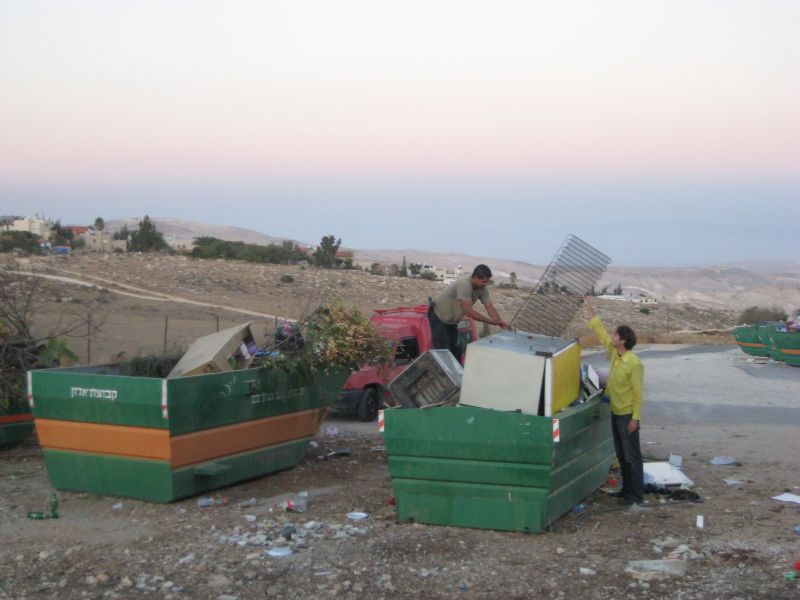
Locations
- Haifa
- Jerusalem
- Tel Aviv
- Be'er Sheva
- West Bank
Israeli freegan Facebook group
Noam-and-kasper-dumpster-diving.jpg — Guaka
Tel Aviv
Edit on wikiNamed dumpsters and map pins go stale. For current spots use dumpstermap.org and the live Trashwiki page. This chapter is culture, legality, and general practice — not a dumpster list.
Tel Aviv is the de-facto capital of Israel.
At the end of the Friday's flea market in Jaffa you can find great stuff.
There is also a perfect place to dumpster dive in the Tel Aviv new port, among all the clubs and pubs. To get there take bus number 4 from the center of the city, and walk till the port.
To get to the dumpster, search for the TLV club. Now turn around and you will see a popular caffe called "Cacao" - there will be a tiny dead-end alley on the right of this caffe, and in the end of the alley, on your left side, will be the door for the dumpster site. It's open 24/7, and it contains food and drinks from all the bars and caffes around, and from an event hall nearby. If you go there after midnight, you can usually find not only food thrown in bags, but also packed nicely in plastic containers, including fruits, vegetables, chocolates, rice and bread goods.
Every week day at The Carmel Market, around 19:00-20:00 (the closing time), they throw a lot of good fruits and vegetables to alley in the middle of the market, it stays there for about half an hour until the big yellow vehicle come and push it all away to the trash. on friday the closing is usually at around 17:00.
India
Edit on wikiIndia is a very populated country in Asia. It is claimed that a lot of stuff queued for recycling in the West is being shipped to India for professional trash pickers to look through.
There is a rich Indian tradition of up-cycling, known locally as Jugaad. There are number of efforts to reclaim this dying art of improvised use of waste materials in the age and midst of modern ecological crisis sprinkled throughout India. One of the more active groups promoting waste awareness is a "Zero-Waste Center" in Udaipur, Rajasthan, called Shikshantar. There is a small community of people in that city leading a zero-waste lifestyle.
Cities and places
- add one here?
Organizations
- Conserve
Bangladesh
Edit on wikiBangladesh is the most densely populated country in the world, with very little in the way of material items. It is basically a huge delta, so has minimal native production capacity except for food. Most of it is rural, though most foreigners stay in Dhaka, the capital city of about 15 million people. Many people, especially kids, are involved in picking through waste and recycling collecting most everything imaginable (and more). Bangladesh has some very skilled repairers and bodgers who fix and recycle broken items that in other countries would get thrown away. Don't count on finding anything of value, far less anything edible in trash, unless you are a Bangladeshi yourself. There are a lot of hungry people and poor people in Bangladesh who probably need stuff a lot more than you!
That having been said, foreigners and those who live in the wealthier parts of Dhaka, such as Gulshan and Banani, do occasionally discard stuff randomly without understanding its value. For example, Robin has found useful trash in Banani and Uttara.
Image:Collecting melted plastic.jpg|Collecting melted plastic (2002) Image:Bangladesh litter pickers.jpg|Young scavengers in Uttara, Dhaka Image:Small Electrical Repairshop.jpg|Small electrical repairshop in Tongi (2010)
Japan
Edit on wiki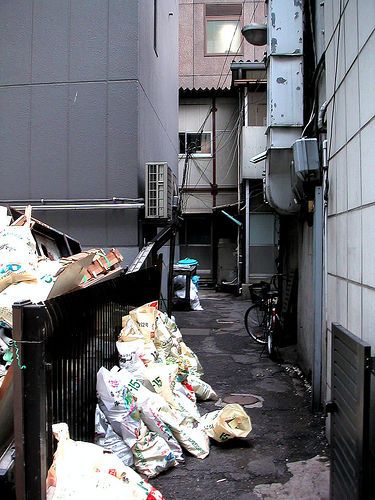 Japan is
an affluent country in Asia and is good for finding trash. In Japan
freegans can dumpster dive by the supermarkets, convenience stores,
fruits & vegetables stores, 100 yen stores; markets and streets in
general are quite good for finding both food and other stuff.
Japan is
an affluent country in Asia and is good for finding trash. In Japan
freegans can dumpster dive by the supermarkets, convenience stores,
fruits & vegetables stores, 100 yen stores; markets and streets in
general are quite good for finding both food and other stuff.
General information
People in Japan generally sort their garbage to burnable/non-burnable material, glass and metal (cans, jar lids, etc.). Besides that, everything has to be put into transparent plastic bags for the garbageman to see if there is no "cheating" - freegans win from that, too, since one can easily identify what supermarkets throw away without opening a trash bag: if there are cans, bottles or just folded paper in trash bags, a smart to do would be abandoning them and moving instead to those bags that clearly have some fruits, vegetables and/or other goods.
Image:How to organize trash - japan.jpg|There are very specific instructions how one should organize one's own trash in Japan. Image:Burnable rubbish day in Japan.jpg|Burnable rubbish day in Japan.
Supermarkets
Most supermarkets keep their garbage inside the building and never bring it out. That's a sad thing, since some expensive supermarkets throw away tons of good food. It is recommended to check in the first place for the supermarkets near you and see if they keep their garbage outside. If they don't, forget the place. If they do throw something out, check what kind of garbage is that. Some stores keep only bottles and cans outside and never bring fruits, vegetables or other expired food products out. If you're lucky you may find some good dumpster diving spots just a few minutes from your home, although generally there aren't many supermarkets with food dumpsters outside the store; most supermarkets have a policy not to throw fruits or vegetables away, even though it is still possible to find some expired food products.
Convenience stores
Convenient stores are the best place to get some fresh food out of their garbage. All convenience stores (7-eleven, Lawson, FamilyMart) leave their garbage in a closet right by them. Sometimes you do have to open a small door, but don't be afraid. If you are there at the right time (the best probability is on early morning since they throw food away during the night shift), you'll find the garbage full of food. Everyday a whole bag of bentos (around 10 everyday), onigiris (around 20 everyday), baked products and fresh snacks are dumped. You'll be able to eat and store these products for up to a week. If you are out of luck, just walk 5 more minutes to the next convenience store and try again.
Fruits & vegetables stores
You can try checking fruits and vegetables stores in your neighbourhood. Some of them leave no trash, but some do. You never know what you can get.
Markets
There aren't many of them in Japan but those that do exist can be very good for dumpster diving. For example, the biggest market in Tokyo - Tsukiji - is quite a good place for freegans. There is a huge produce section and you can nearly always return from there with a backpack full of different kind of fruits and vegetables. Best time to go is from 9am to 1pm, but afternoon is OK, too. Because it's a wholesale market, people throw away many things without much thinking. Look for piles of boxes or trash bags, and check them. Some boxes look empty but they may have many good things inside.
100yen stores
100yen stores is one of the primary targets for freegans. One can find two types of them in Japan: the one that sells mixed kind of stuff, and the other one that sells mainly food. The latter one works non-stop, 24/7, and usually throws away more garbage than he first one. First thing you should do is to check where they place their garbage. Some of them lock it inside, some have dumpsters at the front of the store, and some place them somewhere nearby (behind the corner in the small street, etc.). Of course, you can't do anything if they lock their garbage in the store. If dumpsters are placed at the front of the store, checking what's inside them becomes quite complicated and probably not so convenient, especially when the streets are busy - you don't want to atract anyone's attention. But it's not so difficult to find 100yen stores that put their garbage in small streets around the corner - in such cases dumpster diving becomes really easy.
What you can get from 100yen store? It depends, but usually they throw away quite much of their produce. One can get different kinds of fruits and vegetables: apples, oranges, tangerines, pineapples, lemons, kabocha, daikon, salads, cabbages, carrots, potatoes, sweet potatoes... Expired goods appear to be thrown away more seldom, although it is possible to find spices, flour, pasta, soy milk, tofu, some ready-to-eat meals, etc.
Streets
Japanese people get rid of things by leaving them on the streets for garbageman to pick them up. There are special days for specific types of things to be thrown away. For example, on a "paper" day one can find many books (e.g. manga comics), magazines, newspapers, etc; on a "burnable trash" day one can find clothes; and so on. You can also find bulky items (furniture, electric equipment, etc.) on random days left outside the houses. Some of them can be surprisingly in a very good condition. In this way, of course, you can find only non-edible things.
Cities
- Tokyo
- Osaka -..
Links
- Sharemo: How Japanese people share used stuff using their cell phones
- Sharemo - a social sharing service for exchanging goods
- Eat More Trash: Dumpster Diving in Japan
Japan backlot trash.jpg — Sigurdas
Tokyo
Edit on wikiNamed dumpsters and map pins go stale. For current spots use dumpstermap.org and the live Trashwiki page. This chapter is culture, legality, and general practice — not a dumpster list.
Tokyo is the capital of Japan. It offers multiple possibilities for trash recovering. In Tokyo freegans can dumpster dive by the supermarkets, convenience stores, fruits & vegetables stores, 100 yen stores; markets and streets in general are quite good for finding both food and other stuff.
General information
Like in most places of Japan Tokyo residents must sort their trash in at least five categories. Everything has to be put into transparent plastic bags and left outside the building for garbage man to pick up. There are special days for specific types of things to be thrown away. It is an advantage for freegans since one can easily identify what is inside the bag without opening it and on what days specific type of trash can be expected.
Supermarkets
Most supermarkets keep their garbage inside the building or put only bottles and cans outside and never bring fruits, vegetables or other expired food products out. Some supermarkets keep their trash outside only at day time and lock it inside after closing.
Some supermarkets throw away expired products in bulk, so it is recommended to check their trash regularly.
Convenience stores
There are thousands of convenience stores in Tokyo but unfortunately they're not good to dumpster dive at all. The stores usually tend not to throw away (or they simply might not have much of) expired food, plus their trash generally is being kept inside - so don't expect too much from such chain stores as 7-Eleven, Lawson, etc.
Fruits & vegetables stores
You can try checking fruits and vegetables stores in your neighbourhood. Some of them leave no trash, but some do. You never know what you can get.
Markets
There are almost no small traditional markets in Tokyo. Existing ones are mainly wholesale markets and not everyone can enter them. Their trash is usually kept inside the locked territory which makes the dumpster diving very difficult or impossible. The biggest open market is Tsukiji and sufficient amount of food can be dumpster dived there.
Bakeries
Chez Lui in shimokitazawa puts out its leftover bread and pastries at night.
100yen stores
One can find 100yen store in almost every street in Tokyo. There are two types of them: the one that sells mixed kind of stuff, and the other one that sells mainly food. The latter one works non-stop, 24/7, and usually throws away more garbage than he first one. First thing you should do is to check where they place their garbage. Some of them lock it inside, some have dumpsters at the front of the store, and some place them somewhere nearby (behind the corner in the small street, etc.). Of course, you can't do anything if they lock their garbage in the store. If dumpsters are placed at the front of the store, checking what's inside them becomes quite complicated and probably not so convenient, especially when the streets are busy - you don't want to attract anyone's attention. But it's not so difficult to find 100yen stores that put their garbage in small streets around the corner - in such cases dumpster diving becomes really easy.
Streets
People in Tokyo get rid of things by leaving them on the streets for garbageman to pick them up. There are special days for specific types of things to be thrown away. For example, on a "paper" day one can find many books (e.g. manga comics), magazines, newspapers, etc; on a "burnable trash" day one can find clothes; and so on. You can also find bulky items (furniture, electric equipment, etc.) on random days left outside the houses, especially in residential areas. Some of them can be surprisingly in a very good condition. In this way, of course, you can find only non-edible things.
Freecycle
Freecycle group in Tokyo has more than 1000 members and is quite active (2-3 messages a day in December, 2008). The communication language is English.
Links
- Tokyo Freegan blog (not updated anymore)
- Tokyo Freecycle group
Cambodia
Edit on wiki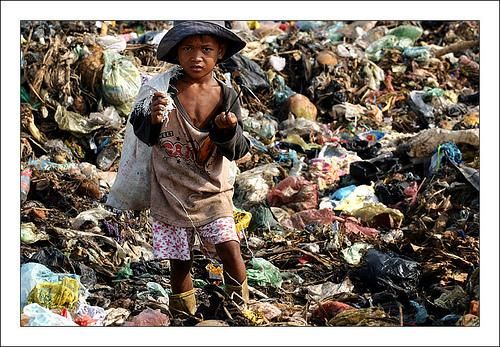 Cambodia is a country in Southeast Asia.
While Western countries produce overflow of stuff, people in countries like Cambodia often live off garbage dumps just to make living possible. Scavenging here is a chance to live, unlike the scavenging culture in the West where living off the trash is an optional alternative.
The child in cambodia.JPG — Sigurdas
Singapore
Edit on wikiA lot of great stuff can be found at residential areas in Singapore.
Landed properties
Large pieces of trash (furniture, unwanted consumer electronics) are often left at the front of houses where it usually gets picked up by the professional karang guni (trash recycler) people. They normally do their collections on the weekends, cruising around the neighbourhood with a pickup truck and sounding a horn.
HDB flats (government housing)
The majority of Singaporeans live in blocks of flats. There are centralised trash collection centres for each group of flats. Good trash can sometimes be found there, but given that everything ends up in the collection centre, dumpster diving is often a stinky, unpleasant experience.
Flea markets
The Thieves Market at Jalan Besar is one of the largest flea markets in the country.
Freecycle
The Singapore Freecycle mailing list can be found here. Yahoo Groups membership is required to view and post messages.
Indonesia
Edit on wiki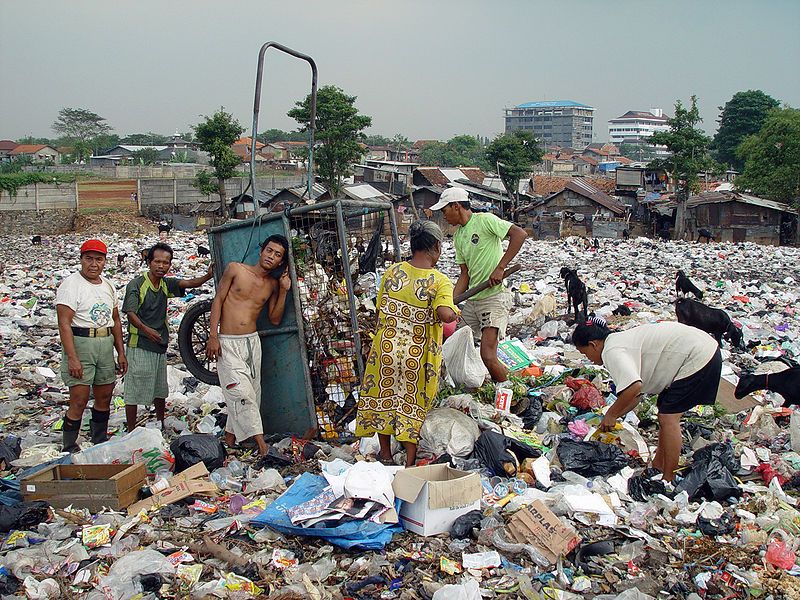 Indonesia is a country in Southeast Asia.
While Western countries produce overflow of stuff, people in countries like Indonesia often live off garbage dumps just to make living possible. Scavenging here is a chance to live, unlike the scavenging culture in the West where living off the trash is an optional alternative.
800px-Jakarta slumlife42.JPG — Sigurdas
Africa
The Maghreb and Egypt first, then west, the centre, the east, and the south.
Morocco
Edit on wikiMorocco is a country in North Africa. Morocco is not very rich country but even there you can find in big cities good food. People are used to place their old bread in bags on street. Sometimes you can find in plastic bags also couscous with vegetable or things like that. It is also possible to find some fruits and veggies at souks (markets). But still you will probably recycle just few of things and on countryside and smaller towns you will not find almost anything. Some Moroccans are very hospitable so they will probably give you some food or invite you for a dinner time to time.
Places
- Agadir (it is probably no problem to table dive there due to many tourists visiting this town, hotels with buffets are in abundance)
- Casablanca
- Fez
- add more!
Oceania
Australia and New Zealand, then the Pacific islands.
Australia
Edit on wiki: For more detailed info on freegan opportunities in every Australian city and town see template at the bottom of the page.
It's relatively easy to dumpster dive (or as they some times call it here skip dipping) in Australia. Many medium to small supermarkets have accessible bins, and often waste a lot, so treasures are plentiful! Larger supermarket chains, such as Coles or Woolworths, lock their dumpsters, or keep them inside a warehouse.
Organic grocers such as Mrs Flannery's (now rebranded as Flannerys Natural Grocers) are often a good choice for dumpster diving. Most cities and towns have a local food market on Saturday or Sunday, and leftovers can be found at the end of the day. Asking the sellers nicely often goes a long way too!
Bakeries, pizza houses and other small businesses are a good place to look at the end of the day when food is no longer fresh.
Most dumpsters are kept around the back of the buildings, as they are often stand-alone structures, with plenty of room in the carpark/back area.
In Australia (and presumably in other countries), local councils organize periodic collection of "hard rubbish" from households - items such as washing machines, furniture, mattresses, refrigerators, as well as scrap timber and metal. These collections can happen as often as every two months, or as little as every two years, depending on the council. In any event, this can be a great way to pick up items such as electronics, furniture and other useful stuff that residents no longer want.
Risks
It is important to note that in many parts of Australia, the high temperatures (even in the so-called "colder months") means that certain foods found in bins are often not good to eat. The dumpster diving advice of people from the Northern Hemisphere must be taken with a grain of salt, especially with regard to meat and dairy products you have "rescued". So always use your senses and your commonsense when collecting food from bins in Australia.
Another risk to be aware of is wasps, especially [http://www.csiro.au/resources/European-wasps.html: European wasps], an introduced pest. They are attracted to many of the same things that attract you to the bin and can be extremely aggressive and territorial. Some dumpster divers suggest just moving on if you see a lot of wasps in and around the bin. Whatever you decide, use caution.
It is possible that some of the foods thrown out may have been recalled for various reasons (and binned rather than sent back to the supplier). These reasons may include; ingredients have been left off labels, there are foreign objects or even bacterial or viral contaminations. If you are worried about this then check out the products here regularly.
Reports
- Skip Dipping in Australia by The Australia Institute.
- Skip dipping: Turning waste into wealth by journalist Cathy Coote.
Supermarket chains
- Woolworths
- Coles
- IGA - Independent Grocers of Australia
- Franklins
- Aldi
- FoodWorks
Store Locators
Find shop near you:
- Coles store locator
- IGA store locator (in South Australia some of shops from this network are called "Foodland")
- Woolworhts store locator
- Aldi store locatore
- Franklins supermarkets (only in New South Wales)
- Foodworks supermarkets
- National store search at LocalStore.com.au
- AFMA national directory of Farmers Markets
Free Internet
- OfficeWorks is an Australia-wide chain of shops for office and stationery products. In some shops (e.g. in Hobart, Perth, Adelaide) you can find 1-2 PC computers with free Internet Access (no password nor subscription is required). OfficeWorks also offers free tea and coffee, which you can self-serve inside the shop.
- McDonald's very often has free wifi access inside the restaurants. They do not advertise it with signs on the doors.
- Starbucks are known to have free wifi, such as the store in Brisbane CBD, off Queen Street Mall.
Free public transport
Some free (and legal!) public transport options are available in major Australian cities, as detailed in a lifehacker article.
Melbourne
Edit on wikiNamed dumpsters and map pins go stale. For current spots use dumpstermap.org and the live Trashwiki page. This chapter is culture, legality, and general practice — not a dumpster list.
Melbourne in Victoria, Australia, has some good places for dumpster diving as well as other opportunities for freegan lifestyle.
Maps
There are a number of dumpster maps for Melbourne
- The OG trashwiki map: Melbourne Dumpster Map.
- The fb freegans coop map (which is mostly supermarket and bakery pins without much info on the bins): 1
- And another google map with a copy of data points from the other maps: 2
- Check also the global DumpsterMap.org
- And FallingFruit.org (not so usable on a mobile device)
Groups
- Melbourne Freegan Co-op facebook group
here. (Very Active)
- Melbourne Freegan Co-op (Queer edition) facebook group here. (Active)
- (Dead) Melbourne Dumpster Diving facebook group here. (last post years ago)
City
- The best place to find fruits & vegetables are the Queen Victoria Markets. Go there in the afternoon just after closing time and you will be certain to pick up a selection of produce. Saturdays and Tuesdays are best. Don't be too late, there are many people collecting the food. Some of the small restaurants even leave leftovers like bread, cake, pastry, pizzas or fries outside their doors when they close. Don't bother with the smaller organic market, they give their leftovers away for charity. Proceed to the farmers section on the main market. Vic market closes at 2pm tuesday and thursday after which time 'waste' fruit and veggies are dumped into wheely bins marked 'food waste' which are located in the in-between isles of the fruit and veg section. These bins are then emptied into a truck around 4pm so the best time to go is between 3 and 4pm on tues and thurs when the bins are the fullest but havent been emptied yet.
- Laurent Bakery in Lt. Collins St.
- Note the Laurents bins on Collins st haven't been accessable lately and when they have they've been locked.
- heaps of bread, sandwiches, pastry, and more in their bins. Often it's even wrapped so it stays clean. Go any time after closing (7pm). They have branches throughout Melbourne e.g Jolimont and Kew.
- Coles Express supermarket in Elizabeth St, close to Flinders St. has some garbage bins in a little backstreet, accessible via Flinders Lane. Sometimes baskets of wrapped bread are just standing on the street. Check the packaging though, there are many rats who eat that stuff as well. Lately the dumpsters have been locked so bringing a key is useful. Also recently there has been a few incidents of a verbally abusive guy (staff) who claims it is his store, and saying you are "stealing their stock" and have threatend to call the cops
Coburg
- Coburg in the northern suburbs of Melbourne have many famous dumpsters off Sydney road; other suburbs in the north including Northcote and Brunswick also have many good dumpsters, mainly "Safeway", "Coles" and "Aldi" supermarkets.
- There's a bin often filled with fruits and vegies at the back of this Safeway in Coburg. That's the address. (Last checked: November 2010)
Camberwell
- Woolworths supermarket, close to Camberwell railway station has their bins on the back of the building accessible, unlocked and usually out of sight of anyone 24/7. If the gate is open, so that the employees can see you, just come back a few minutes later.
- Coles supermarket in The Well shopping mall has containers in the back of the building, but they seem not accessible.
- Laurent Bakery in Burke Rd, close to Camberwell Junction leaves loads of Bread and Pastry in their bins after closing time in the early evening. They push their bins to the Woolworths parking at the end of the little passage.
Hawthorn
- Renaissance Supermarket at 550 Glenferrie Road has bins that can be accessed via Henrietta Street. It closes at 9pm and has regular offerings of fruit, vegetables, meat and baked goods. Some digging may be required.
- The bins outside 7/11 a few hundred metres further north along Glenferrie Road almost always have a rich seam of doughnuts to be mined, plus occasional loaves of bread, sandwiches, salads etc.
St Kilda
- The bins of Woolworths at 117 Acland Street often have bread and other items.
- The 7/11 on Smith Street (opposite Lentils as Anything) usually has some doughnuts and bread in their bins, which are located in the small car park at the rear of the store.
Food markets
- Queen Victoris Market, see above.
- Preston markets, located outside the CBD (Bundoora/RMIT tram, plenty of stops from city), might have similar results as Victoria markets on the weekend. (Last checked:?)
- If you go to the Prahran market at closing time you can pick up dropped produce. (Last checked:?)
- South Melbourne Market?
Rent bicycle for free
Dining hall Little Creatures at 222 Brunswick Street, Fitzroy is offering free bicycle rent. Information about the conditions of this offer is needed.
Other
- Food Not Bombs 6.30pm every Monday and Tuesday in the city, and Wednesdays 6.30pm outside the Coburg library.
- *NOT RUNNING* The Local Kitchen Brunswick 6:30 - 8:30pm every Tuesday, serving %99 Vegan food donated by local businesses and served outside of Northside Boulders, 329 Victoria Street, Brunswick. Facebook: The Local Kitchen
- *ON HIATUS* Free Feed Street Kitchen 7pm every Wednesday at on the footpath at 161 Smith street, Collingwood. ´Free Feed´ is a non-faith based street kitchen providing rescued food from local restaurants for free. Facebook: Free Feed.
- *SHUT DOWN* Lentils as Anything is a chain of 4 vegetarian restaurants with buffet, based on donations and a "pay as you feel" philosophy.
New Zealand
Edit on wikiNew Zealand doesn't seem particularly great for finding trash, but there are some good things set up. For example, in Nelson you can find a trash store, next to the recycling point, where you can buy a lot for much cheaper than the usual second hand store. Christchurch has The Free Shop (everything's for free) and also SuperShed which sells recycled items at incredibly cheap prices.
Dumpster diving
In New Zealand dumpsters are usually referred to as skips.
Officially NZ police treat dumpster diving as theft, however, enforcement and attitude of individual police officers may vary. Nevertheless, be discreet and remember about diver's etiquette.
As of May 2011, things seem to be getting better, as somebody arrested for dumpster diving had the charges dropped (see link). In December 2013 six men caught dumpster diving in Blenheim were released by the police without being charged.1
Video
<videoflash>dZlYDX3t2ss|250|200</videoflash>
Useful NZ websites
- AskShareGive is an online community where people share their time, skills, transport, and old or unused goods.
- Freestuff where one can find free stuff and/or list items to give away.
- New Zealand food share map
Wellington
Edit on wikiNamed dumpsters and map pins go stale. For current spots use dumpstermap.org and the live Trashwiki page. This chapter is culture, legality, and general practice — not a dumpster list.
Wellington is the capital city of New Zealand.
The Free Store opened in Wellington in June 2010. It is currently located at Left Bank Arcade, Cuba Street: Tue-Sat (5-7pm).
Dumpster diving is common here, while finds can be quite generous.
You find a Pack'nSafe in Kilbirnie: Rongotai Road. The dumpsters are behind a fence but it is possible to crawl under it since it's quit a bit above the ground. It's quit likely to find some fruit and veg there but the store closes at 11pm and workes work in the back of the shop even longer. It is a quit busy area,too so try to go there late.
Check out the New World in Island Bay: Parade. The fence is quit high above the ground here,too (there is not too much space to crawl but it's possible) and in the night the streets are empty. They have seprate dumpsters for fruit and veg (which is not so common in new zealand) and sometimes quit a lot of bread. Shop closes at 10 pm. It should be fine to go there after, though. have fun!
<videoflash>dZlYDX3t2ss|350|250</videoflash>
Auckland
Edit on wikiNamed dumpsters and map pins go stale. For current spots use dumpstermap.org and the live Trashwiki page. This chapter is culture, legality, and general practice — not a dumpster list.
Auckland is a city in New Zealand. It is the largest city in the country and the largest Polynesian city in the world. In Auckland there are regular dumpster diving groups called 'Scabs'. This term is derived from the slang verb 'to scab', which is to ask for food or money, generally at school.
Food
- Nosh - there are at least three of these in Auckland (Ponsonby, Mt Eden, Greenlane). Usually plenty of fresh produce and bread, as well as meat if you're into that. Refuse is packed into bags by type, i.e. meat/veg/bread are all in separate bags. Easy access, but go at night you'll probably meet other divers. (Last checked: Jun.2015)
- Faro Fresh in Grey Lynn have a bin exclusively for produce 'This is only for produce'. Nearby, there are several other dumpsters which have may have other salvageable food. (Last checked: Jun.2015)
- Countdown Greenlane is 24 hour, and you have to jump a fence to get into their dumpsters. However, if you're willing to take the risk the dumpster is plentiful. (Last checked: Jun.2015)
--Blanky (talk) 20:41, 1 September 2015 (CEST)
Part III — Resources and your turn
The practice pages are how to look. The country pages are where. This section is the rest of the network: Trashwiki, maps, sister sites that were current when this edition was compiled.
URLs rot. If a link here is a husk, the live Trashwiki page at the end of the chapter is current. The final pages turn from references back to practice.
Related websites
Edit on wikiRelated websites:
- Hitchwiki can be considered the spiritual mother of this project.
- umsonst-oekonomie.de.vu
- the former Upcycling.org (contents preserved in Autoorganisations-Wiki now)
- European TV project and campaign Taste the Waste 1
- http://freekipedia.net is a wiki on all aspects of a money-free living
- add more
Related pages
- Dumpster diving: an Introduction at Kuro5hin
Miscellanous links
- Some US-based recycling sites
- Cory Doctorow on dumpster diving tech stuff
- Boing Boing TV interviews Dumpsterologist Darren Atkinson
Literature
Edit on wikiLiterature related to dumpster diving, freeganism, Grow your own food, Health, Urban farming, etc:
(Click on a book's ISBN to find it on the net.)
Dumpster Diving
- The Art and Science of Dumpster Diving, John Hoffman (ISBN 1-893626-07-5)
- Dumpster Diving: The Advanced Course: How to Turn Other People's Trash into Money, Publicity, and Power, John Hoffman (ISBN 1-58160-369-X)
- Dumpster Diving: The Advanced Course by John Hoffman (brings dumpster diving into the computer era). Paladin Press, 2002; (ISBN 1-58160-369-X)
- Wasted Lives: Modernity and Its Outcasts, Zygmunt Bauman (ISBN 0-7456-3165-7)
- Dumpster Diving: An Introduction, Craig Durkin
- UpCycling, Gunter Pauli and Johannes F. Hartkemeyer (ISBN 3-570-50006-3)
- Einfälle statt Abfälle, series in German
- Dumpster Diving - One Man's Trash by Grifter; originally given as a presentation at a "2600: The Hacker Quarterly" meeting in Salt Lake City, Utah. Later published in the summer 2002 issue of "The Hacker Quarterly" magazine.
- Travels with Lizbeth, Lars Eighner. Contains a chapter on the topic (ISBN 0-449-90943-3). (You can find an extract here.)
- The Simple Life, Berkeley Press (contains a chapter by Hoffman on dumpster diving)
- Steal This Book! by Abbie Hoffman (speaks briefly on dumpster diving in the "Free Food" chapter) (ISBN 1-56858-217-X)
- Evasion, CrimethInc., Far East, an autobiography detailing one anarchist's shoplifting and dumpster-diving-supported travels
- Mongo: Adventures in Trash by Ted Botha; (ISBN 1-58234-452-3)
- Encyclopedia of Garbage by Steve Coffel, William L. Rathje; (ISBN 0-8160-3135-5)
- Roskisdyykkarin käsikirja, Tarja Siltala-Huovinen (in Finnish, "Dumpster Diver's Handbook")
- The Scavengers' Manifesto, Anneli Rufus and Kristan Lawson (ISBN 978-1-58542-717-8)
- add more?
Gardening/Urban Farming
- Composteren voor Biologische Tuiniers, Steve Soloman. Originele Engelstalige titel: “Organic Gardener's Composting.”
- Organic Gardener's Composting, Steve Solomon.
- add more?
Health
- Rational Fasting: Regeneration Diet And Natural Cure For All Diseases, Arnold Ehret. Ehret's original text.
- Return to Nature, Adolf Just, 1903. A nature cure classic.
- add more?
Waste
- Waste: Uncovering the Global Food Scandal by Tristram Stuart. Penguin Books, 2 Jul 2009. (ISBN 0-14-103634-6)
Your turn
You do not need a manifesto to look in a bin. You need a bag, a light, and the nerve to open a lid that other people walk past.
The practice pages exist so you do not make a mess, do not eat something you should not, and do not pick a fight with a law you have not read. The country and city pages exist so you are not shocked that a locked compactor in one place is an unlocked fruit crate in another. The resource pages exist so you can find the live map and the rest of the network. None of that replaces walking around the back of a shop after closing.
Start small. Bread and vegetables from a supermarket you already know. Take what you will eat this week. Close the bags. Go home and cook. If it felt ordinary, that is the point: a huge amount of food is ordinary until someone decides it is trash.
If you were waiting for permission, this is not quite that — dumpster diving sits in a legal grey area in many countries, and this book is not legal advice. It is a record of people who looked. You can look too. Read the local chapter. Then go see.
The waste stream ahead
The goal is not more dumpsters. The goal is less waste. If shops stop throwing good food, diving gets harder, and that is a win. Until then, the alley is still full.
Some places lock more than they used to. Some places run apps that give away what would have been binned. Some cities still put whole pallets of yoghurt on the pavement. Trashwiki exists because that mix will not sit still, and because a pin from 2014 is a rumor.
Use the live tools. Trashwiki and dumpstermap.org are the current book. This file is a snapshot. Meetings, Food Not Bombs, freeshops, and the other community pages in the practice section are how people find each other. They are not a brand.
The future of this practice is not a secret list of bins. It is more people who notice abundance, take only what they will use, and say so in public so the next person is not guessing. If a chapter here is wrong, fix it on trashwiki.org. If a spot died or a lock appeared, say so on the map. If you cooked something good from what you found, write the method.
This book ends. The waste stream does not, not yet. Someone else’s first look in a bin is tonight. Leave them a page.
Attribution
Contributors
The wiki-derived chapters include work by these registered contributors, listed alphabetically:
2fish, Absurdistaner, Achkiy, Aeropyornis, Aga, Aida82, Aidrian, Ainim2bf, Ajeremias, AlBundy, Alfazema, Alius, Amylin, Annaluz, ArsiRC, Astikain, Atopia, Augustas, Bajusz, BamCe, Banuthewitch, Basura, Bawer, Bea, Benji, Bglover, Bikepunk, Blacbloc, Blanky, Bodhin, Brb, Buga, Bugmenot, Caracolman, Cassiopeia, Chillion, CoenDJ, Containerjay, Crabofchaos, Cravos, Czeller, Damaniacle, Dan-yell, Dante, Dario, DarkNinjaZelda, Daviddureault, Deanwick, Demokritos, Dimde, Divpadsmit, DizzyIsDark, Doingtheworld, Drako, Dumpstergrrl, Dypvannsfisk, Ebanimoloka, Elster, Emmanuel52, Erga, Estel, Exelent, Falcor, Falkar, Farbenrausch, Fay Furness, FedeDc, Flov, Forteller, Fourtonfish, Foxli, Freddyfreegan, Freeganizmkato, Fridai, Frieder, Gary St, Gina, Guaka, Guakatest, Guttergirl, Hairyfotr, Hapman, Hattifnatt, Hayzem, Helper, Hemlock, Holymoly, Humanvirtue, Husky, Icarne, Incogitatus, Itay, Iwegge, Jacksmith, JakeTraveller, Joa-Kim, Joker20, Jonny, Jtredd, Juju, JulianTR, Junksuper, Jzito, Kaduvik, Kai, Kalina, Kami, Kardan, Karli, Kenilchattiero, Kimdime, Kloedreamer, Kons, Korilane, Kraecker, Kris K, Kuka, Lanigiro, Lantti, Laurencebxl, Le gipsy, Lemjok, LeoCarona, Lhm, Lilylove, LinasD, Liorvol, Lomis, Lookingup, Louisa, Loulou, Luacheia, Ludmil, Luhukasu, Luna1, Madeline, Marcus, MaRiot15, MarkOv, Matiasw, Max and Nina, Meyer, Mikael, MilkMiruku, Miragranada, Mirkman, Mirtillosmile, Mirto, MrTweek, Mtvoid, N0id, N0r, Nab, Narnua, Naught101, Nauti, Nina Unexia, Nuclearphyllis, Olof Sommarfågel, Omega3, OpenIDUser2, OpenIDUser4, OpenIDUser6, Opspin, Oscar, Pajamabandit, Paxus, Payne, Pelican, Perilisk, Peter.Pantheist, Peter2, PeterOB, Phidias81, PiaRedondo, Platschi, Preky, Puma, Ranger McJones, Ratchandelier, Ratodoporao, Ratte, Regen, Robin, Robin Chilii, Robino, Rossignol, Sacrelicious Waffle, Sakartvelo, Sesaworuban, Sevenacids, Shane, Shrub, Sigurdas, Siinvincible, Silbo, Sitarane, Smacznego, Smarkaty, Smaua, Snaporaxx, Stenemo, Stopluka, Strolliver, Subaculture, T0ma5, Terrehappy, Therobohobo, Timmy Tofu, Toddoli, Tomasmarc, Trashbot, Trashphotographer, Traumschule, Tritonia, Trout, Ttimitri, Ugocrazy, Unk, Uyku.tulumu, Vajraseva, Vapaakulkuri, Vaporlze, Vorp, Walkth3world, Whisper, Wixxi, Wordnerd, World against me, Wukk, Xbroccolix, Xo, Yellbanoid, Yooks, Zaltee, Zenit, Zeroni, ZParrow, Zuphit
Anonymous contributors are credited through the revision histories linked in the chapter-source list below.
Sources and licence
This edition was compiled from trashwiki.org. Source pages and revision histories for imported chapters are listed below.
The book metadata records the content licence as CC-BY-NC-SA-4.0.
Photograph and illustration credits appear with their images and are consolidated below.
WikiHow is by wikiHow contributors: original article, via Trashwiki; CC BY-NC-SA 3.0.
Chapter sources
Amsterdam (revision history) · Andorra (revision history) · Armenia (revision history) · Athens (revision history) · Auckland (revision history) · Australia (revision history) · Austria (revision history) · Bangladesh (revision history) · Barcelona (revision history) · Beachcombing (revision history) · Belarus (revision history) · Belgium (revision history) · Berlin (revision history) · Brazil (revision history) · Brussels (revision history) · Budapest (revision history) · Cambodia (revision history) · Canada (revision history) · Chicago (revision history) · Colombia (revision history) · Compactor (revision history) · Copenhagen (revision history) · Czech Republic (revision history) · Denmark (revision history) · Dublin (revision history) · Dumpster (revision history) · Dumpster diver (revision history) · Dumpster diving (revision history) · Edinburgh (revision history) · Employees (revision history) · Estonia (revision history) · Facebook (revision history) · Faroe Islands (revision history) · Festivals (revision history) · Finland (revision history) · First time (revision history) · Food (revision history) · France (revision history) · Freight bicycle (revision history) · Georgia (revision history) · Germany (revision history) · Good Samaritan Food Donation Act (revision history) · Hamburg (revision history) · Hard rubbish (revision history) · Health (revision history) · Helsinki (revision history) · Hungary (revision history) · Iceland (revision history) · India (revision history) · Indonesia (revision history) · Ireland (revision history) · Israel (revision history) · Istanbul (revision history) · Italy (revision history) · Japan (revision history) · Landfill (revision history) · Latvia (revision history) · Laws (revision history) · Leipzig (revision history) · Liechtenstein (revision history) · Lisbon (revision history) · Literature (revision history) · Lithuania (revision history) · London (revision history) · Los Angeles (revision history) · Luxembourg (revision history) · Lyon (revision history) · Madrid (revision history) · Making money (revision history) · Malta (revision history) · Manchester (revision history) · Maps (revision history) · Marseille (revision history) · Meetings (revision history) · Melbourne (revision history) · Mexico (revision history) · Mexico City (revision history) · Mold (revision history) · Moldova (revision history) · Monaco (revision history) · Montreal (revision history) · Morocco (revision history) · Munich (revision history) · Netherlands (revision history) · New York City (revision history) · New Zealand (revision history) · Norway (revision history) · Ollie (revision history) · Oslo (revision history) · Pamphlet (revision history) · Paris (revision history) · Planned obsolescence (revision history) · Poland (revision history) · Porto (revision history) · Portugal (revision history) · Prague (revision history) · Precycling (revision history) · Recycling (revision history) · Recycling Guides (revision history) · Related websites (revision history) · Residential Food Diving (revision history) · Restaurants (revision history) · Rio de Janeiro (revision history) · Romania (revision history) · Rome (revision history) · Rotterdam (revision history) · Russia (revision history) · San Francisco (revision history) · San Marino (revision history) · São Paulo (revision history) · Seattle (revision history) · Singapore (revision history) · Slovakia (revision history) · Slovenia (revision history) · Spain (revision history) · Stockholm (revision history) · Sweden (revision history) · Switzerland (revision history) · Syria (revision history) · Table dive (revision history) · Tel Aviv (revision history) · TLog (revision history) · Tokyo (revision history) · Toronto (revision history) · Travelling (revision history) · Turkey (revision history) · Ukraine (revision history) · United Kingdom (revision history) · United States of America (revision history) · Unlocking dumpsters (revision history) · Urban foraging (revision history) · Uruguay (revision history) · Valencia (revision history) · Vancouver (revision history) · Vegan (revision history) · Vienna (revision history) · Warsaw (revision history) · Waste (revision history) · Wellington (revision history) · WikiHow (revision history) · Wintertime diving (revision history)
Image credits
- Cover photograph: Edible food recovered from a food retailer’s container — PizzaToast · CC0
- Divyman.png — Oscar · licence not recorded
- Dumpster_diving_in_Toronto.jpg — Sigurdas · licence not recorded
- 2010_stckhlm_found_in_a_trash.jpg — Sigurdas · licence not recorded
- Dumpster_diving_in_canada.jpg — Sigurdas · licence not recorded
- 2008_dd_day_010.06.JPG — Sigurdas · licence not recorded
- Black_bananas.jpg — Sigurdas · licence not recorded
- Sulo_dumpster.jpeg — Helper · licence not recorded
- Sulo_hinge_pin.png — Helper · licence not recorded
- Compactor.jpg — Sigurdas · licence not recorded
- Dumpster_in_Groningen.JPG — Sigurdas · licence not recorded
- Workcycles-bakfiets-medium.jpg — Sigurdas · licence not recorded
- Scheisegal20_sirla.jpg — Absurdistaner · licence not recorded
- 636px-Recycle001.svg.png — Sigurdas · licence not recorded
- 400px-Recycling_bin_bottlescans.jpg — Sigurdas · licence not recorded
- 800px-Computer_Recycling.JPG — Sigurdas · licence not recorded
- V_for_vegan_relief_frosted_glass_reedited.png — Sigurdas · licence not recorded
- 800px-Common_rubbish.jpg — Sigurdas · licence not recorded
- 800px-Dumped.JPG — Sigurdas · licence not recorded
- Containernin_oesterreich.jpg — Sigurdas · licence not recorded
- 2011.08_CPH_trashdigger_vegan.JPG — Sigurdas · licence not recorded
- 2011.08_CPH_trash_or_food.JPEG — Sigurdas · licence not recorded
- LyonDiveGoods1.jpg — 2fish · licence not recorded
- 2012.07_eurotrip_Liechtenstein_02.jpg — Sigurdas · licence not recorded
- 2008-02-28-kaunas.jpg — LinasD · licence not recorded
- Luxembourg_dumpster.jpeg — OpenIDUser2 · licence not recorded
- FYSL_Logo.jpeg — OpenIDUser2 · licence not recorded
- Freegan_rotterdam.jpg — Sigurdas · licence not recorded
- Trashbooze.jpg — Astikain · licence not recorded
- St.p._homeless.jpg — Sigurdas · licence not recorded
- Stirfry.jpeg — Therobohobo · licence not recorded
- Runingarden.png — PiaRedondo · licence not recorded
- 2008_dd_day_016.00.JPG — Sigurdas · licence not recorded
- Grybai2.JPG — Sigurdas · licence not recorded
- The_child_in_cambodia.JPG — Sigurdas · licence not recorded
- 800px-Jakarta_slumlife42.JPG — Sigurdas · licence not recorded
- Noam-and-kasper-dumpster-diving.jpg — Guaka · licence not recorded
- Japan_backlot_trash.jpg — Sigurdas · licence not recorded
- 800px-Map_of_USA_with_state_names.svg.png — Sigurdas · licence not recorded

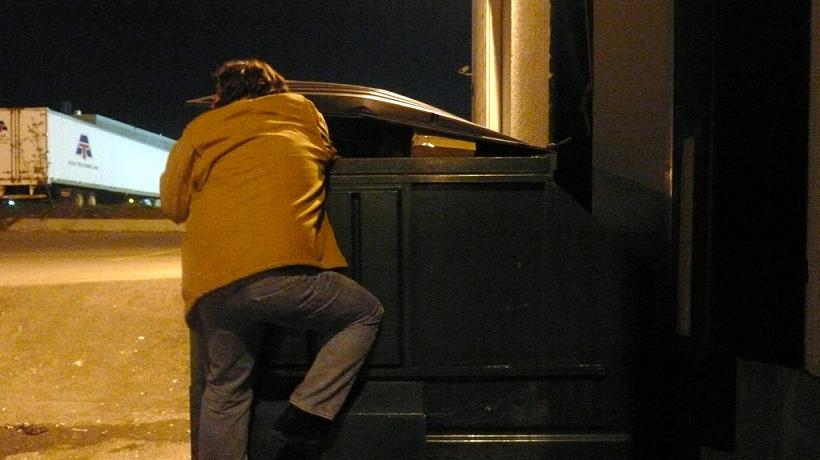
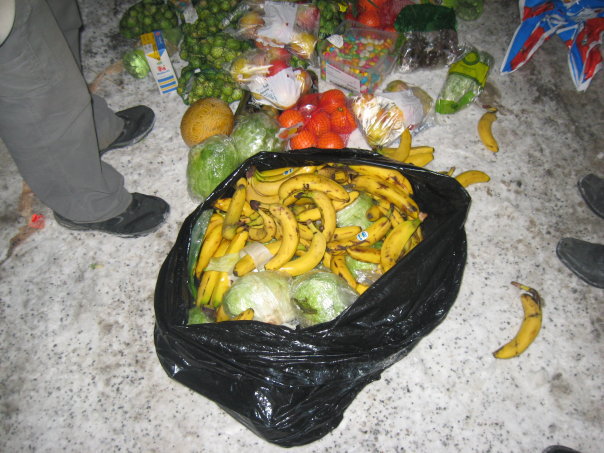
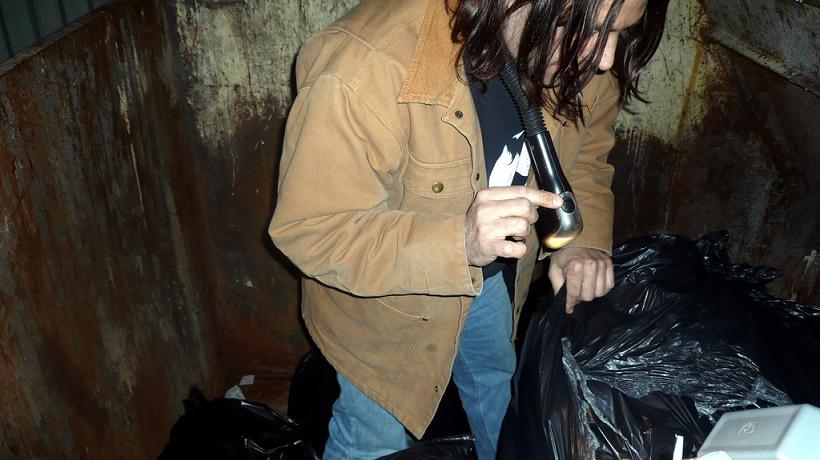
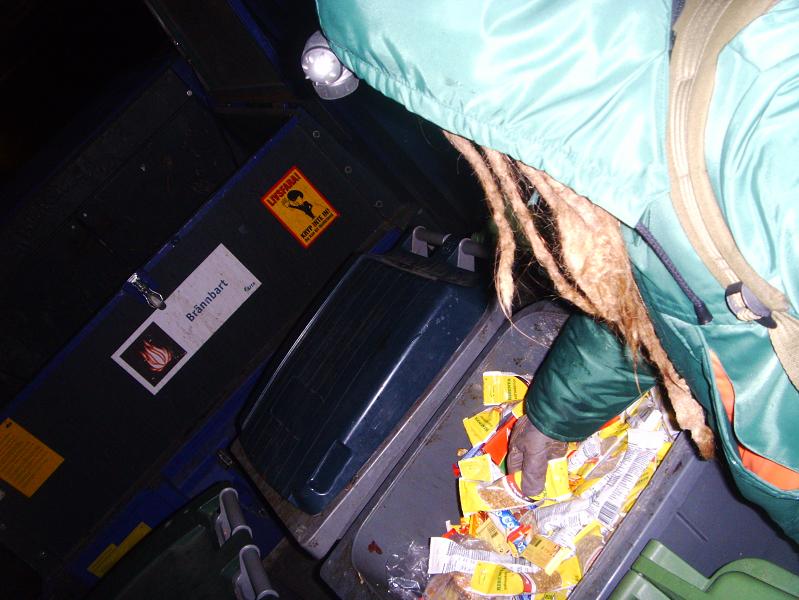
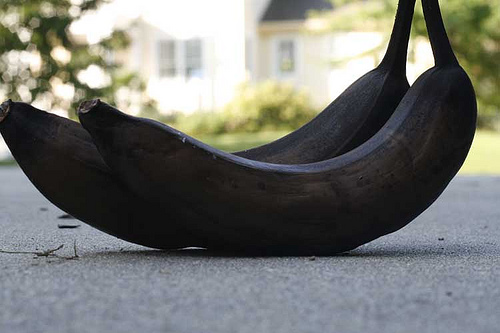
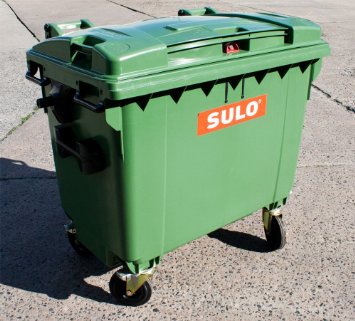
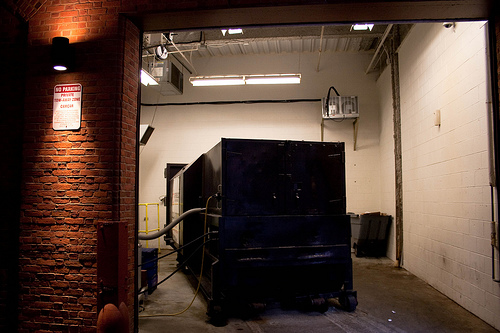
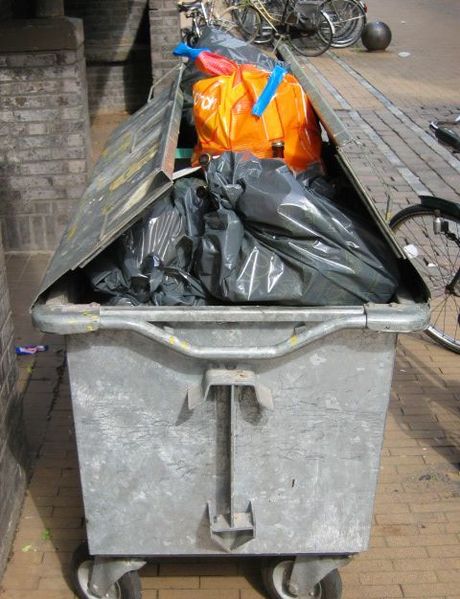
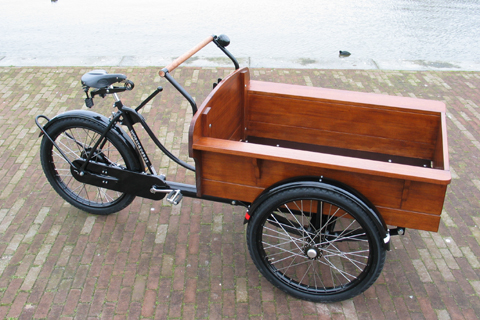
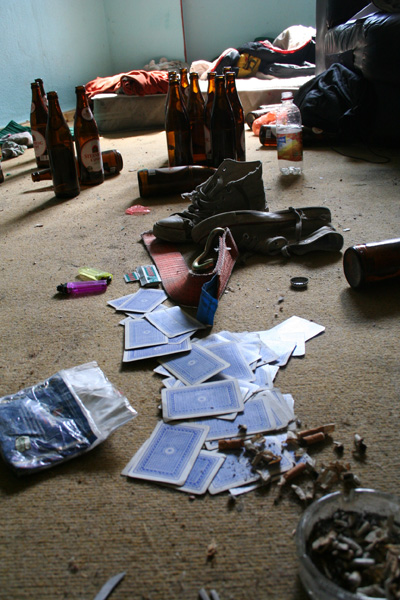
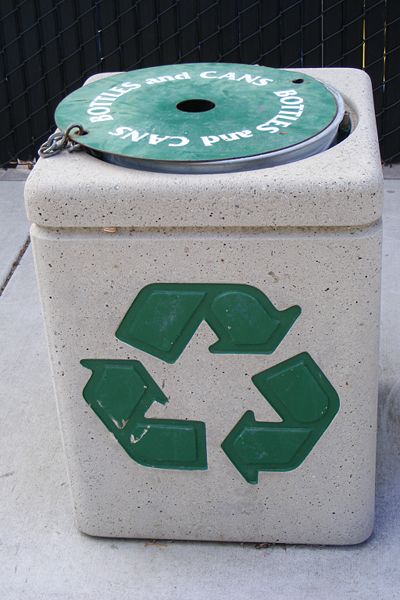
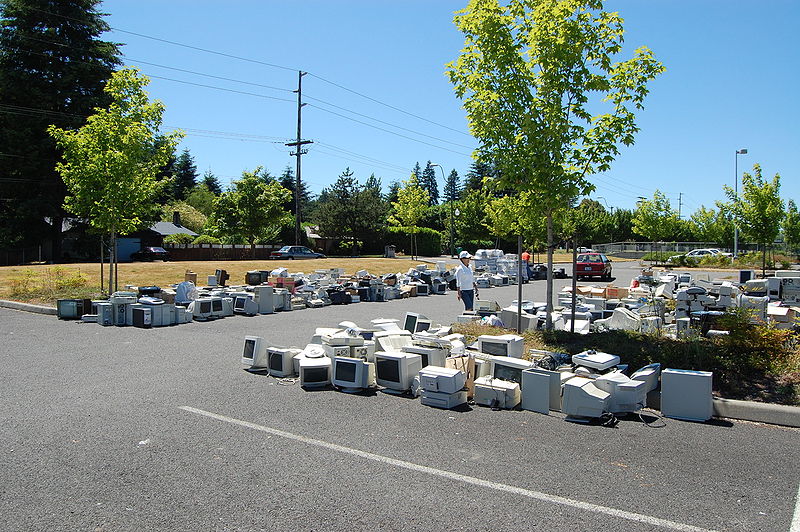

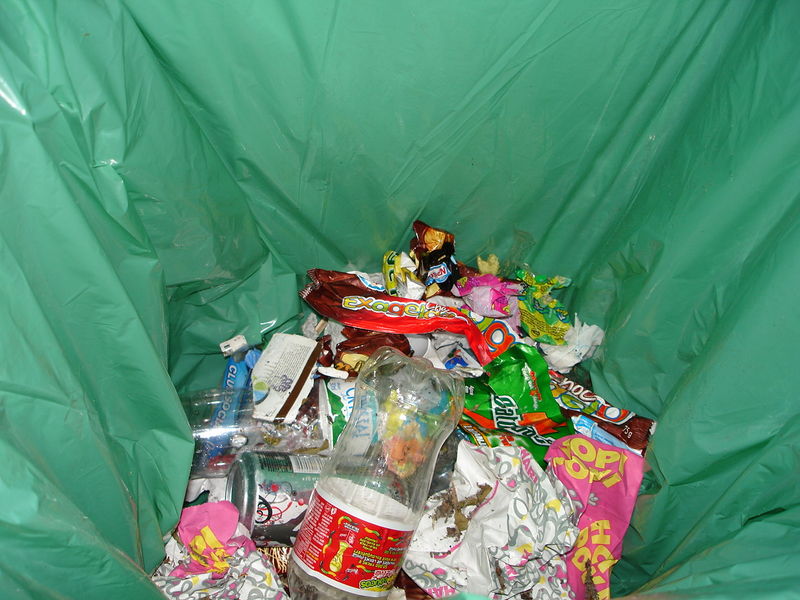
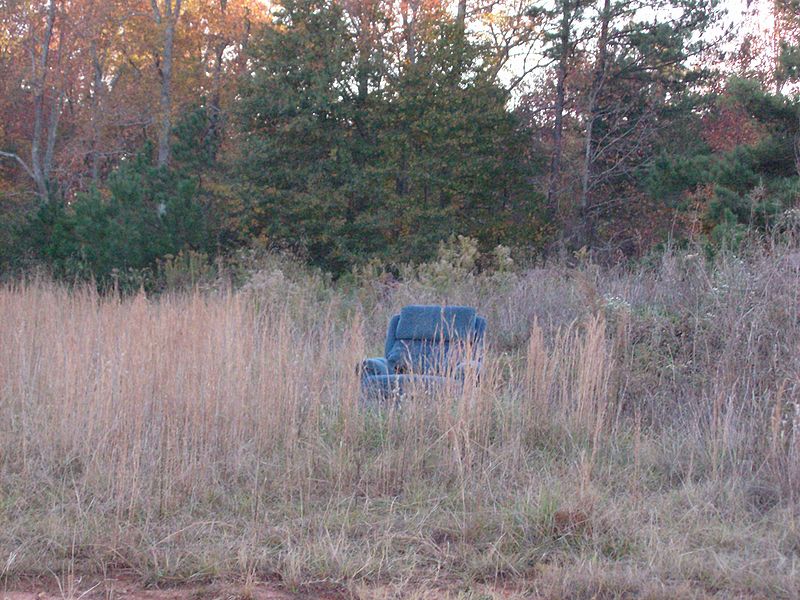
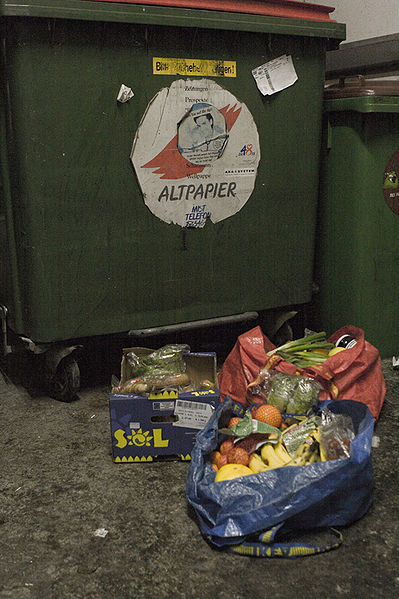
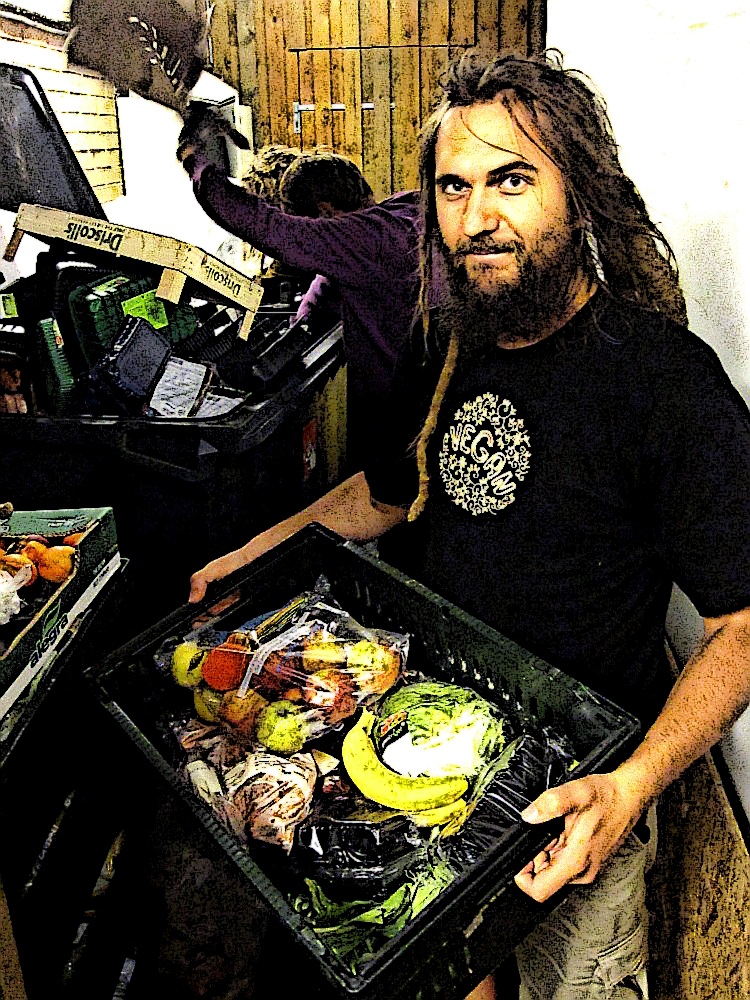
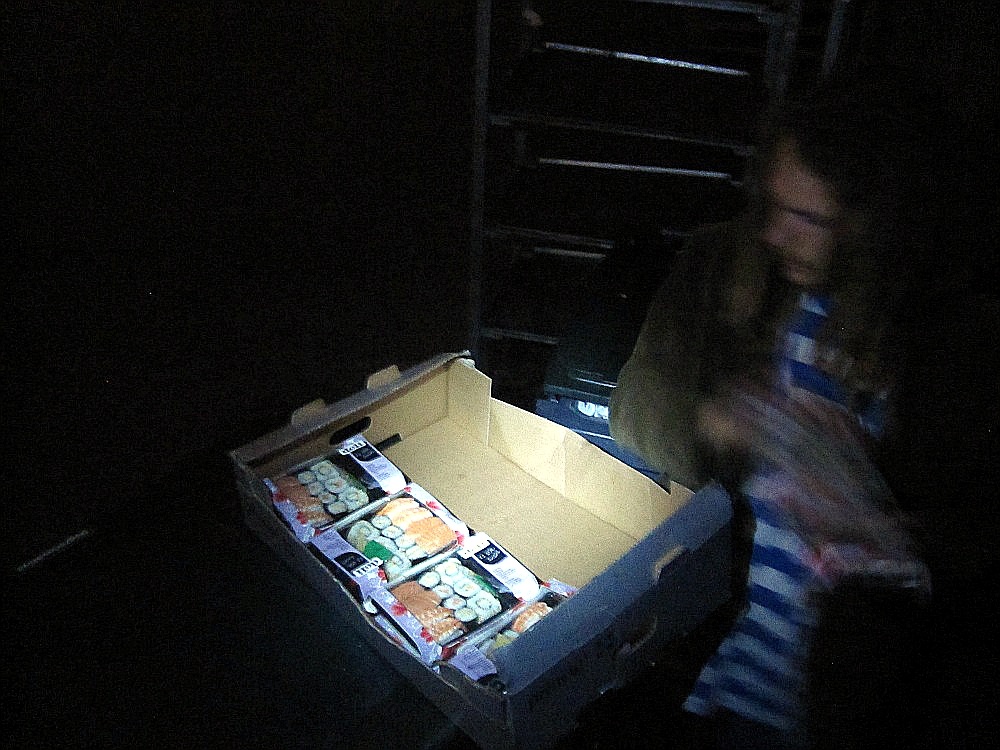
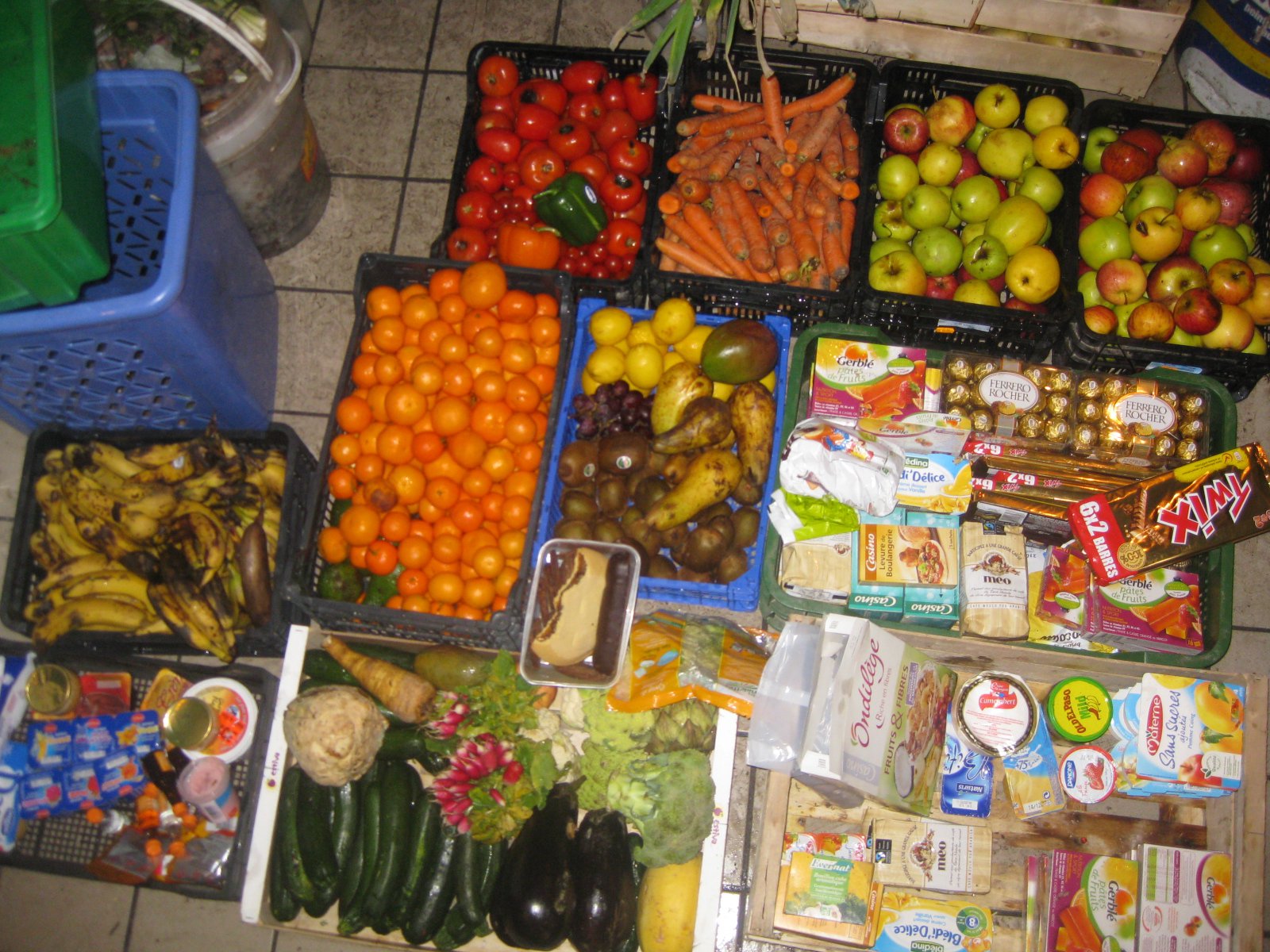
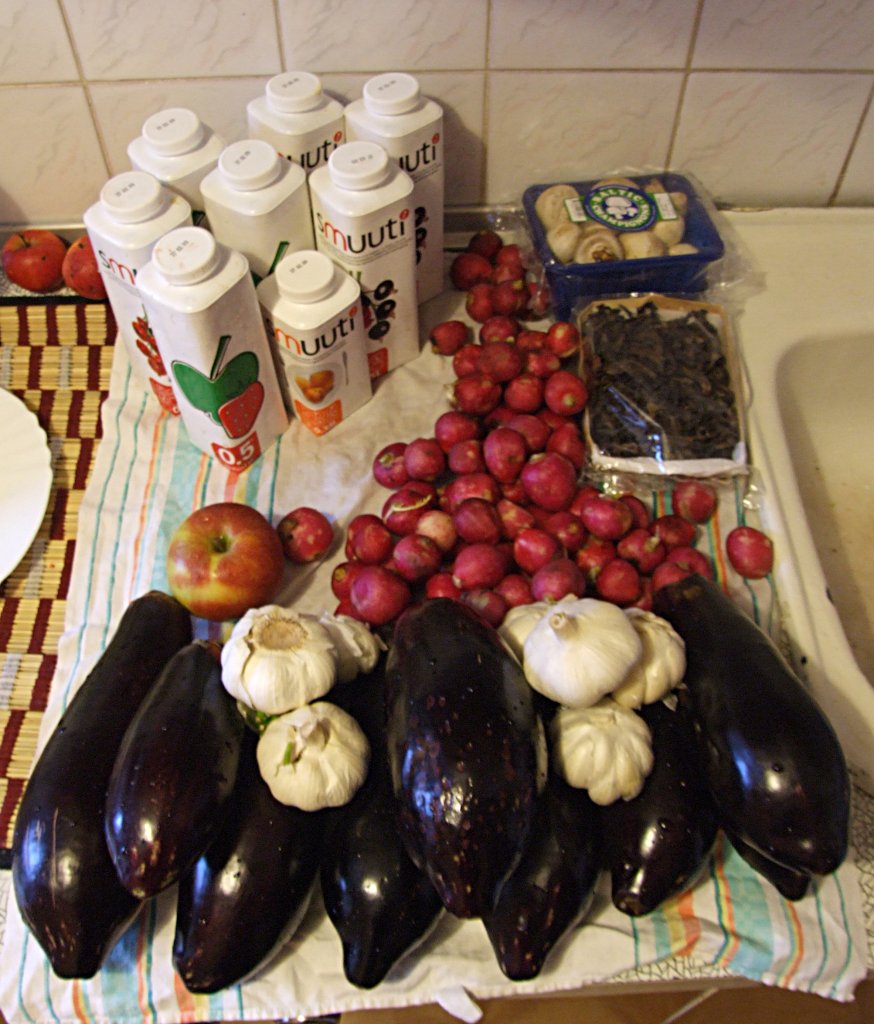

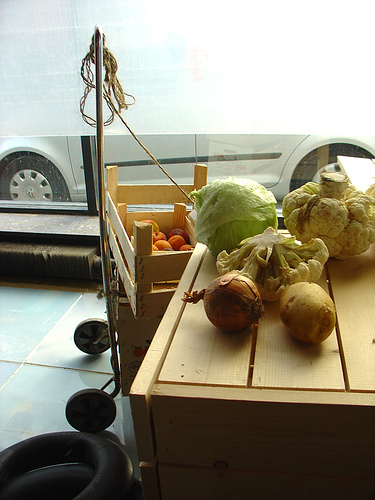

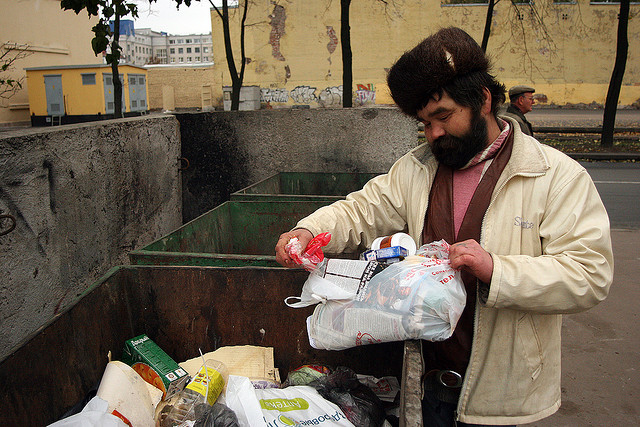
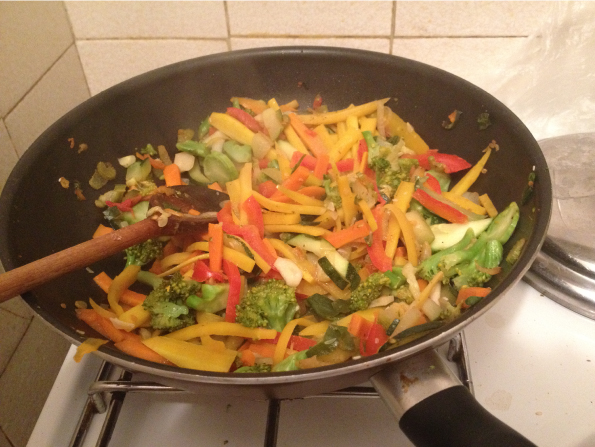
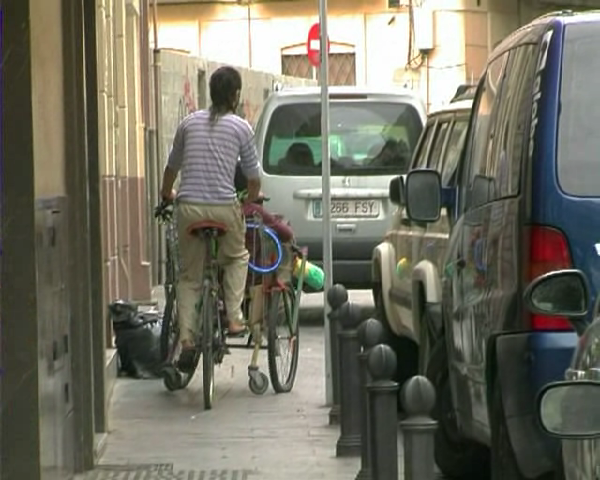
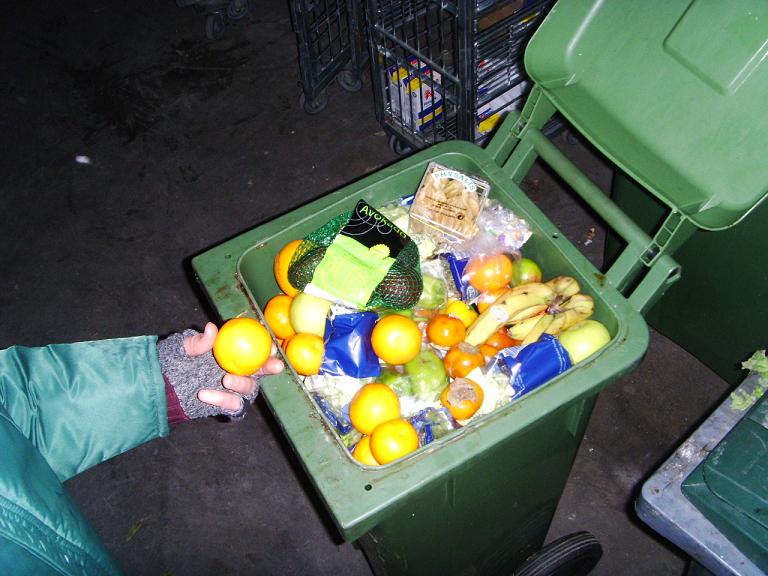
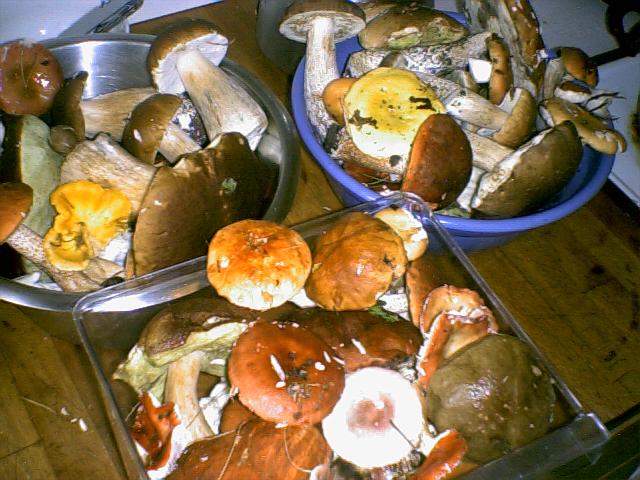
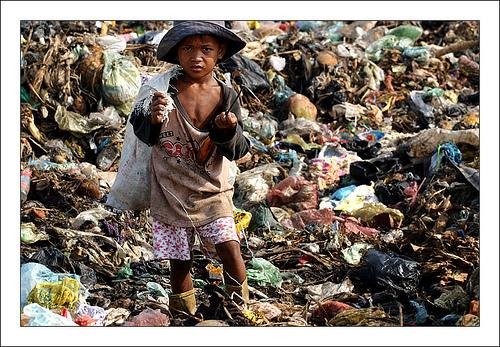
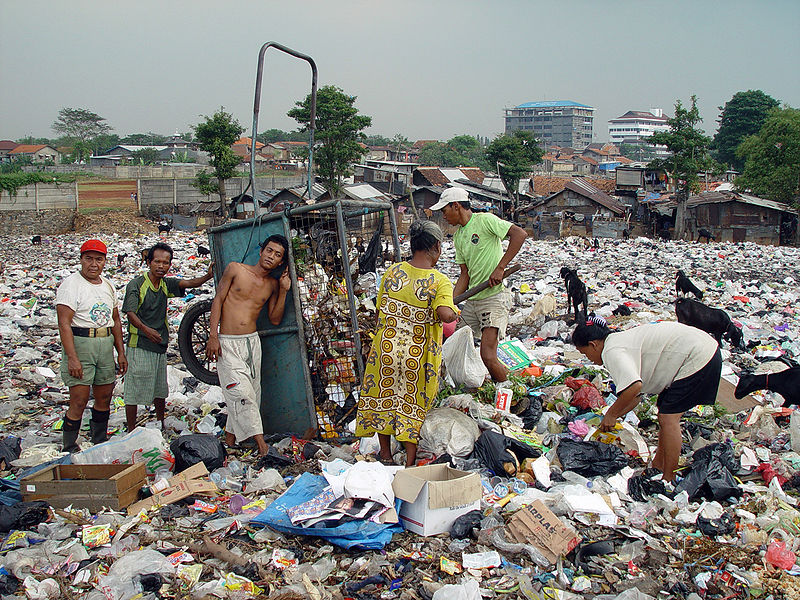

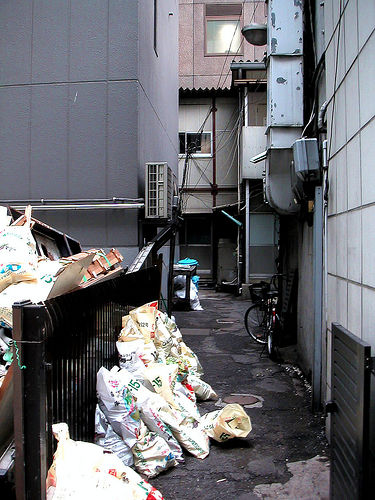
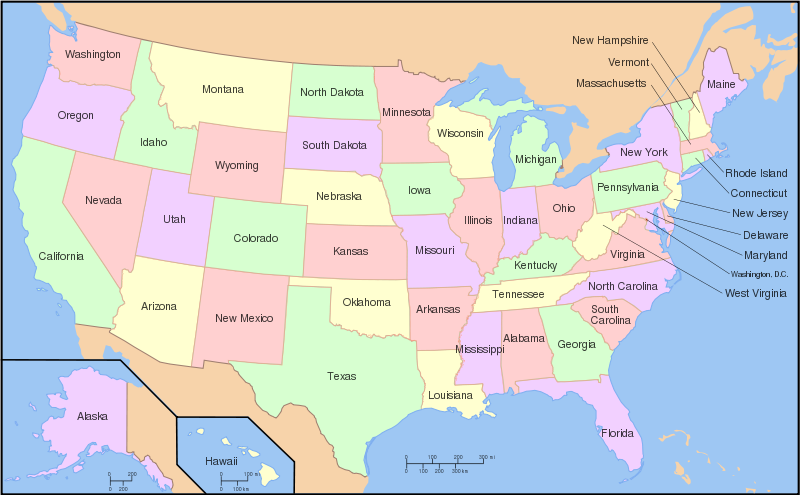
"Dumpster Diving." Wikipedia. http://en.wikipedia.org/wiki/Dumpster_diving#Legal_status Retrieved 22 July 2011.↩︎
One skipper chose not to cooperate and had a very difficult time of it until admitting under threat of arrest that the goods were skipped; the police took their information and let them leave without charge. In any future Section 1 PACE S&S, they have chosen to reveal immediately that the goods are skipped and hope to avoid giving their details; YMMV.↩︎
"Legal Advice for Activists." Free Beagles. http://www.freebeagles.org/articles/Legal_Booklet_4/lb4-6.html Retrieved 22 July 2011.↩︎
"Dumpster Diving Laws." Emoware. http://www.emoware.org/dumpster-diving/dumpster-diving-laws.asp Retrieved 22 July 2011.↩︎
"Dumpster Diving." Wired. Issue 5.09. September 1997. http://www.wired.com/wired/archive/5.09/es_dumpster.html Retrieved 22 July 2011.↩︎
↩︎" How to Dive for Food in Non-Commercial Dumpsters. " I Love Garbage. http://lovegarbage.tumblr.com/post/4332652518/some-fresh-dumpster-snacks-from-the-latest-round Retrieved 22 July 2011.↩︎
Torbay Council (2006) Municipal Waste Management Strategy for Torbay, Consultation Draft↩︎
[http://www.ibisworld.com/pressrelease/pressrelease.aspx?prid=125: March 2008, Cashing in on Climate Change], IBISWorld↩︎
The Landfill Directive Defra↩︎
Attitudes and Actions: A National Survey on the Environment↩︎
The Definition of Waste Waste Definition, Agrarian↩︎
Waste explained CIWM↩︎
[http://www.ibisworld.com/pressrelease/pressrelease.aspx?prid=125: March 2008, Cashing in on Climate Change], IBISWorld↩︎
Unless otherwise indicated, this data is taken from, which attributes, "Garbage Solutions: A Public Officials Guide to Recycling and Alternative Solid Waste Management Technologies, as cited in Energy Savings from Recycling, January/February 1989; and Worldwatch 76 Mining Urban Wastes: The Potential for Recycling, April 1987."↩︎
Lavee D. (2007). Is Municipal Solid Waste Recycling Economically Efficient? Environmental Management.↩︎
[http://www.usatoday.com/tech/news/2002/02/25/computer-waste.htm Much toxic computer waste lands in Third World↩︎
Bonnie DeSimone. (2006). Rewarding Recyclers, and Finding Gold in the Garbage. New York Times.↩︎
ScienceDaily. (2007). Recycling Without Sorting Engineers Create Recycling Plant That Removes The Need To Sort.↩︎
Environmental Protection Agency Frequently Asked Questions about Recycling and Waste Management↩︎
Recycling Is Garbage The New York Times, June 30, 1996, by John Tierney↩︎
Diaper Recycling in California The Free Liberal, September 08, 2003↩︎
http://econlib.org/library/Columns/y2007/Mungerrecycling.html "Think Globally, Act Irrationally: Recycling↩︎
Recycling: It's a bad idea in New York The Heartland Institute, May 1, 2002↩︎
City Council Holds Hearings on Saving Recycling, WNYC, April 18, 2002↩︎