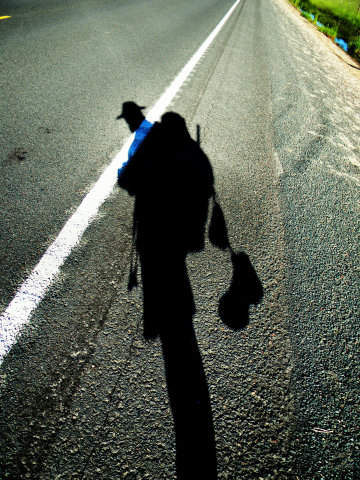
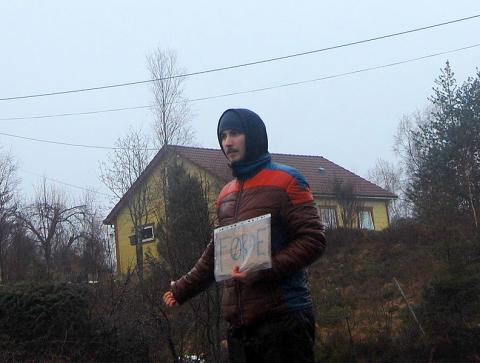
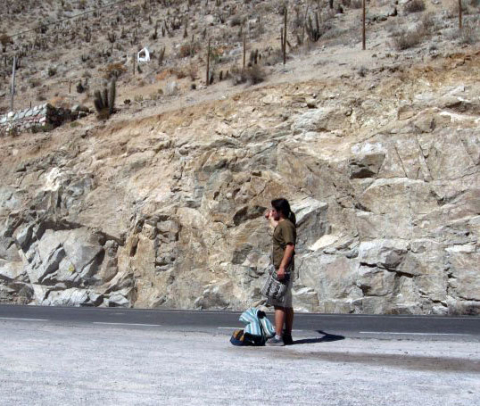
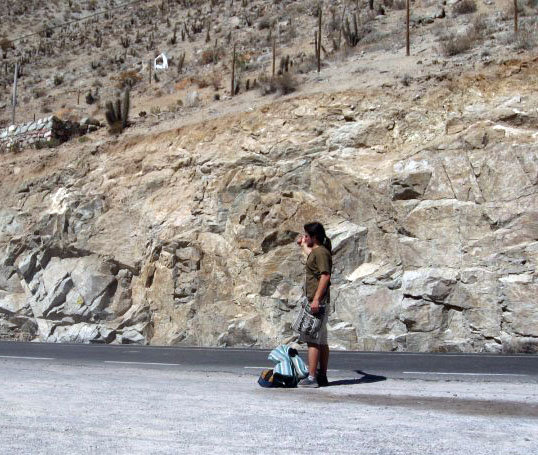
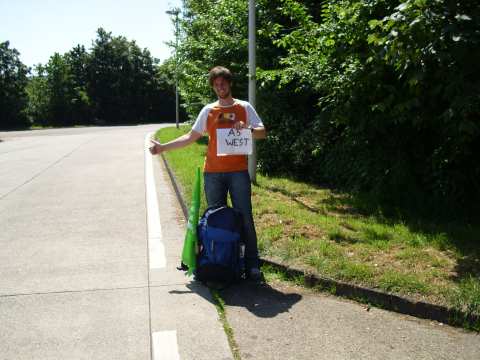
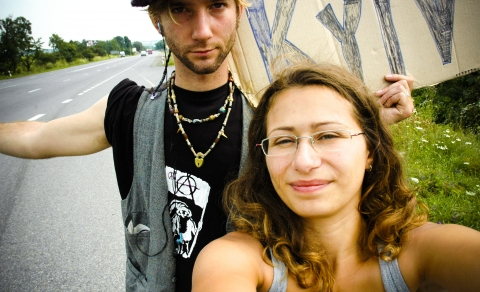
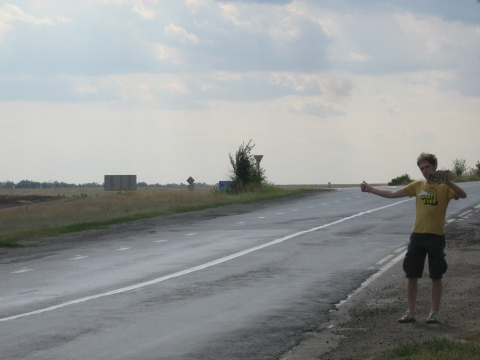
Cover photograph: Seth Doyle · CC0 1.0 — Country road hitchhiker, 2017
.jpg)
Random Roads
A magazine about independent traveling — hitchhiking, sailing, hiking, cycling — compiled from randomroads.org.
Developed by Robino. License: CC-BY-NC-SA-4.0. Additional terms may apply per author or piece.
Stories appear in the order fetched from the zine. Reviews of other people’s copyrighted books are omitted.
Background
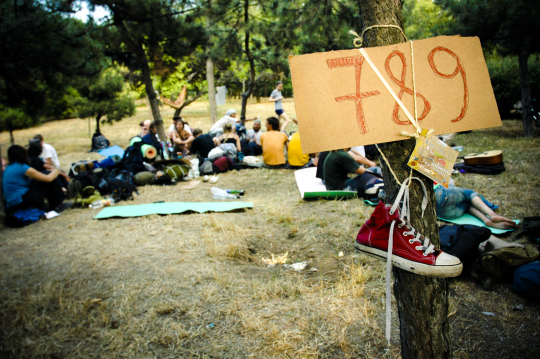
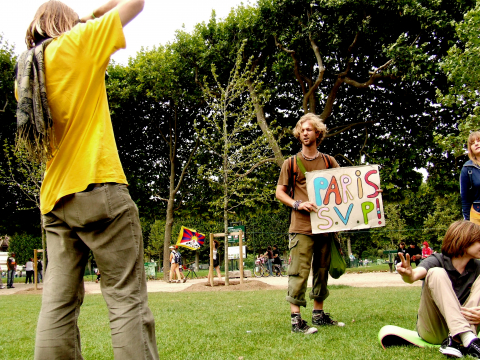
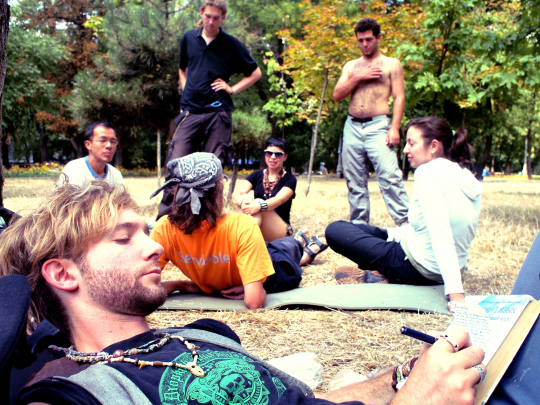
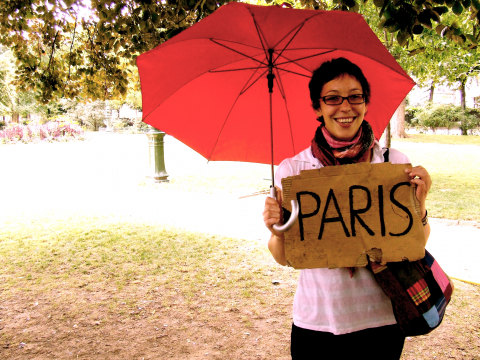
The idea for Random Roads was born after a gathering of traveling hitchhikers in Paris, on the 8th of August 2008 (888) when more than 150 hitchhikers gathered to celebrate the act of hitchhiking. We became more aware of the community we are. Ideas were floating around, a documentary-movie was made, we set up more meetings to keep in touch and we organised yet another festival, this time on the 7th of August 2009 (789) in the Ukraine. And at the same time, we also had this idea of a magazine about our culture of hitchhiking and nomadic traveling.
About Random Roads
Random Roads is a magazine about independent forms of traveling. We cover stories, photography and art about hitchhiking, sailing, hiking and cycling and yet undefined forms of independent traveling. Submit Your work Random Roads features many travel-stories but mostly about hitchhiking and nomadic lifestyles. We would like to encourage you very much to submit your work. Think here in terms of a story, a poem, a postcard or even a photo-story. Quality After you have submitted your work, your work isn’t published yet. One of the editors will get in touch with you and review your article. If needed the editor will also improve the article in terms of grammar and style. All changes made are visible through a special revision tab available to logged-in users. A Magazine In Print One of the ideas of Random Roads is to publish our work in a printed form. The initial idea is to make this available as a magazine but we’re also thinking about releasing it as a book. Community Random Roads is a community driven magazine and only volunteers are behind everything we do. Our server-space, the forthcoming print-editions and other costs are covered by donations. The current volunteers are here to set up the basis for a hopefully long-lasting community-based magazine. Ideas that you have for a next printed issue or your involvement in any other way, are very welcome. Your Role Random Roads need writers, artists and photographers to publish their work. We also need editors who are able to change style and grammar into good English if needed and who can see what an article misses to be really good.
Basic Idea
Random Roads covers all forms of traveling that are part of our “nomadic culture”, a culture of people who leave behind their “fixed home” and are set for a nomadic journey which - as many nomads out there believe - can bring them further than anything else at that moment in their lives. They often travel by hitchhiking and most of the time are want to interact with people they meet. Hitchhiking isn’t the only form of traveling that we cover at Random Roads. We also cover stories of people who roam the world by bike, or even on foot. Therefore we rather talk about the broader concept of being nomadic and “Free Fall Travel”, a way of traveling by which you “let go”.
Hitchhiking Magazine
Stick up your thumb, go from one place to another. Feel the road, hear the cars, find your drivers. In your hands a sign, in your bag your towel, food, clothes and… this magazine! Showing your driver something tangible like a traveling magazine is a great way of showing where you come from, what you do and the culture you are part of. How will your driver respond when he finds out there is a hitchhiking community with even a magazine? And why not offer it to your driver for a donation or give it away for free? Support your hitchhiker, buy this magazine!
Free Fall Travel & Nomadic Culture
Hitchhiking isn’t the only form of traveling that we cover at Random Roads. We rather talk about the broader concept of being nomadic and “Free Fall Travel”, a way of traveling by which you “let go”. Hitchhiking is an obviously an example of Free Fall travel, but also long-term cycling and walking or horse-riding and sailing can be considered as such: being on the road, not having a fixed home, and not knowing where you will be tomorrow. In more general terms, Random Roads covers all forms of traveling that are part of ou “nomadic culture”, a culture of people who leave behind their “fixed home” and are set for a nomadic journey which - as many nomads out there believe - can bring them further than anything else at that moment in their lives. And that is what Random Roads mostly wants to be: a magazine -online as well as offline- that is born out of the culture of nomadic traveling, and which also can be seen as a representation of that same culture. For more information, see the draft manifesto which was a result of a Random Roads Gathering in January 2009 when the community decided how to move ahead.
Community Driven
We are a community driven magazine and only volunteers are behind everything we do. Our server-space, the forthcoming print-editions and other costs are covered by donations. The current volunteers are here to set up the basis for a hopefully long-lasting community-based magazine. Ideas that you have for a next printed issue or your involvement in any other way, are very welcome. This is a collaborative effort.
A Printed Magazine
We are a printed magazine, one that travels from one person to another, one that travelers can give to their drivers or other people they meet on the road. As such, our magazine is a great way to create further bonding between hitchhikers, and to have something we can give away that is representable for our culture. We will be in need for funding. We want to be able to give the magazine away on a pay-as-you-wish basis. We intend to print it 2,500 times sometime in 2010 (full-color) and will be needing an amount between 1500 and 2500 euro for it. To reach that amount we will be doing some serious fundraising.
Thumbin’ It: The Evolution of Hitchhiking
“Hey buddy, you lookin’ for a ride?” With his thumb pointed skyward, saying ‘no’ would be an insult to the speaker’s intelligence. He was looking for a ride, just not from this bearded monstrosity of a man. “I’m headed east on the 10 to Juntura,” the driver continued. In his 22 years, Keenan Recker had heard enough gruesome campfire stories to know the fate of hapless hitchhikers. He imagined the horrors in store should he join this stranger. Torture. Decapitation. Ritual sacrifice. “Be dark bout’n hour or two,” offered the grizzly. Keenan looked at the horizon, looked at his watch, and opened the car door. The act of bumming a ride has existed ever since people discovered modes of transportation superior to ambulation. The history of the word ‘hitchhike’, however, is as bewildering as the identity of those who pioneered the tradition.
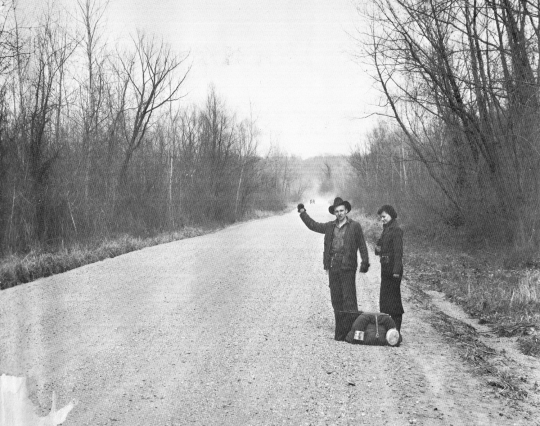
Walker Evans / Farm Security Administration. Public domain.
One popular, though highly disputed, theory traces these origins to the 18th century. In 1737, David Garrick and Samuel Johnson completed a 150 mile journey with only one horse between the two of them. Because of this transportation constraint, they were forced to devise a system that wouldn’t overburden the creature. They concluded that one man would ride a certain distance, hitch the steed to a tree and begin hiking, thereby allowing his companion—once he reached the horse—the opportunity for a restful ride before switching off again. This practice was likely as old as the domestication of horses, but Garrick and Johnson were the first recorded travelers to employ the method. Though delightfully quaint, many etymologists find this anecdote too tailored to be true. The journey itself is not doubted, but its direct connection to the word ‘hitchhiker’ certainly is. A more plausible, albeit less rustic, theory suggests the term was coined in the first years of the automobile era. The earliest models were so slow that a hiker could literally “hitch” himself to the running board of the car, thus prompting some clever observer to create the word we know today. There is also added linguistic appeal in the double meaning of ‘hitch’; in defining the action of attaching oneself to a moving vehicle, it also describes the gesture of raising one’s thumb to indicate intention. The origins of this pastime may be uncertain, but what is clear is that the phrase and tradition gained popularity in the 20th century. Hitchhiking was a necessity during the Great Depression, as depicted by Steinbeck in Grapes of Wrath, but it wasn’t until Kerouac’s On the Road that its appeal found new meaning. The physical act itself had little impact in 1950’s America as much as the lifestyle it represented. This generation fulfilled the desire to go off the beaten path by stepping on the beaten path. And that lifestyle is exactly what Keenan Recker wants. It is no surprise, then, that Kerouac is his favorite author and the inspiration for his new hobby. “I want to see the world in a way that few experience,” explains Recker, who spent three days hitchhiking from Portland, Oregon to McCall, Idaho. “At first I thought it was stupid and dangerous, but now I’m hooked.” Indeed, hitchhiking has rarely enjoyed a balanced reputation. It is polarized either as a guaranteed bloodbath or a state of nirvana, with little in-between. It is at once overly romanticized and the stuff of horror stories. In fact, both aspects contain elements of truth. Most travelers never experience physical harm (though any good hitchhiker is capable of weaving a tall tale at the snap of a finger). Some stories, however, are chilling. Troy Barnes, veteran hitchhiker of 20 years, was once forced to pull a knife on a truck driver and his companion. “They were saying some pretty uncomfortable things,” says Barnes, “so I took my knife out and told them to pull over and let me out.” As unsettling as this story may be, it is the only frightening encounter in his two decades of thumbing it. And Barnes confesses that the incident was entirely avoidable. “I had a weird feeling about it, but I was desperate to get moving.” Risk is an inherent element of hitchhiking, something Recker glossed over for his friends and family. “Of course I was scared, but that is part of the reason for going in the first place, to confront that fear and grow from it.” Recalling the man headed east to Juntura, Keenan laughs about how terrified he was. “He was the friendliest guy in the world, but all I could think at the time was, ‘this guy is going to murder me.’” While moments of fear are not uncommon, they are well compensated for with the more pleasant aspects of hitchhiking. Aaron Rouza recalls the time a large family stopped to offer him a ride, shoving their daughter onto the lap of the eldest son to make room. When they deposited him thirty miles later, he had gained $20 and a new appreciation for humanity. “It’s easy to be cynical about the world,” says Rouza who spent June and July on the road, “but I also saw a lot of kindness that summer.” Seventy year-old church deacon Larry Sample recalls his memories of hitchhiking in the 1960s. Long hair and short winters; warm breezes and cool nights; loud music and quiet self-reflection; many friends and few plans. “The [hitchhiking] community was strong,” says Sample, “we looked out for each other.” This sense of community was a defining aspect of the counterculture. Like most minority groups–they were literally ‘against the culture’—unity was essential. “Those were good days,” he reflects, “they were the golden days of hitchhiking.” Sample may be more right than he knows. Numerous states have outlawed hitchhiking, and growing paranoia limits the once casual attitude America had towards the activity; indeed a noticeable decline in hikers has been observed. What was once a carefree means of transportation has been vilified as a dangerous activity, all in the span of two generations. Researchers Chester and Smith argue that hitchhiking has been nearly eliminated thanks to well publicized acts of violence of and by hikers, and their Hollywood adaptations, such as the films Hitcher and Kalifornia. The Lonely Planet series went so far as to state that “these are not the Kerouac days of old . . . we feel it is so dangerous that we would rather people didn’t take the risk.” With such vivid arguments against the free-spirited tradition, it is no wonder people avoid hitchhiking. But while the physical act of ‘thumbing a ride’ may be an endangered pastime, the value behind the gesture has grown stronger than ever. The desire to travel on the cheap while meeting new people has spawned several resources that could exist only in the 21st century. Online hitchhiking may seem like an oxymoron to many, but the synthesis of technology and community has produced websites developed solely for that purpose. The creation of rideshare opportunities is a testament to this symbiosis. Craigslist offers a popular rideshare forum where people can post offers and requests for traveling partners. Every day there are over 25 listings in Portland alone. While this may lack the glamour of traditional hitchhiking, it espouses the philosophy with an efficiency that only technology can offer. Couchsurfing.com is another example of alternative travel made accessible online, and in fact transcends the limits of ridesharing and even hitchhiking. Members create a profile, select their home city, and choose their hosting availability on a spectrum that ranges from ‘free for coffee’ to ‘available couch’. Hosts can also become travelers by simply searching their destination city of interest, browsing profiles, and chatting with potential hosts. The website is free and immensely popular. The golden age of hitchhiking may have disappeared, but it has been replaced with the chrome age. Though a cultural emphasis on technology has upgraded our generation to hitchhiking 2.0, it has not eliminated the original. There will always be those who view such virtual trends with suspicion, who favor the thud of pavement over the click of a mouse. For these people, hitchhiking is an art, a lifestyle that has never been in fashion and therefore can never go out of fashion. You can still see them, from time to time, with a bag on their back and their thumb in the air.
Not The Average Ride
Hvor skal i hen? I asked when I opened the door of the white transporter that dared to pull over on the narrow on-ramp close to Hjørring, in North Jutland. In the van was a young and seemingly hip couple. Sitting next to the door I had opened, the guy looked at me with a cell phone glued onto his ear, ignoring my all-important question that was still awaiting an answer. From the other side of the cabin, the girl at the wheel, whose arms were covered with gross home-made, heart-shaped tatoos, threw a weird, interrogating glance at me, but then she got it and replied in Norwegian Vi skal mot Tyskland: we are heading to Germany. The guy, who was still talking on the phone, and was evidently greatly annoyed by it, made some room for me in the front, I hopped in and we set off. Since I had put my bag in the back of the truck, I had noticed it was completely empty. When hitching from Denmark to Germany, a route that I know very well, there is but one thing that you see all over the place: respectable Danish middle-class men driving to the border, an empty trailer at the back of their car, waiting to be loaded with cheap German drinks. But the couple was evidently coming all the way from Norway, so that made it a bit unusual. To break the ice and start a conversation I asked them, so, you’re gonna buy some booze, uh? The guy turned around and giving me a withering glance, said ssh, the cops are on the phone. Fuck. I didn’t even stand 10 minutes waiting for this ride, and I had soon put away my Århus-sign, thinking that it might get hard to hitch and so I got ready to accept nearly any ride south. I burst in a big smile when the van pulled over, thinking that finally I was in Denmark and getting rides would get a lot easier than in Norway, a country where I often feel miserable and transparent while waiting long hours for my ride. So my surprise was even greater when I realized I had hitched a ride with two Norwegians… in Denmark. They were going all the way to my final destination, so my day on the road was basically already over, and I didn’t need to worry any further. However, at this point it was clear that that wasn’t really the average ride. What I had seen so far was already a bit fishy, but I usually don’t give too much importance to things such as how people look. But the trouble they had on the phone seemed to be serious, and as if that wasn’t enough, they were very keen to tell me every detail about it and other troubles. A friend of theirs had been injured during a fight the night before, and they reported the fact to the police; the following day though, the cops called them in to testify, which of course they couldn’t do, as they were on the road to Germany and had no interest to tell them what their business was. Almost as a ritual, they were alternating on the phone, each time yelling that they were stressed and needed a holiday, and that the police had no right to enquire about their location, and that that was the last time they were ever helping them swines. Each time, the conversation would end with either of them smashing the phone onto the dashboard, so that both the battery and even the sim card would immediately pop out. It became quite annoying for me too, but somehow, they would each time put the phone parts back together again and start over again yelling at the police. During the whole process, I was vehemently asked my opinion about the quarrel, which of course was that they were absolutely right… At some point, the arguing finally stopped. Nobody picked up the phone any more, and we enjoyed a couple of minutes of silence, at which point I finally had to answer the usual what-the-fuck-is-an-Italian-doing-here-in-Denmark-and-why-the-fuck-you-speak-Norwegian-kind of questions. What I like about these people is that, unlike for example in Germany, nobody asks me why don’t you take the train, son? almost as if they found hitchhiking normal (while in fact it’s very rare). To dissipate my calm, evidently, they soon informed me about the business that they were dispatching. They said they had already been stopped and searched a couple of times. I childishly thought of my Swiss army knife and my wood carving knife, that since the special laws introduced during the Climate Summit the previous December, could get me very easily into trouble in Denmark. During the summit, construction workers were being arrested because they were carrying cardboard cutters in their tool box and stuff. I don’t want trouble, I have a ship to Iceland to catch in two days, I kept on repeating myself. As to demonstrate his claims, the guy proudly showed me a pretty big piece of Afghani hash, and suddenly grabbed a bottle of vodka from somewhere around his feet and took three generous mouthfuls, as if it was spring water. The girl looked at him. He was not going to drive, I was, he said. You have a license, don’t you? I hate driving. Plus, holding the wheel had the awkward inconvenience of being legally responsible for everything going on in the car; but on the other hand, I had the situation under control, and regardless of them drinking and copiously smoking hash and talking to the cops well, at least I could trust myself. I tried to stay cool, concentrate on my uncoordinated driving, not look hostile but at the same time politely saying no to them every time they asked me what kinds of drugs I was into, and if I knew any good dealers that sold by the kilo. For some reason, the guy had seen a fellow smuggler in me, or something. The time was soon over and yes, I “dropped myself off” at a lovely gas station. So much for today.
Am I Brave Enough?
My thumb was up but my knees were shaking in anticipation of what could possibly happen. It was exciting, like a first date with a girl who I admired for a long time. Today was my first time long distance hitchhiking. I had thought about hitchhiking a lot, before I actually hit the road. The idea appeared in 2005 when I spotted a couple of hitchhikers at a service station in Germany and spoke with them. They were friendly and inspired me. What a nice way of traveling, I thought. I had done some hitchhiking from school to home in 1999 but this was something else. Am I brave enough for a long trip? Two years later the idea was still there. So I read everything I found on the Internet, prepared myself and was ready for my 400km trip from Wolfenbüttel in Germany to Bonn. I took the bus to the end of town and raised my thumb… After 10 minutes a car stopped. A young guy opened a trunk full with closed plastic boxes. Upon these boxes I placed my bag. In the car we had a very nice conversation and I asked him about the boxes. He smiled and said: “You won’t believe it but they are full of baby phytons. I am going to a fair to sell them.” I was shocked, as I am totally afraid of snakes. But he was so nice and took away my fear: “Nothing will happen, because they are really babies and the boxes are locked”. He dropped me at a service station, I thanked him and waited nearly 3 hours for my next lift. I was making some novice hitchhiking mistakes: standing with a sign of a town too far away, together with being in the wrong direction! A helpful guy picked me up and drove me to another spot where it was incredibly easy to get away. A journalist picked me up and we had a wonderful conversation all the way to Bonn. It was an exciting day, I had an adventure that would stay with me for a long time and didn’t spent any money for the expensive train ticket to Bonn. My addiction had started.
Zoë’s First Time Hitchhiking
The first time hitchhiking is something that’s always special. It can be a bit scary sometimes, as you don’t really know what to expect. You feel your nerves, and you have no clue if it will work. How did that go with Zoë, whose first hitchhiking trip was 888 (8th of August 2008), the first European Hitchhiking day - when on the same day 150 people were hitching to Paris? What did you expect on your first day? Well, actually, I didn’t know what to expect, I thought it was going to be like hitching on the highway itself with your thumb up and with cars driving really fast. I also thought I was going to die, haha. But it wasn’t like this at all. It was just hitching from one petrol station to the next. It was quite safe, and really fun. It did take longer than I expected to arrive in Paris, though. Why did you decide to hitchhike? I decided only two days in advance to join this hitchhiking gathering, on the day itself that I heard about 888. I wanted to do something different, I was looking for some excitement and adventure. When I arrived the next day at the Utrecht meeting, where we had a pre-meeting, everyone was fully prepared, with maps, signs and lists of the petrol stations. I was a bit in shock then. I had zero preparation and came with a half-broken suitcase. I went to Utrecht to find someone I could travel with, because I didn’t want to hitch alone for my first time ever. At the meeting, I quickly found my partner. And, how did it go? Well, my partner and I got lost in Utrecht for two hours the next day, as we were trying to find our spot. Then some guy gave us a lift from the city and dropped us directly on the highway. Ha, so you did hitch from the highway! Yes, and we were very afraid that some police car would stop to jail us, but a nice guy stopped and brought us to the first petrol station. From there, it finally really started. Until then I actually thought it was all just a big joke; that this whole hitchhiking thing wouldn’t work. At the petrol station, we also met another hitchhiker who was going to Paris, departing from Copenhagen. Later, we met Jan from Berlin who also was at the Utrecht meeting the night before, and he was all covered with sweat, as he had come walking to the petrol station with a huge backpack. So, we were all there, trying to find rides, when suddenly, I found one car with enough space - for all four of us! What did it do to you all this hitchhiking? I was really surprised how much the trip helped me to build up self-confidence. Also the people I met at the event inspired me a lot. Most of the people who were there are very different from myself. I met someone who was 19 and who had hitchhiked for weeks already. He just had his backpack. And also people who had been traveling in that way for years on a row, without the need for some kind of security. That really is impressive. And what’s next for you? You will carry on hitching? Next is buying a proper backpack! I was hitchhiking with a suitcase this time, and that doesn’t work. It was even broken a bit, so I had to carry it along the highway as well as in Paris, where I got lost while hitching out. I am not hitchhiking anywhere until I have a good bag! Then, maybe I’ll start hitchhiking across Australia, or somewhere, and meet people along the way. In the end you went home by yourself, hitchhiking. Were you afraid? Yes, I was. Very much so. I kept pushing back my departure date, to see if there was anyone who wanted to join me, but no one did, so I had to go by myself. I was afraid within Paris, itself, but once I was on the highway, I felt fine. How do you approach your potential drivers? With a big smile! But, I was also picky. I was looking for families, couples and women to ride with. I think you have to be picky - it’s one thing to hitchhike and trust people, but another to . . . You know, I am a woman and also from South Africa, where bad things happen relatively often. So, the bad things that could possibly happen to me are even more in the forefront of my mind. I am definitely very picky. I actually wound up waiting at one petrol station for several hours more as I could have, as I let a lot of cars go without talking to the drivers. My last ride was going to Liège, which is about 20 kilometers away from my destination, Maastricht. But the final petrol station, where we arrived at 12 at midnight, was closed. So I thought, “I want to get home, but I don’t want to spend the night here as a woman alone in the middle of the night with nobody there.” So they dropped me at the train station, where I spent the night. That was really cold. That is, by the way, the next thing I really have to buy - a sleeping bag!
The Miserable Hitcher
You have to be dead broke, or a romantic, to persevere. “Why didn’t that last car pick me up?”, the constant refrain. With every passing car, the hopeful traveller hones their cynical, psycho-sociological observations, between the points when the driver first spies them and when they decide not to stop. If the car is full or driven by a woman alone, it doesn’t really count – no conclusions can be drawn. Otherwise, vehicle after vehicle disappoints, and thick, helpless misanthropy sinks in. Of course, every hitchhiker knows that no driver is obliged - by any kind of social duty - to take an anonymous passenger. But as the percentage of benefactors dwindles, it is inevitable to begin to believe, by force of statistics and over-thinking, that at least some are dodging an act of kindness out of media-induced paranoia and increasing societal isolation of individuals. Each and every one afraid and alone, speeding from one protected environment to another. If they’re right to be afraid, it’s a sad, vicious world; if they’re wrong to be afraid, it’s a sad, vicious world. So, in those few seconds of interaction during which the driver decides, what can the hitcher do to win them over? Well, she can be a female: that’s rather easy. And if male, he can hitch together with a female: drivers tend to trust a cute couple on the road. But otherwise, it becomes more complicated. And between cursing the world, the hitcher will endlessly try to figure out what they could do to increase their odds. Dressing well must help, but perhaps they don’t want to dress too well. After all, the hitcher is not standing next to a broken-down luxury car: why then are they so spiffily dressed? Clearly something is amiss. When the hitcher smiles, does it make them look friendly, or more like a deranged psychotic? When they have a sign indicating their desired destination, are they losing the unimaginative drivers who think to themselves “well, I’m not going there, I’m only going half-way.” Should the hitcher display their huge backpack, making it clear they are a serious traveller and not a derelict, or will this backfire because the driver doesn’t want that filthy bag laying in the dust at the side of the road dirtying their pristine upholstery? It doesn’t matter if the driver’s logic is specious: by the time they’ve made up their slow minds, the fast car has blown by and they can stop feeling guilty about it because it’s too late to turn around anyway. They decide it’s okay so long as they pick up the next hitcher they see, some other day. But the penniless, or romantic, or now irreversibly committed by dint of finding themselves in the middle of nowhere, will endure this taste of bile in their mouths and eventually, be it after 24 minutes or 24 hours, the ride will surely arrive. How quickly does all the disillusionment about humans and their lack of humanity dissipate when that car pulls over! In a flash, the hitcher believes that all homo sapiens collectively become a species so tremendously magnanimous and so understanding of the connections between them! Even when the driver is taking the hitcher out of sheer boredom and loneliness, breaking the monotony of their drive, they are still temporarily alleviating it by extending a helping hand. They still represent the willingness to be good that can be found in all of us, somewhere. They have demonstrated a faith in human nature, and thereby reinstilled the hitcher’s. Then they’re on their way. The overwhelming sense of freedom is instantaneous, the heart swelling as quickly as the disappointment fades: the idea that all one has to do is desire something to make it happen; this idea can be the seed that grows into a solid certainty that all in life is possible if one simply tries. This experience, even after only one success, transforms the hitcher from a vulnerable beggar into a master of the roads. The driver is no doubt content with their pretty automobile, but the hitcher… The hitcher is a god that traverses distances without even lifting a finger… It only takes the thumb.
Rules of Thumb: Tales from the Road
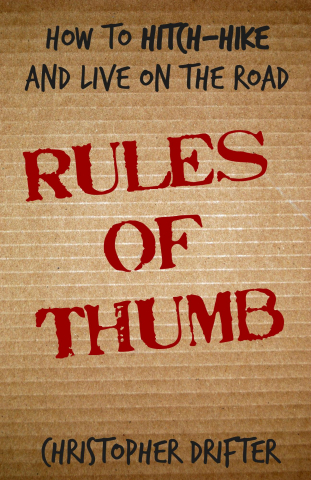
“This is a good spot,” I said to Lauren. The long, straight road that stretched out before us was lined by trees but still had plenty of space either side for vehicles to pull over and stop. A steady succession of vehicles crawled along the road through the still air. Bumper to bumper festival-goers all on their way home. We paused. The forest had provided us with shadewhile we had hiked away from the music festival. Neither of us were ready to step out into the 40°C Tennessee heat – our clothes were soaked in sweat and it wasn’t even the afternoon yet. Still, at least our hike had come to its end. We dropped our bags a few metres from the vehicles and drank our water thirstily. A few drivers watched Everyone was in a good mood and the traffic was so slow that we were able to talk to people for a few minutes before they passed us. We laughed and joked and swapped stories. Lots of people passed out their leftover festival goodies as gifts to us: chocolate, bottles of water, beer, and a huge watermelon. Every time we saw a Colorado license plate we rushed over and cheered. But the drivers just smiled and shrugged – every vehicle was full. They wanted to pick us up, I could see it. It was just a matter of finding someone who could “We’ll have her, but not you!” was the most common joke shouted from car windows as they passed us by, and I laughed every time. “We could take you as far as Nashville,” a few people offered more seriously. One could even take us 400 miles to St. Louis. “Thanks, but we’re going to do it in one trip,” I said, and I believed myself. We were in such a good spot, how could we fail? An hour and four Colorado license plates later, somebody beckoned us to their window. “Did you know there’s two guys down the road, and they’re hitching to Colorado too?” the driver said. Lauren and I looked at each other. The chance of one vehicle going all the way to Colorado seemed plausible – but two was impossible. “Thanks for telling us,” we said. I reminded myself that our fellow hitch-hikers had no way of knowing about us, and no way of knowing that we’d been trying for longer than they had. Nevertheless, our bad luck was frustrating. We put away the sign and decided to accept the next offer to Nashville. Our rivals, two young guys from Denver, came up the road after a little while in search of a better hitching spot and I called them over. It was midday, but we were all already exhausted from a couple of hours of standing in the sun. We walked away from the road and made ourselves comfortable in the shade of the forest. I sliced the watermelon we had been given and the four of us ate together in the shade of the trees. Our spirits were high despite the fact that none of us had found a ride yet. We talked about the hopes we had for our journey ahead, shared tales of our journeys already travelled, and failed to notice as the traffic steady dwindled. When we finally returned to the road an hour later, almost everyone had finished leaving the festival. The traffic had dried up completely. No problem. We decided to walk up to the next road together to try to get the non-festival traffic too, and our new friends offered to hitch from further down so that we could get the first ride – an offer I gratefully accepted. When we reached the next road, however, there was already a queue. Three homeless men were waiting at five metre intervals at the best place for vehicles to stop. I could hardly believe our bad luck. Before that day I had never seen another hitch-hiker on the road. At this point we’d seen five – and it was meant to be illegal in Tennessee. We talked to the homeless men for a few minutes before moving on. Suddenly the air felt cooler. I looked up at the sky – there were storm clouds coming. When we reached the next road, however, there was already a queue. Three homeless men were waiting at five metre intervals at the best place for vehicles to stop. I could hardly believe our bad luck. Before that day I had never seen another hitch-hiker on the road. At this point we’d seen five – and it was meant to be illegal in Tennessee. We talked to the homeless men for a few minutes before moving on. Suddenly the air felt cooler. I looked up at the sky – there were storm clouds coming. It had been raining for quite some time when the cop car pulled over beside us. The cop gave us a long stare as he hauled his heavy frame from the vehicle and I began to reflect upon how fragile my permission to travel in the USA really was. But before my panic had the chance to really set in, the cop turned around and disappeared into an office trailer. My confused relief was replaced a few moments later by even more intense panic when I realised that we were hitch-hiking directly across from a mobile police station set up for the festival. Lauren and I must look like a miserable pair, I thought, if Tennessee cops are getting more pleasure from watching us suffer than by coming over and arresting us for breaking the law. Finally, a car stopped – a young guy on his own. “Where are you going?” I said. I didn’t care, we were going to get in his car anyway. “Nashville,” he said. Perfect. Rules of Thumb: How to Hitch-Hike and Live on the Road
Random Acts of Trust
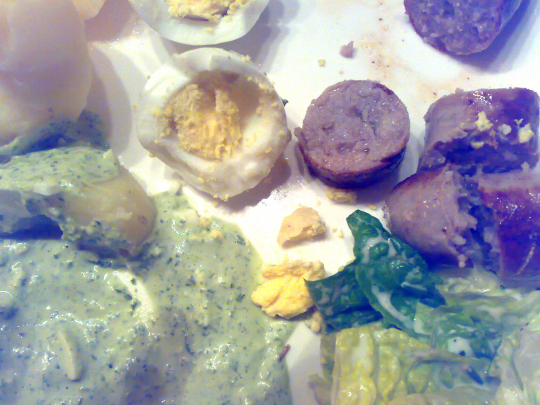
The sun was going down somewhere behind the rain clouds and we weren’t even halfway to our destination. After a series of rides off the beaten path from Amsterdam to Northern Germany, my partner and I ended up in a “not-so-good” place, where nobody seemed to be going anywhere that was even remotely relevant to us. What seemed like a well-connected central city on the map, ended up feeling bleak and largely disconnected once we arrived. The destination was Munich, the present location Munster. We were still 700 kilometers of highway away. I didn’t really care though. But at the same time I couldn’t deny it was rainy, becoming colder and that my mind was wandering to the question of where we would sleep. A young couple pulled up the petrol station in a silver station wagon; they were from Frankfurt we could tell by the numbers on their plate. I couldn’t help but enthusiastically hold up my sign high in their direction. We had been checking plates out of desperation. Finally, someone came by that was going our way! The man said he would ask his girlfriend if he could take us. He asked her, then put his hands up and nodded his head no. Bummer. I walked around the station a few times and passed them as they were eating, “I’m not stalking you, I promise,” I told her as I smiled awkwardly. I didn’t know why she said no, but I certainly didn’t want her to think I was bothering her. Really, I was just circling around looking for new cars. As far as I was concerned, no was no. And who knows, perhaps they were in the midst of a heated argument and she was doing us a favor. Twenty minutes later, he came around and surprise got us, “come on, get in the car.” We were ecstatic. She told us that hitching was dangerous. That her mother said under no circumstances should she ever do this. He told us that she picked us up because she was worried something might happen to us. People couldn’t be trusted. She asked us about our journey, our choice of hitching, where we had been, where we were going… I told her about hitching, hospitality and the spreading of trust networks. She said she always wanted to try something like that. We got on the phone to have someone put in a last-minute couch request (on Couchsurfing) for Frankfurt because we weren’t making too good of time. It was cold, rainy and we had no outside gear. Hearing my conversation, they didn’t hesitate and offered us their home, which I eagerly accepted. They insisted on cooking us a dinner and pressed me for some sort of request. “Whatever is local and special,” I replied. They brought us to their beautiful home in Frankfurt and offered us a room upstairs. Warm blankets, a soft bed and a hot shower. So it turns out that in the end all those “bad rides” that held us up, brought us to here. I guess they weren’t so bad after all. Getting left at a 15-car parking lot on the Autobahn in the pouring rain with no shelter. Being driven around in circles through some city for two hours of rain and traffic. Finding ourselves in tiny gas stations in tiny towns. It was all part of the plan, or lack of plan, that brought us to this wonderful place, to these wonderful people. They entertained us without end. Fresh tea. Offers of warm socks. Good wine. It was clear they were a young couple hungry for guests. They had every type of wine glass and every type of wine. A beautiful home. Lovely art. Full of books. But empty. According to them, they had never entertained. And you could tell they really enjoyed entertaining. Waiting on us, granting our wishes, seeing our smiles. They were living inside the shell of their lives and reached out to us. For dinner, we had boiled eggs, potatoes, salad, sausage and a special sauce. It’s called “green sauce” and is made from an herb only grown in Frankfurt. It was amazingly tasty. We drank a few bottles of wine. Stayed up late chatting. Slept in a little bit. They made us an amazing breakfast and gave us some advice on traveling in Germany. It was actually their enthusiasm that led me to some places later in my trip. A polite request. An awkward decline. The resignation of a young woman that she couldn’t let us just be. Strangers together in a car, making their way in the rain. New friends having dinner together. That night as I nestled under the warm fluffy blankets, I felt great warmth. Not just from the blankets or the body heat of my partner next to me, but from my renewed faith in random acts of trust.
We Never Shared Names
It costs 29 euro to take the train from Heerlen to Amsterdam, which seems reasonable, especially since I want to support the efficient, comfortable and comprehensive Dutch mass transit system. But it misses the point - the point which is about radical sharing. And about storytelling. And about dropping social barriers. And about taking useful risks. And about modeling behaviors for a more sustainable future. I am talking about hitchhiking. Dutch weather is perfect for hitchhiking today - it is cloudy and threatening to rain. So even if I am not wet now, I could be in moments. You get to be a hero for picking up someone at the edge of a storm. Many people wave, some indicate that they are only going a short distance or that their vehicles are filled with family or junk. One woman gives me a thumbs down, but she is the exception. After about 45 minutes, a car stops on the wide breakdown lane entering the highway to the North. He is going to Eindhoven and on to Tilburg - far enough along my way to give up my good spot for what might be a poor one further on. He is totally charming and speaks good English. He is an art lecturer, who amazingly makes his money from the entry fees to his lectures. He rents out auditorium space, self promotes and makes enough to live relatively comfortably. I can’t conceive of someone doing this in the US, unless they had a huge name and then they wouldn’t do their own promotion. We talk about Jackson Pollack, who I have never understood. And Andy Warhol, whose art doesn’t impress him, but whose intellect he respects. I ask him about Rembrandt and the Night Watch and why it is so important. He talks about artists as revolutionaries, as challenging our perceptions of the world. In Pollacks case, he talks about revolutionizing the tools artists use - throwing out the brush and the easel. I tell him stories, talk about the commune and of course memetics. He is enchanted and seems pleased that he took the opportunity to pick up a hitchhiker. And I’m glad I skipped the train. Often it is part of the culture of hitching, to be vulnerable and nearly intimate with someone and never know this label on their identity. We parted in Tilburg and we never shared names.
Some journeys (thankfully) just don’t end.
This morning should have been an omen. But I was too eager to leave, to be back on the road. And so I stood at a forgotten truck-stop staring out from Poland on to The Czech Republic wondering why, and how. It all started when, upon waking up, I opened my eyes and things came into focus. I realized I was still here in this same squat that I had been for the past ten days. I was still sleeping on this dank and dirty floor only separated by an even danker and dirtier foam mattress. I looked for the time: Shit, eleven in the morning. I was already late. Rushing out of the room on the top floor and down to the kitchen I say my awkward English goodbyes. “Maybe we will see you again,” they said while I rushed out the front door. Three hours later, after a botched attempt at figuring out Krakow’s tram and bus system, I arrive at Motel Krakow, from where my journey began. Sign and thumb, one, two, three, and I am on off! I am so delighted with my doctor driver that I completely forget about all of my troubles. One ride became two, two on to three, three grows to four, young, old, student, business man, literally everyone stopped for me, until suddenly the border appeared. I now stood in front of the truck-stop that would be the next eight hours of my life. No cars stopping, no trucks rolling, I ponder my situation. How did I find myself here with only fifty cents, and a bag of clothes? I try and try, walk away and walk back, no one wants to take me anywhere right now… this must be my destiny. Hearing my stomach howl, I take my first break of the day. I eat the last of my bread, and sip on the last of my water. When I looked up and saw an old car pulling up, a young woman stepped out of it. This must be it, this is my ride I thought. I find out that she is in fact heading straight through Zilina but that she does not want to pick me up. She seems afraid as she walks into the convenience store. On her way out I ask her again and explain better my situation. She answers me with ‘two small children at home’ and that she does not feel safe taking me, a dirty looking nineteen year old, who has not showered in a week. I ponder this as I watch the two red lights on that rickety red Volvo pull off and down towards a never ending dimly lit snake of a road, stretching out into the black hills of the Czech Republic. I have never felt this lost and demoralized. Why could I not be a female myself so she wouldn’t have feared? Thinking about all these things, and how sad this earth can be, I sat down and cried, defeated. Several hours later I awoke in the middle of the grassy field that I had selected as my home earlier in the morning, and realized I could no longer feel my feet. Or maybe I actually did, which would explain why they hurt so much from the cold. It was still dark out, but I decided that the only thing there was to do was keep on going. I pulled up my unwieldy backpack and I walked on toward the highway. One by one the cars and trucks floated by. Some of them honking at this lone figure walking down a dark highway, but none stopping. I kept up the same solid pace. I felt like a soldier, training for war. Gear on my back, I took steps. One two one two, to my own rhythm, the rhythm of the road. Ahead a four-lane highway became two lanes, and things got quieter. On I went, until there was no longer a highway, only a winding road passing through a sleepy village. Nothing but a few fenced-in homes, each one with its royal guard dog, and a church with its cemetery. I came upon the one corner shop and saw that the baker had left the bread sitting out front. Seeing that no one had yet come to open the shop, my stomach commanded to take a few bread rolls. Guiltily eating them, I wondered where all the people were and what time it was. I kept hoping to encounter some English or Italian speaking person but all I saw was a blisteringly orange sunrise over the Czech countryside. The beauty of it moved me, and for the first time in who knows how many kilometres I felt compelled to sit down. The rolling fields tended by early morning tractors, moving off in the distance in front of those black hills, now green, I realize that this is beauty. And now I am happy. The school children finally come out, the mothers and fathers are off to work, the town is alive, the sun is bright, and my journey must continue.
Not Knowing What Would Happen Next
I travel without a plan to go home. I have no exit plan, just a one-way ticket. I have my guitar, a harmonica and I make jewelery. I left Canada with 4000 euros, which is actually quite a lot. I worked in a restaurant in Canada for eight months. I had free food from the restaurant and cheap rent - my lifestyle was based on saving money. Not spending it, not buying anything useless. Since I arrived in Europe, I traveled until I ran out of money. I didn’t think about my money until I ran out of it. Once you are traveling and you stay in a city for a bit longer, you meet people from all over the place who you can meet again in their cities. As you keep on traveling, you keep on expanding your network and you get more opportunities on the way. When I almost ran out of my money during this trip, I choose to go to Dublin. I did some couchsurfing and I was staying at different places. I asked people in Dublin for tips on how to find a job and a room. I let them know that since I was low on money, I couldn’t pay rent straight away. Several people gave me good leads for jobs and through a friend of a girl I actually got a room and work. First Time The first time traveling I had no money either. I had a backpack and a ticket to Costa Rica. I thought I would go there, get a bus to the beach and put up my tent. I met other people who were sleeping on the beach for free, including many people who had been doing that for years. I was living mostly on coconuts and bananas that I found. Other people who I met there were surprised. How can you travel without money? They said that I was naïve. But it helps being naïve, I guess. It makes you realize that it is possible to travel and life life like this. I later hitchhiked back from Costa Rica to Canada. It has been seven years since my Costa Rica adventure and people still say that I am wasting my life; that I have to grow up. As I see it though, I am growing and learning everyday. Nothing can stop that. Unlike most people I am free to go where I want, live how I want, and do what I want. I don’t feel like falling into society’s many traps. I don’t own a house, pay for a car, have a huge credit debt, or watch the idiot box! Deportation Eventually at the end of 2008 after almost a year of Europe, I went back to Canada because I was deported from the U.K. The authorities didn’t like my beard and dirty hitchhiking clothes. And my answers to their questions about what I have been doing and where I have been living didn’t help me in making friends with them. Reason for deportation: they didn’t take my word for it that I wouldn’t make money in England without a work permit. In Canada my nomadic lifestyle continued. Not having my own place, I lived with my bag always packed and I slept on friends couches and floors. Some money from the government, some money from an American phone company, and money from selling weed to friends - and I was back hitching overseas, half a year later. Word of Mouth The essential thing is that you realize you don’t need money to travel. You come to this point when you realize the different things you can do to get by. When I have no money, I go to the bakery during closing time and ask them if they have any food they’re going to throw away. You can do the same thing at food markets, and so on. Grocery stores throw away their old food too, but sometimes it is still really good - you just have to cut off the bad pieces. And there is always music I can play. For example, I got coins playing the guitar in the streets of Madrid. I learned also to play the harmonica, which I recommend for anyone. It fits in your pocket easily and has the same volume as an acoustic guitar. But if you do need to get quick money, you can find black market work. In Amsterdam, one year later, I helped someone with painting stairs. And that turned into helping someone paint a boat. And that turned into washing windows for someones warehouse, which that turned into helping someone in the warehouse make clay tiles for an art project. Word of mouth, connections made. It happens everywhere.
When You Are All Whatever It All Clicks Together
I don’t like to think how hard something might be, I just go on the road to find my way by doing it. Believe it can be done and you will see it will happen. It is sometimes hard to figure out ‘where is this damn highway’ but once you are on the road, it feels really good. I have been traveling in Europe for two and one half years now with a no/low-budget. I mostly get by with whatever I find on my road, or whatever finds me. For example when I was traveling through Akureyri to Reykjavik when I was in Iceland for the second time I spent more time writing Reykjavik than holding the sign. The driver who picked me up had a friend organizing an art exhibition. He asked if I wanted to work for him, being paid in cash. Things like this happen. You just have to get to know the people and network around that. There are many examples of how things fit together when you travel like this. When you don’t really have plans you come to see it all falls into place. I always wanted to go to Finland. And then, while I was in Iceland, I met someone who offered me a job and a place to stay in Finland. It did take me a while to figure out how to survive there, but even without papers (I am from the US and have no working permit) this proved possible. It seems that things fall together in that way when you have less expectations and when you worry less. But when you need to be somewhere at a certain time, it gets much more stressful to find your food and to find those rides. When you are all “whatever,” it all clicks together. It’s about letting go. Learning process The first times I came to Europe, I had a budget and a return ticket. I was on holidays, visiting Europe, using my credit card. I always had to go back to the United States to work and pay off my debts that I made while traveling. But now I don’t do that anymore - I have no return ticket and basically no budget. Two and a half years ago I left the U.S. with only 250 dollars and I made my way to Iceland for a job. That was the first time I was there. I ended up working 90 hours a month in a youth hostel just to sleep in a dormitory. To actually earn some money, I had to work 120 hours a month. Iceland is expensive though, so I ended up with nothing. And at the end of those first three months, I was about to overstay my tourist visa. The hostel helped me and arranged a ticket for me to the United Kingdom to get out. I left Iceland broke and wanted to go to Ireland to volunteer at a hostel on the Aran Islands. But with no money at all, I got detained at customs and got sent back to the UK. They detained me for seven hours in an empty room and returned me for free to the UK. Then I stayed at the London airport for a night walking pass the restaurant area with no money at all. That was hard, seeing all those people eating. I could have done it differently by obtaining a work-visa so that I could have stayed in a rather normal way but I prefer not to have that responsibility, it is a different mentality. I stayed in the UK and through a friend I went to a Wwoofing farm where they paid me 70 pounds a week, for 40 hours labor. I still wanted to go to this hostel in Ireland, that I really wanted to visit for nine years now. It was worth it I believed, it is a special place. So when I got some more money, I finally managed to make my way to Ireland. After that I traveled through mainland Europe, moved back to Ireland, got kicked out again, and so on. The hardest moments? Finding food is actually the hardest part. Every morning you have that same thing again - you feel hungry and need food. Sometimes it can be really hard when you wake up hungry. Or at night, when you are wandering around a random city and you really want to have a decent hot meal, a nice cold beer and you see people having those meals. Slow Travel My traveling is now a lot slower than in the beginning. I now have a system of finding a place to stay, getting a routine, obtaining some work and then look for where I want to go next. In the beginning it seemed forever to stay at one spot for six weeks but now six weeks is nothing - you go to a place, find a job, a place to stay and those six weeks are over in a blip. The jobs I do vary a lot. To get by, I sometimes just go out on the street and collect bottles with deposit. But you can also do Wwoofing or construction work. My favorite work to do is some bartending, which is pretty easy to get a job in. Bartending is a good way for meeting people. When you are on a construction site, you only meet the crew. What is essential about traveling like this is to meet the local people. You also depend on them, to get what you need you know. In the way that I was traveling before, I was working and living in youth hostels, I met a lot of travelers. So wherever I was living, I always met the same sort of travelers. It didn’t matter where I was, the experience was all the same. But now that I stopped traveling like this, I interact with others much more. When I wander around in a city I force myself to interact with people. Good things happen out of that. Either they buy you a beer and you get by for some hours. Or if you hitchhike, you get further on your way to a new destination. Or when you tell your story to your driver they sometimes even help you with a surprise. — Interview of Reese, by Robino. November 2008
Butterflies Invading Rabbit Holes
I found him on a bar stall in Virginia, hanging from a noose strung
from the moon, chattering obscurities, drunk as a skunk. His eyes were
full of the mountain snow that reached up above us, even now, at the end
of may. They licked down every woman in the room. I’d been searching for
the artist of the penis etched on every bathroom stall I’d entered, and
now, I realised, I’d finally found him. “My name is Al, what’s your
name?”, he drawls, and breathes close to me, smelling quite like a wet
otter. The white balls just below his forehead seem ready to pop out,
full of salty water from the ocean. “Yeahhh, I drive everywhere; Canada,
Mehico, all across the United States”, he grins. “In a big truck, the
biggest you can have, one which carries houses and stuff, you know? Earn
two hundred thousand a year…nothing to do with it though..” The karaoke
drowns the bar. I have to move closer to him to hear anything. This
would be what is commonly known as a redneck drinking hole, but here,
unlike those of the north, there is a warm sense of comradery. “Your
trough is here too? Well, drink on up, partner”. “I like this place”, Al
says, “I’ve been visiting here for twenty five years…they won’t screw
you here, steal your money or overcharge you…It’s a good place to be..”.
He buys us drinks, Lee and I, the first Englishman I’d encountered in
three months. Lee gazes at Al in wonder, like he’d just appeared there,
out of nowhere, out of a trucker’s hat, like a rabbit. Lee picked me up
in the Appalachians, North Carolina, an hour’s walk from my friend’s
small little mountain cabin full of mice, wine, tea and chocolate. My
friend had drunk solitude like water, and two weeks after arriving, it
was time to leave with scribbled words and books, into the rain and
north to Québec. Disappointment has a way of adding up, but the cabin
had been nourishing and warm. He was exploring the roads, searching for
bears, mountain peaks and avoiding skunks. “I’m gonna take you to
hooters, Jass, you can’t leave the states without going…” and so we
went, drowned in throngs of nipples tight against white shirts and beer
guts. And then - the announcement that to drink at this fine
establishment, one must have a US identity card. Uh huh.. Here, southern
blue grass songs lick the walls sung by middle aged men and women with
perfectly rounded beer bellies, with the tattoos of partners that they’d
long since forgotten adorning their arms, bellowing their songs without
the need to read the lyrics flashing on the screen. “You know, I don’t
know about you..”, Lee murmurs in my ear with his thick midlands accent,
despite having living here for seven years, “but I think most of these
women could be anywhere from nineteen to forty five, eh eh eh?”, Lee
says, “but back home, you wouldn’t see a girl with tatts like that, know
what I mean?” He speaks in particular of a woman standing at the bar
with blond hair pulled into a ponytail that makes her look remarkably
like a donkey with large bucket like breasts and a bowling ball stomach.
“But I tell you what, I wouldn’t fancy a fight with any one of them”.
Their arms were like tree trunks. Al touches me on the arm as if
desperate for attention. Sitting on a bar stall, his height is elevated
to my own, but looking down at his legs, they seem to be that of a small
jumping jack. “I have a massager in my seat, in my truck”, he says. I
react as if being blessed a tibetan lama. “But”, he smiles in delight,
“it’s not a normal chair. See, one time, I was walking in a field and
had to climb a fence. Can’t remember what I was doing there, mind…but I
was walking, I know that. Oh, yeah… there were cows and I’d been
camping. I thought they would come and eat me. Cows are mysterious alien
like creatures, don’t you think? Anyway, so I’d packed up and was trying
to avoid them. Every time I moved, the herd followed me. See, I had to
climb over a fence into where they were and then back over again to get
to the road. They weren’t there when I’d been there in the night. I step
on the fence and get a big shock. I forget about the cows. They stare at
me. But oh, how glorious it was to touch this fence! Oh oh oh…” He
becomes lost in his memories, murmuring. I don’t see it, but I can sense
his saliva dripping down onto the bar. “Oh…it was so good…I stayed there
all day fondling it, writhing it over my back, oh such pleasure I have
never known. The cows lost interest. Maybe they thought I was crazy. In
the evening, a farmer came and asked me what I was doing. I tell him. He
turns away in disgust. How I laughed! I was in heaven…such heaven.. The
farmer returns with a shotgun and I scamper off, my skin leaping at the
sky…”So you know, I had to get an electric shock therapy machine in my
truck, so now I can just press a button and it shoots straight down my
spine, oh such ecstasy I knew every time I drove…” His eyes flutter up
to the ceiling, into the hovering fans and burst through the roof, out
to the mountain stars. “But now…I find it’s not strong enough…I have the
strongest one…”, he blinks his eyes sadly. “Yet, look at me, I look so
young…so, so young…”, waving his arms in the air. He looks to be in his
late sixties. “I’ll be fifty two this year! Just look at me, would you?
All because of my electric shocks!” War everywhere here: Tiny wars,
large wars between a wife and a husband or supermarket workers
sabotaging the milk isle while the managers all had their backs turned:
A Remember North Korea and 9-11 banner, huge, stretched
across an entire house in Boston. The homeless bellowing shrieking
screaming down alleyways of industrial cities…discarded when their body
or mind failed them, no longer any use for war. Or those armed to the
teeth in arms and still manage to shoot their best friend in the face by
accident. Or young kids who know nothing else but to murder another,
because it’s all they’ve been trained to do. “Yeap, served my time in
`Nam”, Al murmurs when I ask him. “Still I have dreams about it, it’s
why I like my tequila, warms me up a little, you know…I saw something
out there…one of the circles of hell, it was…”. Now he lowers his voice
so that I can barely hear him. “I don’t really want to talk about it
though…people here might get upset…” “Then just tell me”. He looks at
me, surprised. “I made a lot of good friends, out there. You have to…so
many of them are dead now…but not me!” He grins and downs another shot
of tequila. He shakes “But a lot of people had to be killed…you
see…there was no time to feel for the people we were killing…we had to
do it…or suffer the same fate ourselves…”One time, a teenage woman came
in. So pretty, she was, flawless. Had a body to die for, from her toes
to her eyes. Her dress was lowcut and almost revealed everything she
had. But she didn’t fool me, not my type: I, unlike everyone else, just
looked in her eyes. Saved our lives, that did. I swear we would have
been dead by now. She had two children with her. This was the time of
the ceasefire, at night…it was still a humane war, you know…we are not
animals…I shot her in the head, twice to be sure, then the children”. I
finish my corona…beer from Mexico, and suck on my lime. “Sure enough,
she had explosives strapped around her. That could have been dangerous
too, but we were trained for it and quickly dismantled it.” He smiles
and sighs…“Oh, this life of ours…” “You know what, Jass?” He smiles
wider. “You know what I really, really love?” “I can’t guess…” “Fat
women. There’s so much more to love, and they have so much more of a
appreciation to be with somebody because not many others would take
them. And no matter what, they always cook for you…” I suddenly become
aware that I’m in the company of a great master. Of what, I do not know…
“There was once this really big babe here. I got talking to her and
asked if she wanted to wrestle. She agreed. We were both really
drunk…really sloshed…We both took off our tops, half naked. Her titties
were so big, I tell you…oh how I squeezed them! She squashed me onto the
ground, though. ‘Alright, alright!’, I says, ‘I give in!’…oh it was so
good, made me so horny, all on the floor here, right before you.
Everyone loved it. But my back has been strained ever since, for weeks
and weeks, I couldn’t drive for a long time…they don’t have insurance
for wrestling fat girls, do they?” We leave him and the men who look
like their women and tattoos and tequila and bluegrass sung with lungs
bursting and come out into the night, climbing back out of a rabbit hole
full of sweat, stories and old yarns that nobody else in the world will
ever hear.
Green Tunnel, Delirium and Recovery
It’s my third day in the green tunnel and I’m exhausted, I see a big wall of entangled vegetation in front of me. I have no clock and mist has been hiding the sun since I’ve started walking but birds tell me the night will fall soon, so I decide to set up my tent. I can see many dishes, the best dishes I ever ate during my life, the bread from my mum, the rice from my stepmother, vegetables, meat, fishes, olive oil, mediteranean dishes… I have a kaleidoscopic vision of it. All is for me! People bring it to my table. I’ve been told I’m close to a village called “El Negro”, yes! I already listen to their dogs… Hold on, why is it called like that? El Negro… nero… noir! (black) STOP!!! I wake up in my tent full of humidity and I feel terribly lonely. A pouring rain is falling, there is lightning every 5 seconds, water is running under the tent… inside also. I have to eat more, I’m rationing my food because I’m not sure I’ll have enough. This trek was supposed to take only three days but I’m still in this green tunnel somewhere in those cloud mountains. It used to be a road connecting Cochabamba with Chapare, going down hundred of meters. In the 60s, the road was abandoned and was slowly colonized by vegetation. Pieces of the road have been swallowed by streams, others have been covered by stones. The more you go down, the slower you walk. I’m probably not that far from the end but I have no idea how long it’s gonna take me to do it and I have only 2 days of food left. I don’t want to rot there, I want to see my friends again, the situation is becoming too dangerous. I make the decision to go back, it’s not an easy one, will have to climb back this bloody mountain, 3 days again. When morning comes, it is still raining, have to hurry up because food is running off. So I start walking, I have to go under trunks, over rocks covered by inextricable plants, cross ravines, go into the water. I’ve done it already so it might be okay but I can’t make any mistake. If I get hurt I’m fucked. Nobody knows I’m here, would take months to discover my skeleton. I start thinking about the Vietnam war. This exuberant vegetation, rain, mud, stressful situation remind me that. But wait, why am I thinking about the US Vietnam war? Why not the French one? Probably because the French didn’t make good movies about it so I don’t have the images inside my subconscious. Probably one of the reasons anti-americanism is so widespread is because American are good movie makers. And also, who knows about Dutch crimes of war? Who knows about what this “peaceful” nation in the East Indies did? Who in the Netherlands even knows the name of Raymond Westerling? I fall down in the water between two trunks. Have to stay focused on my way. I’m quicker than on the way on because this time I just have to go back on the track I already made. After one day and a half I cross the last ravine. Now I know I’m SAFE. Will be painful but I’m sure I’ll see again the ones I love. As I go up, there is less vegetation but it is still raining and I’m getting cold. Let start to sing stupid songs to go faster “Ho chi minh is a son…” No, another one! I know I will soon reach a place where Bolivian workers are staying, close to network antennas. Will have to ask them for some food, otherwise I would have to walk another day before eating anything. Yes they are there, digging holes close to their shelter. I go to see them and explain the situation. ¿Hay pa’ comer? (“Is there anything to eat?”) Yes, they say, ¿Pero no quieres descansar aca un rato? (“But don’t you want to have a rest?”) They are not especially friendly but have enough humanity to read my face and help without asking stupid questions. The housekeeper gives me a plate of chicken soup with bread. As soon as I finish it there comes another. Food is so good, I’m going back to life. After that, I wait for dinner, trying to dry my poor clothes. Totally focused on food, nothing is more important for me. I’m anxiously listening to the guy cooking. Workers come back from outside, they are laughing, telling jokes probably about me in quechua. I’m so glad to see humans laughing, whatever they say. We eat fried chicken with rice, potatoes and chilli sauce, typically Bolivian, drink tea and after a while go to sleep on the same big couch on the floor. On the morning we drink api, a hot drink made of corn, sugar and cinnamon. I want to go, but the Bolivians convince me to wait for them. They are finishing setting up a lightning rod. Again, I wait for food, this time we’ll eat boiled chicken with potatoes, lentils and rice. Wow! That’s real worker food, perfect for me. After a while I am brought back to civilization on the back of their big pick-up, covered with a tarp. Under my plastic burka I’m smiling because I know I’ll be able to tell this story.
Slower Than a Caveman Rolling Down a Hill
“I will ride my bicycle around the World.” With an audible power, these words drew a fantasy into the realm of possibility. People wanted estimates, people wanted answers. “What’s your plan?” they asked. “Plan? What plan? I told you – I will ride my bike around the world. That’s the only plan.” The only thing I knew for certain was that nothing is certain. On September 15, 2007, with a bike and a passport, I left my beloved Wisconsin. I went East on two wheels, food for fuel and freedom for breath. Somewhere past Norfolk, Virginia, I discovered an ocean in my way. “What do I do now?” Deep inside, I knew I wouldn’t fly across it. Airplanes are just too damaging to the environment, and besides, they move too fast. So I went down to the docks to look for a boat. What I found was discouraging, week after week: dirty freighters, patronizing shipping agents, and stern-faced harbor guards eager to disappoint scruffy visitors who can’t afford cars. Winter threatened and the road beckoned; I packed up and headed South. I rode until the land ran out, to the bottom end of Florida. The Miami coastline was crowded with megayachts and materialism, but here and there the mast of a sailboat was flying a flag of hope. I knew next to nothing about sailing, but every time I honestly analyzed my desires, wind power was the only option with which I was comfortable. It was the only option that didn’t leave a bad taste in my mind. I had to become a sailor. Starting from scratch wasn’t easy but after two months of building contacts and skills, certifying myself for boating safety, and tracking down leads on transatlantic crossings, I finally got a hit. A Finnish skipper on the internet invited me to sail with him from Antigua, an island in the middle of the Atlantic Ocean, to England – ‘all’ I had to do was make it to his boat, more than 1400 nautical miles away. I only had three weeks but luck was with me. Mere days later I found a flier - a captain soliciting for crew, sailing from Florida to Antigua! Perhaps it was something more than luck, actually, because as I was dialing his number with shaking fingers - “Don’t screw this up, don’t screw this up…” - I realized it was a Wisconsin area code, my hometown… I was a shoe-in for his crew position, and in less than a week, my bike was loaded onboard and I was on the deck, watching my homeland disappear over the horizon. “Someday I’ll be back. Someday.” Across the Ocean Two months later I was reassembling my rig on the ancient shores of oh-so-green Cornwall in England, overjoyed to have my feet on solid ground after nothing but blue on blue for so long, but also with a greater appreciation for all aspects of life – especially water. The “World” part of this world bike tour had begun, but it wasn’t long before the true strength of my conviction was tested – my grandmother was ill, and preparations for her funeral were underway. Would I betray her by continuing? Or would I sacrifice my principles and fly home to be with my family? I searched deeper in my soul than I ever had, until I finally knew the answer: my granny would want me to keep going. So keep going I did: left side of the road, all the way to London. France and the European Continent were close, but Ireland was a must-see, so with plenty of time to reach Spain before winter, I turned around and crossed Wales. Somewhere in the Silvermine Mountains of Ireland, alone in the middle of nowhere, my principles were tested again – and this time in a very peculiar way. It’s not just the oil consumption and pollution of motor vehicles that really grinds my gears, and try to reject, but also their sheer convenience. I like to live slowly and naturally; anything that moves faster than, say, a caveman rolling down a hill – is too fast for me. I believe speed and convenience to be opposed to self-confidence and community – give me the simple way of life, every time. Motor vehicles are dangerous technology; they’re too new to trust and they make things too easy for them to actually be healthy for us. Soon the generation that knew how to live without cars or airplanes will be extinct, and their grandchildren grown into a society that doesn’t know any better. Who will think to question? Who would be so bold as to refuse to use a car? Well, I am trying my best. And I had nearly weaned myself completely from the gasoline teat, too, when I crashed my bike coming down a mountain. There were no reckless drivers, no one to blame. No potholes, no slippery gravel. I was just plain going too fast. I had to let them put me in the ambulance after that, internal cumbustion engine or not; my bike was wrecked and there was a bone sticking out of my foot. My ironically slow recovery from this injury was fraught with such compromises; one ride from the hospital, one ride out to a potato farm, where I was invited to stay with a Catholic family, and one bus up to Galway City after I had my chromoly frame welded back together. Such a loss of mobility was crippling, even if I could sit on the saddle and sort of push my loaded bike around a little bit. Three months was a long time to be invalid and broke in a foreign country, but I survived, by enthusiasm and honesty. Now I have a ton of new friends in Ireland, and my faith in humanity is stronger than ever. An artist named Dawn helped me more than most in Galway. We never really rode bikes together, but when my foot was healed and I was packing up to keep going, she said she would follow me. My first reaction was idiotic jealousy: “This is my bike tour!” My tough-guy ego didn’t want me to have anything as soft and comfy as a beautiful woman to travel with. But I had promised myself I would remain open to every possibility that comes my way on this tour, and after some due consideration - some short consideration - I realized what a fool I would be if I didn’t share it with her. So what if it was late November and freezing cold? So what if she had never ridden a bike more than twenty kilometers? We zip-tied a rusty shopping basket onto her handlebar, borrowed some panniers, and set off for Dublin on Thanksgiving Day. We had a blast together in the Irish winter, and said goodbye in Dublin’s Fair City. Land Of Bicycles After a dangerously cold winter tour across Scotland and spending Christmas in Edinburgh, I finally landed in Holland, the land of bicycles, on New Year’s Eve 2009. I found a nomad base in Amsterdam where I could stay for two months, and made it a major stop-over for my tour. It’s easy to get stuck in a place like that, but despite all the reasons to stay, I still had a mission. When March rolled around, I was on my way again. But I wasn’t alone. This time it was Lily who came with me; Lily who had always considered hitch-hiking the most sustainable way to travel until she met me. She filled some second hand postal delivery panniers and slapped them on her single-speed city bike, eager to join the bicycle revolution. Together we struck off towards Paris, la cité d’amour, leading others by example and finding our own inspirations in the cobbled streets and hidden earthy dens of Europe. We trekked clear across the continent, following the mighty course of the river Danube all the way to Budapest, camping wild and surfing couches, eating cheap and living free. We traded stable security for exhilerating liberty and floated on the wind, no worries, no reservations. Lily finally upgraded to a bike with gears, and took off solo towards Greece, with a mind full of her own fantasies and that robust confidence only bike touring can cultivate. I continued on my way, fixing bikes, giving interviews, and discovering new ways to help our Earth, in my own cyclophile way and at my own turtle’s pace. Adventure [ad-ven-cher] n. proceeding despite uncertain outcome Now, two slow years since I pedaled away from home, I am on the verge of yet another new stage. Ahead lies Africa and a whole new set of challenges. I plan a little more than I used to, the more foreign the locations become, but still only when I absolutely need to. Pilgrimage, spirit quest; eco-mission or mid-life crisis, living proof or fantasy, wanderlust or fool’s goal - call it what you will. But I will ride my bike around the world, homeward bound since the very first day, until I complete the circle, and finally return to where I started. I don’t know what the future will hold, but that’s the way I ride, that’s the way I love it - rubber side down with a cackle on my lips. And the best thing to come out of it all? My mind is free.
A Train of Thoughts: Catching Up on Letting Go
I left Haydarpaşa a few hours ago and have been very sleepy during the first few hours of the ride. Waking up every now and then from my snooze, I would see large quays, harbour areas in the middle of nowhere and huge oil transformation complexes. I went on reading the guidebook to Turkey Daniel gave me as he was flying back to Australia, diving into it for the first time. What do I know about a country before I get there? Nothing. I knew nothing about the Bosphorus, the Dardanelles and the gap between two continents that Istanbul was trying to bridge. I knew nothing of this language so full of harmonies. I knew nothing, apart maybe from the kebab. Train rides do that to me sometimes, and the sleep I had earlier eased my melancholic moods. The route I’m taking now reaches to a certain aesthetic; the Marmara Sea, plain but wild, unfolded to my right side with grace, though the small beach resorts on the way were plainly ugly. Now, the rocky hills have a deserted but untamable look, just like the small stream we just went past. Peasants are burning some wooden debris; women wear long skirts, head-scarves… and look folklorically beautiful. There are less and less olive trees. We must have gained altitude now because the landscape is mainly punctuated with evergreens. My bald head feels funny, I want to scratch it, it tickles, even with the headscarf on. Last night, I was feeling cold while attempting to sleep, and realized that a great deal of that feeling was because of my naked head. This journey will be bald and bold, and I will learn to hitch alone in Turkey, celebrating in my own ways Pippa Bacca’s death, almost exactly a year after her raped and lifeless body was unearthed, a few kilometres away from the tracks I am riding today. Hitchhiking from Italy to Jerusalem with a wedding gown for only baggage, she wanted to prove that people could encounter peace and trust on their path in the world. They say History proved her wrong. I want to prove her right. But for now I’m just eating leblebi – roasted chick peas – and enjoying the train ride, biting in a lemon every once in a while. I wish I’d have taken some salt and chillies with me because I prefer to eat lemons dipped in this intense mix at flavours that spurs saliva in my throat… I like lemons alone nevertheless. I decided to like them after reading a short story where a girl ate lemon and mustard on bread because it makes her feel like she’s living life more on the edge. She also collected means of suicide, even a guillotine! In the end, she dies of laughter. Oh, how I love the taste of lemons now! We just went past a train station called Bicelik and I can count on my hand the amount of women without head-scarves. I wonder if this is the same in Azerbaijan. Is Taylor there already? A few kilometres before the last station, we passed abandoned and crashed wagons. Does anybody record that? Does anybody care about that? I’d like them to talk, to tell me stories… The story about the crash, the spill, the stream. I wonder what Taylor wonders about when he sees such things. I wonder how his eyes look at things from a wide angle.. Or if he’s nervous to be hitching alone there, or if he’s tired of talking to himself… I love the noise and the swinging one feels in trains; I’m reassured by them. In that regard, this train sure is a paradise, with tracks that click-a-click like on a road bridge every second or so. Click – a – click – a – click … – Playing poïs with street musicians in Eskişehir. I enjoy their music, accents of the Balkans, but can’t juggle for long. It’s so easy to be part of it; I really suck at poïs, but who knows it? Who notices it? The rule of the street seems to be something like “just to it”. Well, let’s kill Nike, because they made of a pure statement pure commercial bullshit… And now artists certainly have something to teach people. Just do it. I’m just doing it. No excuses. Are you just doing it? The wheel of sharing is spinning again, and I have a new camping mat. What a chance I didn’t buy the ones I found at the market. Do you realize I would have lost an opportunity to receive? Not only did I spare 10 Turkish Liras, but I received an item with some history, a life, a concert, a festival, a merry merry time with merry merry friends. I received a gift, that person is now bound to me by solidarity. And it made me feel better on this rainy day. I still miss my partner, but today it has nothing to do with suffering. I’d like him to see what I strive for, to witness bits and pieces of my life. To encourage me with one look. Or maybe just to exist. Am I on a way to letting go? This can only come with renouncement or self-realization. I’ve been trying to go both ways at the same time. I’m catching up on life. Leaving tomorrow by thumb to Ankara.
One Day I Will Go To Malmo
“I usually don’t pick up hitchhikers. But you don’t look like the usual hippie… “ The 40-something man opens the door of the fancy car he drives to make an impression on his clients. I’m in. comfortably sitting in the rear, with my shoulders finally relying on something smoother than a rock. It was fun to sleep for few days in a tent under zero degrees and winking stars fighting to be brighter than the orange moon. Listening to the birds talking to each other the whole night. Fun and humid. the surface of the tent was frozen every morning we woke up. Sometimes I dreamed I would lose my legs since they were so cold. But as far as my body is warm, legs and arms are not a big issue. I’m fine with it. I don’t look like a hippie, you can say so. I shaved in the morning, before hitting the road. And worn the jacked my mother hand-made for me. Maybe my hair are a bit ruffled by the wind. It’s not my fault if they are curly. If they would be straight, I guess they’d look dirtier. who cares, anyway? the only important thing now, is hosting these random travel-mates in my life. and understanding theirs. Is he happy about having to give up his plans to lead the family company? Is he ok with being in the petrol business? why does he keep saying “we live close to the Continent. you know, in one hour we are there…”?. why not to describe the beauty of the countryside and the place were he sleeps every night, next to the woman sitting at his side, who didn’t speak a word for the whole journey? Malmo. here is where they live. Malmo. such a mysterious sound… open vocals spaced out by sweet consonants. Producing the first “M” is like getting ready for a kiss. “A” of surprise for its wonder. “LMO” slowly blow the kiss in the space. Such a sensual shape my mouth takes to speak the word. MALMO. the mystery of a place that tells me about water, forests and Nordic city-lines. And people who want to escape to the Continent. Malmo: Italian sound that makes me think about the little gypsy sitting next to me. she is the one looking like a hippie and i don’t undestand how we managed to find a ride. Maybe is because of the way she smiled at them. Here she is: looking outside the window to catch glimpses of the lakes next the highway. It seems there is always a lake you can go to wash your thoughts, in Sweden. You can sit at its borders and look at the clouds mirrored in the water. And forget about anything else but your breath. When she is not immersed in contemplation, her body moves forward, as to absorb the meaning of our driver’s stories. or she lies back on the sitting, to look at him from the rear mirror. I know she will go back home, after this new adventure, playing with stories and memory in my behalf. taking the license of writing in my name. giving freedom to the inspiration that she collected through life and pictures. and I don’t care if I will end up being another of her characters in the not-written yet novel of her life. or at least she hopes I don’t care.
Border crossing in Transnistria
Today started as early as possible. I had no time to waste. I was heading to Odesa (Ukraina) from Chisinau (Moldava) for the 789 hitchhiking festival, a trip of only 180 kilometers. But I was up for a big challenge: crossing the borders of a country that officially doesn’t even exist and that has scary stories attached to it. I am talking about Transnistria, a region of Moldova located in the east of that country. From one day to another they declared independence and put borders around their self-declared state. I had heard many stories about the border, it would be nearly impossible to cross. As I am always up for a new challenge, this seemed like just the right mission for a hitchhiker like me. The start of my hitchhiking day didn’t give much to hope for. It was pretty hard to get a lift in Moldova, but when I finally arrived at the border my last driver explained me the procedures for crossing the border and gave me a migration card. I jumped out of the old Soviet truck and headed for the guards. “Where do you come from” and “do you speak Russian?”, were the first questions they asked me. Somehow I managed to understand them with my limited Russian. The first guard asked me to fill in both arrival and departure migration cards in order to be registered in their database. Once done, I was told that registration is not free of charge. This was a blunt lie but didn’t come unexpected. I made an attempt at negotiating. I explained I was hitching across Europe, that I was on my way for a European hitchhiking gathering. There was no space for this type of negotiating, I discovered a second later. They started pushing me to make me pay. I refused persistently. When they noticed that it wasn’t going to work for them, they sent me to a next guard: a huge guy with on his back a machine gun. A frightening situation. He took me to a small office and standing in front of me he told me I can’t cross the border. It was supposedly against the law for me to cross. He wanted money of course. I didn’t let him bully me and told him they can’t charge me because I didn’t have any money. The guard continued to threaten me. He wanted to send me back. But after refusing to pay and letting him know I knew my rights, the improbable finally happened. I was allowed inside the unknown country, after all, without paying a cent. They gave me a deadline though: I had less than twelve hours to get to the border on the other side, and get out of the country. Somehow my persistence had gained the respect from the guards. One guard fixed me a ride to the capital of Transnistria, where a policeman told me that I have no chances to get a lift from there to Odesa (I had a sign to Odesa actually), and that I should go to the border first and then to Odessa (bright, wasn’t it ?). After around 30 minutes I got a lift from an old guy driving to the border. When I got there, it wasn’t as awful as on the Moldovian-Transnistrian border, but both Ukrainian and Transnistrian border guards were seeking for a reason to rip me out of money.
The Importance of Border Stamps
Still filled with happiness in our hearts from the last ride, we walk up to the Ukrainian border guard. Hmmm, we could have known better. We give him our passports and as he flicks through them he says: “Where is your arrival stamp for the Ukraine?” “We didn’t get one”, I answered. “Impossible”, was his simple reply. A couple of days earlier, while hitching from Moldava into the Ukraine, we ended up in a weird Moldavian transit zone. That’s how we didn’t get an arrival stamp when we got to the Ukraine, we explain. Apparently this is a big deal in the Ukraine. We got to sit on a wooden bench, while they drank beer, let Moldavians through, and sort of checked out our story. My mind and stomach wonder to our last ride. The lift took some getting, as we were waiting in the middle of nowhere which is usual in the Ukraine. But eventually we got a lift of an Ukrainian husband and wife. I was feeling pretty ill (reminder: don’t eat prawns that you buy off the street in the Ukraine in summer) and I slept for the duration of most of the ride. At the end though they actually took us into their home for some food. It was a very basic dwelling, with hand washing outside from a can. The mother lived with them and was the main person preparing the pasta and soup. It was very tasty, but I couldn’t eat much. We did have to say grace, but for such giving people and considering everything, it was not even a problem for me (due to my Atheism views). No worries. Some coffees later they gave us a bible (in Russian Cyrillic) and a watermelon which we carried for 3 countries before having to leave it behind. They did look at Felix and I as if we were from another planet and for all intents and purposes, that was true. They then dropped us at the border and we felt truly lucky to have met such nice people. Now it was getting to late evening and we were still waiting at the border. It took them three hours before they finally gave us an exit stamp. Finally free we walked across Moldova and after just some kilometers walk we arrived at yet the next border, the one between Romania and Moldova. “You can’t walk across this border”. Yet another borderguard stands in our way of crossing the border on foot. He speaks to us in Moldavian. Turns out we arrived at a no-walk-border. Not much traffic and who really wants to take two random dudes across the border at 10pm? Yes, the usual cons who want €20 for a 5km lift. Eventually though we get a lift with a couple, who are just anxious that we have the right passports. But we are with the right people. They turn out to be great friends with the border guards. I see 200 lei in their hands when we get to the Romanian border. Then Felix sees another 50 lei getting folded into one of the passports. Then just after we get into Romania, they stop and the remaining lei go to some random police-border guards. Only when we arrive in the closest town we find the reason. They are smuggling cigarettes. Two huge shopping bags filled with cigarette boxes come out from under the seats, and they are taken off to a nearby house. It’s not the best neighborhood, so we just sit tight, feeling nervous. When they drop us off in another part of town, we are pretty relieved to say goodbye. Wandered along the highway out off town, getting surprised by wild dogs on the other side of a fence and very glad the fence was there as they seemed pretty keen to get to know us. That night ended at a train station though, where we took turns sleeping, with the awake person guarding our bags. We followed the highway, but it ended in a ferry crossing… At 11pm. Damn. We asked a couple for directions but they ended up taking us to the main train station (even though the guy was an off-duty taxi driver). Apparently at the station I got into a snoring competition with an elderly woman…
On The Way to Odessa: The Road Is Life
The road caught us, flexible and free like a cat. Its yellow, silently smiling eyes followed us. Sooner than I realized, we were guided by the flow of the events. Again and again the magic of things revealed itself in any rides and in the simple beauty of our encounters. Angels and savers, monks and royals arrived to us. Speaking without language, skipping the barriers of words and indifference. The embarrassment of the hugs at the end of each ride and the laughs of the non-understood are an exercise of mimic: training for gesture and instinct. Un-pre-dic-ta-ble. The road is life and it is a teacher. When Shaun and I left Amsterdam on the 1st of August, we knew nothing. Nor where, nor how. We had a destination: the dark of the Black sea waiting for us on the 7th: the 789 and the mystery behind this number.
- 5 days
- 4 countries (The Netherlands, Germany, Poland and Ukrain)
- 2500 kilometers
- 18 angels
- 1 postcard left and one sent to say thank you and to invite our drivers to the Casa.
Saturday, 1st of August: Amsterdam-Potsdam 14.45-15.45: Waiting at the Amstel station of Amsterdam after hugging Stove 1- 15.45- 19:00: Amsterdam- Gronegau Our first ride with the orange Buddist Maarten, his friends, a goose and a cock-roll. His green van was our first bless, his generosity drove us 100 kms after the German border, way out of his destination. His enthusiasm picked up Stove who we spotted at a different petrol-station and made us travel together for a few more rides. At the final petrol station we had a free meal: three untouched plates left for us by the events. 2- 19:00- 20:00 From Grogenau to Hannover, chatting with Pedra of wind-turbines; 3- 20:00-21:00 From Hannover to Braunscheweig with Sacco. Me speaking at the phone with an Italian born in Germany and missing an Italy that he doesn’t know. We leave Stove camping here. 4- 21:35-23.30 From Braunscheweig to Potsdam, with a Polish family who teaches us essential hitchhiking phrases. Iac toiate. Barzo genkuie. Scepraze. She mozes mie podviest. Proscem. We skip the Berlin 789 pre-meeting to camp in a tent under a starred sky. We are too happy with the road and too excited with the journey to leave it and enter Berlin. Tasting Pastamadre bread and German beer. With a smile we fall asleep. Sunday, 2nd of August: Potsdam to Lublin Waiting long long time for the perfect ride. Too many bags, too many grandpa and grandma on the back seats to have space for us: people seem to be sorry but that doesn’t help. We shared our time with another road-rider heading to Latvia. Shaun is in love. I wanna eat. 5- 13:25-02:30: from Postdam to Lublin, Sharing stories, stopping to eat, driving her car, crossing her country, looking at the fields, sleeping a bit during a 13 hours ride, 740 kms with Anna. At the end of the day, next to the road, below the trees, under the storm, we listen to the rain: so loud and sweet and generous to Earth and to us that the drops not even touch our clothes or skin. Just a bless and a ninna nanna. Monday, 3rd of August: Lublin to Lviv 6- 10:30-11:00 Lublin-Piaski: Gregor wanted to pay for a bus ticket that we refused. Gregor’s eyes were enlightened by the idea of our adventure. His first hitchhiking contact, his shininess couldn’t help his innocence and the hunger of communication. Gregor is the reason why I love hitchhiking: his marveled expression, his response to our adventure, the trace we leave behind makes me believe in the destiny of our encounters (karma?). 7,8,9,10,11- 12:00-13:15 from Piaski to Belzec, at the border of Ukraine. Here, we discover the “truck-drivers solidarity chain” and the playful participation of them to our adventure: Piot and the Zulwowshi family(Marek, Magdalena and their 2 kids traveling on a track) are amused by our mission and happy to find us another ride, another ride, and another more. Traveling on the waves of the radio transmission, we fly next to the border, light and fast like the seeds in the wind. Just one more puff, blow for me. 12- 15:40-17:30: Belzec- Rava Ruska (just across the border): walking is not allowed. We stop the first car passing by and we meet the Madras family. Broken English to communicate with father, mother and daughter coming from Poland to go to holiday in Ukraine. Sharing our dreams and our lived utopias, feeling the love between them. Telling us about our families, our past, present, and I-don’t-wanna-know-the-future-It’s-gonna.be-perfect-anyway-I-wish-one-day-to-be-happy-and-full-of-love-as-you. They offer us a full dinner, paying at the restaurant crazy money, while they are having a soup. I didn’t feel like leaving them anymore. 13- 20:00: Rava Ruska- Lviv. On a zebra-covered-seats car. With a crazy girl and her friends. So difficult to explain “write me your address: I send you a postcard from Odessa”. So rewarding when they get it. We arrive at night. Tuesday, 4th of August Walking, walking, walking. Unable to decide and to trust the road to Rainbow we wait for Robin and Tau to appear somewhere impossible to reach. And I am so disappointed with myself for having lost direction within myself, for not knowing what I want. The magic of the road is somewhere else today, but we still enjoy our time together. Reading, joking, attaching the big dwarf on my belt bag, sleeping on a soccer field, we realize to be the favorite meal of mosquitoes. At least no boars show up. Wednesday, 5th of August 14- from the nowhere of Lviv ring to Lviv direction to Kiev. We watch a dead bird for a while. We are alive, with Bob Dylan as a music track for our thumbs. The driver of the little van is embarrassed by my hug at the end of the short ride. Everyone needs a hug, but sometime they forget it. 15-12:43- 14:13 From Lviv to Bus’k. No word again. A guy with blue eyes and a black spot next to his mouth pick us up, speeding through the roads, stopping to a restaurant and offering us an amazing lunch. No vodka, no… iacuiu. Yes, we are a bit crazy. Toc toc on our head. But what’s normality at the end of the day? Working for survive? Killing yourself for a career? I want to be Erasmus from Rotterdam here and applaud to the craziness of my soul. Before to let us go, this angel buys us a little angel each. A little doll of clay, gifted with wings and a smile. On her back we fly away. 16- 14:30-16:30 From Bus’k to Rivne. Saved from the rain by a former royalty member driving a white Mercedes. Stopping here and there to show us the landscape. Playing Italian song to listen to my non-intoned voice singing. He crosses Rivne to show us around, calling someone able to speak English to make sure we understand he will drop us at the right spot. 17- 17:00-20:20 Rivne- Kiev outskirt: Mikholau nods when I explain why we hitchhike. Spreading networks of trust. The randomness of the encounters. The destiny becoming alive. New contacts made. Different levels of communication and understanding. He finds us the next ride to Odessa yelling from the window to another truck driver. 18- 20:20- 5:00 of Thursday, 6th of August. Kiev to Odessa. Full moon here and there. On the road and on the mountains at Rainbow. The energy flows, the street leading and deciding for us. I sleep and I feel sad it’s already over.
Featured Country: Syria
Hitchhiking in Syria, a medium-large country in Western Asia / the Middle East, can be considered “very easy” for foreigners, although drivers might not always understand the concept or reasoning behind hitchhiking. In urban areas, busses are the most frequented form of transportation, used by everyone, and are considered very inexpensive by Western standards. Locals often don’t understand why foreigners would attempt to traverse distances without busses, and therefore generally assume that a hitchhiker is simply a misplaced tourist in need of assistance. Fortunately, owing to a great culture of common hospitality, these drivers still respond easily, and stop their cars to help hitchhikers. However, in the more rural areas, such as the mountains and desert, hitching a pickup is extremely normal due to the absence of public transport. In most cases, nevertheless, drivers tend to be happy to oblige, and so, hitchhiking is “undifficult” and simultaneously “not simple”. As with hitchhiking in any foreign country, language is power. It’s wise to learn at least some basic Arabic to communicate with locals. Few people speak more English than a single phrase (such as “Welcome to Syria!”), and gestures might be misinterpreted or simply not understood. Still, there is sometimes the off chance that older residents have studied French several decades ago and can recall enough to facilitate normal communication. Learning some sentences in Syrian-dialect Arabic to explain hitchhiking intentions will go farther than not. Conversation is warmly received and appreciated. To avoid confusion and time delays when hitching out of a city, it is advised to stand by a road where there are no other people or houses around. Otherwise, hitchhikers may find themselves the subjects of local curiosities and invitations to tea that turn into police interrogations. If police or military personnel are summoned, it is probably with the best of intentions, and when those in authority profess hitchhiking to be “illegal”, it is also probably “in order to protect” the foreigner whom they deem to be vulnerable. Those conversations can be avoided if the hitchhiker starts thumbing at a spot that is adequately desolate. Border Crossing Most European passport holders can get their visa directly at the border, but of course, check your local embassy for updated country-specific visa requirements. When entering Syria, tourists will receive an entry/exit card that they need to hold onto in order to leave the country. Purchase of an exit/return ticket is also required in order to leave the country. In most cases, they can be bought in small minimarkets just in front of the customs passport controls. As of August 2008, the price for an exit card was 550 Syrian Pound (500 SYP exit card, 50 SYP taxes). Turkey borders Syria to the north. Hatay checkpoint: This checkpoint is easy to reach via Reyhanlı (Turkey). Passing the border by foot is no problem, but it might be wise to hitch a ride after crossing the Turkish checkpoint, the distance to the Syrian checkpoint is around 4 km. Behind Syrian controls, hitch toward Aleppo (~65 km). Don’t wait for trucks to pass the border and give you a ride, you can be much faster with walking to the next village and catching a ride with some motorbikes or pickups. Kilis checkpoint: The northern checkpoint with Turkey, easy to reach from Aleppo (~70km). The different checkpoints here are within walking distance of eachother. Be aware of street dogs. When traveling from Aleppo, also be careful in the city of Azaz and surrounding area near the border. More about it at the specific Azaz city article. Lebanon borders Syria to the south-west. Masnaa checkpoint: The only open checkpoint with Lebanon on its western border. It is located directly on the highway Damascus-Beirut and is very easy to hitch. Get a ride to the border, where many cars will wait to get over the controls. Just talk to people who have an empty car and get a ride to Beirut, where nearly everyone here goes. Exit cards can be bought in a little supermarket just before the controls. Be aware of Jordanian taxi drivers. Aaboudiye checkpoint: Checkpoint in the north of Lebanon and north-west of Syria, might be a choice if you come from Tartous or Aleppo going to Tripoli or Beirut. It is a small border checkpoint, with roads in very bad conditions. Aside from taxis and busses, there isn’t much traffic at all. Take care! Platschi recommends to take the Masnaa checkpoint, which in fact is much further away (if coming from Hama/Homs or Aleppo), but also possible to hitch in one day if the ending destination is Beirut. Jordan borders Syria to the South. Daraa checkpoint: It is not permitted to walk across the border, and any cars going across must have a formal manifest of all passengers. The guards on the Syrian side are generally not willing to allow a hitchiker to stand at the border gate to wait for a car, and any car willing to drive back into the city to add your name to the manifest at the transportation office will want money. Iraq borders Syria to the East. Iraq has three border checkpoints with Syria: one near the town of Abu Kamal, another near Attanf, and a third in the north-eastern corner of the country. There are good roads to travel on in the case of the first two. To enter Iraq, a visa must be purchased in advance, as visas are not obtainable on arrival at the borders. —
One More Cup Of Coffee. Hitchhiking In Syria.
I had decided to start early, but the Syrian hospitality and friendliness of Omar’s neighbours keeps me drinking one last cup, and again, one more cup of coffee before leaving. The neigbour’s boy, Ali, and I are making pictures for the photo album as a good bye to “our” mother, who - as I experienced for the first time in this country - has no reservations in talking to me openly. It felt like she adopted me from the first day. Picture a Syrian woman bringing coffee early in the morning without a question or second thought about it. Some hours later, she’ll return with big plates of salad, just for the traveler being hosted by the neigbours’ son. She makes it seem like the most normal thing in the world. After an emotional good-bye, I wait just seconds to get a ride out of Damascus. A couple going somewhere, me on the back of the pickup, Syria’s overwhelming countryside passing by, and some rides later I’m back on the road, making my way to the Damascus-Aleppo highway. It’s a bit more difficult to hitchhike on Fridays because most people are in the mosque praying. There are only a few taxis driving around, and minibuses are scarce. Several rides follow: One guy offers me a coffee and lets me out at a police station where he talks to the officers. They want to stop a minibus for me, but after explaining my intention to hitchhike, they stop a truck for me. Everyone seems to know everyone else, or is it really just plain friendliness? I’m overwhelmed. This reminds me about a ride I got some days earlier by a Syrian army officer just outside of Damascus in the direction of Daraa. After the usual round of phrases - “Welcome to Syria”, “Yes, Germany; No, not married” - we began talking about the army and the dudes from Disneyland. Sure, Micky Mouse is bad, but he’s also sick of the conflict and just wants to live in peace. I asked him if he would be going to fight, if there were to be another senseless conflict. “Definitely”, was his response. Seconds later, he offered me bonbons and an unanticipated shower with his awful-smelling deodorant. Of course, before he had to get off at his ramp, he forced a truck to stop along the highway, spoke some Arabic to the driver, and managed to get me a ride some kilometers further. Like that, I was off again with a handshake and a quick goodbye! And, anyone might assume that hitching a lift is a completely normal thing in Syria, except that it isn’t, at all. A lot of drivers did not really understand the idea of hitchhiking, or as I always tried to say, “autostop”. Most of them thought that I wanted to stop a minibus. Why would a (in their eyes) rich Westerner stand on the side of the road waiting? Forty-degrees Celcius with a blazing sun overhead and a loaded backpack looks like suicide to most Syrians. To avoid my imminent death, they picked me up, naturally. It was a way of trying to help me; to bring that poor, ignorant guy to the next minibus station. However, this guy doesn’t even want to go there. He simply smiles and thanks his driver as he gets at the next crossing in the middle of nowhere. This is, essentially, the dilemma of hitchhiking in Syria. People often ask me why I hitchhike. Why accept so much danger just to get from one place to another for free? What I’ve discovered, in talking to many different hitchers, is that everyone seems to have a slightly different reasoning and point of view. For my part, I hitchhike because it allows me to see the world from a completely new perspective. The potential coincidental drivers I encounter share their knowledge, their ideologies, and their lives. It’s the best school of education one can have. I also think that the most important thing is that drivers pick me up out of their own free will, not because they think that I’m in danger or need help. Getting lifts because of some people’s good deed of helping someone that is in need feels like cheating to me. Of course, when waiting at some village in the rain, or at the on-ramp on my way to my University, I strongly feel the need to get a ride quickly. It isn’t the same case in Syria. Many people in Syria help others in need because they love to; because they are raised to do so; because they believe their god is watching them all the time. Because of a lot of reasons, but not always because they just want to have some company, to talk someone with, to give someone ‘just a ride’ as it might be usual in the Western world I’m coming from. Most times, it’s because they think you need help, because, as stated previously, they think you just might die sooner or later if you’re left out standing in the heat. So, what to do then? Should we stop hitchhiking in the Middle East? Is it better to take a bus, which really costs nothing for a Westerner? I would hitchhike in Syria again anytime. Surely, according to the stories above, one could also advise against this, but how else could I have met such a diverse spectrum of the country’s people so immediately? I hitchhiked with Palestinian and Iraqi refugees, tribal leaders, army officers, Kurds, Sunnis, Alawis, Druze, Christians, and so on; listened to the hottest Arabic pop music as well as to the latest stuff by religious preachers. I’ve met so many friendly police officers that managed me to find rides for me. I’ve eaten grapes together with Syrian soldiers at the controversial border Golan Heights that is still occupied by another nation. I’ve had lifts from rich Syrians as well as poor citizens, heard funny anecdotes about the country and its history, as well as horrible accounts of what happens to those who go against the government… At last, I guess that nearly all drivers who took me for just some kilometers up through the whole desert haven’t been disappointed by me, either. Who knows when those friendly guys will ever get the chance again to cruise around with some German guy who’s interested in their country?
Will Ferguson Updated: Winter Hitching in Japan
A ridiculously inexpensive flight from Milan to Tokyo and back, my backpack, a fluent-Japanese-speaking girlfriend wwoofing on a tropical island in southern Japan who is waiting for you (while Europe is buried in snow), and a copy of Will Ferguson’s book “Hitching Rides with Buddha” [1]. Pretty much everything you need for setting out for a trip to Japan. And here I go. Ferguson’s book is brilliant. It has all the features that I happen to like in a book: it’s well written, funny, educational, useful, it tells a damn true story. I just had to read it before starting my trip, although my timing and the season did not allow me to go all the way to Hokkaido. And by the way, you have to do something during those 12 hours you’re forced to sit in the plane, so you’d better have something good to read if you don’t want to watch Bruce Willis saving the world for the 348th time on a 10-inch-screen with the audio resolution of a tamagochi. But the book needs some updating. That’s why I’m telling you the story of my hitching in Japan. Ignorance My ignorance about Japan was already creeping me out before I got there. The weirdest thing about me going to Japan was me going to Japan. The only reasons I decided to go are those mentioned above. Secondly, I decided to fly just after having solemnly stated that I would never set foot on an engined aircraft again. Planes are bad for Mother Earth, I sentenced. Besides, I took two, because I also flew from Tokyo to Nagasaki on the day of my arrival. For someone concerned about the environment, Japan really forces you to rethink your resolutions. In Japan, you have the Shinkanzen, the bullet train. It’s almost as fast as flying and it seems to be more sustainable. But apparently, only people with super-sized bank accounts can afford to be sustainable (the fare from Tokyo to Nagasaki is almost the same as the popular JR pass for the whole of Japan). Poor me. So I decided that hitchhiking back from Nagasaki to Tokyo would have helped me pay back my ecological debt. And if it really is karma, what this is about, then I will certainly hitch from Italy to Japan and back in my next life; I promise. Rock Stars Yes, Japan is an excellent country for hitchhikers. People treated us like rock stars and we started living that part so much, that we printed pictures of us with the wooden plank we used as a sign and our autographs on them, and would give one to each of our ridegivers as business cards (professional hitchhikers, yeah). We may as well have been the only two people hitching rides at that time in the country. Then we met Brian from the States and realized we were three. We stood on the road laughing about that summer when as a group of four we hitched three consecutive rides into Berlin, all together, thinking it was impossible. In that very moment, a car pulled over and took us all three aboard, and took us to the spot where we stripped naked in a steaming cave and soaked our bones in 50-degrees-Celsius egg-reeking water. For sure, we were the only Westerners. But not because the Japanese wouldn’t stop for Japanese hitchhikers, like so many people think: it’s because the Japanese are so proud. Even if they think it’s super cool to see us foreigners raise our thumbs, as if they were watching a Hollywood movie, they would feel somewhat like being begging for money if they did it themselves. It is also not true that you shouldn’t use a sign in Japan because people will otherwise think they should stop only if they are going all the way to that very place. If that were somehow true, then it’s all about writing the right thing on it. But the traffic was usually so thick in most of the places we hitched from, that it never took longer than a reasonable waiting time to be picked up by someone going to that very destination. Or willing to take you there, like that guy that drove us 50km from Matsuyama to Niihama, paid the ridiculous highway fee, and then said that he was actually from Matsuyama and drove us all the way there and was then driving back because “nobody picks up hitchhikers here”. This is a popular statement in Japan, and as a hitchhiker, you have to hear it quite often and slowly learn to put up with it. But he was not kidding: the reason why he took us was that he hitchhiked himself once and nobody would stop for him. Good karma. Hard to get In fact, Japanese hitchhikers exist, unlike it is often stated. Unlike Japanese vegetarians. Those Japanese vegetarians died long ago and reincarnated in some Manhattan-born Hollywood stars, or live in London and married John Lennon and then build the Peace Tower off the coast of Reykjavik in Iceland (I swear). Trying to explain a Japanese why you don’t want to eat meat is as hard as explaining them that the fact that the Japanese import tuna all the way from Europe doesn’t necessarily mean that the Mediterranean is teeming with tuna, but only that the Japanese are willing to pay huge money for their ubiquitous tuna flakes just like they sail to Antarctica for catching whales. They just don’t get it. Oh, and forget about macrobiotics, or healthy Japanese food. There is a reason why George Ohsawa and Miko Kushi (the theorists of macrobiotics) and Masanobu Fukuoka (the developer of he no-till cultivation method at the basis of permaculture) got so popular in the West. Nobody knows about them in Japan, and in the few (American-owned) macrobiotic restaurants in Tokyo you will find soy milk from the US, grain from Canada and honey from New Zealand. Ohsawa, who said that food should come from maximum 16km away from its eater, is definitely rolling in his grave. What does indeed exist is a few thousand naive vegetarians and vegans from the West who daily dream of Japan’s tofu and one day will find out that the only time you will ever eat tofu in a Japanese home is when it’s sadly swimming in a fish broth of some sort, amidst crab and lobsters’ claws, and a bright pink and white ground fish pie that somehow pops up in every dish. The price you pay Don’t even try to mention seitan (gluten steaks), nobody knows what it is. Of course, there should be shojin ryori (the traditional Buddhist vegetarian cuisine) somewhere out there in a temple, but you have to book in advance and apparently I won’t be able to afford it until I will earn as much as Sting does (how often vegetarian dishes are absurdly more or just as expensive as meat dishes always disgusted me, but in Japan it’s even more extreme). One day, my girlfriend found a website advertising shojin ryori for only 700 yen (about 5€). We got to the temple on my last day in Tokyo, enthusiastically, but found some fish in the menu. So I said I was not going to eat fish (beside ideology, I was not there to eat fish), and what I was then given was a bowl full of meat. I was baffled. The waiter was petrified, and was so sorry for having given me the wrong food that eventually charged me more for having asked to change the meat for vegetables and rice porridge. When my girlfriend said that we were there because the website said there was shojin ryori and we were sorry for the misunderstanding, the cook took it so seriously that she replied to her “your Japanese is very good”. Eventually, we made it. Albeit with some difficulty and some acrobatic hostel-cooking from supermarket scratches, we managed to stuff our bellies. And meanwhile, we hitched 1300km in 10 days from Nagasaki to Tokyo. The biggest sin we committed was believing that we would never succeed to hitch all the way to Tokyo on time, so booked a night bus from Nagoya, but while trying to hitch a ride to Nagoya we got a ride straight to Tokyo that we couldn’t refuse (the truck driver was not going to stop in Nagoya). For a moment, we thought we could get our money back, as we were told, but it didn’t work out. That’s the price we miscreants had to pay for not believing that our thumb could really take us anywhere.
Going to the North of Chile
I understand that South America may not be the first destination that comes to mind for many travelers. Often, people eagerly share their European or American adventures, and some even mistakenly view the USA as the entire continent. However, I’m here to enlighten you. South America is a treasure trove of breathtaking landscapes, lush rainforests, diverse wildlife (yes, even presidents!), and an array of climates that defy easy enumeration. It’s nearly impossible to capture the full scope of what this beautiful continent has to offer in a single passage. In this story, I was in Chile, a country located in the southwestern part of South America, bordering the Pacific Ocean. Stretching over 6,000 kilometers of coastline (though our journey covered only about 2,000 kilometers), Chile’s weather defies easy generalization. Nevertheless, we can broadly categorize it as follows: the north typically experiences hot and arid conditions, boasting the Atacama Desert, the driest desert in the world. The central region enjoys a mild climate and is the most populous area, home to over 40% of the nation’s total population. Heading south, you’ll encounter a rainy and colder climate, with stunning forests, lakes, volcanoes, and snow-capped mountains. My adventure in Chile began in the northern region, where I embarked on a hitchhiking journey with two friends, Belen and Carolina. Our expedition started in Santiago, the capital and, unfortunately, one of the most polluted cities in Chile. It was our first time hitchhiking, and our inexperience was unmistakable. We awkwardly attempted to hitch a ride in the heart of the city, near the Gnral. Velasquez highway. After waiting for about two hours without success, a kind soul advised us to head to the city’s outskirts—a sensible move, in hindsight. So, off we went, and on the Ruta 5 in Quilicura, a friendly truck driver offered us a ride. Our first destinations were Coquimbo and La Serena, both located 450 kilometers away from Santiago. These areas are renowned for their papaya production, and you can even find liquor made from this delicious fruit, which combines sweetness and strength. La Recova is a great place to explore local craftsmanship with an Andean touch. Mornings in the region are often foggy, but afternoons are typically clear. The beaches can get quite crowded, but my personal favorite is La Herradura – a peaceful and secure spot. Be cautious, though, as there may be jellyfish in the water; fortunately, I didn’t encounter any incidents, but I did spot several on the sand. The local nightlife in Coquimbo and La Serena is vibrant, with plenty of people ready to “carretear” (party) throughout the night. If you’re a foreigner, especially if you have blond hair and blue eyes, you’re in luck – Chileans are generally enthusiastic about meeting people from other countries. They may affectionately label you a “gringo,” mistakenly assuming you’re from the USA, but it’s an excellent opportunity to educate them about other parts of the world. What struck me was the presence of many fellow travelers, particularly at hostels. Even if you don’t speak Spanish, you’ll likely find some compatriots at these hostels. Continuing in the same region, we explored Valle del Elqui, arguably one of the most enchanting places to visit. This area boasts numerous vineyards and is renowned for having some of the world’s clearest skies, a fact endorsed by scientists, not just national pride. The stars here appear larger than life, creating a mesmerizing spectacle. I highly recommend a visit to Rancho Rodriguez, a camping site where young people gather for lively evenings. Other camping sites are more family-oriented, offering a different vibe. At night, bonfires light up the atmosphere, and if you play the guitar, you’ll find a warm reception. However, one challenge in Valle del Elqui is the scarcity of truck traffic, which leaves you reliant on car drivers. I vividly recall having to walk approximately six kilometers before finding rides to Vicuña and then Paihuano, turning a three-hour bus journey into a six-hour adventure. After having spent one week in Coquimbo we decided to move on. We waited at a gas station next to ruta 5, until a truck driver who was going to Iquique (1.330 km away from Coquimbo) picked us up. While heading north, we could see the desert landscapes of the north. We stopped to sleep in the middle of Atacama Desert, the driest in the world. I have to say that at night it’s really chilly. So make sure you have a warm sleeping bag and a good tent. After a while on the road, it seems that you’re not advancing on your trip, ‘coz there’s only desert to see. However, it’s really worth traveling through this part ‘coz there are high dunes!! The second highest dune, El Medanoso, is here. So if you like sandboarding this is for sure the place to be. Iquique is such a lovely city. Its beaches are warm and just in case you’re wondering, in Chile there are no sharks, so you can swim with no problems. If you like surfing you may have to go somewhere else, ‘coz the beaches are really quiet in Iquique (but if you go to Pichilemu in Chile that’s another story). There are buildings that date back to the 17th and 18th century (my country isn’t as old as European countries). We spent two day in there. I have to say that couchsurfing was very useful; you should try using this website. We saved lots of money in accommodation. And the Chilean couches are very welcoming. Thank you all guys!! I’ve heard that WWOOF works really well too, and it seems more interesting too ‘coz you go to organic farms (you have to grow your own food). There are many organic farms in my country. So why don’t you give it a try (I was at one of these communities and they are such good people, they won’t even harm a fly ‘coz they love nature). Then, we continued our trip to the north. The next day we wanted to go to Arica. To get there, we had to travel from Iquique to Humberstone, ‘coz there isn’t any direct route between Iquique and Arica. Humberstone is a really interesting little village where saltpeter workers used to live. You can visit the old facilities of the saltpeter company. A ghost town if you like. Hitchhiking there was difficult ‘coz there is a lot of traffic. And, for what I heard, they usually don’t pick people up there ‘coz they may have drug. As this place is near the border between Chile and Peru, there’s a lot of drug dealing. We had to resign and pay for a bus to take us to Arica. And finally we got there!!! (About 300 km away from Iquique). Arica is called “the city of the everlasting spring”…. And it really honors its name. It’s really quiet and the rates of delinquency are low in comparison with other places of Chile and Southamerica. There you can find some buildings designed buy Gustave Eiffel himself (the cathedral made of metal and the ex customs). From the Morro de Arica, the highest hill of this city, you can see the whole city. It’s really worth. If you haven’t been there you’re missing out. The casino is really fun too (but as we didn’t have much money, we didn’t bet) there’s is a free karaoke underground where they play popular song. There are competitions too, and you may find really good singers. Afterwards we went to Tacna, Perú. It’s really shocking to see children selling you craftwork and offering to polish your shoes for little money. They even offered me to polish my sandals!!! And that just crossing the border between Chile and Peru. I also have to say that Peru is really cheap; five soles are worth two dollars. A packet of 20 cigarettes costs 3 soles (a little bit more than a dollar), and you can have lunch for 2 ½ soles (that’s one dollar). Well, in general, Chile is also a cheap country for people from Europe and the USA. The minimum wage is about 160.000 Chilean pesos (about 320 bucks). That’s more or less what you have to pay to rent a good house and pay your bills (you’d not survive with that in Europe). In most places you can have lunch for 1.000 pesos (2 bucks). But it’s also one of the most expensive in Southamerica, together with Brazil and Argentina. But that’s not the topic of this writing; I just want you to have an idea of what’s like to live in Chile. On my way back I was really sad. I wanted to go to Bolivia. But I didn’t have more money. I went on this trip with only 60.000 pesos (about 120 USA dollars) so, as you can imagine, I didn’t have many chances to go on (until that moment we had spent three weeks travelling). The last three days I only drank water and ate one piece of bread per day… and I won’t talk more about money!! When you’re hitchhiking you learn how to live without much of it. Money just comes in handy to eat and to pay for a bus if nobody takes you, but nothing else. If you want to know something else about the north, don’t hesitate to contact me. I can give useful tips on where to “take” transportation and where you have to be careful. Que tengan un buen viaje y nos vemos en la ruta
Summer Solstice Above the Arctic Circle
I was on a mission - I wanted to see the midnight sun as far North as I could make it during its solstice, when the position of the sun reaches its northernmost extreme in the sky Just 4 days before this event, I was close to Stockholm in Sweden, after getting side-tracked for taking any car along the route from Copenhagen. If I wanted to get really far North, I had to cover a lot of distance, fast. For that you want to ride the E4 highway, that runs through all the towns on this path, if you are to cover distance in Sweden. With the time of the solstice creeping closer and closer, the sun was magnificent in the late evening/early morning. One night I camped next to the water. It was breathtaking the way the sun dipped behind an island out in the water for an hour, before starting its climb back up for the day. (Factbox: In Sweden, the Allemansrätt (lit. All men’s right) has existed for many centuries only as a customary law. But since 1994 it is part of the Swedish constitution. As in other Nordic countries, the Swedish right to roam comes with an equal emphasis being placed upon the responsibility to look after the countryside; the maxim is “Do not disturb, do not destroy”.) There wasn’t much time left. When looking at a map (which I rarely did) all the cities look just a short ride away. But when you are riding in the car and have an end goal, it takes forever. Even catching a bus for 100km for a better spot was worth it for me. Sometimes you just have get moving and I like to let the wind blow me where I go. From Stockholm to Lulea on the top of the Baltic Sea and halfway my most desired route, took me two and a half days. If I wanted to get far North, I needed more wind! Having contacted someone on the internet before arriving in Lulea proved to be the key element in my mission. It just so happened that he had the weekend off, owned a car, and if I paid the petrol cost, he would drive all the way past the Arctic Circle and up to Tromso Norway, instead of Nordkapp (which is a popular ending point for travelers). Yeah, I was on it! We packed our bags early and headed for the Svensk and Suomi border, over the main road that runs along the political ‘line in the sand’. Or should I say line in the forest, as for almost 12 hours we drove through some of the most pristine and beautiful woods (which looks a great deal like Northern Minnesota where I’m from). After a while, I noticed something strange about these trees. They were starting to grow in odd ways. The branches were twisted and turned in weird angles to the sky. It must have something to do with the magnetic pull of the earth at that latitude. Being turned toward and away from the sun for months at a time may also play a part in that. We continued on this road until it crossed the tri-state area where Sweden, Finland and Norway all come together. There were no stamps issued into our passports, but our possessions and car were searched by the border-patrol because I was wearing a simple “THC” patch on my jumper. I guess that was enough to cause suspicion. Not having found anything, they gave us a, “have a great time in Norway” farewell and we were off again, with wild reindeer crossing the road as if we didn’t exist in 700kg of metal. And finally we got sight of Tromso, our destination. A great city on a fjord split by water with a huge bridge connecting both sides. This was my solstice. But without much sun. Being a coastal city, there was lots of rain, fog, snow and mist. All of nature’s finest elements combined, preventing us to see the sun at its highest… Just enough time Daniel and I decided to head back to the tri-state area for that time. It was a sad moment leaving there, taking the same road back the way we had come. I try to never back-track, it seems counter productive. We took the 45 minute boat ride instead of hiking the 11 km to this point. (See picture). Being free-minded wanderers in the vast wilderness, we missed the boat returning and got stuck out in the secluded pure nature for another 3 hours. It was a very serene time where we got to know each other well. He is about to sell all his possessions and is planning a trip to Thailand later in the year to be a certified dive instructor. We drove back to his house another route so he could show me more of the countryside. As we ended our trip together he offered me a high quality rain/wind jacket for the stories traded, which fit nicely, and dropped me off by the side of the road. I really enjoyed meeting him. Sometimes I feel there are too few open-minded souls willing to take a chance with a complete stranger to help fulfil a dream. It was another 2 days back from Lulea to Stockholm hitchhiking, barely making it in time to meet a good friend Svensk-Nomad by the name of Joel, or The Dude, who was on a trip of his own, visiting family in Mora. Two travellers coming together and joining paths for a little while; he was doing one of those “Rental Car Returns,” so we drove back to Copenhagen airport that day crossing at Helsingborg with no cost for petrol, just the ferry fee. In total this trip lasted about 10 days and I crossed a great many Swedish melee. One Swedish melee is 10km. If you go traveling through Sweden, be aware, that when a native tells you the next city is 25 melee, that really means 250km!
19 200 Litres Of Jet Fuel
I have just flown from Barcelona to Amsterdam in 60 000 kilos of steel speeding through the sky. It took three hours. When I boarded, it was 28 degrees, when I arrived at my destination: 13 degrees. My eyes, my skin, my clothes, were all very used to summer sun in Spain. Suddenly, I began to shiver, goose bumps raising the hairs on my body. I needed twice as many layers and my eyes felt scratchy, unused to this dry cold wind. While in transit, I met two people. The check-in guy who said to me “Tickets please” - and the air-hostess offering me beer with a plastered-on smile. On such a trip, the community break-downs and unnatural speed means less trust and more health risks. Without even considering the amount of energy unnecessarily consumed. I have a friend who cycled from Amsterdam to Paris. It took a week. As she peddled through the days, the temperature changed slowly and signs of the seasons showed themselves gradually. When she left it was the start of spring, but the trees were still bear, their spindly branches haunting the canals. By the time she reached Belgium, a few leaves had begun to sprout, and when she arrived in Paris, wildflowers peppered the streets, the trees were blossoming. She was invited into a stranger’s home for dinner - three times; offered Stroop Waffles by a post woman; helped a man fix a flat bike tire; and met two Spanish guys who became good friends. The only immediate energy used on a journey like this one, is what you eat. You power on potatoes and muesli. The connections shared are real, true and tangible, and they last longer. My brother hitchhikes everywhere. He once went from Milan to Budapest in one day. It took him 8 rides. The adventure began in Italian, his driver speaking no English. By midday he was hearing German on the radio, and by nightfall, learning Thank You in Hungarian. He discussed politics and spirituality, helped a woman decide what to do with her life, and had lunch in an Austrian pizza shop owned by one of his drivers. With Eight people, he shared language, stories, culture, and skills, each one teaching him something new. The fuel he used was 0.2 Litres of petrol, when a woman took him 5 kilometers out of her way to drop him off in a good spot. The others were all going his road anyway. Traveling, moving, nomadism – can be inherently environmentally unsustainable. I can’t grow my own food, I can’t carry a lot and I often don’t know the communities in the area. Finding ways to combine our passion of traveling, whilst living in balance with the planet, can be a challenge, but consuming consciously is the first step. Of course, the way you travel is the most important thing. Inspiration can be found in those using sustainable transport. Walkers, cyclists, horse riders, sailors and hitchers are roaming their random roads. Their eyes sparkle with stories. Aside from the other benefits though, alternative travel also drinks a lot less diesel. Not like the plane I took, which by the way, used around 19 200 litres of jet fuel.
Ten Different Captains
In 1989/90 I sailed across the Pacific Ocean from Los Angeles to Sydney. Hitching on sailboats is easier than it sounds. I took 10 different boats, mostly on the west coast of the Americas. Ten different captains and ten slightly different agreements for passage. Mostly, it was berth space, food and passage in exchange for some work around the boat and especially steering and adjusting sales. In one case a skipper asked me to pay 1/4 of the diesel fuel bill for the passage, so I would sail as much as possible. We sailed a lot, even with very little wind and when we arrived in Panama he declined my offer to pay my agreed share, saying he just wanted to cut fuel expenses which we did. Most sailboats are owned by persons of affluent background and they want to sail with their friends. Often their friends think it is a good idea and agree to come along and then find out that sailing is not their cup of tea (too dirty, bumpy, boring, cramped - any number of reasons). Thus crews are constantly unexpectedly reforming. This is your opportunity for a ride. In all the ports I visited in Central America and the South Pacific including Australia at 8 AM local time all the boats in the harbor talk with each other over radio on channel 19. They talk about all kinds of things they need, like where to get the bottoms of boats scraped and where is a good place to buy diesel fuel that is not watered down. At the end of this broadcast I gave my name and said: “I am looking for a ride to the Marquesas and I can navigate.” The four capabilities that boat captains are most often looking for are
- cooks
- people with the capacity to repair diesel engines
- navigators
- people with medical skills, especially emergency medical skills
I mostly choose navigation, since I am good with math and dangerous with cooking. Learning navigation is relatively accessible, by going to a course or getting a book. The navigator also turns out to be one of the easiest jobs, because almost all sailboats going long distance have satellite navigation systems which make directing the boat relatively easy. Navigators, like medical folks, are to be able to deal with emergencies, specifically lightning hitting the boat. The author Paxus Calta-Star is organizing a tree house sustainability wind festival in the Ozarks called Villages in the Sky. June 1 thru 6 2010. Build up camp is happening right now; come volunteer to build zip lines, micro wind turbines and giant play structures in the trees.
Trains and Snow
December 14th. I spent the day today on the train, another stupid decision that weighs on my morals and will further reduce the time I spend with the people I love. I am alone in this car, and the snowy landscape rolls by more and more slowly as I approach the station at Modane. The snow I’ve dreamed of for the first time in years, is finally here. She appeared a little earlier, in the early afternoon on the edge of the railroad tracks. Already she seems to want to fade all traces of humanity, the landscape of roads and parking lots disappear, leaving only the small trees without any leaves, like death. After the landscape, it is the sky the snow is set to invade. Mountains begin to appear, yet these mountains seem to be a trap to keep in the oppressive haze. My eyes try desperately to find a path that will take them past the infinity of the railway tracks. In a few minutes the train will stop at Modane, near the Italian border. I will have to close my book again, and leave this train where I’ve had to shed tears of melancholie. Once again I’d be alone as I have always been, but it doesn’t matter as I’ll soon be far away. It is almost 20h now, and here I am, a new arrival at the station in the middle of the Alps. I was suppose to wait for a train to Milan for two hours, but it has now been 3 hours delayed because of the snow and mechanical problems. I really should have continued by hitchhiking. I say this every time I take the train. Maybe that would have left me more time to see her. When I arrived the snow was also there, and well present, she seems to have waited for me. Outside the snow is frozen and the pain of my ankle I broke a few months ago makes it hard to walk. Every step tells me that this not my place here either. I had impatiently saught after her. I didn’t see her often, but she stayed marked in my memory forever. I had only buried her somewhere in my memory like the rest of my childhood, without even knowing it, but she was still there, I’d just looked in the wrong place and the wait didn’t help me in any way. As expected I got off the train alone, and here too she seemed to want to hide the pathway. The presence of man is still more visible, but cracks in the sidewalk open up to allow her spaces, and for measure fill them up with a layer or ice as to resist even more. Remain lifeless for too long and you will get imprisoned. The snow defiled by man, regains immaculate whiteness by the morning. It finally seems that I am not so alone,. I find everywhere that I am these things that constitues who I am. I have to lighten my bag, yet I find it tugs at my body and my mind even more over the weeks that passed. Tonight I am far. I will finally see her for a few hours and everything will be fine. Until tomorrow.
Neige et train
14 decembre J’ai passer la journée d’aujourd’hui dans le train, encore une décision stupide qui pese sur mon morale et va réduire encore plus le temps que je vais passer avec les gens que j’aime. Je suis seul dans ce wagon et le paysage enneiger défile de plus en plus lentement a l’approche de la gare de Modane, la neige que j’ai revu pour la première fois depuis des années est enfin la, elle apparu un peu plus tôt en début d’après midi sur les bords du chemin de fer et semble déjà vouloir uniformiser toute trace d’ humanité avec le paysage faisant disparaitre parking et routes, ne laissant que de petit arbre sans aucune feuille ce distinguer, comme mort. Après le paysage c’est le ciel que la neige c’est mis a envahir et des montagnes commencèrent a apparaitre, et ces montagne semblais n’être la que pour emprisonner qu’une brume oppressante et mon regard qui tente désespérément de trouver une voie moins infini que celle du chemin de fer a l’horizon. Dans quelque minute le train va stopper a Modane près de la frontière Italienne, je devrais refermer mon livre et quitter ce train qui m’auront fait couler quelque l’arme de mélancolie, encore une fois je serais seul comme je l’ai toujours été, mais peut importe je serais bientôt loin. Il est presque 20h maintenant et me voici arriver en gare, en plein milieu des alpes, je doit y attendre un train pour Milan dans 2h qui finalement n’arrivera qu’avec 3h de retard a cause de la neige et de problème mécanique, j’aurais vraiment du continuer en auto-stop comme je me le dit a chaque fois que je prends le train, peut être cela m’aurais laisser plus de temps pour la voir. La neige était aussi la et bien présente, semblant m’avoir attendu, a l’extérieure la neige glacé et la douleur de ma cheville que j’ai casser quelque mois auparavant rende chaque pas difficile semble vouloir me dire que je n’ai pas ma place ici non plus. Moi qui la recherchai impatiemment je ne l’avais pas vu souvent mais elle avais marquer ma mémoire a jamais, je l’avais seulement enfouis quelque par comme tout le reste de mon enfance sans même le savoir mais elle étais toujours la, je la cherchai juste au mauvais endroit et l’attendre ne servais a rien. Comme prévu je suis descendu seul du train, et ici aussi elle semble vouloir faire disparaitre tout chemin, la présence de l’homme y est aussi plus marque mais rien n’a faire, les trancher ouverte pour retrouver quelque espace praticable de trottoir ce referme au fur et a mesure par une couche de glace, comme pour résister encore plus, tout objet imprudemment rester inanimé trop longtemps ce fera emprisonner, et la neige souiller par l’homme regagnera ca blancheur immaculée au petit matin. Il semble finalement que je ne sois pas si seul, je retrouve partout ou je me trouve c’est chose qui me constitue, il faudra que j’allège mon sac, encore lui qui me tiraille mon corps et mon esprit plus les semaines passe. Ce soir je serais loin je la verrais enfin pour quelque heurs et tout ira bien, jusqu’à demain.
Hitching to Zion
I sat in the back of the speeding pickup surveying the desert in the direction the other hitchhiker was pointing. “There’s water in those mountains,” he said. I wasn’t so sure. There wasn’t anything green as far as I could see. The truck was approaching a gas station where the guy wanted to be left off. “You see this green part on the map? That means there’s water out there.” I looked at the green areas that said National Forest on them and thought the guy would be lucky to find even a single plant in those mountains, let alone water. Those green spaces only meant it was national land. “Are you sure?” I said. “Yeah. I’ll be all right.” He waved to the driver to pull over. I’d been weighing whether I should go with him. I had always wanted to learn to live off the land. That’s what the guy planned to do. He said he’d learned how to do it from a book by Chief Eagle Feather or somebody. I had read several of those types of books, but never expected the advice to actually work. This was my first long trip where I was completely on my own. I’d done a lot of hitchhiking, like the summer I sold dictionaries in Oklahoma, but those were all short trips, I never had to sleep en route. For those reasons this felt like a lot bigger adventure than when I left home in Michigan. I’d traveled to California the fall after graduating from Notre Dame. I’d worked a few summer jobs, cracked up my dad’s car, then made the trip with my brother, Bern, and a couple of his friends. My dad had a long talk with me while we were driving down to Lansing to get the substitute car the insurance company had found to replace the one that I’d smashed. “I know you want to go to California, but I’d rather you stayed here. There’s nothing special about California.” I disagreed. There’s the mountains and the ocean, but he said I’d rarely see them since I had to make a living and the mountains were at least four hours away from the city, I didn’t have a car, and besides, Michigan had plenty of nice places to go. I was unconvinced and undaunted until—”Larry, couldn’t you just stay for a while longer, just a year or two. Your mother and I need your help to support the family right now. I hate to ask you, but it won’t be for long.” I felt my heart sink; I couldn’t say no if they needed me. “All right.” I said goodbye to my father, who was continuing on to Ohio for work. I returned to Spring Lake. I was the oldest son of 11 children, with five brothers and five sisters. I had an older sister, who was long gone from home. I was tired of the responsibility and weight of so many expectations. I wanted to be free, on my own. The next day while speaking to my mother—a kind, round, long-enduring woman—I was depressed and angry that I was not going. “How much of your stuff are you going to take? I’m not sure you’ll have room in John’s car.” “I’m not going. I have to stay.” “You’re not going? Why not, you’ve been planning this all year?” “Dad said you need my help. I need to stay and help make money to support the family.” “He said that?” she asked incredulously. “He said he needs me to help make money for a while, that I can go later.” I had a tone of angry, yet hopeless, resignation in my voice as if I were used to having my dreams grounded right before they were about to take off. “You go,” she said. “He shouldn’t have asked you to stay. We’ll make it somehow. He had no business doing that. You go, Larry. We’ll be all right.” “Really, you mean it?” I was so happy I could’ve kissed her, should have. I couldn’t believe my mother would take my side against my father. I couldn’t believe she would put my concerns above her own. The pickup pulled to a stop next to the gas station. In the still, silent air I felt the hundred degree heat baking me and everything else. The scrawny hitchhiker got out and said goodbye. I waved to him as he fixed his pack. I looked in the direction he said he was going to go, across the flat, light-drenched sand towards the gray mountains at least five miles distant, carrying neither a water bottle, nor a sleeping bag. Earlier, I had pulled out my salami, cheese, and bread. He looked starved. “Want some?” “No thanks, you go ahead.” I cut a slice of salami with my army surplus jackknife and stuck it in my mouth even though I wasn’t hungry, “Are you sure?” “I don’t want to eat up all your food.” “I have plenty.” “Well, maybe just a little bit.” He reached out and took the salami and the knife; he tentatively cut a slice and bit a dainty bite out of its circumference. Then as if something was awakened in his stomach, he popped the whole piece in his mouth, cut a larger piece and quickly devoured that. Then he took some cheese, then some French bread, a swig of water, more cheese, some salami, back to the bread, then a little more water at which time he looked up from this very focused meal. “Are you sure?” “Yeah, I’ve got a lot more in my pack. Why don’t you finish it, there’s too little to put back.” He finished off the sausage, cheese, half the loaf and some more water. Then he handed back the knife, “Thanks,” and the bread, “I was pretty hungry. Haven’t eaten since yesterday.” Earlier yet, that same day, when I had been dropped off in Baker, I found myself a good spot part way up the on ramp to the interstate. I had a red pack with all my stuff—sleeping bag, jacket, clothes, food, map, a couple books, everything I thought I needed and could fit. I wore hiking boots and should’ve been wearing a hat. The sun was unavoidably bright and everywhere, but I was used to this searing California sun. When I looked up from fixing my pack I realized I’d made a mistake. I should’ve stayed down near the entrance to the ramp, because now there was someone else standing there. This short skinny fellow in dirty, dark blue, work pants, no shirt, with a small, green, beaten up, army surplus pack at his feet—couldn’t have had much in it. I was angry. I’d gotten there first! Now the scrawny bum was going to get the first ride. I felt superior and self-righteous about it. Here I was, all equipped and fully dressed, and this miscreant was going to get the ride. Way out here, I thought, it will take forever to wait for one ride, let alone two. The scrawny guy waved, “Hey, you take the first ride, okay?” “Okay.” Not long after that the pickup stopped and told us both to hop in the back. “Where you going?” I asked my fellow traveler. That’s when he told me where he planned to live. “In the desert? Why?” “When I get so I can’t take living in the city anymore, I go to a place like this. One time it got so bad, I had to get out quick and decided to steal a car. And as long as I was gonna steal a car, it might as well be the best, so I stole a Pantera.” “What happened?” “I got caught and spent two years in prison.” “Oh.” “It was a big mistake.” He fell silent. I told him a little of my own story, but it paled in comparison. I was going to a friend’s wedding in Minneapolis. I was tired of my old routines, my job, a place that I shared with Bern and John. I needed an adventure; I needed to find out something. That’s why the idea occurred to me that maybe I should see if I could tag along with him. Maybe this was the person who could help me find that something out. However, I wasn’t ready to take the chance that this fellow really knew what he was doing. It was too big a leap and besides that, I would miss seeing my friends, my old college friends. After fixing his pack, the hitchhiker went into the gas station. It was one of those little huts with oil cans, maps, and bathrooms. As the pickup took off under the blazing sun, I watched to see the hitchhiker start across the expanse of sand and rock towards the mountains in the haze on the horizon. But by the time I lost sight of the gas station, the hitchhiker had not yet emerged. He’s still a question mark to me. Sometimes I picture him at that rundown gas station, sometimes, haggard and dirty, scraping by in those desolate mountains. My mind shifted to my own trip—to see my old college friends, good friends who had once save me when I was in crisis. Rick was getting married. Both he and Kelly had gone to grad school at the University of Minnesota. It had a good drama school. Kelly was studying history of the drama and Rick was focusing on directing. There were a few other friends from Notre Dame there too. I wished I could’ve somehow gotten back in school. I had applied to the University of California at Irvine for admittance into the writing program, but had not heard back. I felt like my life was in Limbo. Kelly had written about the wedding, asking if I could come; Theo was going to be there too—the biggest hearted person I had ever met. Perhaps this was the opportunity that would make the difference. Despite these warm thoughts, there was a certain despair looking out on the desert from the back of the speeding pickup. The barrenness sweeping to the horizon matched the barrenness of my prospects, but I hid that from myself beneath the excitement of the adventure of going somewhere new, on my own, moving at great speed through the middle of nowhere. — This is the First Installment of a memorable hitchhiking trip I took in my twenties. The story continues with http://viewsfromthebridge.org/journeys/hitchiking-series/hitching-to-zion-2/.
Hitching to Zion #2: Las Vegas Welcome Wagon and a Ride from a Cowboy
The pickup truck, that had whisked me across the California desert, dropped me off on the strip in Las Vegas. In those days the casinos were smaller, many open to the street. I walked along, somewhat apprehensive, with my pack on my back, looking at all the blinking and flashing lights and signs, listening to the sounds of the sirens going off every time someone got a few quarters back from one of the slot machines. “Hey, you just get here? You come a long way?” A thin unshaven man in his forties in a rumpled green shirt and brown pants stepped in stride with me. “Well, let me tell you, this is a great place. There’s cheap food and always something going on. Especially if you like to gamble. You come here to gamble?” I told him I was just passing through. While I didn’t know what to make of him, I was glad for his input. “The floor managers sometimes give me coupons to get breakfast. Mr. Clyde here at the Three Note, he’s a good friend of mine. He always slips me a few coupons to get food.” This guy should’ve gotten a job with the Welcome Wagon people. “Come on. I know where we can go. We can get a free meal at the kitchen. You can meet some of the guys.” This sounded good to me. I wouldn’t have to spend any more of my money. I wanted it to last as long as possible. “Are you sure it’s okay? I’m not destitute, you know.” “Oh, sure. They’ll be glad to have you. That’s what this is for, people hitchhiking around, camping, needing a meal. It’s a place to meet people too, you’ll like it.” I started to see the possibilities. Maybe I’d stay in Las Vegas for a while, go hiking in the mountains, see the Grand Canyon. Looked like an easy way to get by. We went down the strip a few blocks, and then turned right. It was starting to get dark. Maybe I could stay with these guys tonight, get breakfast and head out in the morning. I didn’t know yet where I’d sleep. I was a little concerned about it. When I had started up that morning, My brother, Bern, and his friend, John, had dropped me off at an onramp to the interstate in Orange County. I found there was already someone there trying to hitch a ride. The kid had a pack and a sign. He was going up north. “You hitch much?” I said to the kid. “Yeah, I’ve been across the country twice.” “Where do you sleep if you don’t get a ride?” This was one of my main concerns. I knew how to stand and hold my thumb, and now decided to make myself a sign, but I didn’t know what to do once it got too dark. “I just sleep right along the highway. I find a spot in the bushes.” “And nobody ever bothers you?” “Naw.” He looked at me with that confidence that comes from experience. “Nobody cares and nobody knows you’re there in the first place.” “Oh.” I was relieved. I looked around and picked out an unobtrusive spot to sleep just in case I never got a ride out of there that day. Though I felt tempted to, I just couldn’t call Bern and John to come back and pick me up, I’d have felt foolish. “Here we are.” The Welcome Wagon guy pointed to some steps that lead down to a double door into an old cafeteria. Inside there were rows of tables at which were sitting men in various states of decay. Their defeated eyes stared at me in my nice clothes and backpack as I got in line for food. When I finally got to the head of the line, the person serving, who was used to not judging people but knew I didn’t belong there, said there was only black coffee left. My new “friend” and I sat down at one of the tables. I felt out of place. I hadn’t realized from the description that it would be a mission. I kept my pack right next to me. All these guys probably came to Vegas to gamble, I thought, lost all their money and now just hang on, like moss, living off the moisture. I sipped my bitter coffee. Not being able to just down it, and, in spite of the fact that it was getting dark and I needed to go, I felt I needed to put in a little time. It would be rude to just up and leave. After a bit, I returned my cup and slipped out the door. It was dark. I had just wasted the last valuable hours of daylight sipping bad coffee without cream and feeling uncomfortable. It’s next to impossible to get a ride in the dark. People can’t see you well enough to make a judgment and are afraid to stop. I remembered one time in Oklahoma near Ponca City, I got so desperate I tried to flag cars down. People just swerved to go around me. Finally, some Indians picked me up. They were swerving too; they offered me a drink from the bottle of whiskey they were passing around. “Now you tell people, Indians aren’t all bad,” they said as they dropped me off at a bus stop in the next town. I’d never thought they were bad, I just had heard that alcohol was sometimes a problem for them. I walked to the main road out of Las Vegas and stood under a light so people could see me. A lot of cars went by; some sped up but none stopped. I picked out a place to sleep. I still had never camped-out beside a road. It made me nervous, but I tried not to think on it and all the other things beneath that and beneath that, cooking under pressure in those mysterious caverns, seeking for a place to seep out. I tried to keep myself calm enough so that the top of the mountain didn’t get blown off. A dark sedan, a little beaten up, pulled over. The passenger door swung open, “Where you going young fella?” “Minneapolis.” “Well, I’m going all the way up to Meadow Valley, that’ll get you part of the way.” I didn’t know where that was, but it sounded good. I put my pack on the backseat and climbed into the front. “Been out here long?” said the driver, a wiry man in his fifties, wearing an aging cowboy hat. “A while. Thanks a lot…My name’s Larry.” I offered my hand. “Edward Johnson, but people call me Pete.” He shook my hand. “Folks don’t usually pick up people after dark.” “Yeah. I appreciate it. Where you coming from?” “Baker. Had a job.” “What do you do?” “Just about every damn thing you can think of.” “Sort of a jack of all trades.” “You could say that. I’ve done a thing or two in my time. What you gonna do in Minneapolis?” “A friend is getting married.” “I’ve been married a few times, didn’t care for it.” There was silence then. From the pale glow of the dash I could see the driver set his jaw. I tried to think of something to talk about. “Do any camping?” I had several favorite places I would camp in the mountains around LA. I lived for it. There was something I got there—a oneness with nature, or maybe silence, or perhaps it was the only environment I felt capable in, not lost like I was in the workaday world of the city. “Shit, Boy, I’ve been camping all my life. Why I was working construction in Baker for a week and slept a few nights under the stars. You can’t beat it. You do any huntin’?” “No, a little backpacking and climbing.” “Let me tell you about the time we were up Dawes Creek. We were hauling equipment up there for a mining company, that was about 15 years ago. One of the trucks got a flat. There was no road, just a dry creek bed. Well, there we were fixing that flat when we hear this rumbling in the distance. It had been raining in the mountains. It was a flash flood coming our way. It hit us like a ton of bricks. The three of us grabbed hold of the truck while it bashed us into every damn thing. Shorty couldn’t hang on and was sucked away like a bug in a fan. Didn’t think we’d see him again. Damn near drowned myself.” “Did he drown?” “Well now, I’m getting to that part. See, this wall of water swings the truck around and pushes us up sidewards on this big ass rock. I get a good bash on the head, but I managed to pull me and Reid up out of there on top of the boulder. I start hollering for Shorty but you can’t hear nothin’ above the roar of the water. Suddenly, it dies down, just as fast as it started. And I hear this ‘Help, get me out of here!’ A tiny voice off in the distance. I figured it must be Shorty, so I make sure Reid’s all right, then I find some rope that’s under the seat. I shook the mud off it and put it over my shoulder. Rope’s pretty damn heavy when it’s wet. Then I climb up the bank about 50 feet to see if I can see Shorty. Well, I can’t see nothin’ so I climb back down and start walking down the muddy creek bed toward the sound of his voice. I must’ve walked a mile before I came upon him. I was about 50 yards away and he sees me and starts a hollering, “Get back, Pete, don’t fall in the quicksand too.” “He was up to his neck in soft mud. The flood had pushed Shorty and a lot of mud into a bend of the creek. There was so much of it every little move sank him deeper and deeper.” “ ‘Don’t come too close, Pete, it’ll get you too.’ ” “Well, I wasn’t afraid o’ that, but I didn’t see how getting both of us stuck would do either of us any good. So I climbed up on the canyon wall, it was pretty steep, and I inched along above the mud tryin’ not to step on something that was gonna give way and send me into the same perdicament as Shorty. Finally I got right above Shorty. The problem was there weren’t no good place to perch; all the rock was pretty loose. So I threw Shorty one end of the rope, but I told him not to pull on it because I had to climb to the top so’s I could get a foothold. Well Shorty was so scared, he started pullin’ on it right away, pretty near pulled me in. So I threw him a bunch more rope and said I’d leave him there if he didn’t stop pullin’. “Please don’t leave me,” he yelled, then he started bawlin’ like a baby. I could barely stand it, but I felt sorry for him so I told him to hold still and I scrambled to the top as fast as I could. Once I had my feet firmly on level ground, I started to pull him out. Man, was he covered in muck. He looked like the creature from the black lagoon. I laughed and laughed. Of course he didn’t think it was too funny, but he didn’t say nothin’ seein’ as how I saved his life.” “Wow, that’s quite a story.” I was thrilled to be sharing a ride with someone right out of an adventure novel. “That ain’t nothin’. There was a time we was drilling for oil….” Pete regaled me with about four more stories before we got to the truck stop where the cowboy stopped for some coffee and pie. “The coffee here’s not too good, but they make the best damn pie around.” We sat at the counter. I decided to have some pie too and some hot chocolate. The hot chocolate was a mistake because it didn’t go that well with the pie, the pie was sweet enough. I’m always trying to get the most out of an eating opportunity but it usually doesn’t work out. “I was over in the Panamints rounding up some strays that got loose and wandered up in the canyons. I worked for Tom Pinter at the Red Flats Ranch at the time, and this steer got hisself caught in the branches of a dead tree of all the damned things. I got off my horse and was trying to free his horns without getting’ gored when I saw the snake.” “Was it a rattler?” I was hanging on every word that came out of the mouth of this rugged man, when the chubby smiling waitress came over to warm up his coffee, “You fillin’ him full of your bullshit, Pete?” “Well now, Honey, I’m just givin’ him the benefit of my experience.” She laughed and said sarcastically, “Lucky him.” “Ah, she’s just jealous.” “What? Cuz I ain’t as good a liar as you?” She moved down to the other end of the counter with her coffee pot. We finished our pie without a lot more talk, paid our tabs, and left. Pete drove about a mile more, pulled over, and said, “Well this is it.” Dropped me off and turned down a dirt road. We had come about 50 miles. I was disappointed. I thought from the way Pete was talking we were going ten times that far. There were no lights to stand under now and few cars. I was out in the country. East of me was open land that ended in the dark outline of a mountain range providing a jagged earthly frame to a sky full of stars. It was my first night hitchhiking. I new I had to find a place to sleep now. On my side of the road there were some trees and a fence with a few strands of barbed wire along it. I could hear the lowing of cattle in the distance. Carefully, I lifted my pack over the fence, then spread the barbed wire and climbed through. There were no cows in sight, no way to know whether I was in their field or not. I worried they might walk on me as I slept. I climbed into my sleeping bag and listened—how could I sleep and watch out for cows at the same time? Exhausted, I dozed off anyway. I dreamt that I was lying in the middle of a herd. I tried not to move for fear they would step on me. Sometimes the sound of a car going by woke me, but mostly there was silence, distant peaks, and a long empty road on the other side of the fence. I awoke in the gray light before dawn intent on getting back on the road before someone spotted me trespassing. Still there were no cows in sight, just the distant lowing. I fell back to sleep. All of a sudden it seemed like my head was filled with loud moos. I opened my eyes, clear bright light poured in. I was surrounded by cows. The mooing, which all night had served as a lullaby now was strident and alarming. I quickly pried myself out of my bag and stuffed everything in my pack. Grateful I wasn’t lying in manure; I climbed back through the fence. Snow-laced peaks sat coolly under the morning sun on the eastern horizon. I had missed the colors of sunrise but felt refreshed and happy that I’d crossed a hurdle. To continue see Hitching to Zion #3: Volunteers for the New Zion Army
Hitching to Zion #3: Volunteers For The New Zion Army
A man going to work took me to Cedar City, a town in southern Utah. I could see I was going to spend a lot of time trying to hitch out of there. A car would go by no more than once every five minutes traveling north on the near empty interstate which lead to Salt Lake City. Since it’s illegal to stand on the interstate, police will give you a ticket and remove you, I had to stay on the on ramp. There, a car would only pass every half hour. I decided that, since it was warm and I’d be there for a while, it would be a good time to sno-seal my leather hiking boots. I’d been planning to do this for a while but never found the time. I took everything out of my pack—the boots were on the bottom. With my belongings spread out on the grass, I opened up my can of sno-seal, a very slimy substance, and smeared it all over the leather, working it into all the pores and seams. After that I set the slimy, glistening boots in the warm sun so the leather could soak up as much as possible. I intended to repeat this process until the boots could take no more. After I’d applied the second coat, I sat on my sleeping bag and thought about cracking open a book. It looked like I was having a yard sale. I wasn’t afraid it would hurt my chances to get a ride since there were so few cars anyway. Oddly enough, the very next car pulled over, a Toyota Celica. “Where ya going?” said the smiling passenger on the driver’s right, a handsome man about 25. “Minneapolis, Minnesota.” “Really, that’s where we’re going. You want a ride?” I was thrilled, how lucky could I get. I thought it would be all day before I got a ride even as far as Salt Lake, “Yeah, that’s great!” It was then I noticed their car was packed to the ceiling with clothes, boxes, shoes, stereo equipment and other flotsam of the human condition—there was no room. “Where we gonna put my stuff?” The back seat was jammed to the ceiling. Where will I even sit, I thought? I felt my enthusiasm waning. These guys, who were both big to begin with, sure were generous to make this offer, but there just wasn’t room. “Don’t worry,” the driver said, we’ll fit you in.” He was a stocky ruddy guy with scars on his face left over from adolescence, yet he had an attractive air about him due to his enormous self-confidence. “We can put some in the trunk and some in the back seat.” They took individual pieces of my gear and clothes and stowed them in nooks and crannies between all their belongings. There were a few pieces that wouldn’t fit so they opened up the trunk. That’s when I saw the rifles. “We’re hunters, you don’t have to worry, we’ll protect your stuff,” said the driver with a dry laugh. I took my foam sleeping pad and folded it up to make a seat for myself on the console, the only place left to jam myself between these two six footers. If I was big like they were, I would never have fit. “Boy, thanks a lot, you guys. This is really great of you to go to all this trouble. My name’s Larry, by the way.” I reached my hand towards the driver. “Charlie,” he shook my hand. “”I’m Ken,” said the handsome passenger, he shook my hand too. We chitchatted a half an hour in the afterglow of finding a joint purpose. More than just a coincidence, I thought, this all came together too perfectly to be just a coincidence—all of us going to Minneapolis. Must be part of some higher plan. “Where’d you stay last night,” I asked. Charlie stopped smiling, “Vegas, the fucking assholes, I’d like to go back and blow up the whole damn town.” He turned and looked at me for a moment to emphasize the weight of what he was saying, “We were trying to get up some money. We quit our jobs and are starting over in Minneapolis. My mom lives there.” “We shoulda stopped when we were ahead,” said Ken. They both looked at me at the same time. “Sure is beautiful out here,” I said trying to change the subject, “Ever do any camping?” “Did all the camping I wanted to in Nam. But, what the hell,” Charlie’s eyes narrowed and his mouth contorted from a grimace into a half-smile, “You want to do some camping along the way? We could stop when we’re up in the mountains for a day or two.” “That’d be great,” I said, not getting the picture. We had left Cedar City on I-15 heading up toward Salt Lake City. We stopped in a bar a couple towns up for a beer; there were lots of jackalopes on the wall. The jackalope is a jack rabbit with antelope antlers. I wasn’t sure it was a real animal. I asked the bartender and he said, “Yeah, but they’re pretty rare, aren’t they, Dale?” winking at one of the patrons. Charlie turned around on his stool and addressed the two ranchers behind him, “I thought you Mormons didn’t drink.” “Well, if you’re a Jack Mormon, you can drink,” he laughed. The countryside we were driving through was broad and flat with mountains on the eastern and western horizon. The monotony of the unchanging landscape hour after hour gave me plenty of time to worry. Little things started to occur to me like why were they so eager to share their tiny car, especially since they had to move all their stuff around? Also, when we got to talking about the Vietnam War, which hadn’t been over that long, the driver said something noteworthy in relation to Nixon, “Yeah, I’d like to kill him.” I had brought the subject up and enjoyed how they immediately got onboard about what a jerk he was, but became concerned with the vehemence Charlie lent to the subject, “I’d like to kill the fucking bastard. And I wouldn’t kill him fast; I’d kill him slow, by the death of a 1,000 cuts like the Vietnamese do.” He’d been to “Nam” for two hitches—four years. “Yeah, I went over there and so many of my buddies got killed, I was pissed, real pissed, so I signed up to go back and kill some more.” I got real quiet. Up to that point, Charlie had been confident, funny, and friendly. He was still confident, but confident like a crocodile sizing up his prey. He’d done a lot of killing in Vietnam. The further we drove, the angrier they got about things. I was very careful to be nice. They told me about losing $300 in Las Vegas, about Vietnam, about being best friends, about their jobs delivering Silver Springs water in Watts, about how Ken was running away from his wife, “Maybe I should call her.” “Naw, don’t do that. Don’t give the bitch the satisfaction.” “She might be worried,” Ken was worried. He wasn’t sure he was doing the right thing. His wife didn’t know he was leaving. The more tired all of us got, the darker their moods became and the more paranoid I became. They obsessed about the money they’d lost in Vegas while trying to develop some cash for their new life. Their eyes were narrow black apertures peering down the road in the twilight. They both looked at me squeezed between them in the middle, sitting on the console, as if I were part of the solution to their problems. “You hear about the war that’s comin’?” “What war?” I asked. “We heard all about it in Watts. We know all about it. The word on the street is the Red Chinese are going to attack in the spring. They’re going to pour over the border from Canada,” said Charlie. “Yeah,” agreed Ken, “We’re going to go and join the New Zion Army up in the Colorado Rockies.” “We’ll be a million men strong and we’ll fight the Red Chinese. You want to join us?” “I don’t think so,” I said, “I’m going to a friend’s wedding and then to Michigan to see my family.” “Well, then you could come after that.” “Maybe.” To continue see Hitching to Zion #4: After the Prairie Dogs
Hitching to Zion #4: After the Prairie Dogs
Not only were my hosts on their way to join the New Zion Army, they were also stopping in Charlie’s hometown, Minneapolis, so they could live with his mom, get jobs, and save some money. “Hey,” Charlie said, “When we go up to South Dakota to do some camping, we can do some shooting too. They have those prairie dog towns. You just sit there for a while and wait for them to pop their little heads up.” “Sounds like fun,” said Ken. “Yeah, it’s a ball. It’ll help you relax, get your mind off your troubles.” Charlie laughed; they both laughed. “We could use a little fun after Las Vegas.” I wasn’t sure I still wanted to go camping with these guys. I wasn’t sure I wanted to see prairie dogs splattered all over their mounds. It wasn’t how I liked to experience nature. The sun set orange over the mountains in the west. “You wanna drive straight through?” said Charlie to Ken. “We’ll stop when we hit South Dakota.” “All right,” said Ken. Ken always went along with Charlie. He looked up to him. Charlie was a very self assured person. He always knew what to do. The lengthening evening gradually shrank the vistas outside the car windows. There were few lights beyond the head beams of the little Celica and few cars on the interstate. “I can kill a man with my bare hands,” said Charlie to no one in particular. You just have to grab ‘em by the throat and twist. I did some in Nam…It was fucked up there.” His voice got very dark, like the night outside the windows of the car. “The bastards killed my buddies right beside me. I killed as many as I could. After I finished my tour I signed up for another.” I was very quiet. I felt sorry for Charlie and all the “Charlies” Charlie had killed. I could understand an anger that can’t be quenched; however, I never killed anyone. As a matter of fact, I’d only been in two fights my whole life. The thought of being in a fight scared me; I didn’t want to get on the wrong side of Charlie. I could feel some kind of plan that was shared by my two Samaritan friends, but that I was not party to. They had gotten quiet, aside from the occasional curse or bitter remark. Charlie gripped the wheel his eyes knifing into the road ahead. Ken sat at attention, both hands in fists, one arm across his lap, the other under his nose supporting his head, his brow aiding his intensity by pressing down like a collapsed accordion. “I hope I’m not too much of a bother,” I said. “No bother,” said Ken. “Hmmph,” said Charlie, “What?” “I hope I’m not too much trouble.” Charlie turned his head, “Nah,” he half smiled then looked forward down the road. The little car ate up the interstate like a Chihuahua nibbling a midnight snack. Why did they pick me up? I thought. The glow I’d felt from having my problems solved with a ride clear to my destination, had worn off. I was tired like my traveling companions. I hadn’t had much sleep and we’d been driving for hours. The grim reality of my situation began to dawn on me. They had gone to a lot of trouble to fit me in. There was no good reason for them to pick me up. They were best friends, I was a stranger. They had a cramped vehicle even before I got in. They had guns and other weapons. The driver was nuts and a trained killer. The blood drained from my face. My heart pounded. I felt they must hear it above the sound of the engine and tires on the road. They would take me up to South Dakota, way out in the country. They would camp, kill a few prairie dogs, then kill me. They wanted my money. Many thoughts, like visions of poisoned sugarplums, danced through my head. Maybe they would make me get down on my knees and blow my head off. Maybe they would beat me to death. I knew I didn’t stand a chance against these two. And, since I wasn’t sure they were going to kill me, that maybe it was just my overactive imagination, I couldn’t try to escape or tell someone. Doing that, would cause a lot of trouble, and that would really piss Charlie and Ken off. In addition, I’d lose all my belongings since they were secreted throughout their car. Besides, I’d be too embarrassed. I would look like a fool if it wasn’t true. “I’m getting pretty tired,” said Charlie. “I wanted to drive straight through, but maybe we should stop.” Ken agreed, “Maybe we could all share a room.” A glimmer of hope lit my manacled brain. Maybe this nightmare would clear up with a good night’s rest and maybe, when they saw I had only traveler’s checks, they’d reconsider murdering me. We pulled into a Howard Johnson’s. Just as I thought, when I paid my share of the room with a traveler’s check, Charlie let out an annoyed hiss. I was glad if it ruined their plans. I didn’t want them to benefit from my demise. We got a room with three single beds. I was given the middle one. When Ken opened his suitcase, he showed me the throwing knives. “I can stop a man at 30 feet with one of these.” “Yeah, and do you see the blades on those?” added Charlie, “They’re tapered so the wound won’t close. Anybody who gets one of those in him will bleed to death.” It seemed that Charlie and Ken wanted to be sure that I didn’t try anything in the middle of the night. I lay in the bed, lights off, peering at the faint ceiling above me. Part of my thought was terrified, panicking, Maybe I should make a run for it, tell the manager, something, another was so tired that it said, Wait till morning, this will probably all clear up in the morning after everybody’s had some sleep. I was so exhausted I felt I would take the chance they’d at least wait till tomorrow. So I closed my eyes. To continue see Hitching to Zion #5: Road to Minneapolis
Thick As Thieves
The hills are filled with rust and gold. It’s funny how one has a tendency to become the other, in a roundabout way. Not so long ago passage across this Great Basin was a risk that claimed many. A landscape that is both enigma and canvas, intangible and predatory. Using stillness as barrier – anything that intrudes upon its terrain must be willing to endure time. Summers its heat can turn glass to liquid, winters can fall like a blanket, perfect and absolute. To walk in this desert is to feel suspended within a held breath, a landscape mercurial – solid and definite until one tries to grasp it. Distance bound us on every side, and beyond that distance the mountains towering to the clarity of the late-afternoon heavens. In silence. In layers. A sheer immensity that reflects vulnerability. The exposed layers in the stone hold time on display in jagged bands. A story is as a landscape, made up of turbulent and often contrasting forces. It’s the visible lines, the apparent details, that get told, that are charted and recorded in the histories and biographies. But it is the unseen, the tides and currents beneath the surface, that govern the narrative. History – memory rewritten and enforced. Though, as is unstated in all texts but always true, its validity is only as authoritative as one’s acceptance of it. Dig beneath the layers and you will find the veins, the stories. Nevada. The name encompasses risk and masquerade. Lawlessness and a human coexistence with the desert as fragile as the sullen feminine vibrato voice of an old blues record, crackling, ethereal, unable to leave the haunting fringes of a tragic serenity. Frequently I wonder to what degree an environment is shaped by those who inhabit it, and to what degree the opposite is true. Some people can’t be bound by conventional notions of work, of security, of love. What is it about the desert that draws the gamblers? We situate ourselves beside the highway, somewhere between the violet skies and the silver veins, in the safe path carved out by other trespassers, autumn air crisp as disintegration, facing the vastness… Nevada, tell us a story. ‘Y’all are welcome to a beer’ he said, motioning to the case of Budweiser sitting on the seat between he and us as he opened one himself and drank. Speed limits in Nevada are 75 mph, meaning a driver on a crowded highway could hit about 85 and not worry about police. A driver on this desolate open stretch – such as a beer-swilling miner by way of Texas – could hit the upper 90’s without thinking about it. ‘What brought you to Nevada?’ we asked. ‘Racing’ he answered briskly. ‘My dad built engines for racecars. Traveled all over the country and ended up here. Live in Winnemucca. But you’re looking at the largest gold deposits in North America up in these hills. So I got into mining.’ Maps like memories can tell of the towns that this desert has consumed. If one were to compare the maps of this landscape over time, one-time towns would be absent from future editions. This landscape can swallow them up, make them disappear, leaving rusting machinery as the only landmarks of these settlements, steel and cement skeletons of the boomtown gone bust. Airstreams and mattress coils framing the sagebrush that grows from within its decomposing ribs. All along this highway are settlements spanning the phases of collapse, the ghosts of the map. I wonder if time itself has a memory. That intuits when to bring the freezing nights and inclement storms. If the unseasonable weather is merely an experiment carried out by the heavens with the ease and curiosity with which one may add a new spice to a familiar meal. People defend the theories of civilization the same way that at one time they would laughably dismiss challenges to the idea of the flat earth. That the earth is flat is recorded in the texts. Another landmark rusting off the map. A notion collapsed except for the ink that remains, authoritative, when the only consistency throughout time has been that no rule has gone unbroken. ‘Open pit mines. I drive the machines. We got machines that’ll level the earth down to two inches. From there we load it into trucks and ship it off. Got no old lady or kids. Been here five years now. I’m going to get my check right now and it goes straight to the bank. I’m set to retire in three or four years.’ He couldn’t have been past his early forties. ‘What are you planning to do once you retire?’ ‘Don’t know. Maybe get some land away from everyone. Maybe I’ll just work more. There’s one old guy that’s there, been there 57 years. Still working. He puts me to shame. I wish I had his talents.’ He had a crazy grizzled miner’s laugh. And he’d burst into quick laughter without provocation. Solitude has a way of uncovering your weaknesses. Maybe this is why this landscape carries with it an air of tragedy, a way of creating mythologies of vice where others have their heroes. Those who are canonized out here are the self-made individualists. The courtesan given the key to the city. Those who squatted the land abandoned by Mormons fleeing back to Utah Territory, turning an opportune river crossing into a metropolis. The criminal money that turned a railroad stopover into a billion dollar tourist destination. The desert’s mythologies evoke highwaymen and lushes with the same celebration that other places praise physical strength or virtue. Disaster-struck, it wears its scars of pit mines and nuclear test detonations. Though what is disaster but an event that shakes people from the direction they’ve become comfortable in. The gold is there, in the veins beneath the surface. Therein lies the hope that brings the gamblers. Riches have been found and lost in these mountains. Rust and gold. There are those who have dug for gold and struck madness, those who hit rust, or those who hit nothing at all. There are those who invested their time and money, striking a vein of rust, another cast-off layer in a desert full of valueless expanse. They gave up and moved on. They challenged time and were defeated. It wasn’t until later when the rest was examined that it was realized that what they had abandoned was the largest silver strike in history. These mountains can hide veins of precious metals, or sometimes nothing save for the remains of steel spade and weathered bone. Towns that were built to withstand time lie like bodies fallen. Time has moved on. The maps have followed. Their stories have dispersed, or disappeared altogether. The phases of collapse. Other towns remain standing, where glitter and neon dance for non-existent cars. They would have died too were it not for the tendency of cars to break down on the highway or that habit of hunger to beckon at regular intervals. ‘These are the biggest deposits in the country right now. Last year these hills produced 800,000 ounces of gold. Now 800,000 ounces at three to four hundred dollars an ounce, up to five hundred during the wartime, for some reason war increases the price of gold, and that’s just one of the companies. I work for a smaller company based out of Canada contracted out to these larger companies. It’s better than working for the big companies.’ I asked if there were any small mining operations or if it was primarily larger corporations. ‘A lot of it is for the government. It’s mostly big corporations, along the lines of the government, and practically as stupid. One company has a nineteen-year contract, and that’s just to process what’s already been turned up. The money’s here. You see those mountains? Just behind them are some open pits. They’re all over these hills.’ The desert is a landscape that keeps no secrets, but whose terrain itself is barrier. Carrying vastness and patience the way one makes visible their talons or incisors, this distance has been able to hold at bay the civilization that has asphyxiated so much of the rest of the country. Calm and violent, as the tides of the sea. Standing like a dare to those who wish to conquer land – the prospectors, the mapmakers, those who sought to turn the wild into a garden. This landscape has seen the creation of what were amongst the most modern and decadent cities in the nation, and also seen them fall into dusty stopovers. A stranger’s truck barreling through the desert. Layers like time. They each have a tendency for movement, re-formation. The land changes, shifts, collapses – as absolute as disaster. The maps follow, the surface layers of the past. It’s a mistake to imply that the story has an ending, that any history is definitive. For it’s only the surface of memory, while the hidden tides of rust and gold, of stories and landscape, of disaster and tragedy deep as the desert remain unwritten. It’s no secret that stone is more malleable than a photograph. ‘The government gets the gold. I don’t know what they do with it. You know those Wells Fargo armored cars? Out here they have big rigs like that. And they say for every one they send out full of gold, they send out three that are empty.’ What is it about the desert that draws the gamblers. For whom disaster is contained in their veins as surely as the gold lies beneath the surface. For if survival were enough you wouldn’t challenge death. ‘Have there been any successful robberies?’ Desert mythologies. ‘Well the one I heard about, there was this man who worked in the melting area. And when they pour it, some splashes out and dries on the ground, and they’re supposed to scrape it up and melt it again. Well he was taking that and hiding it in his thermos. Just somewhere in there. So when he went through the metal detector, it was a metal thermos, no one looked at it. Seems he was able to do this for a while.’ He pulled over, an offramp marked by a lone road sign and the road immediately turned to gravel. ‘Ain’t no traffic out here but you got fifteen minutes down the road and a beer.’ Mountains bound us on every side. Desert and sage in shades of frontier and isolation, the sky a boundlessness you can taste and the air a scent of being forgotten, and being satisfied with that. [postscript] Crossing northern Nevada by way of small towns and strangers’ cars. Through highwayside waits and 2 am casino diners, we passed our time with stories and memories. Gamblers have always occupied a fascination of mine. Those who wagered despite risk, despite precedent, despite convention. For the history that you find in the texts is often the self-congratulatory banter of the victor. I’ve always been drawn to the tragedy and desperation, the acts that fringe on – and oftentimes are fully indulgent in – lawlessness and utter abandon. A gut reaction to the rationalized constraints of civilization. My heroes have always been the ones who defied those who wield the authority. Those who set aflame the machinery, those who have taken knives to the slaveowners’ throats. Rust and gold. Here’s the rest of the story… ‘Seems he was able to sneak this gold out for a while. And no one would’ve known except for his wife and he got divorced and she went and told them. Now gold’s all regulated by the federal government, fell under federal jurisdiction.’ It’s funny how one has a tendency to become the other. And then falls the night. Showing stars that were never gone, only hidden for a time. The hum of day is replaced by the lonely and debaucherous language of the insects. We awaken at night – on desert floors and theatre rooftops. The desert concealed by darkness and our world what lies in each others’ arms, and the night gives cover to those scavengers who move invisibly throughout the tides beneath the surface.
Hitchhiking in Reverse: Navigating the Uncharted Roads of Adventure
For those who have ventured into hitchhiking, you’ll know exactly what I’m talking about. It’s that moment when you’ve ridden public transit as far from the city center as possible and spot a promising spot to stand, just another kilometer down the road. You’re determined never to miss a chance for a ride, but now you face two tasks. First, you must reach that perfect “sweet spot” where drivers are likely to pick you up. It can’t be just around the corner, as you need to give drivers enough time to notice you. It also shouldn’t be near a confusing intersection. Ideally, the driver should be accelerating but not too fast, allowing them to take a good look at you and perhaps feel compassionate. So, how do you get there and also manage to stick out your thumb when cars are passing by? The answer: reverse hitchhiking! Reverse hitchhiking isn’t as simple as it may sound. Sometimes the road is uneven with cracks in the sidewalk, loose gravel underfoot, or overhanging shrubbery that could snag your heel as you walk backward. When there’s no traffic, it’s easy; you can focus on the road ahead, identifying and avoiding obstacles effortlessly. But when the sound of a car approaches from behind, that’s when you need to spring into action, spin around, put on your best smile, and stick out your thumb. The spinning part is quite straightforward. Most backpacks are heavier than they need to be, so a quick twist of the hips while walking will have you facing the opposite direction faster than you can catch an STD. However, making ground while doing the Toe-Heel Toe-Heel method while maintaining a carefree smile is no walk in the park. Here are a few tips to help: 1. Drivers may find it confusing to see someone walking near the road without construction-worker attire, so give them plenty of “face-time,” preferably without sunglasses or a beard (note: easier for women than men). 2. When you hear the sound of an approaching vehicle, turn around (having dangling objects on your bag helps). Move away from the road or closer depending on the situation. 3. Before attempting the spinning maneuver, scan the ground ahead for obstacles. 4. While attempting eye contact, slow your pace to signal that you’re looking for a ride and not just hiking. 5. If you don’t succeed, simply plant one foot and swing like a monkey in a tree to return to your original hiking position. Remember, no harm, no foul. 6. In most cases, if a vehicle does stop, it’s usually after they’ve passed you. Revert to your old hitchhiking lessons and make haste to the car. 7. If there’s a line of cars, be cautious to ensure you don’t trip on anything as you approach your special spot. As you approach that special spot, remember that it’s not just about where you stand; it’s also about the whims of fate that determine whether you get a ride or not. Happy hitchhiking!
Hitchhiking: Blazing the Path of Life
“I was discontent . . . ,” he states. “. . . [S]o I just threw in the towel and took off.” For a South San Franciscan city boy, this was a monumental decision. Leaving behind his hard-won position as a color-tester at DuPont Paint, he partnered up with a fellow San Franciscan named Ed, purchased some hiking boots, and set out for New York. As he boarded a turbo prop plane to Iceland in February 1967, Dennis Del Greco embarked on a hitchhiking journey across Europe that would change his perspective on relationships and the world. Upon landing, Dennis relates how little he knew about travel – particularly the sharp contrast between European and Californian winters. “I got travel-wise real quick,” he admits matter-of-factly. He and Ed hastily journeyed south to England, then France and Spain. Armed with his travel bible, Europe in $5 a Day, Dennis adapted to seeing drivers on the left side of the road and taking speedy showers when charged for hot water by the minute. While in Spain, Dennis visited Toledo: still a vivid memory though forty-six years have passed since his journey. He mounted the crest of a hill and looked down in wonder on “this City of Oz . . . in a valley surrounded by water.” Of particular interest was the home of the painter, El Greco, who shared a similar last name with the hitchhiker. Dennis commented in his journal that “I felt like this was my house . . . ,” when he read its designating plaque “El Casa Del Greco.” Adventures in Africa The hitchhikers’ next destination was Tangier, Morocco, but they were not permitted passage due to Dennis’ appearance. Although the grandfatherly Italian has since cut his thick, gray hair, at the time it was long and brown and accompanied by a beard (he still proudly wears a full one). In an age of clean-cut hairstyles, the twenty-six-year-old stood out unmistakably. When asked why he chose to wear his hair long, he replies lightly, “I don’t know; it’s just me,” – a subtle hint at his self-assured persona, which has never been governed by others’ opinions. Dennis recalls how, although his hairstyle and beard hindered him when attempting to enter other countries, they also proved helpful in procuring rides from curious passersby. He relates, “. . . [W]hen I went through a town, people would follow me like the Pied Piper, and windows would open, and people would stick their heads out the window, and kids would follow me. . . .” After being denied admittance, Dennis and Ed entered Tangier through the “back door” of the east African city of Cuerta. To procure passage, Dennis tucked his hair under a hat. Once in Tangier, Dennis purchased a hooded Djellaba robe and sandals – the customary attire of locals. Dennis relates the effect of his travel outfit and hairstyle when entering Lisbon, Portugal: “. . . [W]alking down the street . . . people would come up and kneel in front of me and make the sign of the cross.” Not wanting to be known as Jesus, Dennis quickly mailed the robe and sandals back to the U.S. After visiting Portugal, he and Ed traveled back to Spain. Here, the personal growth and increasing confidence of the young San Franciscan culminated in a decision to separate. Ed had burdened Dennis by forcing him to make all the decisions, so Dennis struck out on his own. Dennis enjoyed several weeks of solitude and freedom. “I didn’t have much conversation with anybody at any time due to the language barrier,” he explained. When communicating with non-English speakers, Dennis relied on hand motions to ask basic questions regarding food and lodging. Despite his striking appearance and struggle with language differences, Dennis recalls how receptive and understanding people were – a fact that remains impressed on his memory.
Spanish Oranges and Italian Earrings
Dennis continued into Spain, where he grew so ill with a fever and intestinal infection he could only stomach one potato per day. After recovery, he continued to Barcelona and on the way, discovered a welcome drink in the form of orange orchards. Standing on a bridge above, he saw workers picking oranges and called out to them to throw him some. They graciously obliged, and in his customary, matter-of-fact tone, Dennis relates his reaction: “I guess I was appreciative. I picked them [the oranges] up and ate them. They kinda quenched my thirst. . . .” This generosity continued as Dennis passed through Monte Carlo, Monaco. He met some young ladies visiting from Florence who gave him their college address and promised him a room in Italy. When he reached Italy, Dennis prepared to set up camp on the beach, but a young couple intervened. They told him it was not safe and offered to let him stay in their garage. After a welcome meal of bread and soup, he settled down for a secure night’s rest. He relates his reaction when he passed by the site the next morning and saw the tide completely covering it. “Yeah, I was surprised, and I saw their point. (laughs softly) It was well taken.” His adventures continued as he journeyed to Florence and found the dignified college campus described by the young ladies. They kindly gave him a room, and one night, while they were all enjoying ice cream, one of them asked if she could pierce his ear. He agreed and afterward bought some gold hoops to display. To this day, he proudly sports a Mickey Mouse earring but has since given the gold hoops to his wife. From Florence, he traveled to Rome and discovered another example of human kindness. Tired from a long day, he was struggling to find a hotel when suddenly an elderly lady appeared out of the crowd, grabbed his hand, and led him to a room. Dennis was very grateful for this woman’s benevolence to a complete stranger.
Generosity of the Oppressed
While in Italy, Dennis decided to travel through Yugoslavia to Bulgaria and Turkey. Upon entering Yugoslavia, Dennis was deeply impressed by the poverty of its inhabitants under the Soviet Union’s dictatorship. He was even more moved by their great generosity in sharing food with him. Dennis comments with conviction, “It seemed that the poorer the country, which was southern Europe, the people didn’t have much, but they were willing to share. . . . I never asked [for] much, other than directions or a place to stay, [but] . . . the ones that picked me up, they would always share their food with me.” When he attempted to enter Bulgaria, the guards blocked his access, but indicated that he would be admitted if he cut his hair. Stubbornly refusing to alter his preferences, Dennis backtracked to the Greek border, where he was denied again. After this discouraging defeat, Dennis trudged down the darkening road, then slithered into his sleeping bag in a ditch. Thinking he was safely out of the way, his heart jumped when he “woke up with an army personnel with a rifle and a police dog, and the rifle was pointed at my head.” Dennis quickly gathered his gear and hurried down the road, noting the adjacent airfield surrounded by barbed wire. “I’m not too apt to forget that incident,” he remarks decidedly. Without water, Dennis grew very thirsty as he tramped ahead. He approached some women working in a field and, through gestures, asked for a drink. At that moment, a man on a bicycle arrived with water and gladly gave some to the parched traveler. The string of charitable acts continued with a generous bus driver, who gave Dennis a free ride. One night, he bedded down in a large, open field of tall grass. He was discovered by some children, all under the age of seven and unable to speak English. Unreservedly, the little ragamuffins presented the stranger with a box of dandelions, which they had spent all day collecting. Dennis remembers with simple appreciation, “. . . [O]ut of friendship, they offered them to me. . . . [It was] something they gave up – something that was theirs – that’s the only gift they had for me.”
Visiting and Escaping Berlin
After sojourning in several other countries, Dennis hitched a ride to Berlin with two English gentlemen. They were forced to procure special visas in order to enter West Berlin through the Hannover corridor. As they prepared to cross the border, a woman with a machine gun inspected them carefully, examined their vehicle, and poked around in their gas tank for stowaways. Once inside West Berlin, Dennis climbed up some scaffolding on the Berlin Wall for a view. While looking down at the guard houses and soldiers, he suddenly heard a bullet whistle over his head and immediately abandoned his perch. “That kinda scared me,” he recalls with a soft chuckle. Dennis and his English companions also visited East Berlin, and, after successfully navigating through Checkpoint Charlie, they entered the war-torn city. In his journal, Dennis described the decayed buildings, the myriad of bullet holes, and the prominence of policemen posted at every intersection. “Well, it gives you a very uncomfortable feeling with somebody standing around looking at you, so, I told the guys I was hiking with . . . , ‘We spend our money that we had to convert, and let’s get out of here.’ I just didn’t like it at all.” After a depressing tour of the dreary city, Dennis and his companions attempted to reenter West Berlin. The air of oppression choked them and culminated in a problematic border crossing. Although his friends were quickly approved, Dennis was delayed while the guards evaluated his passport. He had lost weight and his hair had grown, which made them suspicious, but after he pulled his hair away from his face and turned various angles, they let him pass. When asked if he was afraid of being detained, Dennis laughed heartily. “Well, I don’t remember. I knew who I was, but I mean, at the time I guess I should have been more concerned than I was.” Eventually, Dennis parted ways with his English friends and traveled with a fellow hitchhiker to Hamburg, Germany. By far, this was the most memorable aspect of his trip, for in Hamburg, he met the hitchhiker’s friend, Hartwig Schultz. Although Hartwig was in the hospital with heart problems, he arranged for the two travelers to stay with his mother. This short, rotund lady welcomed them in as though they were family, and for a solitary young man, this must have been a very special gesture. Although unable to communicate with her, Dennis relates in his journal how she laundered his clothes, prepared his meals, and guided him gently by the hand. Their relationship was such that he referred to her as “Mama Schultz.” The family took him on excursions to the park and to ride a barge; he even got a haircut from Mrs. Schultz’s daughter, who was a beautician. At the end of his sojourn with the family, Dennis was so touched by their graciousness that he promised Hartwig a place to stay if he ever traveled to the United States. This visit marked the beginning of the end of Dennis’ hitchhiking. From Germany, he traveled to Denmark and Sweden, where he finally boarded a plane to return home. And so ended his amazing, cross-continental journey. Yet, this was only the beginning of a much bigger life journey. His trip to Europe inspired him in several ways: Dennis learned to appreciate his immense freedom in America as he contrasted it with the militaristic government in many European countries. He values the security of not living in intimidation and being able to enjoy such routine activities as going to the Post Office and train station without fear. “I’m very thankful that I was a U.S. citizen and not under a police-state control . . . where everything was threatening and everybody walked around with a rifle or shotgun.” After seeing other people living in such oppressed circumstances, he realized how blessed he truly is. When asked to name a specific life-lesson from his journey, Dennis’ voice warmed as he spoke. “I came back with an attitude that I wanted to do things for other people because I was assisted so many times,” he said. From offering their homes to stay in, to tossing him oranges, giving him a free bus ride and presenting him with a box of dandelions, Dennis discovered the depth of others’ generosity to strangers. “People were truly nice,” he recalled fondly. This spirit of helpfulness was most clearly evidenced in the story of Hartwig Schultz and his family. Dennis relates his gratitude with his words “. . . [T]he family took care of me; they did everything for me and they didn’t know me from Adam.” The impact of their kindness so influenced Dennis, that years later he and his wife welcomed Hartwig into their home when he came to visit at Purdue. Dennis’s wife even drove Hartwig to Cincinnati, OH, where the immigrant became a prosperous U.S. citizen. But Dennis didn’t stop there. After returning to the States, Dennis achieved his nursing degree and has been using it to help people in a psychological ward, nursing home and five different hospitals. Although his hitchhiking journey only lasted for seven months, it has changed him as a person and will continue to impact him for the rest of his life by Lauren Williams
Viva con Agua Hitchhike Race 2008
On the 23rd of August in 2008 twelve people in five groups made their
way hitchhiking from Hamburg to Saragossa for the Open Network Viva con
Agua de Sankt Pauli, a charity movement from Hamburg-St.Pauli. This
movement provides villages in Latin America and Africa with clear
drinkable water resources. The hitchhikers called attention for the
worldwide drinkable water problems with 5,000 flyers in different
languages and through the media. This is the story of how this all came
about. Unforeseen competition in Corsica It was someday
in 2006, when I and my best friend Marcel decided to hitchhike the first
time a bit around Europe. We had no idea how to hitchhike, just got some
information on the internet and a couple of days later our thumbs were
shining the first time in the sun on the road direction south of
Hamburg, destination Corsica to do the circle around the island. Our
first ride in a foreign country was probably one of the most amazing
till now, but for sure unforgettable. The rusty car with low air was
full of bad sprayed graffiti animals - a bunny and a cow and something
we never figured out what it was - and the three principles of the
french constitution: Egalite, Liberte, Fraternite. So far, so good…low
air, heavy heavy rain, already some cars beside the road and a freaky
guy who proudly called his home this car, provided with moss in the
front of the steering-wheel and some plastic figures, a bunch of some 50
parking and speed tickets in the glove box (“hehe, they can’t catch me,
i live in this car and have no address - who cares”) and a clothesline
from window to window on the backseat with some more or less freshly
washed shirts. Wow, this is crazy, if every driver who picks us up is
like this guy, we’ll never stop hitchhiking we thought. After the 30
minutes ride he dropped us of somewhere and we still wondered how this
car survived even this short trip in such a fucked up condition…we were
even more excited when he told us he’s heading back to the harbor now to
get a ferry to the French main land and then continue driving to
Thailand - without money, a working car and we would not even wonder if
had no proper map…this has been our first hitchhiking experience outside
of Germany - there is no better way to start we agreed standing in the
rain waiting for the next lift! After a couple of days spending time on
the beaches and the beautiful mountains of Corsica we discovered another
pair of hitchhikers standing with a sign on the road. Sometimes we saw
these two guys twice or three times a day, always hitchhiking, always
the same route we did, because there is only one good main road in
Corsica. And here the idea of a hitchhike race was born. We never met
the two ones personally, but always overtook them somewhere on the road
and they for sure did the same with us, so we had our little competition
on the island of Corsica - always celebrating the moment we saw these
guys standing below a tree with a sign in their hand and sticking their
thumbs out. We imagined some great evenings and stories if we only had
met these guys once to share some time together on a bonfire…Too bad we
didn’t… Hitchhiking and Viva con Agua 2 years later in
2008, after some time of traveling, working and studying we decided to
organize a hitchhiking race for two weeks to a certain destination
somewhere in Europe. We heard about this charity movement from
Hamburg-St.Pauli called ‘Viva con Agua’, which was known to raise money
for social projects in another way we know it from big organizations. We
liked the idea of an open network, where everybody has the option to
move, organize or participate in something, with own ideas and
influence. We also liked the idea, that Viva con Agua doesn’t just ask
people to donate money on a simple bank account but involving them in
every project they run. Organizing parties, concerts, cultural and sport
events or arrange ‘Water Days’ in schools with a charity run afterward,
so the kids know what they’re running for. They also walked 1000km from
Hamburg to Basel with a wooden bicycle from Kongo to the European
Football Cup opening game in 39 days to call attention for the worldwide
drinking water problems and collected deposit cups on every bigger
festival in Germany the whole summer long. A crazy crew of young people
willing to move something, open for new ways and ideas. Behind every of
these activities stands one simple idea: to combine fun and social
engagement. Organization and disappointment
So our idea of a hitchhike race fitted perfectly in the philosophy of
this a little bit different charity organization. A hitchhike-race, the
ultimate combination of fun and the possibility to support the drinkable
water-projects in countries in Latin America and Africa. We liked the
idea a lot and so started to work out everything necessary. First we
needed to find the route, checkpoint city’s and organizing information
for every hitchhiking group like maps, hitchhiking phrases, security
issues, meeting points in the checkpoint city’s, etc…Then we started to
promote the race in the internet (not that successful) and our home
towns Kiel and Hamburg in the university, bars and public places,
spending nights tagging traffic jams and bus-stations with posters and
flyers, talking to everybody we know, telling about our project and
tried to motivate them to join. Everybody was interested, a lot excited,
some said they’re joining definitely - and some weeks before we planned
to start from Hamburg to Saragossa we were kinda sure: we are freaks who
like to spend our free time half the day on a dusty road or a smelly
gas-station just to be the fun-and-fear-factor for hundreds of
car-drivers. Only 1 more group signed up after weeks of spreading the
word of the hitchhiking race in August, making a trailer for youtube.com
and informing people - all the effort for only one group?this was
definitely not what we wanted…but organizing a hitchhiking race is like
hitchhiking itself - you can only influence it to a certain point, than
everything is going to happen on his own.It was disappointing. Alright,
we gonna have fun anyway, if with 2,3 or 20 groups doesn’t matter we
thought, let these boring people staying home watching reality TV-shows
or getting sunburned somewhere on a fake-beach in a 4 Stars hotel in
Turkey - we don’t care, because we gonna have fun and a great time
together! After quite some time of disappointment after all that effort
we just kept on working out the last details for the race. We needed a
camera to document the whole race, we contacted different radio stations
and newspapers, even wrote a short message to a local TV Channel which
is covering the whole north of Germany. Our destination was still
Saragossa, the place where the EXPO 2008 took place with the topic
‘Water and Sustainable Development’ and we wanted to see this exhibition
for free, so we asked the German pavilion for some support. 5,000 flyers
needed to be designed and printed in 3 different languages to spread the
idea of Viva con Agua on the way and we still wanted to find sponsors
before the race who donate one cent for each hitchhiked kilometer. In
that way we avoided to ask people for money during the race, because for
us it was out of question to keep hitchhiking free of money for the
whole time we gonna spend on the road. Response Wow! it
seems to work! - Reactions close before the start and after two weeks of
hitchhiking And two weeks before the race actually started, our project
started to evolve like the rule number one of hitchhiking: you always
get away. In the end we were 12 people who hitchhiked 2500km from
Hamburg to Saragossa and back, always spreading good vibes, flyers and
information on the road. And even the media started to become interested
in our small project: 3 radio stations called us during the race for
live interviews, the TV channel accompanied two groups the whole first
day from the starting point on in Hamburg, a bunch of newspapers wrote
about the race and its background and even one of the biggest internet
news platforms in Germany wrote a long article about the hitchhiking
race. In Montpellier we received the invitation of the German pavilion
in Saragossa and the whole crew welcomed us with beer and bratwurst and
we didn’t even had to wait 4 hours like every other visitor to see the
pavilion from the inside! So 12 people reached approximately more or
less 500,000 people in Northern Germany (mostly between Hamburg and
Kiel), calling attention for drinkable water issues and promoting
hitchhiking as a generally safe, fast and extremely interesting, funny
and cheap way of traveling. Seven of the 12 participants never
hitchhiked before, not even a kilometer - and now, after hitchhiking
some thousand kilometers they can’t believe how easy it actually is and
how they spent their time gazing out of a window for a couple of hours
in bus or train. They were excited about the hospitality and
friendliness of so many people and heard a dozen of different stories
from all the life’s ups and downs. To make it short: they became
addicted to hitchhiking! Three weeks after the race the snowball effect
slowly starts moving. Showing pictures of all the different people and
their amazing stories, the nice sunsets in Nice, camping in Barcelona’s
parks, guitar-jams in Montpellier, juggling in Lausanne and the fact,
that nobody didn’t pay a cent for 5000km (Hamburg - Saragossa - Hamburg)
of transportation already inspired a lot of people to join the race in
the upcoming year or just start hitchhiking the next bigger distance -
in my opinion far the most success. Some people even sticked out their
thumb the next day to visit parents and friends in their home cities and
have been amazed how funny and interesting it is. In the end our project
was pretty successful: we had two great weeks of hitchhiking, we
promoted the idea of Viva con Agua, we combined fun and social
engagement, we called attention in every possible part of the media, we
promoted hitchhiking and inspired more people to hit the road by
hitchhiking - we’re looking forward for the Hitch in 2009 and more
hitchhiking gatherings and competitions!
Your Role
Random Roads need writers, artists and photographers to publish their work. We also need (experienced) editors and proofreaders who are able to change style and grammar into good English if needed and who see what an article is missing to be really good. We also need more designers and artists, to improve our website and our magazine. Do you see what your role could be to make this common project better?
Join Random Roads
We want your content, your stories! We want hitchhiking stories, about the culture of free-fall traveling, nomadism. We want photo-stories, anecdotes, post-cards, your art-work, comics. Any format and subject can do as long as it is related to what you think should be Random Roads. Also think of country-reports, interviews with other fellow-travelers, people you met and who gave you a lot of kindness, hospitality exchange, lightfoot, and so on.
Submit Your Work
Random Roads features many travel-stories but mostly about hitchhiking and nomadic lifestyles. We would like to encourage you very much to submit your work. Think here in terms of a story, of a poem, a postcard or even a photo-story. Many things are possible here, even when you would like your story to be presented in a way that we are not yet used to. Interested in submitting your work? Create an account or contact us for any questions by e-mail or head over to the forum for public discussions or questions.
Be a Writer!
Write a story, make a photo-report, share an anecdote, upload a photo, send us a postcard or share your hitchhiking art-work with us. Click on ‘share’. There you will find all the formats, including also hitchiking video-links you can share with everyone, you can suggest literature and share links to stories that you think might also be worthwile for Random Roads.
Become an Editor
After articles are proof-read they need to be selected and approved for publication. This is the role of the editor. Do you have feeling for what work is good for print? Do you know how to select, or you want to learn? Editors can also have the role of moderators, administrating anything that has no place here for example.
Are You A Designer?
Do you like to make art? Do you have drawings or icons that can make this website look much better? Do you have images that would go well with how the website currently looks like? Or maybe you have other ideas for graphical improvement? Or you are a first class css developer even. Share your ideas with us! Anything is possible, really.
Proofreaders
Every story that gets submitted will show up straight on the website. But for the print-version, we would like to keep a high standard. We are therefore looking for people with experience in proof-reading who not only know how to check grammar and style, but also know how (up to a certain extent) know how to re-structure an article to make it easy and also exciting to read.
Get Ready For A Pre-Release!
Random Roads Magazine is an online magazine but - maybe even more important - will have a printed edition also, which hopefully will end up hitchhiking across many countries and places. With so much great content that we now have - and that with very little promotion(!) - we are finally ready to make the printed edition happen! At this moment Mark is working on a pre-release for Random Roads of 16 pages that we hope to offer to you very soon. With that pre-release we will also be better able to get the funds together to print the first issue (more about this later). While working on making this pre-release ready, some changes and more features have been added on the website also. One of the nicest is an author info-block on the top-right of each separate article and postcard entry. The block gives you the profile photo, travel-experience and bio of the author. This information will also be used in the printed edition, so if you haven’t updated your “about section” yet, head over to your profile and make some changes!
First Publication Coming Soon
We’re coming closer to our first print publication. Ever since we started almost 1,5 years ago, progress has been steady but we are now at the stage where we actually can really move further. So far we have more than 20 articles that have been selected for the first issue. As soon as we have the selection finished, they will be send to our designer and then fingers crossed we will have our first edition in print ready soon after. There is still work to be done though. We hope to have ready a couple of more articles before that time, such as an article on the hitchgathering 789 and 6810, as well as an editorial, and more photo-reports. Currently we are also enabling better photo-reports and a new section on postcards. If you haven’t submitted your article yet, there is still some time left, but it won’t take forever anymore.
Still Growing
Regardless of the silence we’ve had for nearly a year now, Random Roads is still growing! We released a couple of more stories that had been submitted before and new submissions are very welcome. The printed magazine is still pending. We will still be working on this, one day for sure you can have a printed copy in your hands! The plans for now are first to migrate the website to the lastest Drupal release and to redesign the website. Part of this is to make it easier to work on the website from the back-end, with a clearer distinction of material that has been submitted and material that has been ‘accepted’ and edited. Get on the e-maillist if you want to be involved!
New Feature: Postcards
Since recently we have a new feature on Random Roads: Postcards. The idea is simple: pick a good photo that you took and tell us the story that goes with it. To add a postcard, login and go to Share Postcard. All postcards come together in a special page: http://randomroads.org/postcard I also have been working the past week on making the website better readable. You can see there is more space for content and less clutter in the sidebar. One of the additions is also the the bar with photos on the top, as well as the bar with videos at the bottom. I look forward to more of your comments and further suggestions to improve the website.
Bringing Blogs Together
There is quite some writing about hitchhiking and other forms of independent traveling, especially on blogs. However, these are not easy to aggregate: some people have special travel-blogs, while others again are only writing about hitchhiking now and then. There have been some attempts at bringing them together, most notably the planet-function at Hitchwiki. But as you can see there, we have a lot of unrelated content. On Random Roads we wanted to have a good aggregation for a long time already. Not only to have a nice working portal for hitchhiking blogs, but also to be able to scout for good stories. Therefore I am happy to announce a new page where we are bringing the blogs together, see http://randomroads.org/hitchhiking-blogs So far the blogs are mostly about hitchhiking, but soon we also want to add more blogs of people who are into also other forms of independent traveling and nomadic lifestyle. And if you know one or two, feel free to add them.
Attribution
Contributors
This edition credits Random Roads contributors.
Sources and licence
This edition was compiled from randomroads.org. Source pages and revision histories for imported chapters are listed below.
The book metadata records the content licence as CC-BY-NC-SA-4.0.
Photograph and illustration credits appear with their images and are consolidated below.
Image credits
- Cover photograph: Country road hitchhiker, 2017 — Seth Doyle · CC0 1.0
- rules-of-thumb-hitchhiking-book.jpg — creator not recorded · licence not recorded
- europe-5-dollars-a-day.jpg — creator not recorded · licence not recorded
- DSCN5260.JPG — creator not recorded · licence not recorded
- Walker_Evans_Hitchhidkers_Vicksburg_(vicinity)_March_1936.jpg — creator not recorded · licence not recorded
- bluehighway.JPG — creator not recorded · licence not recorded
- P4181855.JPG — creator not recorded · licence not recorded
- diego.jpg — creator not recorded · licence not recorded
- prairie_dog_0_0.jpg — creator not recorded · licence not recorded
- prairie_dog_0.jpg — creator not recorded · licence not recorded
- cedarcity_0.jpg — creator not recorded · licence not recorded
- lasvegassign_0.jpg — creator not recorded · licence not recorded
- route_127_in_the_desert_1_0.jpg — creator not recorded · licence not recorded
- trein.jpg — creator not recorded · licence not recorded
- pushingtocamp_1.jpg — creator not recorded · licence not recorded
- pushingtocamp.jpg — creator not recorded · licence not recorded
- roadsign_pose.jpg — creator not recorded · licence not recorded
- ireland7.jpg — creator not recorded · licence not recorded
- mae_fiets_01.jpg — creator not recorded · licence not recorded
- great_atlas_mountains_1.jpg — creator not recorded · licence not recorded
- Nampelkafe_0.jpg — creator not recorded · licence not recorded
- Nampelkafe.jpg — creator not recorded · licence not recorded
- Coquimbo.jpg — creator not recorded · licence not recorded
- Iquique.jpg — creator not recorded · licence not recorded
- Valle_del_elqui.jpg — creator not recorded · licence not recorded
- DSCI0254_0.JPG — creator not recorded · licence not recorded
- 523874064_54e6b80eef_o_1.jpg — creator not recorded · licence not recorded
- 927760405_eff03d9cc4_o_0.jpg — creator not recorded · licence not recorded
- P1100368_0.JPG — creator not recorded · licence not recorded
- DSC_0858.JPG — creator not recorded · licence not recorded
- the_789_project-115_1.jpg — creator not recorded · licence not recorded
- the_789_project-115.jpg — creator not recorded · licence not recorded
- the_789_project-6b_0.jpg — creator not recorded · licence not recorded
- the_789_project-11_0.jpg — creator not recorded · licence not recorded
- the_789_project-25_0.jpg — creator not recorded · licence not recorded
- IMG_0340_0.jpg — creator not recorded · licence not recorded
- 3270703790_2be668ab2a_b_1.jpg — creator not recorded · licence not recorded
- 3270703790_2be668ab2a_b.jpg — creator not recorded · licence not recorded
- 3590698437_180839b3c1_b_1.jpg — creator not recorded · licence not recorded
- 3590698437_180839b3c1_b.jpg — creator not recorded · licence not recorded
- 011020092101_1.jpg — creator not recorded · licence not recorded
- 011020092112.jpg — creator not recorded · licence not recorded
- 011020092111.jpg — creator not recorded · licence not recorded
- 011020092091.jpg — creator not recorded · licence not recorded
- SDC10772_0.JPG — creator not recorded · licence not recorded
- DSCN6175_0.JPG — creator not recorded · licence not recorded
- poland_0.png — creator not recorded · licence not recorded
- Lily_hitching_0.jpg — creator not recorded · licence not recorded
- 3947725389_b9f5b2e92c_0.jpg — creator not recorded · licence not recorded
- 3193895201_89dd86de45_m_0.jpg — creator not recorded · licence not recorded
- 3193895201_89dd86de45_m.jpg — creator not recorded · licence not recorded
- 800px-Wukk_gruppenfoto_0.jpg — creator not recorded · licence not recorded
- 800px-Wukk_gruppenfoto.jpg — creator not recorded · licence not recorded
- Truth_is.jpg — creator not recorded · licence not recorded
- Reese_6810_0.jpg — creator not recorded · licence not recorded
- DSCF2384_0.jpg — creator not recorded · licence not recorded
- Shaun_789.jpg — creator not recorded · licence not recorded
- DSCF2586_0.jpg — creator not recorded · licence not recorded